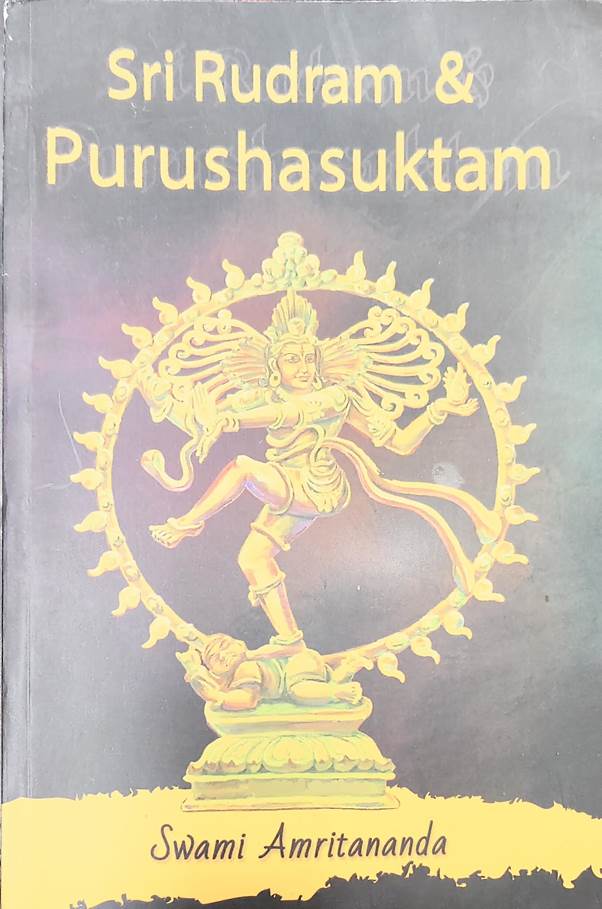
Sri Rudram
and
Purushasuktam
A Contemplative study
by
Swami Amritananda
SRI RAMAKRISHNA MATH
Mylapore, Chennai - 600
004
Published by
Adhyaksha
Sri Ramakrishna Math
#31, Ramakrishna Mutt Road
Mylapore, Chennai-600004
📧publication@chenaimath.org
Online store: istore.chennaimath.org
Ebooks: vedantaebooks.org
© Sri Ramakrishna Math, Chennai
All rights reserved. Apart from any fair dealing for the purposes of private study, research, criticism or review, no part of this book may be used or reproduced in any manner whatsoever without the permission in writing from the publisher.
First Edition, July 1977
Second Edition, Second Print, January 2026
2000 copies
ISBN: 978-81-7120-802-9
Printed in India at
Sri Ramakrishna Math Printing Press
Mylapore, Chennai-4
PUBLISHER'S NOTE SECOND EDITION
The recitation of sacred hymns exerts a profound influence on the physical, mental, and spiritual dimensions of the human being. Among these, the Sri Rudram and Purusha Suktam hold a place of exceptional significance-not only for the individual practitioner but also for their wider cosmic resonance. When chanted with understanding, these mantras possess the transformative power to rewire one's inner conditioning and elevate consciousness.
This edition draws upon the earlier scholarly work of Swami Amritananda, a senior monk of the Ramakrishna Order, whose in-depth study of these texts was first published several years ago. Far beyond a mere translation or literal rendering, his work offers nuanced interpretations that bridge the sacred and the philosophical.
In response to readers' interest and feedback, we are pleased to present this new and improved edition, featuring enhanced layout, refined typography, and better readability. A notable addition is the appendix authored by the translator, which offers deeper insights into the Purusha Suktam through the lens of the Nasadiya Suktam, enriching the reader's contemplative experience.
We hope that this revised edition serves as a valuable guide for readers seeking to understand and reflect upon these timeless hymns, and that it inspires growth-both in this life and beyond.
Sri Ramakrishna Math
Mylapore, Chennai
PUBLISHER'S NOTE
In a world where things are falling apart, values are on the decline and peace of mind seems to be but a distant rumour, it seems all is not yet lost. In the midst of darkness light persists, in the midst of untruth truth persists and in the midst of death life persists. The spiritual heritage of India is unique. This ancient land has gone through so many ups and downs in the course of untold millennia and yet has not only survived but has continued to be dynamic, while other civilizations have come and gone like soap bubbles. The secret of India's strength is that at all costs she has held on to certain vital values of life generally called Dharma.
The central principle of Dharma is that there is only one God, the ultimate Truth. That manifests itself in diverse forms for the benefit of the aspiring souls. Once this Truth is realized, all life's problems stand solved. As Swami Vivekananda observed, 'Each soul is potentially divine. This potential can be made dynamic through devotion, meditation, selfless action or through philosophy. The Vedic mantras are meant to help us in all these ways. Two outstanding texts of Vedic mantras are the Sri Rudram and the Purusha Suktam. These grand and mellifluous hymns addressed to the Universal Being, called Rudra and Purusha, when chanted regularly will endow the mind with strength. To understand their real meaning, commentaries are necessary. Swami Amritananda has laid the devout public under an immence debt of gratitude by his lucid explanation of the mantras. He has pressed into service the commentaries of Sayana, Bhatta Bhaskara, Abhinava Shankara, Vishnusuri, Skanda Swami and Ahobala to make the meaning of these mantras as clear as possible. We believe the chanting of Sri Rudram and Purusha Suktam with full knowledge of their meaning will give immense mental and spiritual joy to the aspirants.
We are grateful to a well-wisher introduced by Dr. S. Viswanathan, Former Head Dept. of Sanskrit, Vivekananda college and Mr. V. Jagannathan, introduced by Prof. N. Rajagopal, Prof. of Commerce, Vivekananda College, who readily came forward to meet the major part of the cost of this publication.
We are thankful to Dr. Goda Venkateswara Sastri the eminent Sanskrit scholar, Dr. K. Panchpakesan, Retired Professor of English, Vivekananda College and Dr. M. Muralidharan, Dept. of English, Vivekananda College who helped us in going through the proofs and suggesting changes, wherever required.
We have, therefore, great pleasure in placing before the earnest public this valuable edition of Sri Rudram and Purusha Suktam.
10.7.1997
Sri Ramakrishna Math
Chennai 600 004
FOREWORD
The Vedas are the oldest, yet ever new, scripture of mankind. They are at once a challenge and an inspiration; the challenge is because the grand truths they enshrine call for very deep meditation to realise them. The inspiration is from the supernal heights of knowledge and bliss of pure spirituality.
Because of the difficulty in understanding their true import, most of the Vedic mantras are far from popular. They are not common coin. But certain Vedic passages stand out, compelling attention by the majesty of their diction and the sweetness of their sound. Sri Rudram which occurs in the fourth kanda of the Taittiriya Samhita in the Yajurveda tops the list.
This Vedic homage to Lord Rudra is remarkable not only for its phonetic grandeur but also for its universality of approach to the Divine. Rudra to whom these prayers are addressed is not a sectarian deity, but the Supreme Being who is omnipresent and manifests Himself in a myriad forms for the sake of the diverse spiritual aspirants. Hence this text is also known as Shatarudriyam, i.e. Rudra in hundreds of forms. Upanishad being called a mystery (rahasya), Rudra Upanishad is another befitting appellation for this text.
Rudram reveals at its centre the great Panchakshari, the famous five-lettered mantra, 'Namaha Shivaya. No wonder Sri Rudram is used by the devout in daily puja, japa, homa and other religious rituals. Its daily recital is said to confer on the aspirant all blessings, material and spiritual. It is said, if Rudra is worshipped, all the other deities also are propitiated. Saluting the Lord with the obeisance 'Namaha' fulfils one's all aspirations.
To worship a deity, the sadhaka must have a vivid picture of the deity's appearance. Sri Rudram, therefore, gives a long list of the details of Rudra's appearance. His body pervades the entire universe. It shines in immaculate white covered by the holy ashes. The snakes dangling as charming ornament, the blue-throat recalling the great service the Lord rendered at the churning of the milk-ocean for nectar, the matted locks adorned by the crescent moon, the mighty bow in hand, the triple eyes, the rudraksha beads, the vibrant dancing pose-all help in meditating on the form of the formless Lord. He is the Sun and the Moon and eternal Fire-or rather he makes all these shine by his light. Being the Supreme Yogi He is sameness (samatva) personified, so we find Him described not only as the Lord of everything good, but also as the Lord of thieves of different types. Also a carpenter, pot-maker, hunter and angler. None is excluded from the shower of his grace. He is Ashutosha, readily pleased. Any wild flower will do for worshipping him.
The first chapter (Anuvaka) of Sri Rudram is a set of prayers to the Lord to give up anger roused against those who transgress the divine commandments. The second to the ninth chapters contain the prostration to his omnipotence, and to His indwelling the hearts of all souls. The tenth chapter celebrates the munificence of the Lord and prays for the prosperity and warding off of evil. In the last and eleventh chapter we get the thanksgiving to the Lords attendants and Ganas.
These eleven chapters are popularly known as namakam, because most of the verses carry the refrain 'Namaha' (or Namo Namah). The next eleven chapters are known as chamakam because the refrain here is 'Cha me. The namakam and chamakam together go by the name of Rudradhyaya.
Though the text of Rudram occurs in the Karma Kanda of the Veda its use transcends the performance of rituals. It is a great help in mental adoration (upasana). Above all it is an Upanishad, each mantra replete with deep spiritual significance. Swami Amritananda has pressed into service the commentaries of Sayana, Bhatta Bhaskara, Vishnu Suri, Abinava Shankara, Skanda Swami and Ahobala to bring out the Vedantic treasures encapsulated in these mantras.
There is time-honoured tradition that namakam and chamakam should be chanted daily along with Purusha Suktam. Indeed Purusha Suktam prevades the Vedas extensively. An integral part of Rigveda Samihta, it also appears in the Taittiriya Aranyaka, the Vajasaneyi Samitha, Samaveda Samhita and Atharvaverda Samhita. Quotes from it are to be found in Shatapatha Brahmana, Shvetasvatara Upanishad and Mudgala Upanishad. This sukta finds a place even today in the worship of deity, in temple or at home, in the daily parayana, in establishing the sacred fire for Vedic ritual, in various rituals and even in the cremation of a dead body.
Purusha of the Purusha Suktam is the manifested state of the unmanifested Brahman. Possessed of all heads, eyes and feet in his Creation he has enveloped this universe completely and has also transcended it. He dwells in every being by a fraction of his self yet his major part is beyond the universe. Being the only reality he manifests himself as Virat, the totality of all objects, in their seed form. Then he enters into it and brings out the devas or bright ones. The devas, in turn, create the world employing the Purusha himself as the sacrificial animal (pasu). We are given a poetic description of the various mental material and types of animals, we see today in the world. The stress is on yajna, selfless discharge of duty, which leads to participation in the cosmic good. Realizing the Purusha one attains not only material prosperity but also immortality.
Chanting this triad, the namakam, chamakam and Purusha Suktam with full knowledge of their meaning can be a smooth way to unbounded felicity and peace. The author deserves our deep gratitude for opening up this path to spirituality.
President
Sri Ramakrishna Math
Mylapore, Chennai
CONTENTS
PURUSHA SUKTAM IN THE LIGHT OF NASADIYA SUKTAM..................................... 109
SRI RUDRAM
Introduction
Sri Rudraprashna also known as Shatarudriya and Rudradhyaya occurs in the Yajurveda, as the fifth and seventh chapters of the fourth book of its Taittiriya rescension. It has two parts called namakam and chamakam. The word namah is used 183 times in the fifth chapter and this portion is namakam. Almost at the centre of this is the sacred mantra Shiva Panchakshari and the word Shiva is in the centre of this mantra. The words cha me occurs 358 times in the seventh chapter and it is called the chamakam. The elaborate rituals of रुद्रैकादशिनी, महारुद्र and अतिरुद्र are based on the recitation of the namakam and chamakam portions. This Rudra prashna is very popular and is chanted during अभिषेक in the daily pujas. It is considered highly efficacious in warding off evils and in conferring various benefits on its votaries.
The Vedas have three divisions karma kanda (ritualistic portion), upasana kanda (worship portion) and jnana kanda (knowledge portion). Sri Rudram occurs in the karma kanda of the Yajurveda and is used in homa. It describes Rudra in His universal aspect as the Supreme Being, the omnipotent, omnipresent and omniscient Lord of the universe and is therefore used in upasana or mental worship. It is also described as Rudropanishad as it confers immortality by giving us the knowledge of the Supreme Being. Rudra Japa is also spoken of as a great purifier, being the most effective expiation for even the worst sins.
The Veda mantras are to be understood properly and the implied meaning is more important than the literary meaning and hence the help of the ancient commentators has to be eagerly sought. This can only be supplemented with modern commentaries if any.
Sri Rudropanishad is the most important text in all the Vedas say shruti, smriti, itihasa and puranas. In Jabalopanishad, brahmacharins ask for the means for attaining immortality. Yajnavalkya replies that it is repeating Satarudriya. This contains the names of the immortal one. This Satarudriya his innumerable Rudras who are devatas as revealed by the mantras of Sri Rudra. This Rudra is found in one hundred branches of Yajurveda. One becomes sinless by chanting this (Suta Samhita). Similar sentiments are expressed in Kurma Purana, Mahabharata (Dronaparva) etc. The speciality of the Shatarudriya is that it is not merely chanted but prostration (नमः) are added. It is said in Kurma Purana that a king who had successfully completed Gayatri Upasana was asked by Shiva to chant the Shatarudriya with namah. In other words Shatarudriya confers mukti on it votaries. The chanting of this is prescribed even for sannyasins (... अत्याश्रामी सर्वदा सकृद्वा जपेत् अनेन ज्ञानमाप्नोति संसारार्णवनाशनम्-केवल्योपनिषद्). In Suta Samhita it is said that this is the greatest expiation for even the worst sins. (यः श्रद्धया युतो नित्यं शतरुद्रीयमभ्यसेत् अग्निदाहात् सूरापानात् अकृत्याचरणात्तथा । मुच्यते ब्रह्महत्याया इति कैवल्यशाखिनः). Again chanting of श्रीरुद्र is prescribed for fulfilment of desires, for expiation, and for attaining mukti (सर्वोपनिषदां सारः रुद्राध्यायः समर्थितः भोगार्थिनो मुमुक्षोर्वा प्रायश्चित्तार्थिनोपि वा रुद्रोपनिषदं मुक्त्वा गतिरन्या न विद्यते).
According to Abhinava Shankara who cites the authority of श्रुति, स्मृति, इतिहास and पुराण the Rudra speaks of Brahman and not karma as stated by Sayana. Vishnusuri also hold the same view and attempts to give an independent commentary to prove the point. In Rudropanishad (Sri Rudram), we see that the overlordship of Rudra is stated in the mantra starting from दिशां च पतये नमः to जगतां पतये नमः. His lordship over various things is praised and in the end He is praised as the Lord of the universe. The mantras इषुमद्भ्यो धन्वाविभ्यश्च show that the Lord is the self of everything. Similarly the mantras नमः सुत्याय च show that he is the indweller of everything. These धर्म's pertain to Brahman and not to gods like Agni who is praised in karma kanda. The mantras which state the Lord is नीलग्रीव etc., show the God as Parameswara. All this cannot be attributed to Agni (as Sayana comments). In this connection Agni's inability to burn a dry grass can also be cited (vide Kenopanishad). Agni is created and controlled by the Lord. Even though in the Agni Chayana, Agni is given ahuti as applicable to Rudra, that is, even though Agni is praised as Rudra (in the karma kanda where 'Sri Rudra' occurs) it should be clearly understood that the Rudra spoken of in the Sri Rudram is Paramatman and not Agni. In other words Sri Rudra is an upanishad and not merely a mantra used in rituals. This has been established by Abhinava Shankara in the light of various nyayas used by the purva mimamsakas. Even taking the upasana view it can be seen that Sri Rudra is the most efficacious mantra.
The Sutrakaras such as Bodhayana, Apastamba etc., have prescribed five-limbed Rudra (पञ्चाङ्गरुद्र) in the performance of each of जप, होम and अर्चना. The five limbs are 1) Rupam 2) Rudra 3) Rudri, 4) Maharudra and 5) Atirudra. The नमकम् and चमकम् together is called रूपम् (स्वरूपम् of Rudradhyaya). Once chanting नमकम् and चमकम् is रूपम् (नमस्ते etc नमकम्, अग्राविष्णू... etc चमकम्). The chanting of eleven anuvakas of नमकम् with one anuvaka of chamakam each time is repeated eleven times with eleven anuvakas of chamakam. This is Rudra ekadasini (रुद्रैकादशिनी). This, eleven time repeated, become लघुरुद्र or रुद्री. Eleven times this is maharudra and eleven times of this is atirudra.
Even a mere chanting of Sri Rudra is highly efficacious. But according to Yaska one who chants knowing the meaning is purified and goes to heaven. This is true in the performance of yajnas also. It is this which prompted the commentators like Sayanacharya to write commentaries explaining the meaning of the mantras. But even with the commentary of Sayanacharya the meaning would be incomplete as the commentary explains the mantras from the point of view of rituals (applicability of the mantras in performing Yajnas). As explained above by Abhinava Shankara, we have to find a deeper meaning and this can be done only by a commentary written from the spiritual point of view. This work has been admirably executed by Vishnusuri (Anandashrama publications).
Here the Lord with his upadhi maya (Mayopadhiriswaraha) alone is praised. Always the Lord with His great powers alone is praised. He is not praised if He has low upadhis as we find in Rudra where He is saluted as the Lord of thieves etc. (the Lord is praised as omniscient, etc. but never as being the indewller of thieves etc.,) उत्कष्टोपाधि's attract praises and निकृष्टोपाधि's are simply recognised.
The peculiarity of Sri Rudra is that we have many mantras where the Lord is associated with निकृष्टोपाधि or where mere facts are stated such as: He is there in those who run, who stand etc., (नम आसीनेभ्यः, तिष्टद्भ्यः etc). We should not justify this plain meaning by saying that all-pervasiveness of Rudra is being praised. All-pervasiveness is stated in terms of generals and not particulars. "He is the indeweller of the Earth and pervades the Earth" as in Brihadaranyaka, is all right. But when we say He is trees, leaves and stones etc., then the mantras are either not clear or have nothing special to convey. This is the argument of Vishusuri. He feels that the purva mimamsakas erred in interpreting the Vedas as preaching only karma. He finds some inconsistencies in the mantras guiding the performance of अश्वमेध, अजामेध etc., The essential message of the Vedas is to remind man of his divinity and help him to realise his true nature. In other words the message is spiritual and knowledge-oriented and not action-oriented. This principle is accepted by Abhinava Shankara even though he does not make any effort to give consistently a spiritual meaning to the mantras. In his commentary he follows Sayana and Bhatta Bhaskara even though he criticizes Sayana.
The action-oriented meaning is justified when we remember that a vast majority of people understand only this. The knowledge-oriented meaning is justified as that is the real meaning in the ultimate analysis and one should know this even though one is not prepared to accept it straight-away. Karma should lead to jnana and a smooth transition is provided by the philosophy of the Bhagavad Gita viz. the philosophy of upasana and nishkama karma. It is Bhatta Bhaskara, Skanda Swami and Ahobala who praise worship-oriented meaning (upasana parata).
Unfortunately Abhivana Shankara, Bhatta Bhaskara and Ahobala have not commented on चमकम् and we have to depend only on Sayana and Vishnusuri for the commentary. Here again Sayana is very brief and Vishnusuri is our main support. One thing may be remembered, even though Bhatta Bhaskara gives various interpretations none of the commentators is clear in every place consistently. This is true of Vishnusuri also.
All the available commentators taken together and of course with the sraddha of the reader associated with the reading of commentaries it should be possible to get a fairly clear idea. Vedic mantras can never be made very clear. Their clarity is available to one who constantly meditates on them. But even a casual listener or reader can get sufficient inspiration to go deep into their meaning and he should not come to rash conclusions.
The explanations given here are very brief and for details the reader is referred to commentaries. The mantra becomes clear with this explanation and its potency in indicated at the end of it. For details one should refer to the commentary of Bhatta Bhaskara. It is beyond the scope of this work to go into the details. The introductions that Vishnusuri gives before explaining some mantras are a grand exposition of advaita viewed from various angles. These introductions could be complied and made into a manual of advaita. But I have to be very brief in this work.
Purusha Suktam similarly is a Vedic mantra occurring in all the Vedas. For instance it is the 90th sukta in the 10th mandala of the Rigveda. This is highly popular and is used in daily pujas. This again speaks of the Supreme Being and the origin of the Universe and how man is related to the two, God and the Universe. There is a puranic exhortation which says that namakam, chamakam and Purusha Suktam are to be chanted regularly. Just as namakam and chamakam are used in karma, upasana and in sublime search after Truth, Purusha Suktam is also used in a similar way. In fact it integrates the three kandas or the divisions of the vedas viz karma, upasana and jnana. It speaks of yajna (sacrifice), and elobrates the concept of dravya yajna (physical aspect) , manas yajna or upasana (mental aspect) and jnana yajna (knowledge aspect). It is these seminal ideas which are taken up by the Bhagavad Gita and other books for further elucidation.
Considering the importance of the above three texts namakam, chamakam, and Purusha Suktam and the necessity of rendering them in a simple language, an attempt has been made in the following pages to collect the interpretations and ideas expressed by eminent scholars on the texts and give a connected account for the benefit of the lay reader. This is not intended to be an intellectual pursuit but is meant only to help seekers of spiritual illumination. In the course of thinking on this subject in the last few years many books might have influenced my thinking but the most important of them are: a) commentaries by Sayana and Bhatta Bhaskara, Abhivana Shankara, and Vishnusuri, b) poetic rendering of Sri Rudram by Skanda Deva (Revised second edition)and Abobalabhatta, (Tanjore Saraswathi Mahal) c) publications in Kannada of Adhyatma Prakasa Karyalaya, Holenarasipur, d) Purusha Suktam commentary by Sri D.V. Gundappa in Kannada and e) English rendering of Sri Rudram by Sri T.R. Rajagopala Aiyar published by Bharatiya Vidya Bhavan. It is interesting to note that these texts have been engaging the attentions of scholars throughout history.
While trying to explain the mantras the following procedure is adopted: 1) a brief introduction and the general features of the mantra are given wherever necessary followed by the mantra with accentuation marks. 2) a free rendering of the meaning. 3) a discussion divided into two portions, one based on the karma and upasana view and the other based on the esoteric explanation of Vishnusuri. 4) foot notes to give quotations and to explain different ideas.
The namakam is explained with the help of commentaries by Sayana, Bhatta Bhaskara, Abhinava Shankara, Vishnusuri, Skanda Swami and Ahobala and chamakam with the help of the only two commentaries available namely Sayana's and Vishnusuri's.
Purusha Suktam is explained with the help of the commentaries of Sayana and Bhatta Bhaskara.
It is our fervent hope that the rendering may be found helpful by the reading public.
Namakam
श्री रुद्राध्यायः
नमकम्
There are eleven anuvakas here. In the first consisting of 15 mantras we pray to Rudra for his grace. He continues to be angry even after killing Tripurasura. He is angry with our transgression of moral codes. So He has two forms one terrific, the other benign. The devotee is terrified by His terrific form. Hence the prayer to please Him and propitiate Him invoking His benign form.
ओ॑ नम॑स्ते रुद्र म॒न्यव॑ उ॒तो त॒ इष॑वे॒ नम॑ : ।
नम॑स्ते अस्तु धन्व॑ने बाहुभ्या॑ मुतते॒ नम॑ :॥ १
रुद्र - O! Rudra ते मन्यवे to your anger नमः salutations उत ते इषवे नमः again salutations to your arrow. नमस्ते अस्तु धन्वने Salutations to your bow उत ते बाहुभ्यां नमः again salutations to your arms (which wield the bow).
Rudra:
The term is derived in various ways as follows:¹
a) Who makes us speak;
b) Who makes people understand everything by words (language);
c) Who makes us conscious of our dharmas through the vedas;
d) Who leads us to Self-knowledge through repetition of pranava;
e) Who removes sins and melts in compassion;
f) Who makes people cry at the time of dissolution of the universe;
g) Who removes the miseries of samsara by His grace;
h) Who enters the hearts of people as Nada Brahman;
i) Who imparts spiritual knowledge to seekers of Truth through the upanishads;
j) Who imparts to Brahma the creator the truth (knowledge of the vedas) at the time of creation etc.
__________________________
1. (i) रुतिं शब्दं राति ददातीति रुद्रः प्राणः, (ii) रुत्या वाग्रूपया वाच्यं द्रावयति प्रापयति इतिरुद्रः, (iii) रुत्या वेदरुपया स्वात्मानं प्रापयतीति रुद्रः, (iv) रुत्या प्रणवरुपया स्वात्मानं प्रापयतीति रुद्रः, (v) रुतौ नादान्ते (सत्ये) द्रवति द्रावयति (त्रिधा बद्धो वृषभो रोखीति महो देवो माँ आविवेश) वा रुद्रः, (vi) रोदयति सर्वमन्तकाले इति रुद्रः, (vii) रुदं संसारदुःखं द्रावयतीति रुद्रः (viii) रुद्रो रौतीति सत्ये रोरूयमाणो द्रवति प्रविशति इति रुद्रः (ix) रुतिं शब्द्रब्रह्ममयीं करोतीति रुद्रः (x) कल्पादौ रुतिं शब्दं वेदात्मानं धात्रे ददातीति.
These meanings are derived from the root रु to produce sound, to cry and द्रु to shed tears and g to flow, to run, to melt.
मन्यु is anger. This is at the root of all misery. Shiva's anger causes destruction. So to propitiate Him salutations first to Shiva who is anger embodied. It may mean: manyu-anger is shakti of the Lord and therefore our salutations to it so that He may not use it against us for our transgressions of the eternal moral codes. Again manyu is the cause of misery.
The word Rudra is derived as one who removes misery and its cause, namely, manyu in us. Therefore our salutations to Him. Again it may mean-May He direct his anger against our enemies and not against us, His devotees. Salutations to your arrow इषवे Salutations to your arms and the bow. One hand holds the bow and the other the arrow.
The Lord is thought of as a young warrior and our salutations to His hands, the bow and the arrow so that we may be free from fear नमः (namaha) means abosolute surrender to God. It is denouncing the ego. It is humility. It means serving the Lord for getting purusharthas. It also means that this world is not in paramatman. So reject the world knowing this. नमः means parabrahman. (ओं स्वाहा स्वधा वषण्णम इति पञ्च ब्रह्मणो नामानि-Bhatta Bhaskara).
Vishnusuri: Rudra is Atman, arrow means jivatman, which when discharged merges in paramatman. Manyu is maya shakti of the Lord. Rudradhyaya is an upanishad. Its subject matter is the all-pervasiveness of Rudra. Rudra is the self of everything. Jiva is essentially Rudra and his ajnana makes him think that he is different. So, salutations to the maya shakti of the Lord which is manyu and which makes the Jiva feel helpless, miserable. The bow is pranava. The Lord is the goal of pranava and holds the bow. The two arms of the Lord are the two powers of maya the concealing power and the distorting or projecting power- avarna shakti and vikshepa shakti. These may also mean dharma and adharma which confer happiness and misery on the jiva according to his prarabdha karma.
The following mantra prays for happiness.
या त इषु॑: शि॒वत॑मा शि॒वं ब॒भूव॑ ते॒धनु॑ :।
शिवा श॑र॒व्या॑ यातव॒ तया॑नो रुद्र मृडय ॥ २
O! Lord (Rudra) your arrow has become benevolent and benign (It was aimed earlier at me, a sinner, and has assumed a terrific form. Now with my prostrations it has been pacified). Similarly your bow - pinaka, your weapon-Saravya, also have become peaceful. Saravya may also mean the quiver holding the arrows; make us happy with this peaceful Saravya and other weapons.
The Lord is holding the bow and the arrow and is seated in a chariot along with Uma and has a benign smile. This is the form for contemplation. The repetition of this mantra is used for warding off of calamities such as famine.
Vishnusuri: इषु has already been explained as jiva. Saravya is explained as that in which jivas find themselves i.e. maya. (So the prayer is for granting one happiness by making this maya ineffective or benign).
After praying for happiness, in the following mantra eternal happiness which results from तत्त्वज्ञान liberating knowledge is prayed for.
या ते॑ रुद्र शिवा त॒नूरघो॒रापा॑पकाशिनी ।
तया॑ नस्त॒नुवा॒ शन्त॑मया॒ गिरि॑शन्ता॒भिचा॑हि ॥ ३
O! Rudra in your benign form, which does not harm us, you reside in the Kailasha Mountain. Reveal that form conferring happiness on me.
Shiva has two forms benign and dreadful. Here the benign form is meant. Even the benign form may have weapons and this is addressed in the next mantra.
गिरिशंत- one who staying in kailasa confers hapiness on beings शंतमया - that which is full of bliss, अभिचाकशीहि reveal (thy benign form) to me, अघोर that which is that which does not not terrific i.e. benign. अपापकाशिनी that which does not reveal the terrific form i.e. that form which does not cause grief. In this benign form there are no weapons. Or this may also mean that form which does not reveal the sins committed by the votary as they have been destroyed by revealing the benign form. शंतमया the form which gives immense happiness or confers infinite bliss on the devotee.
Appear before us with this auspicious form of yours. गिरिशंत - one who stays in kailasa and protects all beings. It may mean protecting life in the form of cloud-pouring rain. Or he stays in speech - (गिरि) in the vedas in the form of meaning. That is, He is the essence of the vedas or being indicated by pranava, is the object of meditation conferring eternal bliss. अपापकाशिनी may also mean that which gives ज्ञान (jnana) which destroys sins. In this sense according to Abhinava Shankara अभिचाकशीहि means (आत्मतत्त्व) the truth. reveal to me
Shiva is meditated upon as with a smiling face and accompanied by Parvati and as one having three eyes and smeared all over with ashes and having serpents as ornaments. This meditation is said to ensure welfare of cattle.
Vishnusuri: At the end of a long discussion Vishnusuri concludes as follows: In Iswara's anthahkarana which is nothing but his own maya that modification वृति caused by its going out to external objects (which are again posited by his maya) is avidya vritti, whereas that (वृति) which is caused by turning the gaze toward inner self is vidya vritti, These two vrittis, the vidya vritti and the avidya vritti, are his two bodies. The avidya vritti which causes, according to fruits of action of the jivas transmigratory existence, delusion etc., is called अशिव inauspicious whereas the vidyavritti which ends in the experience of infinite Bliss is शिव auspicious. So in the present mantra; अघोरा means benign form, that is, that which puts an end to the dreadful transmigratory existence. अपाप is Atman that which is free from sins. काशिनी प्रकाशिनी reveals. The benign form, the vidya vritti, reveals Atman and puts an end to samsara. This samsara itself is difficult to surmount, like a steep hill. Jiva and Iswara are both in the samsara (the one unattached witness, and the other, attached and miserable). So Shiva is called as गिरिशंत - staying on a mountain शंतमया - by that form which is vidya shakti अभिचाकशीहि reveal your स्वरुप by removing अविद्या in me and lead me to liberation.
After having prayed for desired objects, in the following mantra prayer is addressed for not harming the devotee with the arrow.
यामिषं॑ गिरिशंत॒ हस्ते बिभ॒र्व्यस्त॑वे ।
शि॒वां गि॑रित्र॒ तां कु॑रु॒ माहिंसी॒: पुरु॑षं॒ जग॑त् ॥ ४
O! Girishanta! The arrow you are holding to be discharged at the enemies, please make it harmless on men and also animals such as cows etc., in the world.
गिरिशंत - has been explained as one who staying in the Kailasha mountain makes His devotees happy or one staying in the cloud makes the world happy by pouring rain.
गिरित्र means by remaining in Kailasha he protects it or becomes the cause of its glory. He protects the clouds by making them rain or protects the chariot (formed by various divine elements) in which He rode to destroy Tripurasuras, i.e. protects the gods that make the chariot or protects or grants the speech or prayers of His devotees or protects even the sinner if he sincerely prays to Him according to Abhinava Shankara. Girishanta and giritra mean one and the same thing. So this explanation gives a special meaning justifying the use of two words with the same meaning.
The arrow was taken out to be shot अस्तवे at Tripuras. But the Tripuras were burnt like heap of cotton and the arrow had done its expected work. May the same arrows become auspicious so far as I and my people are concerned. I am your servant, please protect me and my belongings like animals and even inanimate objects. Turn your arrow away from us.
Vishnusuri: Prakriti has two shaktis, getting transformed and causing transformation. The first shakti is called vikshepa and the second one kāla (time). If this is not accepted there will be choas. The powers of maya are therefore three: kāla, avarna (concealing) and vikshepa (projecting).
The fruition of an action occurs in time. The avarana shakti makes one lose the correct perception as his memory is affected. Projecting names and forms is caused by vikshepa. All the three maya shaktis - kāla, avarna are subservient to Iswara. So in this mantra and vikeshpa kāla shakti is spoken of. Ishu, is kāla shakti as it afflicts the intelligence of jiva like an arrow. The meaning of the mantra is; O! Girirshanta you hold kāla shakti in your hand to direct it on the jivas. We are afraid, because everything is subservient to time (in the sense karmas come into fruition in time). गिरि is here the world. One who protects the world by granting illuminations is गिरित्र. So see that the jivas are not frightened. Use kāla shakti in such a way that jivas are out of fear. May not kāla shakti cause loss of memory etc.
Now comes the prayer for all round prosperity.
शि॒वेन॒ वच॑सा त्वा॒ गिरि॒शाच्छा॑ वदामसि ।
यथा॑ न॒: सर्व॒मिज्जग॑दय॒क्ष्मगंसु॒मना॒ अस॑त् ॥ ५
शिवेन वचसा with auspicious words त्वा - you गिरिश dweller in the Kailasha mountain अच्छ to attain you वदामसि we utter, pray - सर्वम् इत् जगत् all this world of men and animals, अयक्ष्म without any disease, सुमनाः असत् may live in harmony.
O! Dweller on the Kailasha mountain! We pray to you with auspicious words so that we may attain you. By this prayer may all that belongs to us in this world be free from disease and live in harmony.
गिरि - mountain, mountain - like (high) Vedas. One who is the soul of the Vedas and is to be known only through the Vedas is गिरिश.
अच्छा-pure, one who is praised by the Vedas to Him we pray with pure auspicious words. The prayer is for making our relations, animals etc., in this world free from disease. Now if we take अच्छ (vocative case) to mean pure: the meaning of the first line of the mantra would be: I am impure. The Lord is pure and is therefore praised by the Vedas with auspicious words. My words are not so pure or auspicious. But when they are addressed to the Lord they become pure and attain the status of the Vedas as drain water which falls into the ever pure Ganga gets mixed with it and becomes indistinguishable and one with Ganga. This is the interpretation of Abhinava Shankara.
The fourth and fifth mantras together form one mantra. The mantras are chanted to ward off untimely death etc. The Lord is to be thought of as one who created terror in the Tripuras by his loud laughter and as one who is holding the bow which is Meru mountain and is seated in the chariot. This is the description by Skanda Swami who hastens to add that we should think of the Lord as non-different from the Supreme Brahman though imagined to be with a body.
अच्छ is taken to mean the Lord who has appreared before us, according to Bhatta Bhaskara. So we praise the Lord standing before Him and directly addressing Him.
We pray to one who is capable of granting our prayers. So Shiva is the repository of all wealth, powers and auspicious qualities and we pray to Him for granting us all auspiciousness. We praise his divine sports in the world, This is the extended meaning suggested by Bhatta Bhaskara and Skanda Swami.
Vishnusuri: After a long discussion comes to the conclusion that jivatwa is imagined. Jiva is none other than Brahman. The shruti with the help of mahavakyas तत्त्वमसि etc., reminds the jiva of this fact and wakes him up. Jiva in truth is untouched by the world.
The vedas like the bards (vandi) praise the Lord Parameswara to wake Him up from the imagined jivahood which is compared to sleep caused by avidya. So the Vedas like the servants who wake up the king by praising his valour and other qualities praise the Lord, saying "You are the Self of everything and if you go to sleep caused by avidya all this world of jivas which is a reflection or image of yours cannot be free from the disease of samsara (transmigration) and will suffer from lack of harmony. Therefore may this world of jivas and objects after knowing its true nature and thus freeing itself from all sins not fall into samsara again. May it enjoy supreme bliss-this is our prayer. This is going to be elaborated in the next mantra.
The Lord has the अन्तःकरण of maya. But here there is preponderance of sattwa. Even as witness (साक्षी) He has this anthahkarana and rules the world. The prayer is for revealing his pure self by getting rid of self-imposed bondage maya thereby enable the jiva to get the knowledge of pure
Atman. This is done buy the Vedic dicta like tattwamasi. This is referred to as शिवेन वचसा by auspicious words.
The devotee seeks a special treatment from the Lord.
अध्य॑वोचदधिव॒क्ता प्रथ॒मो दैव्यो॑भि॒षक् ।
अहीँश्च॒ सर्वोअ॒म्भय॒न्सर्वैश्च यातुधा॒न्य॑: ॥ ६
Rudra is the greatest God and controls and protects every one. Let him say that I am great in the presence of other gods. By merely contemplation on him all the diseases vanish. May He destroy all the Rakshasas and wild animals like tigers snake etc. प्रथमः among gods, the greatest. Gods are protected by Rudra, so दैव्यः भिषक् - physician अधिवक्ता - May He be partial to me and declare my greatness (I am a devotee of His). अध्यवोचत् - may He speak like this. जम्भयन् - killing यातुधान्यः Rakshasas. अधिवचनम् – to speak in favour of some one out of partiality or declaration to this effect by one who is great. अधिवक्ता one who is habituated to say like that. If one who is not great shows partiality will be laughed at. So I seek partial treatment from Shiva alone who is great देवः may mean one who sports. Both Skanada Swami and Bhatta Bhaskara dilate on this. दिव् means to play. He is the goal of all sports. He is the joy in the sports, victory is our desire to win. He is detached in activities. He is the soul of His devotee. Light in illumination. In praise he is the object of praise. He is the destination in journeys. Even though He is one, He appears as many like air.
देव may also mean one who is spiritually illumined. He is the foremost among such (दैव्य:) He is the mouth of gods as fire including that of Brahma. (vide skanda Swami's देवानामपि यः स्वयं मुखमभूद् - ब्रह्मादिकानां प्रभुः based on the shruti अग्निमुरवा वै देवाः and रुद्रो वा एष यदग्निः)
The term अधिवक्ता may also mean one who can issue commands (to various gods) to do their duties properly. Rudra has full authority and compels obedience from other gods.
So the prayes is, "May Rudra destroy all my enemies seen and unseen such as snakes, tigers etc. which are seen and tribes of rakshasas who are unseen. May he appear before me and grant me fearlessness and say that He would save me".
This mantra when repeated ensures long life and wealth to the devotees.
The word भिषक् which means a physician may be made to yield other meanings also such as: 1) He is the physician in the sense he destroys the seed of samsara, by prescribing the medicine which is devotion to Him. 2) He grants fearlessness, 3) one who is approached by the fear-stricken. Now a few words about the devotees seeking Rudra's intercession. There are gods who have seen me erring and are authorised to deal with me. But Rudra can intercede and say 'no. He is fit to do it as He is above all gods. This is not partiality strictly as the devotee has earned this intercession with his devotion. Is he not cruel to Rakshasas etc., whom he kills to protect the devotees? No, it is like a surgeon causing pain but prompted only by kindness. So omnipotence, and compassion of the Lord are indicated in this mantra. He is also the inner controller of all gods. This mantra is our armour कवचम् according to Bodhayana.
Hitherto we had direct prayer addressing Him. This mantra indirectly refers to Him.
Vishnusuri: देव is Iswara according to shruti. Rudra is दैव्यः He, by good counsel, removes the disease of samsara. So, He is भिषक् physician. He is the foremost among physicians प्रथमो भिषक्. अहि here means desires etc. यातुधानी avidya vrittis. These are obstacles to Self-realisation. अधिवक्ता omniscient as everything is derived from Him. Such Rudra instructs in Self-knowledge by helping us to negate our imagined jivahood. This is the meaning of अध्यवोचत्. He destroys desires (अहि) and avidya vrittis. Such Rudra addressed me, who is a jiva, as Brahman. So I should realise that I am Brahman non-different from Parashiva. The Veda Purusha realised this and through this mantra instructs others.
Now Rudra is seen in the Solar orb and addressed as such, referring to the rising and the setting Sun.
अ॒सौ यस्ता॒म्रो अ॑रु॒ण उ॒त ब॒भ्रुः सु॑म॒ङ्गल॑: ।
ये चे मागंरु॒द्रा अ॒भितो॑ दि॒क्षु श्रिताः स॑हस्रशो वै॑ षा॒गꣳ हेड ईमहे ॥ ७
The same Rudra is seen in the Solar orb. He is red while rising. He becomes slightly less red. He acquires golden hue (or white according to some) later. He is highly auspicious as he assumes different colours and removes darkness. There are again many little Rudras who can be compared to the rays of the Sun surrounding the Earth in all direction. We are propitiating them with our prostrations so that their anger at us for our mistakes may be lightened. ताम्रः deep red, copper red. अरुण light red or rosy colour. बभुः - golden hued. हेड their angry moods अवईमहे - अवेमहे ward off. बभ्रु may also mean one who sustains the world by giving knowledge just as the Sun wakes up people in the morning by his rising. Giving knowledge and waking up are compared.
The thousands and thousands of little Rudras with similar appearance and powers surround us from all sides to give us the fruit of our actions. They become either angry or indifferent when we do things that ought not to be done or do not do things that ought to be done. Their anger or indifference is intended to be mollified by our prayers and prostrations.
Vishnusuri: Prakriti originally has sattwa guna. It has two shaktis, rajas and tamas which cause vikshepa and avritti (projecting and concealing powers). The projecting power is responsible for creation and the concealing power conceals the difference between the seer and the seen internally and Brahman and the creation externally (दृग्दृश्ययोर्भेदः and ब्रह्मसर्गयोर्भेदः). Therefore rajas and tamas have to be subdued only by sattwa which is Prakriti in original form (मूलप्रकृतिः). The same maya which has preponderance of pure sattwa (विशुद्धसत्त्व) is responsible for projection and concealment in case of one who wants to enjoy the world and is also responsible for completely destroying rajas and tamas and its own disappearing for one who seeks liberation. The point to be seen here is that the Supreme Being with maya shakti which has pure sattwa appears red due to rajas thrown up by maya. Then he is associated with the creation as its soul and becomes auspicious. (बभ्रु is used in this sense, one who maintains or sustains). The thousands of Rudras are the jivas. We try to remove their अविद्या (हेड तीक्ष्णत्वं -अविद्यायुतत्वं) by instructing them in the meaning of the Vedic dicta tattwamasi etc. the thousands of Rudras spoken of here are the jivas because jiva is essentially non-different from Rudra. Liberation is from many to one.
The same idea is continued in a poetic description highlighting the accessibility of the Lord.
अ॒सौ यो॑ऽव॒सप॑ति॒ नील॑ग्रीवो॒ विलो॑हितः ।
उ॒तैने॑ गोपा अ॑दृशन्नदृ॑शन्नुदहा॒र्य॑: ।
उ॒तैनं विश्वा॑ भूतानि॒ स दृ॒ष्टो मृ॑डयाति नः ॥ ८
Rudra is Nilagriva (blue throated: blueness or blackness caused by His containing the poison in His throat). The same Rudra assumes deep red colour appearing as the solar orb. By appearing thus He causes dawn and dusk (by the rising and the setting of the sun). The Lord appears in the solar orb so that the simple cowherds who are uneducated in the shastras may have His vision. The maids carrying water (in the morning and evening) easily have His vision. Even animals such as cows, buffaloes etc., too can see Him (those who are well-versed in the shastras alone can see the Lord staying in Kailasha but not others). May such Rudra make us all happy. असौ who is in the form of the sun, विलोहीतः assumes a deep red colour अवसर्पति rises and sets गोपाः cowherds उतएनं अदृश्यन् behold him well. उदहार्यः अदृश्यन् the women carrying water also behold. विश्वानि भूतानि उत अदृश्यन् all creatures behold. नः मृडयाति May He make us happy.
The accessibility of the Lord in the assuming the form of the sun so that all lay people may have a chance to behold Him is described here. Water is to be brought before the sun sets. Men and animals return before the sun sets. Ritualists wait for the setting of the sun to round off the rituals. So none can miss the sight of the rising and the setting sun. Rudra therefore compassionately appears as Sun. Now Bhatta Bhaskara adds quoting a shruti saying one should not see the rising and the setting sun. Even then, may the Lord forgive us for this and make us happy. Abhinava Shankara quotes the shruti to say that people rejoice at the sunrise. So every one the learned and the laity rejoice at the sight of the raising sun. May Rudra who is easily accessible thus make us happy. It should be noted that Rudra as sun is seen by everyone. Rudra as the Lord of Kailasha can be seen only by upasakas. Rudra as Satchidananda is realised only by jnanis. This mantra by its japa ward of drought.
Vishnusuri: the sakshi chaitanya with maya as upadhi is Iswara. The same with अन्तःकरण as upadhi is jiva (who has the ego). Pure Chaitanyam with no upadhi is Paramatman. The vedantas seek to establish this. Bondage and liberation are for the jiva who is chaitanyam with अन्तःकरण as उपाधि. साक्षी chaitanyam is one like akasha but with the superimposition of अन्तःकरण on it can be spoken of as being born and dying (coming and going). Now death i.e leaving this body is being described in the present mantra. (That is the setting sun is described).
Jiva while leaving the body is helpless. He takes up a different body in due course. He feels miserable while leaving and again miserable when taking birth in a new body as he has to spend a long time in the womb. Now when this sakshi goes from body to body he becomes nilagriva -black throated due to tamoguna which covers and then assumes deep red colour due to rajoguna. गोपाः is explained as gods, those who preside over the sense organs (गोः). They see this sakshi chaitanya with अन्तःकरणोपाधि i.e. jiva after getting the body (उतैनं गोपा अदृशन्). Gods can preside over the sense organs only after they are formed in the gross body. Now उद means शम (control) उदहार्यः means vrittis like desire etc which destroy शम. So उदहार्यः अदृशन् means even the vrittis like desire etc. saw him (jiva). Sakshi chaitanya has even the external objects in its purview. Or the simple water carriers (women) also saw this eternal witness assuming a body. What to say of this. All beings in the world saw him (jiva). Rudra (Paramatman) in the form of jiva was seen like this. (jiva and Iswara are in essence one as Chaitanya. Only upadhis differ). This Rudra is to be attained by following the discipline of sravana, manana and nididhyasana. May this Rudra grant happiness to us. Without realising this Rudra (Paramatman) there is no external and pure happiness.
Rudra is in the form of Indra.
नमो॑ अस्तु॒ नील॑ग्रीवाय सहस्रा॒क्षाय॑ मी॒ढुषै॑ ॑ ।
अथो॒ ये अ॑स्य॒ सत्त्वा॑नो॒ऽहं तेभ्यो॑ ऽकरं॒ नम॑: ॥ ९
The same Nilagriva who is in the form of Indra - May he receive our salutations! Again may he as parjanya who pours rain receive our salutations. Again my salutations to the servants of Rudra.
मीदुषे - to him who pours सहस्राक्ष - Indra सत्त्वानः servants, the pramatha ganas of great valour. He pours rain and causes vegetation and similarly as purusha impregnates all life and further creations.
Abhinava Shankara gives some more meaning to Nilagriva and सत्त्वनां पति. Rudra was Nilagriva (Kailasha pati) is the one adored in this mantra. सहस्राक्ष is not taken as Indra by him. It means one who has infinite number of eyes and therefore sees everything. Nothing can escape his notice. Therefore the devotee is confident that his salutations do receive the attention of Rudra even though he is seated high up on the Kailasha mountain. मीदुषे is taken to mean one who grants the desires of devotees. He simply pours blessing for fulfilment of their desires. My salutations have immediate effect. As Nilagriva the Lord shows his partiality for goodness. He places even a digit of the moon on his head in appreciation of moon's qualities but takes in the whole lot of our sins like kalakuta poison, contains them to see that the world is not harmed by it. He is seen as seated with Uma on the throne with a benign smile on his face. His servants or attendants are spoken of in various ways in the scriptures. They are a group called pramatha ganas and are very powerful. They are blissful, free from, jealousy, and have control over speech. They have attained all powers but they are not conscious of them. They are in the company of the Lord always. I salute such attendants of the Lord.
The Lord is to be thought of as one seated on the throne with Uma and like the moon cools and soothes the minds of devotees.
This mantra japa grants a good son to be born.
Vishnusuri: I salute Nilagriva, one who has preponderant vikshepa shakti (no avarana for Him) अक्ष- is here taken to mean reflected chaitanyam i.e., jiva. There are innumerable (सहस्र) such jivas whose desires are fulfilled according to their prarabdha karma. There are many servants who are His own parts and (as reflections of Himself) they are jivas. My salutations to them. (नमः) सत्त्वानोऽहं तेभ्योऽकरम् There is a reference here and in the next mantra again to his terrible nature.
प्रम॑श्च॒ धन्व॑न॒स्त्वमुभयो॒रानि॑यो॒ र्ज्याम् ।
याश्च॑ ते॒ हस्त॒ इष॑व॒: परा॒ता भ॑गवो वप ॥ १०
Lord! release the string of Yours bow from both the ends. Drop the arrows from your hand. प्रमुञ्च release, ज्याम् the bow-string धन्वनः of the bow उभयोरार्नियोः from both the ends of the bow परा... वप Drop, take away. भगव vocative of Bhagavan (worshipful).
These mantras ask directly and indirectly the Lord to keep aside the dreadful arrows of His and make the bow ineffective by releasing the string (unstringing the bow).
Abhivnava Shankara: The six mantras starting from the tenth pray for his withdrawing the weapons. Even though a similar prayer was made in the fourth mantra the devotee is not completely free from fear as long as the weapons are composition). Even seen in the hands of the Lord. So this is not to be treated as a repetition (which is a defect in a when the bow is unstringed the arrows are seen. So take them away from us. Put them, back in the quiver so that they may do us no harm.
Skanda Swami: O Lord! you are learned, powerful, famous, full of wealth, spiritual knowledge and renunciation. (The qualities which entitle you to be addressed as Bhagavan). So it is not proper for you to direct your anger towards us. You are the embodiment of courtesy and compassion (दाक्षिण्यैकतनुः, दयामयतनुः).
Vishnusuri: You may ask, "Who am I? Who are these Jivas to whom I am offering my salutations?" The reply is: We differentiate between Jiva and Iswara. This is caused by the two powers आवरण and विक्षेपशक्ति. So the prayer in this mantra is to get free from the two powers.
O Lord! Please release the string in the form of ego (अहङ्कार) from both the ends (in the form of avarna and vikshepa shaktis) of the bow (in the form of pranava wrought by maya). Drop the arrows in your hands. That is, drop the jivas who are in your control. Giving up the jivahood manifest bliss which is your essential nature.
This attitude is further elaborated in the following mantra.
अ॒व॒तत्य॒ धनु॒स्त्वगꣳ सह॑स्राक्ष शते॑षुधे ।
नि॒शीय॑ ॑ श॒ल्यानं मु॒खा॑ शि॒वो न॑: सु॒मना॑ भव ॥ ११
You are having innumerable eyes and innumerable quivers. O Lord! After unstringing your bow, keep your arrows in the quivers with their sharp metallic points facing down. Please be propitious and benign to us. अवतत्य after unstringing, इषुधि quiver, शतेषुधे O you with innumerable quivers निशीर्य - having blunted the sharp points of the arrows keeping them in the quivers with their tips down. शल्य sharp point of the arrow शिव propitious. calm, benign सुमना
Abhinava Shankara: Rudra can see with innumerable eyes and has inexhaustible arrows. It is not possible to escape Him. So the devotee prays that the Lord Himself should withdraw the arrows. Even then he is not satisfied. So he asks Him to become propitious and compassionate. Lord is addressed twice and this is justified only if the above extended explanation is given.
Vishnusuri: इषुधि is taken to mean the repository of karmas. After unstringing the bow i.e. after destroying ego (अहङ्कार which is bow string). शल्य different vrittis (modification of the mind). keeping the arrows with face down is negating the vrittis, making them ineffective. So by removing our ego and making the vrittis ineffective appear to us as blissful and benign. This is an elaboration of what has been explained in the previous mantra.
The following is a direct prayer.
विज्यं॒ धनु॑: कप॒र्दिनो॒ विश॑ल्यो॒ बार्ण॑वांगꣳ उ॒त ।
अने॑शन्न॒स्येष॑व आ॒भु॒र॑स्य निष॒ङ्गथ॑: ॥ १२
May the bow of kapardin (Rudra) be unstringed, the quiver be without the arrows with sharp points. May the arrows be not capable of piercing. May the quiver serve the purpose of only holding the arrows and not serve the purpose of yielding the arrows readily. Or, May the scabbard serve the purpose of containing the sword only.
कपर्दः matted locks (of Rudra), धनुः the bow pinaka विज्यं unstringed, विशल्यो – without the metallic sharp points, बाणवान् quiver, अनेशन् incapable of piercing or get destroyed, or may the arrows be some where else unseen (not in the quiver), निषङ्गथिः quiver or scabbard, आभुः a little capacity. The fullness of a scabbard is attained when it has a sword. When the scabbard is without a sword the capacity is lessened (Bhatta Bhaskara). So may the scabbard remain empty. निषङ्गथिः may also mean a sword. In this sense the prayer is that the sword should become blunted. The Lord is thought of as bright like millions of suns come together and wielding many weapons. Enemies are destroyed by this mantra japa.
Vishnusuri: kaparda means अन्तःकरण with four vrittis (mind, buddhi, chitta and ahankara). One who is identified with kaparda is kapardi. May the bow of kapardi be unstringed. बाणवान् or quiver has already been explained as maya causing the appearance of jivas. So may the pradhana which is the cause of jivahood be freed from sharp points of arrows (विशल्य). That is may the maya shakti be free from avarna (आवरण) and vikshepa which cause jivahood. May the arrows which are the vrittis such as desire etc., be incapable of piercing. That is may there not be identification with the vrittis so that they may become ineffective. May the निषङ्गथिः which is quiver or in this case अन्तःकरणम् with vrittis such as desire etc., be ineffective in pursuing vrittis. May the अन्तःकरणम् block the vrittis. This mantra says that I who am साक्षी (witness consciousness because of whom अविद्या is seen) can get rid of अविद्या with the help of vrittis of अन्तःकरणम्.
If the quiver (maya shakti) has arrows (vrittis) without the sharp points (शल्य-आवरण and विक्षेप shaktis) it becomes ineffective in harming others. If the sakshi remains as sakshi getting rid of अविद्या there is no harm, so my अन्तःकरणम् which throws up vrittis should be pure and free from तमस् and रजस्.
After praying for withdrawing all the weapons the devotee now prays for protection.
या ते॑ हे॒तिर्मीढुष्टम॒ हस्ते॑ ब॒भूव॑ ते॒ धनु॑: ।
तया॒स्मान् वि॒श्वत॒स्त्वम॑ य॒क्ष्मया॒ परि॑ब्भुज ॥ १३
O Rudra! you, showerer of blessing on the devotees. That weapon of yours like the sword and that of bow of yours in your hands, with them which do not cause any injury, protect us in every way. हेति- weapon or the injury that is caused by a weapon, मीदुष्टम - showerer of blessing, विश्वतः- in every way. i.e, all the time, from every calamity, from every one, all my relations i.e. sons, grandsons, etc., परिब्भुज protect अयक्ष्मया- causing no injury or disease.
Vishnusuri: O showerer of blessing! protect us from every evil in the world with the help of the arrow (kala shakti) and the bow of the form of pranava and made of maya हेति - means the arrow which is time अयक्ष्मया - firm, protect us with your firm bow and arrow i.e., with the help of your pure maya (sattwa preponderating) and kāla shakti.
The devotee is now assured and free from fear.
नम॑स्ते अ॒स्त्वायु॑धा॒ याना॑तताय धृ॒ष्णवे॑ ॑ ।
उ॒भाभ्या॑मु॒त ते॒ नमो॑ बाहु॒भ्यां॒ तव॒ धन्व॑ने ॥ १४
O Rudra! Salutations to your weapon i.e., arrow-the arrow which is not aimed (not intended to strike) but capable of killing. Again salutations to your two arms and to your bow.
अनातताय arrow which is not aimed.
धृष्णवे - firm potent and capable of killing.
We may also take this to mean other weapons such as mace (गदा) etc., which are lying unused. Here the two hands are mentioned as उभाभ्याम् बाहुभ्याम्. बाहुभ्याम् by itself means two hand उभाभ्याम् is unnecessary. Abhinava Shankara justifies it by saying that the devotee is seized with fear and he seeks protection from those two hands wielding the bow and arrow.
Vishusuri: Time is the cause of all worldly existence. Therefore the kāla shakti is again praised.
O Rudra! Your bow is unstrung. But the arrow is capable of killing. It is of the nature of time. In the fourth Rik this explanation has already been given saying that the (kāla shakti) is the arrow. Salutations to your bow which is of the form of pranava. Salutations to your two hands holding the bow and the arrow.
The prayer concludes.
परि॑ ते॒ धन्व॑नो हे॒तिर॒स्मान् वृ॑णक्तु वि॒श्वत॑: ।
अथो॒ य इ॑षु॒धिस्तवा॒रे अ॒स्मन्निधे॑हि॒ तम् ॥ १५
O Rudra! May your arrow from the bow avoid us. May it not hurt us. Even then keep your quiver away from us.
परि... वृणक्तु - spare us, अरे अस्मत् away from us निधेहि तम् place. Here also विश्वतः may be taken to mean all including children, grand children etc. अरे is taken by Bhatta Bhaskara to mean in the midst of enemies. Keep the quiver in the midst of my enemies. Abhinava Shankara says enemies means one's own sins.
This mantra also is used against the enemy forces.
Vishnusuri also gives a similar meaning. That is, may the devotees be protected and may the quiver be kept at a distance.
Here ends the first anuvaka with fifteen Riks.
SECOND ANUVAKA
In the first anuvaka Rudra with bow and arrow in his hands was propitiated and praised in many ways. For the working of the world the Lord assumes many forms in sport.
These forms are praised in eight anuvakas starting from the second anuvaka. All the mantras here are yajus (यजुष). They and in the end, and the other where namaha comes only are of two types: one where namaha comes in the beginning in the beginning.
In the three anuvakas we have the word namaha both in the beginning and in the end of each yajus. In the rest five anuvakas there is the word namah only in the beginning of each yajus. We have thirteen yajus. (yaju-mantra) in this anuvaka.
नमो॒ हिर॑ण्यबाहवे सेना॒न्यें दि॒शां च॒ पत॑ये॒ नम॑: ॥ १
Salutations to Rudra whose arms are adorned with golden ornaments. He leads the armies to the war. Salutations to Him. One who is the Lord of quarters, to Him salutations.
Lord is the inner controller of all and He is the Lord of all. First, He is saluted as the Lord of all. His overlordship over everything in the world is taken up. He is bedecked with golden ornaments from head to foot, say the shrutis. Hence His lordship over wealth. All the devas, asuras, siddhas, etc. form His army. So He leads all these armies and is therefore called सेनानी. He is the Lord of the quarters, east, west etc. Indra etc., are in charge of the quarters. But Rudra controls them as the overlord and as the inner controller.¹
Gods, asuras, etc. are sentient beings and are भोक्तारः (enjoyers). The भोग्य (enjoyed) things are offered by insentient prakriti. One who regulates the enjoyer - enjoyed relationship is Rudra. This is the meaning of सेनानी. He is leader of hordes of devas, asuras, kinnaras etc and allots their duties.
Vishnusuri takes this up in the light of worship of shakti (शक्त्युपासना). As the whole thing is full of technical terms and is difficult to translate his explanation is omitted upto the end of the anuvaka.
_____________________________
1. Shruti नमो हिरण्यबाहवे हिरण्यवर्णाय, आप्रणखात्सर्वं एव सुवर्णः कारणन्तु ध्येयः सवैश्वर्य संपन्नः शम्भुः, भीषास्मादग्निश्चेन्द्रश्च etc.
Rudra appearing as trees.
नमो॑ वृ॒क्षेभ्यो॒ हरि॑केशेभ्यः पशू॒नां पत॑ये॒ नमः ॥ २
Rudra is seen in the trees with dark green leaves (hairs). He is the Lord of animals and protects them. Salutations to Him.
पशु animals, includes human beings too. In fact it includes everything from Brahma to the trees, according to puranas quoted by Bhatta Bhaskara. All these which are rooted in Brahmanda are वृक्षs trees केश - hair, i. e. the leaves of the trees, which can be taken as the hairs of Rudra. वृक्ष tree, it may also mean that which is mortal. Rudra is seen in every mortal. According to Abhinava Shankara it is as follows: Rudra is the Lord of all living beings. He rejects the interpretation that he is also in the form of trees. This idea is going to be repeated later. Here वृक्ष means transmigration संसारवृक्ष1 हरिकेश here means पलाश tree. As the twigs of this tree are used in karma kanda, palasha indicates karma kanda. Just as leaves protect the tree, karma kanda of the vedas protects the samsara vriksha. World thrives on karma. Karmas are many like hairs. So the meaning of mantra is salutations to Rudra who is the soul of samsara which is full of karma. Beings are pashus and they are bound in samsara. They depend on the Lord for everything and so the Lord is pati (master). He makes use of the sentient and insentient beings to get His work done binding them as it were to samsara. The devotees are liberated. The jivas are not able to free themselves. This overlordship of Rudra is proclaimed by shruti, smriti and puranas.
नम॑: स॒स्पिञ्ज॑राय॒ त्विषी॑मते पथी॒नांपत॑ये॒ नम॑: ॥ ३
सस्पि means tender grass पिञ्जरः Yellowish red सस्पिञ्जरः सस्पि is yellowish red in colour like tender grass. Again he is त्विषीमान् - effulgent. Salutations to such Rudra. पथीनां – the path which is known as उत्तरायण, the path known as दक्षिणायन and a third one. पतये. one who is the protector of the three paths mentioned above. Salutations to Him.
सस्पिञ्जरः may also mean one who destroys the asuras known as सस्पिंतिकाs who are enemies of sacrifices (यज्ञद्रुहः).
पथीनां पतयेनमः one who has sanctioned the spiritual and the secular ways or one who leads the jiva through the अर्चिरादि etc. paths (cf. Gita). पथिमन्तः are the first seers such as Brahma and others. One who is the Lord of Brahma and other seers of paths (Bhatta Bhaskara).
Abhinava Shankara comments on पथीनां पतयेनमः as the master of both vedic and tantrik ways. त्विषीमते one who is of the form of spiritual illumination. Tantrik margas are not approved by the shastras. But the Lord approves. सस्पिञ्जराय - one who is golden red. This shows that all the three gunas are taken into consideration to provide people means of spiritual illumination. People who are born with a preponderance of rajas or tamas are not left out by the compassionate Lord who provides them methods other than the vedic.
__________________________
1. ऊर्ध्वमूलमवाक् शाखं, अहं वृक्षस्य रेरिवा, etc.-shruti.
नमो॑ बभ्लु॒शाय॑ विव्या॒धिनेऽन्नना॑ना॒ पत॑ये॒ नम॑: ॥ ४
One who bears the Lord on its back is बभ्रु the bull (वृषभः). The same is also spelt as बभ्लु as र and ल are used in the same way. One who rides on a bull is बभ्रुश. He is the one who strikes the enemies and is विव्याधी. He is the protector of food. (अन्नानां पालकः) Salutations to बभ्रुश, विव्याधी and अन्नानां पालकः. बभ्रु is taken to mean tawny red colour विव्याधी is taken to mean one who afflicts people with hunger etc.
अन्नानां पतये is taken to mean one who provides food to people by Bhatta Bhaskara.
Abhinava Shankara sees an integral meaning in the mantra as in the other mantras. That is he rides on the bull (which is dharma) and therefore is the Lord of food. Dharma provides food (and logically people who follow adharma are punished with lack of food).
नमो॒ हरि॑केशायोपवी॒तिने॑ पु॒ष्टानां पत॑ये॒ नम॑: ॥ ५
हरिकेशाय one with dark hairs (no grey hairs)
उपवीतिने one who wears the sacred thread as a sign of ign of auspiciousness.
पृष्टाना - those endowed with excellences to the fullest measure (परिपूर्णगुणानां).
Salutations to Him whose hair is dark (i.e. young) and who wears the sacred thread as a sign of auspiciousness. Salutations to the Lord of men of excellent virtues.
हरिकेशाय - implies eternal youth.
पुष्टि's are ten, (virtues in a full measure).
supreme 1) वाक्यपुष्टि - excellent speech, 2) ज्ञानपुष्टिः knowledge 3) शरीरेन्द्रियपुष्टि - good health and keenness of the sense organs 4) धनधान्यपुष्टि - abundance of wealth and food grains 5) प्रजापुष्टि – virtuous children 6) पशुपुष्टि cattle wealth 7) ग्रामपुष्टि flourishing villages 8) धर्मपुष्टि preponderance of dharma 9) अणिमादि पुष्टि- the eight powers (अष्टसिद्धि) 10) गृहक्षेत्रादि पुष्टि - house and richness of the lands.
One who is the protector of all the above pushtis (Bhatta Bhaskara and Skanda Swami). Ahobala adds - good men, gods such as Brahma, the servants of Shiva sages like Kashyapa and others - these are all pushtas. Rudra is the Lord of these. Abhinava Shankara quotes from various scriptures1 to say that Rudra is the first Brahmana. He is the most splendorous. The integral meaning is that the Lord is the first Brahmana and therefore worshipped by all gods and He being pleased confers blessing on them. Blessings are intended to make them grow to perfection. The Lords Himself is eternally young and has all the wealth and virtues to their fullest measure and therefore it is proper that he blesses others to grow similarly.
नमो॑ भ॒वस्य॑ हे॒त्यै जग॑तां॒ पत॑ये॒ नम॑: ॥ ६
भवः transmigratory existence (samsara). हेति weapon, salutations to Rurda who cuts the bondage of samsara and protects the world. हेति - also means afflictions caused by worldly existence. The Lord is of the form of these afflictions. The whole meaning is: he torments people who are in samsara and also protects those who are tormented. Some also say that He with five faces is praised in the five mantras starting from नमो हिरण्यबाहवे in the form of five Brahmas with five different colours and in this sixth He is praised as Lord Rudra direct as one who cuts at the root of samsara.
______________________
1. त्वं देवेषुब्राह्मणोसि (सामवेद), आदिब्राह्मणमीशानमुपधावेन्न चेतरम् (पराशर संहिता)
Abhinava Shankara: In the five mantras the Rudra was praised as the Lord of the quarters etc. Now the praise cannot be continued with reference to each such entity endlessly. So the praise is summed up with reference to the whole world. In पशूनां पतये नमः a similar praise was made. But this is not a repetition as जगतां पतये नमः means one who liberates the whole world. Then it was with reference to bondage. To bind and to release both are the dharmas of Brahman and need to be mentioned separately. (पञ्चकृत्य's सृष्टि, स्थिति, संहार, बन्ध, मोक्ष)
नमो॑ रु॒द्राया॑तता॒विने॒ क्षेत्रा॑णां पत॑ये॒नम॑: ॥ ७
आततावी- one who protects with His strung bow.
आतताविने - to Him our salutations.
क्षेत्राणां पतये नमः- Rudra who is the protector of fields.To Him our salutations.
क्षेत्र- field, this is figuratively referred to the body of the jiva (cf. Bhagavad Gita Ch. XIII)
क्षेत्र- may also mean holy places like अविमुक्त (Kashi) one who is the protector of the jivas and one who is the protector of holy places like Kashi.
Abhinava Sanakara: Again the over-lordship of Rudra with reference to different things is being taken up. Rudra who removes the misery caused by samsara. क्षेत्राणां may also mean one who protects His people i.e. people belonging to His territory. So Rudra removes the misery caused by samsara as He is the Lord of all territories or Lord of holy places like Kashi or Lord of all jivas whose bodies are क्षेत्र's fields.
It is said that Shiva gives the तारकमन्त्र to people at the time of death in Kashi and thus liberates them from the bondage of samsara the embodied state.
नम॑: सू॒तायाह॑न्त्याय॒ वना॑नां॒ पत॑ये॒ नम॑: ॥ ८
सूत - is charioteer, अहन्त्याय one who cannot be killed by the enemies, वनानां पतये Lord of the forests. Salutations to the charioteer and Lord of the woods. World is like a chariot. He who controls this is सूतः (नियन्ता). सूत - may also mean a reciter of the puranas. He is the expounder of the puranas at the beginning of each yuga or it may mean soma juice squeezed for the somalata. अहन्त्याय may also mean the effulgence of the self (आत्मज्योतिस्) which cannot be killed. Immensely powerful and so cannot be killed. अहन्त्याय may be read as the shortened form of आहन्ति in which case आहन्ति विश्वम् means one who destroys the universe.
Or " I am everything" - this attitude is अहन्ता. One who embodies this idea is अहन्तय to Him our salutations. Or, one who is rooted in the ego of everyone. (If we understand this we develop selflessness and liberated).
Bhatta Bhaskara: वन may mean secluded forests or cremation grounds. The Lord is fond of such places and is their protector. Salutations to Him.
Skanda Swami: सूत is taken to mean controller as the Lord controls this great chariot of the universe. He is its supporter with His all pervading form (सूत्रात्मा). अहन्तय is taken to mean the direct connotation of ego.
Abhinava Shankara takes अहन्तय as one who controls the universe as suta but unaffected by its transformations.
नमो॒ रोहि॑ताय स्थ॒पत॑ये वृ॒क्षाणां॒ पत॑ये॒ नम॑: ॥ ९
नमः रोहिताय Red coloured, स्थपति master, वृक्षाणां पतये protector of the trees. Salutations to such Rudra. Bhatta Bhaskara says "some say that से means speech and हित is one who is gracious". रोहित - means one who bestows His grace on those who are gifted with good speaking. Skanda Swami says one who for the first time inspired people to express thoughts in words and is therefore a great benefactor of humanity. He originated the language. (we may think of 14 Maheshwara sutras based on which Panini developed Sanskrit grammar) स्थपति builder of houses etc. Others say one who remains everywhere and protects everything, रोहित - red, according to Abhinava Shankara, is the colour of the Lord as the indweller of the trees. He dwells in the trees and protects them as स्थपति. So salutations to the red-coloured one who dwells in the trees and protects them.
नमो॑ म॒न्त्रिणे॑ वाणि॒जाय॒ कक्षा॑णां॒ पत॑ये॒ नम॑: ॥ १०
मन्त्री – minister, expert in giving counsel to the king in master of tradesman. कक्षाः the royal court. वाणिजाय undergrowth in the forests such as thickets. So salutations to Rudra who is minister and counseller and the chief of tradesmen and the Lord of heavy undergrowth in the forests.
मन्त्र may also mean five Brahmas. Rudra who is in the form of five Brahmas is मन्त्रि. To Him salutations. मन्त्र -may also mean secret communication. उपनिषत्s are secretly communicated (because they are sacred). Upanishads speaks about the Rudra (Brahman) only. So one who is the essence of the Upanishads is मन्त्रि or Rudra who is in the form of mantras (which are said to be seven crore in number).
वाणिजः - tradesmen (sometimes of His own will, He may appear as a tradesman), or like a businessman understands all the intricate transactions of all people and settle matters. So He is also the witness of karmas of all beings. He is in the form of transactions of businessmen or it may mean वाणी – word, expression वाणिज – expressed, meaning of the word. Rudra is in the form of the meaning of the words.
कक्षः - mountain caves, river pools, thickest etc., कक्षाणां पतये - salutations to one who protects the creatures inhabiting कक्ष's or kaksha means impenetrable regions or deep meanings of धर्म, अधर्म and ideas which cannot be expressed in language. The Lord is their परिवृढ (Master).
Abhinava Shankara's integral meaning of the mantra is as follows: कक्ष's are वनगुल्मादि forest thickets etc., they are deep in the forest. वनगुल्म's are those which are deep, hidden in the forest. Rudra is their Lord. How is it? He is वाणिजः just as a tradesman brings out all kinds of things used by people so is the Lord like a tradesman has access to them and protects beings residing in these hidden places.
When this is so (i.e. When a tradesman has access to all hidden things) it is no wonder that Rudra is the Lord of kakshas. All secrets, hidden things, inaccessible things are revealed to Him. He is मन्त्रि. Seven crores of great mantras, upanishads with esoteric meanings and all secret doctrines are included in the word mantra. He is the master of all these and therefore मन्त्रि. Vedas declare that he is the Lord of the vidyas. So no wonder that he is the Lord of kakshas.
नमो॑ भुवं॒तये॑ वारिवस्कृ॒तायौष॑धीनां॒ पत॑ये॒ नम॑: ॥ ११
means भुवन्ति one who expands the Earth (after creating it by adding vegetation) to Him salutations. वरिवः riches. One who creates wealth is वारिवस्कृत्. He is (वारिवस्कृत् is Himself) वारिवस्कृत्. Salutations to Him. ओषधीनां cultivated and wild herbs, of crops protector of all vegetation. To Him salutations. भुवन्ति – may also be taken of to mean - He from whom the world comes and in which he remains as it essence (Existence). It may also mean that which exists everywhere all the time i.e. He exists in everything and all the time.
Or one who expanded the world by adding trees, bushes, herbs, grass etc., to support it.
वारिवस्कृत may mean one who helps those who earn wealth. Some say वरिवः means service. Those who serve Him are वारिवस्कृत's - His devotees. Rudra belongs to them, so he is वारिवस्कृत i.e. He is a lover of His devotees.
Vishnu and Varuna live in water. So they are varivaskritas. Rudra in the form of Vishnu or Varuna lives in water. So he is varivaskrita. Salutations to Him.
ओषधि - in the form of elements (earth, moon, water, etc.) He produces vegetation and in the form of soma (moon), He nourishes them. According to Abhinava Shankara: वारिवस्कृतः is Rudra who resides in the hearts of His devotees. Even though the Lord is omnipresent, He is particularly seen in His devotees (the devotee's heart is God's parlour as Sri Ramakrishna would say). Puranas have proclaimed that the devotees are bodies of Rudra.
ओषधीनाम् - paddy etc., by saying that He is the Lord of paddy Crops etc., the meaning of भुवन्ति has been extended. He is the Lord of the Earth and all the vegetation that grows thereon. Similarly He is the Lord of His devotees on Earth. It is said that he eats through the mouth of His devotee. The fruit of paddy crops etc., is enjoyed by the Lord as it is natural that the owner of ओषधि enjoys it. An upasaka should
always think that Rudra is eating through him. Then what he eats becomes nectar. Otherwise it turns out to be something detestable. This is ordained by the scriptures.
One might notice in these mantras, so far, that the Lord has appeared as a Brahmana (उपवीतिने) and He was praised as the first Brahmana by commentator. He appeared as a kshatriya (warrior) and dominates the scene. He appeared as a vysya (वाणिजाय) in the earlier mantra. He is going to appear as hill tribes, hunters etc. every time accepting our adoration. He is identifying Himself with all castes and all categories of creation. This description may have a lot of meaning to a modern mind.
नम॑ उ॒च्चैर्घो॑षायाऽऽक्र॒न्दय॑ते पत्ती॒ना॑ पत॑ये॒ नम॑: ॥ १२
उच्चैर्घोषाय - in war the Lord shouts forth loud war-cries (causing terror to the enemies). To Him our salutations. आक्रन्दयते - He makes His enemies cry (in helplessness) to Him our salutations.
पत्तीनां - foot-soldiers, salutations to the Lord of foot-soldiers.
उच्चैर्घोषाय according to Bhatta Bhaskara may also mean loud praise by the devotees. Clouds etc., make big sounds. उच्चैर्घोषाय may mean the Lord in the form of clouds आक्रन्दयते - challenges the enemies to war or He makes His enemies weep in everyway. He is always the victor in a war. पत्तीनां पतये पत्ति is a unit of the army so Lord of पत्ति or as a foot-soldier one who can overcome three worlds.
Shankara is Integral meaning of the mantra as given by Abhinava as one who is capable of destroying His enemies with a loud cry, He does not need anybody's help though He is the Lord of the foot-soldiers. He does not need any weapons. He destroyed Tripuras by His loud laughter, he destroyed cupid by merely looking at Him. He killed the God of Death with His nail.
नम॑: कृत्स्नवी॒ताय॒ धाव॑ते॒ सव॑नां॒ पत॑ये॒ नम॑: ॥ १३
कृत्स्नवीताय - one who has surrounded the entire enemy army to Him salutations.
धावते -Rudra our salutations. runs after the fleeing enemy armies. To that
सत्त्वानः - Good people who have surrendered themselves to Him. Salutations to the Lord of good people who have surrendered to Him.
Bhatta Bhaskara: कृत्स्नवीताय one whose entire body is covered, with armour or one who takes in the whole world at the time of deluge. One by whom this entire world is destroyed, is covered, is created, is shone upon (is made to appear) is made to exist, is taken in. (वीत passive of वी which has the above forms) or one who remains himself alone when the entire world disappears धावते runs or is quickly pleased.
सत्त्वनां पतये - destroys the sins of His devotees. Runs behind His devotees to protect them.
Abhivana Shankara: कृत्स्नवीताय to Him by whom the entire world is covered as its substratum and as its inner controller, our salutations.
धावते eager to protect the devotees, He runs behind them like a cow following its calf. Because the Lord is कृत्स्नवीताय, all pervading, it is possible for Him to protect His devotees in every way. This is stated by the shruti.1
The Lord should be meditated upon as decked with pearls, seated under the kalpataru with Uma. This mantra is used in destroying one's enemies.
THIRD ANUVAKA
नम॒: सह॑मानाय निव्या॒धिन॑
आव्या॒धिनी॑नां॒ पत॑ये॒ नम॑: ॥ १
सहमानः one who subdues His enemies. निव्याधी one who strikes at the enemies repeatedly, आव्याधिनीनांपतये - the armies which can strike and pierce on all sides - Lord of such armies salutations to such a One.
So far in the previous anuvaka, Rudra's overlordship of objects was established (such as forests, territories, riches etc.) Here His overlordship over actions is being stated.
Bhatta Bhaskara: He can boldly face any enemy onslaughts and subdue them. He can subdue every one except Himself. Others say सहमानाय means one who forgives even the transgressions of His devotees. निव्याधिने one who constantly strikes. One who strikes those who are not His devotees even if they committed no wrong. आव्याधिनीनां leader of those who strike from every side. Salutations to Him.
Abhinava Shankara: The overlordship of Rudra is being praised in the first eight mantras of this anuvaka. The integral meaning of the entire mantra is like this: He is the Lord of those who strike on all sides. He can subdue the enemy hordes. He can strike repeatedly. The overlordship of such a one is fit to be praised. If we do not give the meaning to the word सहमानः forgiver of His devotee's transgressions then there is no hope for any one as there is none who is free from sins and hence can escape being killed by the Lord. So the key word is सहमानाय which tells us that the Lord is ever forgiving. (cf Sita's words नकश्चिन्नापराध्यति in Valmiki Ramayana)
ककुभाय – one who is like a peak, prominent. निषङ्गिणे – with the sword in His hand. स्तेन one who steals, a thief, स्तेनानां पतये - leader, protector of thieves. Rudra out of sport some times assumes the form of a thief like an actor. Or Rudra is the indweller and soul of all good and bad. So He is called the protector of thieves also.
नम॑: ककु॒भाय॑ निष॒ङ्गिणे॑ स्ते॒नानां पत॑ये॒ नम॑: ॥ २
Sayana: In the bodies of thieves etc., Rudra resides in two ways - as jiva and as Iswara. The direct meaning of the word स्तेन (thief) is jiva. This is decried. But the indirect, implied meaning (लक्ष्यार्थ:) is Iswara. One should contemplate on this to get rid of one's sins and to attain liberation. To facilitate understanding by lay people such words as स्तेन are used.
________________________________
1. वाजसनेयिनां गृह्ये श्रूयते अपः प्रवेक्ष्यन्ननुमन्त्रयते नमोरुद्राय अप्सुषदे स्वस्ति मा संपारय इति, पन्थानं गच्छन्ननुमन्त्रयते नमो रुद्राय पथिषदे स्वस्ति मा संपारय इति मासंपारय इति वनं प्रवेक्ष्यन्न नुमन्त्रयते नमो रुद्राय वनसदे स्वस्ति मासंपारय इति तस्मात्यत्किञ्चित् कुर्वन् स्यात् तत्सर्वं नमो रुद्राय इति कुर्यात् सर्वेषु रुद्र इति श्रुतेः ।।
Bhatta Bhaskara: ककुभाय is taken to mean one who shines sitting on the hump of a bull (ककुत्). One who is high. निषङ्गिणे one who is an expertise in the use of the sword. स्तेनः one who steals concealing himself. Even the thieves when they take refuge in Him are protected and their sins are destroyed. Or He is the leader of thieves and none can steal like Him.
Abhinava Shankara: His prominence is set off against its opposite the leadership of thieves.
Skanda Swami says that Rudra is the greatest of the thieves as He snatches away everything in the end. Vishnusuri is very brief here and in the previous mantra. We have not given his explanation based on his interpretation of the last anuvaka as Srichakra upasana.
For the first mantra and this mantra his explanations are
as follows:
First mantra: In the last anuvaka we explained (I have left out his explanation as it was too technical) that साक्षी chaitanya is one and pervades everything. Now when it becomes pramata (perceiver) it becomes a part of samsara and suffers. सहमानाय means one who bears this suffering. There are vrittis (mental modifications) like doubt, mistaken notions etc) one who thinks they are real and repeatedly indulges in getting them is निव्याधी. The knowledge born of viveka is being overpowered by vrittis like doubt etc. These are आव्याधिनीs. the Lord of this is साक्षी who illumines them. Salutations to such Rudra. It has already been said that साक्षी with अन्तःकरण as उपाधि is jiva whereas pure साक्षी without this upadhi is Rudra.
Second mantra: कभ is one who illumines all the inert things and is therefore prominent. निषङ्ग is quiver and is the karmashaya repository of all karmas (jiva). स्तेन desire etc. स्तेनानां पतये one who illumines them (Iswara). Here we should recall to our mind the explanation given by Sayana that there are both jiva and Iswara in our heart region. Direct meaning is jiva. Indirect meaning is Iswara.
नमो॑ निष॒ङ्गिण॑ इषुधि॒मते॒ तस्क॑राणां॒ पत॑ये॒ नम॑: ॥ ३
निषङ्ग is the arrow in the hand about to be fixed to the bow. इषुधिमते one who has quiver fixed to His back. तस्कराः robbers who rob openly as contrasted with स्तेनs who steal without our knowledge.
Sayana: Protector of robbers. Salutations to Him who has the arrow in the hand and has the quiver fixed to the back and who is the protector of robbers.
निषङ्गिणे one who is attached to the devotees (Bhatta Bhaskara). As before we can say according to Ahobala (Kalpalata) that Rudra protects robbers if they happen to be His devotees (तस्कराणां पतयेनमः)
Vishnusuri: One who is deeply attached is निषङ्गी (jiva) to Him salutations. इषुधिमते one who is in maya. तस्करs are thieves not robbers - the word means memory, tendencies etc. which are not seen directly. The Lord of these i.e. One who illumines these vrittis. To Him (साक्षी – रुद्र) salutations.
नमो॒ वञ्च॑ते परि॒वञ्च॑ते स्तायू॒नां पत॑ये॒ नम॑: ॥ ४
One who gains the confidence of his employer and cheats him occasionally while transacting his business is supposed to have committed वञ्चनम्. If this cheating is regularly done it is परिवश्चनम्. Lord who is in the form of both वञ्चक's and परिवश्ञ्श्चक's may He accept our salutations. Thieves are of two types: स्तेन's who come from outside unknown break the doors in the night and take away valuables, and स्तायु's are those who belong to the owner and steal away money unnoticed. In this mantra Rudra is the protector of स्तायु's (Sayana).
Bhatta Bhaskara: Salutations to Him who goes everywhere cheating and is never obstructed. स्तायु is taken to mean one who comes in disguise as sadhus and steal clothes etc.
Vishnusuri: Waking state (जाग्रत प्रपञ्चः) is not contained (वञ्चते is cheated) in the dream state (स्वप्न). In Sushupti both the waking state and the dream state are cheated (absent) (परिवञ्चते). स्तायु's are taken to mean the subtle modes of अन्तःकरण during सुषुप्ति. Jiva is called as prajna in सुषुप्ति. So Rudra who is साक्षी and is called prajna in sushupti to Him our salutations. [Sakshi illumines the subtle antahkarana vrittis in sushupti]
नमो॑ निचे॒रवे॑ परिच॒रायार॑ण्यानां॒ पत॑ये॒ नम॑: ॥ ५
निचेरु is one who with a view to stealing in his master's house always moves about guardedly. परिचराय one who moves about constantly with a view to stealing from shops etc. Salutations to Rudra who has both these forms. आरण्याः Thieves who constantly roam in the forests with a view to stealing from travellers passing through forests. Salutations to Him who protects them.
Vishnusuri: निचेरु constantly on the move means means अहंकार, mind, Salutations to Him who is in the form of the mind. परिचर one who moves everywhere Salutations to Him who is in the form of अहंकार. आरण्य Samsara is full of misery and is अरण्य. The sense objects in samsara are आरण्य's. Salutations to Him who protects them.
नम॑: सृका॒विभ्यो॒ जिघाँ॑सभ्दयो मुष्ण॒तां पत॑ये॒ नम॑: ॥ ६
सृक - वज्र Thunderbolt. Those who protect themselves with the help of vajra are सृकाविनः Thieves who want to kill others are मुष्णन्तः To Rudra who is of the above two forms salutations. Tenants who steal the crops of their landlords are मुष्णन्तः one who is the Lord of them -salutations (Sayana).
Bhatta Bhaskara: सृक is any weapon. Those who wield सृक to them salutations. These may be attendants of Rudra. Or those who guard weapons and armoury. Other say persons who are well versed in the use of arms and live by their weapons. A type of men.
Vishnusuri: सृका-छुरिका bad tendencies. Those who have bad tendencies. जिधांसद्भयो अपस्मार and others मुष्णभ्यो those who destroy or take away knowledge resulting from discrimination, salutations to all these.
नमो॑ऽसिमद्भयो॒ नक्त्तं च॑रभ्दयः प्रकृ॒न्तानां पत॑ये॒ नम॑: ॥ ७
असिमन्तः thieves who wield swords.
नक्तंचरन्तः those who move about in the nights and trouble the beings who venture out in the streets. Salutations to the Lord who is of the above two forms.
प्रकृन्ताः those who steal after killing one, who is the lord of such, to Him salutations (Sayana).
Bhatta Bhaskara takes the plural form to mean attendants of Shiva.
Vishnusuri: असिमन्तः strong people. Those who move about in the night of avidya in the form of time measures like क्षण, लव etc., are नक्तचरन्तः, those who cut short the longevity of jivas are प्रकृन्ताः to all these salutations.
नम॑ उष्णाषिणे॑ गिरिच॒राय॑ कुलु॒ञ्चानां॒ पत॑ये॒ नम॑: ॥ ८
उष्णीषी one with a head cover. One who like the rural folk covers his head with cloth, moves in their midst and steal is उष्णीषी. गिरिचर one who steals clothes etc. from those who go to forests to collect wood etc. कुलुञ्चः one who takes away land, house and fields from people. Salutations to Rudra in the form of all the above. उष्णीषी may also mean helmet. कुलुञ्चः may also mean one who steals the land belonging to kings. It may mean those who torture others to extort money from them. Or those who destroy families.
Vishnusuri: उष्णीषी one who identifies with the subtle body which covers the jiva like उष्णीषी. गिरिचर - one who prescribes karma marga which is steep to climb like a mountain and one who clings to it. कुलुश्च one who takes away the position of gods etc. salutations to the above.
नम॒ इषु॑मद्भयो धन्वा॒विभ्य॑श्च वो॒ नम॑: ॥ ९
इषुमन्तः those who hold arrows in their hands to frighten others. धन्वाविनः Similarly those who hold bows in their hands. To Rudra who are of the above two forms salutations. These are direct salutations (directly addressing Rudras) Hitherto the leader Rudra alone was invoked. Now onwards His attendants are directly invoked.
Abhinava Shankara: Starting from नमो हिरण्यबाहवे upto this in 21 mantras the over-lordship of Rudra was stated such as His being the Lord of quarters etc., highlighted in जगतां पतये नमः in keeping with the shruti statement सर्वेश्वरः now the Lord as सर्वात्मकः all-pervasive is being stated.
Rudras who are parts of Rudra but essentially non-different are present in the world in the form of men, demons and gods to protect the world and carrying bows and arrows. The terrible forms are saluted twice (२ नमः) the benign forms once.
Vishnusuri: Here इषवः (arrows) means speech. Anger and grace are like bows (धनुः) words uttered in anger and otherwise are respectively angry and gracious. It is said that sages have their words as arrows and when they utter them in anger they become a curse and when pleased the words become a blessing. So sages are not to be angered. Therefore those who have their words as arrows and have their anger and grace as bows become great. Therefore salutations to them. They are parts of Rudra. Here plural number is to indicate there are many jivas.
नम॑ आतन्वा॒नेभ्य॑: प्रति॒दधा॑नेभ्यश्च वो॒ नम॑: ॥ १०
आतन्वानः One who strings the bow प्रतिदधानः one who fixes the arrow to the bow to shoot. So salutations to rudras who wield the bows taut and who have fixed the arrows to them to shoot.
Vishnusuri says that this mantra is addressed to Indra presiding over hands. आतन्वान's and प्रतिदधान's are those who are responsible for producing various things such as sculptures and offering many objects of enjoyment. Hands are responsible for this. The presiding deities over the hands Indra and others are meant here. Rudras who are in the form of Indra salutations to them.
नम॑ आ॒यच्छ॑द्भयो विसृजद्भय॑श्च वो नम॑: ॥ ११
To those who pull the string of the bow आयच्छद्भ्यः and those who discharge the arrows from the bow विसृजद्भ्यश्च prostrations.
Vishnusuri: आयच्छद्भ्यो and विसृजद्भ्यो are taken to mean to them who are responsible for drawing to themselves and releasing. Here legs are meant. While moving we draw the legs to ourselves and release them i.e. put them forward. So salutations to rudras in the form of उपेन्द्र presiding deity over legs (plural number because of many jivas and therefore many legs).
नमोऽस्स॑द्भयो॒ विद्य॑द्भयश्च वो॒ नम॑: ॥ १२
अस्यद्भ्यः To those who are responsible for the motion of the arrow upto the target, विध्यद्भ्यश्च those who hit the target. To both rudras salutations.
Vishnusuri: This and the next mantra offers salutations to the deities presiding over the organs of generation and evacuation.
नम॒ आसी॑नेभ्य॒: शया॑नेभ्यश्च वो नम॑: ॥ १३
नम॑: स्व॒पद्भयो॒ जाय॑द्भयश्च वो॒ नम॑: ॥ १४
नम॒स्तिष्ठ॑द्ध्यो धाव॑द्भयश्च वो॒ नम॑: ॥ १५
नम॑: सु॒भाभ्यः स॒भाप॑तिभ्यश्च वो॒ नम॑: ॥ १६
No commentary by Sayana for these four mantras as the meaning is clear.
Salutations to you (Rudra murtis) who are seated and who are reclining.
Salutations to you who are standing and who are running.
Salutations to you who are gathered together in an assembly and who are presiding over the assemblies.
नमो॒ अश्वे॒भ्योऽश्व॑पतिभ्यश्च वो॒ नम॑: ॥ १७
Bhatta Bhaskara: Salutations to you in the form of horses or अश्व may mean one who does not have anything for tomorrow to fall back upon. That is those who is not lay up things (sannyasins according to Sri Ramakrishna). Salutations to you in the form of lords of horses or who are endowed with great power. All the rudras addressed to directly in the above mantras are attendants of Rudra or forms of Rudra assumed sportively.
Sri Rudra should be meditated upon as a hunter. The mantra japa destroys enemy kings.
Vishnusuri: Mantra 14 is Salutations to rudras in the form of sun god presiding over the eyes. Mantra 15 is salutations to rudras in the form of gods of quarters (दिग्देवताs) who preside over the ears. (Ear can hear remaining where it is if the sound comes from a place near by and goes out and hears if the sound comes from a place far away). Mantra 16-body is like as assembly. Ego is the king, mind is the minister, sense organs are courtiers, buddhi is the courtesan dancing and singing. Ego is enjoying all this. This is possible when the assembly is there. Skin (त्वक्) is the cover for the body (assembly).
The skin covers the body and protects the body so it is called सभा and सभापति - assembly and its president both. Therefore our salutations to the Rudra in the form of air (vayu) presiding over the skin.
Mantra 17 of the sense organs. The tongue is the most difficult to control like a horse. It is said one who conquers taste conquers everything. So salutations to rudras who are in the form of the tongue. Here we have not differentiated the presiding deities from the sense organs as they follow the controller controlled principle (controlled can be identified with the controller).
FOURTH ANUVAKA
नम॑ आव्या॒धिनना॑॑भ्यो वि॒विध्य॑न्तीभ्यश्च वो॒ नम॑: ॥ १
(This is about female forms स्त्रीमूर्तिs)
आव्याधिनीभ्यो salutations to you who strike and pierce on every side.
विविध्यन्तीभ्यो to those who strike with vigour in various ways (Sayana).
Bhatta Bhaskara: Hereafter as we see the overlordship of Rudra over actions, qualities and materials. This mantra is addressed to groups. The armies of Rudra are meant here (and not female forms).
Vishnusuri: This mantra refers to the presiding deity over the sense of smell. (smell is perceived by rubbing something on the hand).
नम॒ उग॑णाभ्यस्तृगꣳ ह॒तीभ्य॑श्च वो नम॑: ॥ २
सप्तमातृका's (the seven उगणाः superior ganas such as matrikas such as Brahmi, Maheshwari, Kaumari etc.), again it is fierce goddesses दुर्गा etc., who are capable of inflicting pain, which are included in तृहत्यः
So salutations to you Rudra in the form of उगण's and वृंहती's (Sayana and Ahobala).
Bhatta Bhaskara: takes उगण to mean excellent army unit (Gana is an army unit.)
Vishnusuri: This mantra speaks about the देवता presiding over buddhi (among the four vrittis of the अन्तःकरण). The buddhi vrittis which convey something determinate are superior and sharp and run counter to vrittis like doubt etc., of the mind. So Rudra forms of the type of buddhi vrittis can be called as उगण's. They are also वृंहतयः sharp (capable of killing other vrittis). So salutations to you Rudra with such forms.
Sri Rudram and Purushasuktam
नमो॒ गृ॒त्सेभ्यो॑ गृ॒त्सप॑तिभ्यश्च वो॒ नम॑: ॥ ३
गृत्साः means people who are after sense objects. Their protector is गृत्मपति.
Salutations to you Rudra who are in the form of people hankering after sense objects and their leaders. (Sayana and Abhinava Shankara).
Bhatta Bhaskara: takes the word गृत्स to mean intelligent people. Those who live by their intelligence. (Skanda Swami and Abobala agree with this) गृत्सपति is the leader of such people.
Vishnusuri: Mind is called गृत्स as it desires many kinds of sense pleasure. देवता's of the minds which are Rudra forms are called as गृत्सs.
So salutations to you Rudra forms in the form of mind.
नमो॒ व्राते॑भ्यो॒ व्रात॑पतिभ्यश्च वो॒ नम॑: ॥ ४
ब्रात's are the groups of various classes of people. व्रातपति is their leader.
According to Bhatta Bhaskara and Skanda Swami, people of different classes with no definite occupation or means to livelihood and depend on mean occupations are called ब्रात's. Salutations to you rudras in the form of different classes of people with no fixed means of livelihood and their leaders.
Vishnusuri: This mantra refers to अहंकार देवता. व्रात -वृत्तित्रात groups of vrittis which are all subservient to अहंकार.
Salutations to you rudras who are in the form of groups of vrittis and their leaders.
नमो॑ ग॒णेभ्यो॑ ग॒णप॑तिभ्यश्च वो॒ नम॑: ॥ ५
गण's attendants of Rudra भूतगण's and their leaders.
Salutations to you Rudra who are in the form of bhutaganas and their leaders like Nandikeswara (pramatha ganas) Kumara Swami and Vignesware (Ahobala).
Vishnusuri: Chitta is meant here.
Vrittis like shama, dama etc., are called ganas.
Salutations to you rudras who are in the form of vrittis like shama, dama etc., and their leaders chittas.
नमो॒ विरू॑पेभ्यो वि॒श्वरूपेभ्यश्च वो नम॑: ॥ ६
विरूपा:- Beings with grotesque forms such as naked ones and with heads shaven.
विश्वरूपा - Diverse forms such as horse, elephants etc. Your attendants who take the above forms - salutations to you in all these forms.
Vishnusuri: Indriyas and वृत्तिs have been stated above. Jiva (kshetrajna) is the devata of the अन्तःकरण which is dharmi (vrittis and dharmas) शुद्ध चैतन्य is one. This with अन्तःकरण as उपाधि is called साक्षी. This साक्षी is क्षेत्रज्ञ when reflected in the अन्तःकरण. This साक्षी is one like akasha. But when reflected in अन्तःकरण is diverse because of diverse उपाधिs. These क्षेतज्ञ's in truth are without form. But in practice are with diverse forms as they identify with inert matter and assume inert form. Salutations to you Rudras who are in diverse forms though without form. Without form विरूप, diverse forms विश्वरूप.
नमो॑ मह॒द्भय॑: क्षुल्ल॒केभ्य॑श्च वो॒ नम॑: ॥ ७
महद्भ्यः to those who have the eight siddhis. Those without are क्षुल्लक's.
Salutations to you rudras who are in the forms of the great ones and the small ones.
Bhatta Bhaskara: The great ones are those who are great in their knowledge, form and powers. The small ones are otherwise or क्षुल्लक (small) may also mean those who confuse others and quarrel.
Vishnusuri: साक्षी has unimaginable powers because he becomes great or small depending on his identification with the concerned upadhi. Rudras are साक्षी's.
नमो॑ र॒थिभ्योऽर॒थेभ्य॑श्च वो॒ नम॑: ॥ ८
Those who ride a chariot are रथि's. Those who are not in a chariot are अरथ's. Rudras riding in chariots in the battles and also rudras who move on foot chasing the enemies.
Vishnusuri: साक्षी also assumes the forms of the controller and the controlled. The bodies are called as रथ's in the shrutis. Kshetranjnas who ride the chariots are रथि's. Rudra who is all-pervading is spoken of as क्षेत्र and क्षेत्रज्ञ and His identification is explained in the sutra तदन्नयत्वमारम्भणशब्दादिभ्यः. That is Rudra is kshetra and kshetrajna as He is the substratum of both (अधिष्ठान).
नमो॒ रथे॑॑भ्यो॒ रथ॑पतिभ्यश्च वो॒ नम॑: ॥ ९
Rudras in the form of chariots and owners of chariots (or foot soldiers protecting the chariot according to Ahobala). Salutations to them.
Vishnusuri: In the previous mantra साक्षी was spoken of as jiva. In this mantra the same साक्षी is spoken of as Iswara. Bodies are रथs. Bodies are created by Iswara through His maya shakti. So it is said that Rudra is in the form of bodies. Again the साक्षीs can be said to be the owners of the bodies in the sense that nothing can happen without the will of the Lord. Plural is with regard to the plurality of bodies.
नम॒: सेना॑॑॑भ्यः सेना॒न्निभ्य॑श्च वो॒ नम॑: ॥ १०
Salutations to you Rudra who sport assuming the forms of soldiers in an army and their leaders.
Vishnusuri: Upto the end of this anuvaka the state of a jivanmukta is being stated (Hitherto the state of a jiva in bondage has been indicated). सेना is taken to mean viveka vrittis which are raised to subdue opposite vrittis which arise in the minds of a yogi during practice. The opposing vrittis are असंभावना etc., (unable to grasp the reality due to doubt). In the case of jivanmukta in his state of existence after निर्विकल्पक समाधि the old vrittis are illumined and controlled by present vrittis. The idea is, before निर्विकल्पक समाधि viveka was used to subdue other vrittis. Now after illumination whenever old vrittis appear they are illumined by the knowledge of Brahman and these vrittis are called सेनानी.
नम॑: क्ष॒त्तृभ्य॑: संग्रही॒तृभ्य॑श्च वो॒ नम॑: ॥ ११
क्षत्तृभ्यो - To those who teach how to drive chariots.
संग्रहीतृभ्यः to those who have collected the reins in their hands. Those who are charioteers. Salutations to you Rudra who are in the form of teachers who teach how to drive chariots and drivers of the same.
Vishnusuri: Kshatta is some one very low in social hierarchy. The Lord in the form of kshatta is saluted. Before attaining असंप्रज्ञात (निर्विकल्पक) समाधि one may get some powers at the stage of संप्रज्ञात समाधि. If he holds on to these powers and rejects the possibility of getting supreme illumination in असंप्रज्ञात he is called a kshatta. One who has gathered powers during संप्रज्ञात is संग्रहीता. Rudras in the form of both are saluted.
नम॒स्तक्ष॑भ्यो रथका॒रेभ्य॑श्च वो॒ नम॑:॥ १२
one who makes chariots. To carpenters (तक्ष), रथकार These are castes and Rudra are identified with these castes and saluted.
Vishnusuri: रथकार is taken to mean yogis who practise for fulfilling some desires. Just like carpenters who fashion chariots these yogis fashion their bodies into divine forms. Rudra in these forms are saluted.
नम॒: कुला॑लेभ्यः कुमारि॑॑भ्यश्च वो॒ नम॑: ॥ १३
कुलाल - potter, कर्मार - smiths. Rudras as potters and smiths are saluted.
Vishnusuri: Just as कुलाल makes pots, yogis also create different bodies with their powers. Shiva Sutras and Patanjali state this. At this state yogi acquires certain powers and the gods presiding over various elements and sense organs do not want him to progress further. So they come to him and tempt him to distract him. He should guard against this. Yogis who join these gods and fall from their state of yoga are called कर्मार's. So Rudra in the form kulalas and karmaras are saluted in this mantra.
नम॑: पु॒ञ्जिष्टे॑भ्यो निषा॒ देभ्य॑श्च वो॒ नम॑: ॥ १४
पुञ्जिष्टेभ्यो To those who kill birds (group of them) similarly to those who kill fish (called nishadas) Salutations. These castes catch a large number at a time (birds or fish). Rudra in the form of these पुञ्जिष्ट's and निषाद's fowlers and fishermen who net are saluted.
Vishnusuri: Punjishtas are groups of vrittis. The liberated ones jivanmuktas sometimes identify themselves with the groups of vrittis. Sometimes remain aloof. Rudra in the from of jivanmukta who identify themselves with the groups of vrittis sometimes sit aloof are saluted.
निषाद - sitting aloof. पुञ्जिष्ट identifying with groups of vrittis.
नम॑: इषु॒कृद्भयो॑ धन्व॒कृद्भय॑श्च वो॒ नम॑: ॥ १५
इषुकृत् - one who makes arrow. धन्वकृत् - one who makes bow.
Vishnusuri: Jivanmuktas in the state of samadhi are in the form of sakshi chaitanya साक्षी's. When they come out they behave as ordinary jivas and धनु is explained as time. Identifying themselves with ordinary jivas they remain in the world. They remain as if they are controlled by time. Rudras in their forms Kala Shakti. salutations. Ishu Jiva, Dhanu
नमो॑ मृग॒भ्य॑: श्वनिभ्य॑श्च वयो॒ नम॑: ॥ १६
मृगयु hunter, श्वनि - Those who lead the dogs with collars round their neck (in this context those who drive hounds to the forest with strings tied to their necks) or those who maintain hunting dogs. Rudras in the forms of hunters and hound keepers - salutations.
Vishnusuri: Hunters who are cruel outwardly but kind inside are called स्वनि or श्वनि.
नम॒: श्वभ्य॒: श्वप॑तिभ्यश्च वो॒ नम॑: ॥ १७
masters श्वभ्यः - Rudras in the forms of dogs. श्वपतिभ्यः of dogs or those who are in charge of protecting some areas (क्षेत्रपाल's). Some say all these refer to various castes in the society. So Rudra in the forms of various castesmen.
Sayana: The second anuvaka was in praise of Shiva assuming various forms in sport. The third anuvaka was in praise of Shiva in the form of thieves of various kinds. The fourth anuvaka is in praise of Shiva assuming forms of various castesmen.
Shiva is meditated upon as seated on a bull smeared with ashes and with Ganesha.
The mantra is a cure for various diseases such as leprosy.
Vishnusuri: अविद्या has 5 vrittis (vide Raja Yoga of Patanjali) like a dog having four legs and one tail. Again I-ness and mine-ness are the two ears of the dog. Always engaged in actions motivated by desires and hence dirty. अज्ञान's (referring to various jivas) which are nothing but अविद्या are indicated by the word श्व. The sakshi's who illumine those अज्ञान वृत्ति's are श्वपति's. To them, salutations.
FIFTH ANUVAKA
In the fourth anuvaka each mantra had one नमः in the beginning and another नमः at the end. From the fifth anuvaka to the ninth mantras have only one नमः in the beginning. This anuvaka has fifteen mantras (yajus).
नमो॑ भ॒वाय॑ च रुद्राय॑ च॒ ॥ १
भवः Beings come out of Him. So He is Bhava. Rudra रुत् is the misery caused by samsara. One who removes it is रुद्र. Salutations to Bhava and Rudra.
Bhatta Bhaskara: In three anuvakas the overlordship of the Lord was stated. Now He is praised in His eight forms. भव one who exists at all times and everywhere. Always exists and there is no time when he does not exist. Beings into existence creation and maintains it. He is the presiding deity over water. Rudra presiding deity over sun.
Vishnusuri: After a lengthy introduction, Vishnusuri concludes that it is taijasa which is jiva in the dream state or साक्षी having the dream state as the upadhi is called Bhava. Similarly साक्षी चैतन्य with the waking state as upadhi is विश्व. Rudra is one who makes us weep because of the misery caused by samsara. विश्व in the waking state suffers in helplessness. So salutations to taijasa and विश्व is the meaning.
नम॑: श॒र्वाय॑ च पशुपत॑ये च॒ ॥ २
शर्व is one who destroys sins. पशुपति is one who protects the ignorant (called पशु as they are bound like animals).
Bhatta Bhaskara: One who destroys everything in the deluge - शर्व. This is the presiding deity over fire. पशुपति one who protects animals presides over Earth. Confers liberation on men. With these five acts of Iswara viz., creation, sustenance destruction, binding and liberation are indicated in the names भव, रुद्र, शर्व and पशुपति.
Vishnusuri: शर्व He is free from anger as the upadhis are merged in Him. Jiva in the state of deep sleep is prajna. The inner soul (self) which called pratyagatman is the साक्षी and illumines the jivas who are ignorant. He is called Pashupati.
नमो॒ नील॑ग्रीवाय च शिति॒कण्ठा॑ य च॒ ॥ ३
As a result of containing poison in His throat, that portion became blue so नीलग्रीव. The remaining portion continues to be white - शितिकण्ठ. Bhatta Bhaskara says one thousandth part of the throat became blue.
Vishnusuri: Now we take up the description of समष्टि-अभिमानी (being which has the aggregate of gross as its उपाधि) नीलग्रीव here is विराट् (who has the gross universe as the उपाधि) विराट् is the presiding deity over the vikshepa shakti with tamoguna preponderant. नील indicates tamas. Malina sattwa (impure sattwa) is preponderant in the उपाधि of सूत्रात्मा (Being which has the aggregate of subtle bodies as its उपाधि). Malina sattwa is the cause of subtle bodies (Lingasarira). So sutratma who has the aggregate of subtle bodies is शितिकण्ठ, सत्त्व is white शितिकण्ठ is one whose throat is white. So salutations to Virat and Sutratma.
नम॑: कप॒र्दिने॑ च॒ व्युप्तकेशाय च॒ ॥ ४
कपर्द - matted locks, one who has this is कपर्दी, व्युप्तकेशः
shaven-headed. The sect of Pashupatas have matted locks. Sannyasins have shaven heads. So salutations to Rudra in the form of Pasupatas and sannyasins. यजमान in a sacrifice is also shaven headed. Some say people with heads shaven half can also be included in this that is householders also could be called व्युप्तकेश's.
Vishnusuri: कपर्दी
means one who has matted locks a tapasi. Here it means Hiranyagarbha. He has vidya shakti dominant in Him. And therefore movable and immovable objects of the world appear like hairs. So he is also Vyuptakesha or it may mean hairs spread everywhere like akasha (sky). The word akasha is used in the shruti (Brihadaranyaka) to indicate the upadhi maya. Vyomakesha is also a name of Rudra with a similar meaning.
Sri Rudram and Purushasuktam
नम॑: सहस्रा॒क्षाय॑ च श॒तध॑न्वने च॒ ॥ ५
सहस्त्राक्ष- who is in the form of Indra. Lord has also appeared as one with innumerable arms and so one has innumerable bows शतधन्वा, सहस्त्राक्ष may also mean one with many eyes i.e., one with omniscience (सर्वज्ञत्व), शतधन्व may also mean one with many weapons. His bow such as vedas, pranava, meru, pinaka are mentioned in the shrutis. Vrittis are like eyes. Depending on the degrees of clarity there are many vrittis. Similarly their illumining consciousness (चिति) can also be spoken of as many. So sahasraksha is explained as one who illumines various matter collective or individually. शतधन्वा is one who is in the form of kshana. Lava etc., (units of time).
नमो॑ गिरि॒शाय॑ च शिपिवि॒ष्टाय॑ च॒ ॥ ६
गिरिश one who resides in the Kailasha mountain शिपिविष्टः in the form of Vishnu. विष्णुः शिपिविष्टः (shruti) or one who resides in the place abounding in devadaru trees or one who is in the form of the sun. Or according to the shruti यज्ञो वै विष्णुः पशवः शिपिः one who has entered into the beings as inner controller अन्तर्यामी.
Vishnusuri: गिरि world, one who is in the form of jiva and Iswara in the world (girisa) शिपिs are jivas. One who has entered them and remains as सर्वसाक्षी (witness to everything) is Rudra.
नमो॑ मी॒ढुष्ट॑माय॒ चेषु॑मते च॒ ॥ ७
मीढुष्टमः one who pours rain in the form of clouds, इषुमान् - holds the arrow or holds many arrows or a great warrior.
मीढुष्टम – is taken to mean Hiranyagarbha by Abhinava Shankara. He pours his energy in abundance to create this vast universe as Brahma. So the integral meaning is Rudra has the form of Shiva and (गिरिश) vishnu शिपिविष्ट Brahma मीदुष्टम. He is of the form of trinity and holds as excellent arrow (इषुमान्) as in the case of destroying Tripuras when vishnu was the sharp point of the arrow. So according to shruti which says विश्वाधिको रुद्रो महर्षि - Rudra is greater than the universe.
Vishnusuri: मीदुष्टम - He showers His blessings to fulfill our desires according to the karma phalas. इषुमते He is the support of the jiva. For the jiva's sake, He indulges in creation etc.
नमो॑॑ ह्र॒स्वाय॑ च वाम॒नाय॑ च॒॥ ८
हस्व one who has a small body. वामन one who has short limbs. Abhinava Shankara says that this mantra indicates daharopasana, because there one has to think God as one seated in the heart which is small. So Rudra is हस्व. वामन is a dwarf. Mahaganapathi is an incarnation of Shiva and He is meant, the shruti speaks of Him in the mantra गणानांत्वा गणपतिं हवामहे.
Vishnusuri takes the mantra from 8 to 11 to mean exceptions to dharmas of upadhi of sakshi. This mainly speaks of the progress of a yogi in his practice. We may take mantras 8, 9, 10 to mean the nature of sakshi. अग्रियः one who moves forward. A yogi goes forward and encourages other to follow him or अग्रिय is one who goes before his guru desiring liberation. When he starts practising yoga after being instructed by his guru he is called a prathama. Rudra is saluted in this form. Yogis attain many siddhis by conquering the first ground (प्रथम भूमिका).
नमो॑॑ बृ॒हते च॒ वर्षी॑यसे च॒ ॥ ९
One who is big in physical form is बृहन्. One who is great in qualities is वर्षीयान्. It may also mean one who is ancient. Abhinava Shankara takes बृहन् to mean Parabrahman. One who does not have spatial and temporal limitations and is unique. Shruti supports this view. Divine qualities such as knowledge, action and power are included in वर्षीयान्.
Vishnusuri upto mantra 11 (see the explanation under mantra 8).
नमो॑॑ वृ॒द्धाय॑ च सं॒वृध्व॑ने च॒ ॥ १०
वृद्धः is one who is old in age. One whose glory is enhanced by the praises of the shrutis is संवृध्वा. Every one has to bow down to one who is very old and fit to be revered. One who is eternally growing in glory by the praises of the devotees. One who makes his devotees prosperous.
नमो॒ अग्रि॑याय च प्रथ॒माय॑ च॒ ॥ ११
अग्रिय is one who existed before the creation of this universe. प्रथम is one who is the foremost in an assembly. In a strict sense Hiranyagarbha is the creator and therefore the first. But Rudra is earlier than him and therefore supreme.
नम॑ आ॒शवे॑ चाजि॒राय॑ च॒ ॥ १२
one who moves quickly, one आशु - pervading अजिरः who has pervaded the world.
Vishnusuri: In the mantras from 8 to 11 conquering the first bhumika (five elements) was described. In the present one (12th) conquering the sense organs is being described (second bhumika).
The sense organs are being guided and controlled by the mind. It is because of this that the senses perceive things which are far away. So salutations to Rudra who can move quickly and pervade the entire world (in the form of mind and His vibhuti).
नम॒: शीघ्रि॑याय च शीभ्यया॑य च॒ ॥ १३
शीघ्रियः शीभ्यः one who moves fast. शीभflowing water one who resides in flowing water as अन्तर्यामि.
Vishnusuri speaks of conquering the mind in yogic practice this is the third bhumika.
नम॑ ऊ॒र्म्या॑य चावस्व॒न्या॑य च॒ ॥ १४
ऊर्यः - one who is in the midst of waves.
अवस्वन्यः- one who is in still waters.
Vishnusuri: This speaks of conquering bhumika called madhumati, which is विशेषाहङ्कार this विशिष्टाहङ्कार - is called ऊर्मि. One who conquers this is called ऊर्म्यः विशेषाहंकार - is I-ness and mine-ness. अस्मिता I am this, is सामान्याहंकार one who wants to concentrate on this in order to conquer this सामान्याहकार is अवस्वन्य (still water).
नम॑: स्रोत॒स्या॑य च॒ द्वीप्यया॑य च॒ ॥ १५
स्रोतस् - current. स्रोतस्य is one who is in moving water. द्वीप्यः one who is present in island.
Vishnusuri: चिदात्मा is compared to water in the shruti -स्रोतम् stream of births and deaths i.e. samsara. One who is in the samsara in the form of jiva is स्रोतस्य. One who like an island stays in the midst of water i.e. one who stays as Iswara in the maya upadhi is called द्वीप्य.
SIXTH ANUVAKA
नमो॑ ज्ये॒ष्ठाय॑ च कनि॒ष्ठाय॑ च॒ ॥ १
ज्येष्ठ one who is great in learning and wealth. कनिष्ठः one who has no learning and wealth. ज्येष्ठ may also mean senior, most praiseworthy. कनिष्ठ - may also mean junior youngest, boyish, and least endowed. In the fifth anuvaka, Rudra was saluted as on endowed with various glories. In the sixth anuvaka, Rudra is saluted as one who is the soul of all and who is the inner controller of all. ज्येष्ठ is taken as one who is superior in learning, age and stage of life (आश्रम) by Abhinava Shankara.
Vishnusuri: In the previous anuvaka conquest of five bhumikas were discussed. Now in this anuvaka the nature of soul (innermost being pratyagatman) is being stated.
One Paramatman with upadhi as maya with pure sattwa is called as Iswara. The same Paramatman with the upadhi as subtle body with impure sattwa is jiva. In the two upadhis the chaitanya which is साक्षी is called as Partamatman and Pratyagatman respectively. In the sixth bhumika called ऋतम्भरा the light of Atman as साक्षी of the three अवस्था's and as Pratyagatman has more of knowledge and powers and is ज्येष्ठ. The same Atman with loss of knowledge of His own nature is कनिष्ठ. He is like one deluded and is a samsari.
नम॑: पूर्व॒जाय॑ चापर॒जाय॑ च ॥ २
पूर्वज - one who was born as Hiranyagarbha before the creation. Later, after the universe is dissolved one who is born as fire for dissolution (कालाग्नि) is अपरज.
Bhatta Bhaskara: पूर्वज unborn, existence before the birth of creation. That earlier existence has no birth. अपरज one who remains after everything has left.
Abhinava Shankara: Clay etc., as cause is पूर्वज; pot etc., as effect is अपरज. Rudra pervades both cause and effect.
Vishnusuri: The terms to mean before the birth of the body and after the birth of the body. One who exists before the birth of the body and takes the jiva through various states (अवस्था's).
नमो॑ मध्य॒माय॑ चापग॒ल्भाय॑ च॒ ॥ ३
मध्यम - gods, animals etc., which are born in the middle (between the beginning and the end) अपगल्भः boy with undeveloped sense organs.
Vishnusuri: मध्यम साक्षी of the youth, अपगल्भः साक्षी of boyhood.
नमो॑ जघ॒न्या॑य च॒ बुध्नि॑याय च॒ ॥ ४
जघन्य - one who like a calf etc is born from the hind part of the body. बुन्धियाय form the root. one who is born like plants
Vishnusuri: जघन्य
witness of old age (वार्धक्य साक्षी).
Old age is looked down upon. बुध्नं अविद्या – which is at the root of samsara. One who illumines it.
नम॑: सो॒भ्यया॑य च प्रतिस॒र्या॑य च॒ ॥ ५
सोभ्यः - That has both punya and papa -merit and sin i.e. world of humans beings.
One who is born in this world of human beings is सोभ्यः.
प्रतिसरः the kankana or wristlet that is tied around the wrist during marriage etc.
प्रतिसर्यः one who deserves this.
Bhatta Bhaskara: सोभ is a city of Gandharvas. This indicates all cities, one who is born in the cities.
प्रतिसर्य - going counter to the flow of a stream.
Vishnusuri: Pratyagatman is married to buddhi and is fit enough to wear a thread round his wrist.
नमो॒ याम्या॑य च॒ क्षेम्या॑य च॒ ॥ ६
याम्यः one in yamaloka to mete out punishment to sinner. Kshema is liberation, one who is fit for this क्षेम्यः. It may also mean a secret place or heaven or protection, यम last breath when the vital airs leave the body. One who stays in the last breath viz. god of death.
Vishnusuri: One who is fit to go to yamaloka or who is fit for liberation.
नम॑ उर्व॒र्यो॑य च॒ खल्या॑य च॒ ॥ ७
उर्वरा - fertile land. उर्वर्य:- that grain which requires a fertile land. खल - threshing floor where grain is separated from husk. Grain is in खल and so it is खल्य. So Rudra who is in the form of special grain which requires fertile lands and that form of general grain we find on the threshing floors.
Vishnusuri: उर्वरा maya which is a fertile field for growth. One who illumines maya is उर्वर्यः. खल means lust, anger etc., one who illumines these states of mind is khalya. Salutations to Him.
नम॒: श्लोक्या॑य चावसा॒न्या॑य च॒ ॥ ८
श्लोक's - are vedic mantras. He is established in the vedic mantras and therefore श्लोक्य, अवसानं - Vedanta (the end of the Vedas). He is established in Vedanta. So अवसान्यः.
collection of letters Bhatta Bhaskara: श्लोक verse regulated by padas. One who is expressed in verses shlokas is श्लोक्य. अवसानं - end of life who is present in that moment.
Vishnusuri: In karma kanda the Supreme Being is described as action (karma), karta (doer) and pramata (perceiver) and in the jnana kanda the Supreme Being is described as one who is not attached to the world.
नमो॒ वन्या॑य च॒ कक्ष्या॑य च॒ ॥ ९
वन्यः one who is in the forest in the form of trees etc., कक्ष्य - in the bushes etc., (कक्ष) - One who is in the form of creeper etc.
Vishnusuri: वन means samsara, one who is fit to be in samsara is jiva i.e. वन्य. कक्ष the aggregate of punya (merit) and papa (sins). One who is fit to be in this कक्ष्य.
नम॑: श्रृवाय॑ च प्रतिश्च॒वाय॑ च॒ ॥ १०
श्रवः sound, प्रतिश्रवः echo. Salutations to Him who is of the form of sound or who is famous. प्रतिश्रवः may also mean reply.
Vishnusuri: श्रव sound (परा, पश्यन्ती, मध्यमा) one who illumines this sound श्रवः
प्रतिश्रव – that which is distinctly heard (वैखरी).
प्रतिश्रवः one who illumines the वैखरी sound (speech).
नम॑ आ॒शुषैनम॑णाय चा॒शुर॑थाय च॒ ॥ ११
आशुषेण - one whose army moves swiftly. आशुरथः whose chariot moves fast. one
Vishnusuri: Indriyas move very fast. This is the army. So one whose sense organs are fast moving. आशुरथः one whose chariot (the body) is fast moving.
नम॒: शूरा॑य चावभिन्द॒ते च॒ ॥ १२
शूरः warrior अवभिन्दन् one who strikes at the enemies.
Bhatta Bhaskara: अवभिन्दन् one who breaks the heads
of enemies of dharma. The one who effortlessly breaks the heads of enemies of those who hate His devotees.
Vishnusuri: शूर one who is bold and steady. One who with the help of buddhi and viveka destroys his enemies like lust, etc.
नमो॑ व॒र्मिणे॑ च वरू॒थिने च॒ ॥ १३
one who has a वर्मी one who has the armour. वरूथी home. वरूथ also means a secure place for the charioteer. Salutations to one who has armour and who has an abode.
Vishnusuri: वर्म here means covering आवरणं. वरूथं
where the nadis meet in the region of the heart. One who resides there. One is jiva and the other Iswara.
नमो॑ बि॒ल्मिने॑ च कव॒चिने॑ च॒ ॥ १४
बिल्मं - the helmet worn by a warrior having holes. बिल्मि is one who has such a helmet. कवच armour.
Some say बिल्म is a vessel for keeping ashes. कवच may also mean coat of armour touching the heels.
Vishnusuri: One who illumines the 101 nadis in the region of the heart which are बिल्म's. Armour is five bhutas covering jiva like armour.
नम॑: श्रुताय॑ च श्रु॒तसे॒नाय॑ च॒ ॥ १५
One who is praised in the vedas in many places. One whose army is well-known and praised by the bards. Vedas are the only pramanam to know Him. The weapons are also mentioned in the Vedas.
This mantra japa is effective in destroying enemies. Shiva is meditated upon as Ardhanarishwara.
SEVENTH ANUVAKA
नमो॑ दुन्दुभ्यया॑य चाऽऽहन॒न्या॑य च॒ ॥ १
Sound produced by the drum (भेरी दुन्दुभी) is दुन्दुभ्यः. The Lord is in the form of this sound. The bamboo stick with which the drum is beaten to produce the sound is आहनन. One who is in the आहनन is आहनन्य. दुन्दुभ्यः may also mean famous; that which is fit to be proclaimed to the world by the beat of the drum. It may also mean that Rudra is in the form of the drum.
Vishnusuri: Gives almost the same meaning except to say that the sounds are produced and heard internally by a yogi by concentrating the mind and the sense organs and by rousing the kundalini by using his will as the stick to beat.¹
नमो॑ धृ॒ष्णवे॑ च प्रमृ॒शाय॑ च॒ ॥ २
धृष्णु one who does not run away from the battle.
प्रमृशः one who is circumspect; does not do anything rashly.
One who gets all the intelligence about the enemy army and weighs before launching an action.
धृष्णु- by Bhatta Bhaskara is taken to mean bold by nature or it may mean; He is an adept in protecting the entire universe.
प्रमृशः one who is a good critic, learned, excels in everything. One prays to the Lord for the fulfilment of one's desire either for glory or for liberation. The Lord protects them and thinking those desires to be His own fulfills them.
Vishnusuri: Air (वायु) etc., are afraid of Him (भीषास्माद्वातः पवते). He is very bold. प्रमृश is circumspect. One who weighs things before acting. His tapas is knowledge. One who knows everything.
नमो॑ दू॒ताय॑ च प्रहि॑ताय च॒ ॥ ३
दूत2 - is a messenger. प्रहितः send by his master for a particular thing. Gods send Agni as a messenger. Rudra in the form of Agni acted as a messenger. The Lord accepts the assignment as even a messenger to protect His devotees and He acts as a प्रहित as an agent, sent on special duty for the same. Agni also can be called a प्रहित as the yajamana of a sacrifice sends Agni to various gods conveying havis. Or one who is a great well-wisher. Rudra is a प्रहित as He is a great well-wisher of His devotees.
Vishnusuri: प्रहित is Iswara as in the mantra द्वा सुपर्णा सयुजा सखाया a great friend of jiva.
नमो॑ निष॒ङ्गिणे॑ चेषुधि॒मते॑ च॒ ॥ ४
निषङ्गी- one with a sword. इषुधिमान्- one with a quiver. This description has come earlier. But then it was in connection with His assuming various forms like thief etc. Now it is in connection with protecting the devotees. The Lord assumes weapons to protect his devotees.
Vishnusuri has almost the same explanation.
___________________________________
1. Hamsopanishad चिणीति प्रथमः । चिणिचिणीति द्वितीयः । घण्टानाद स्तृतीयः । शङ्खनादश्चतुर्थः । पञ्चमस्तन्त्रीनादः । षष्ठस्तालनादः । सप्तमो वेणुनादः । अष्टमो मृदंगनादः । नवमो भेरी नादः । दशमो मेघनादः । When a Yogi hears the ninth then Vasudeva who has शुद्धसत्त्वोपाधि appears to him.
2. रुद्रोवा एष यदग्निः (Homa is done after fire is made and Rudra is invoked in it) अग्निं दूतं वृणीमहे
नम॑स्ती॒क्ष्णेष॑वे चाऽऽयु॒धिने॑ च॒ ॥ ५
तीक्ष्णेषुः one who has sharp arrows. आयुधिन् - one who has many famous weapons.
Vishnusuri has almost the same explanation.
नम॑: स्वायु॒धाय॑ च सु॒धन्व॑ने च॒ ॥ ६
स्वायुध - Has a good weapon like trishula. Similarly सुधन्वा - means He has good bow like pinaka. स्वायुध may also mean the weapon which is infallible or a weapon which is auspicious-looking. Auspicious-looking because Rudra alone can handle them. Similarly सुधन्वन् – means one who has auspicious-looking bow as it is made of gold.
Vishnusuri: Four forms of the Supreme Being are shown. He is with attributes and qualities to protect the devotees. But in truth, anger alone is sword, repository of karmas is the quiver, lust etc., are the arrows. Auspicious-looking weapons are knowledge, dispassion. Auspicious-looking bow is intelligence बुद्धि. With these the Lord saves the wise (jnanis) and throws into samsara the ignorant (ajnanis). Salutations to such an indweller.
नम॒: सु॒त्या॑य च॒ पया॑य च॒ ॥ ७
सुतिः - fit only to walk, small path. One who walks on the small paths is सुत्य. पन्था fit for chariots and horses i.e. well developed roads. One who travels along this road is पथ्यः.
One who protects devotees in every way by Himself walking on small roads and big developed roads.
Vishnusuri: सुति - small path taking only to heaven or pitruloka. One who has sanctioned this path. Pantha - big road leading to brahmaloka. This is well-known to the shruti. One who makes people travel along this road is पथ्य. (These are the dakshinayana and uttarayana margas respectively mentioned in the Bhagavad Gita).
नम॑: का॒ट्या॑य च नी॒प्या॑य च॒ ॥ ८
काट - marshy places where water flows in small one who is in the form of such water. currents. काट्यः नीपः a place like the peak of a mountain from where water falls. नीप्यः One who is in the form of such water. काट may mean well. or काटं a Shivalingam. One who is in the form of well water is काट्य:. One who is in the form of Shivalingam is काट्यः नीपः - dry place so नीप्यः, Water has flown out. (Bhatta Bhaskara).
Vishnusuri: One who goes to hell etc., by following some modes of upasana (काट). This kind of upasana is forbidden. But the Lord has sanctioned that also for some people. So He is काट्यः. There is another upasana of the goddess in mani dwipa which is indicated by Nipa. One who makes people take to this is नीप्य.
नम॒: सूद्या॑य च सर॒स्या॑य च॒ ॥ ९
सूदः - marshy place. One who is in the form of water in a marshy place सूद्यः सरः is a pool. One who is in the form of water of a pool is सरस्य. Water is always seen in a marshy place. सरः artificial lake.
Vishnusuri: Samsara marga is full of activity (कर्म) like सूद's (cooks).
with One who makes people take to this is सूद्य. सरसः Brahman, means that path which leads to Moksha. One who makes men to this path is सरस्यः, Atman is in the form of रस.
With Him jiva attains fulfilment of all desires says shruti. This is सरसत्वम्. (रसोवैसः रसगं॒ ह्येवायं लब्ध्वानन्दी भवति..... सोऽश्नुते सर्वान्कामान्सह ब्रह्मणा विपश्चितेति ।)
नमो॑ ना॒द्याय॑ च वैश॒न्ताय॑ च॒ ॥ १०
Water of a river is नाद्य. A small pool is वेशन्त. The water of this is वैशन्त. Bhatta Bhaskara - नाद्य may also mean that a small pool of still which exists in नाद (sound). वैशन्तः water dug by gods for the purpose of offering oblations to gods.
Vishnusuri: The (नाडी) nadis which the yogis are familiar with are three ida, pingala and sushumna. These are similar to Ganga, Yamuna, and Saraswati in colour. One who manifests Himself in these three river like nadis is नाद्यः. One who illumines the water in a small pond is वैशन्त.
नम॒: कूप्या॑य चाव॒य्या॑य च॒ ॥ ११
कूप - well, one who is in the form of well-water is कूप्य. अवट is a pit. One who is the form of water in a pit अवट्य.
Vishnusuri: कूप means कण्ठकूपः. The pit at the bottom of the neck. One who remains like nectar in the kantha kupa. Patanjali says that if one concentrates on the hollow of the neck he will be free from hunger and thirst. अवट is muladhara chakra. One who reside in muladhara in the form of kundalini is अवट्य.
नमो॑ वर्ष्या॑य चाव॒र्ष्या॑य च॒ ॥ १२
वर्ष - rain, वर्ण्य one who in the form of rain water. Water of the sea and springs which do not depend on rain is अवर्ण्य,
Vishnusuri speaks of chandra kundalini and agni kundalini or surya kundalini. Yogis are familiar with these terms. Chandra kundalini pours nectar in a particular yogic practice. The surya kundalini or agni kundalini dries it up. The former is वर्ध्य and the latter is अवर्ण्य.
नमो॑ मे॒घ्या॑य च विद्यु॒त्या॑य च॒ ॥ १३
मेघ - cloud. One who resides in मेघ is मेध्य. विद्युत् - is lightning. One who moves as lightning
Vishnusuri: Just as we may speak of chandra nadi, surya nadi etc., in the previous mantra we may speak of मेघनाडी. One who is in the megha nadi is मेघ्य. विद्युत् is जठराग्नि. Fire which digests food is विद्युत्. One who in the form of जठराग्नि. (cf Gita अहं वैश्वानरो भूत्वा) वैश्वानर is जठराग्नि.
नम ई॒ध्रिया॑य चात॒प्या॑य च॒ ॥ १४
ईध्रं - autumnal sky which shines clear (without clouds). sun, one who is seen in hot sun is आतप्य. Bhatta Bhaskara one who is in the hot water (water heated in fire) आतप्य. One who is in this form is ईध्रियः. आतप
Vishnusuri: ईधं is शुद्धसत्त्व (pure satwa), one who illumines this is Iswara who has karana-upadhi. Salutations to Him. आवरणशक्ति which is रजः प्रधान, preponderant in रजस् is आतप sun. One who is with this is Hiranyagarbha. Salutations to Rudra in the form of Hiranyagrabha.
नमो॒ वात्या॑य च॒ रेष्मि॑याय च॒ ॥ १५
वात्यः - rain with heavy wind. रेष्मः - deluge dissolution of the universe. Rains with stones (hail storms) is रेष्मियः. Bhatta Bhaskara - संवर्त is the storm that blows at the time of deluge. It pours stones (hail storm). This is रेष्म. Some say रेष्म is summer or dust particles blown by the wind are रेष्म's. One who is in the form of heavy wind and hailstrom.
Vishnusuri: The universe with the envelope of wind is tamas and is vatya. This is virat. Salutations to Rudra in the form of virat. अविद्याशरीर (body caused by ignorance) has desires and actions and is called रेष्मिय. The path to liberation is difficult to walk like the one full of sand and stones (रेष्मा). Rudra throws jivas into samsara through अविद्या.
नमो॑ वास्त॒व्या॑य च वास्तु॒पाय॑ च॒ ॥ १६
वस्तु wealth in the form of money, cows, horses etc. One who resides in them is वास्तव्यः वास्तु- house site one who protects this is वास्तुपः.
Vishnusuri: Vastu sense objects. Vastavya in the form of sense objects. Vastu is the body (which is a house). One who protects this is vastupa.
One should meditate on the Lord as with long matted locks, dancing and granting fearlessness. Riches, long life, knowledge etc., are granted by this mantra japa.
EIGHTH ANUVAKA
नम॒: सोमा॑य च रु॒द्राय॑ च ॥ १
सोम - One who is with Uma. रुत् - misery that causes crying. One who removes misery is रुद्र. From this mantra and upto the mantra नमोवः किरिकेभ्य it is one mantra and speaks about benign forms of the Lord. So some words like Rudra, Pasupati etc., are repeated to highlight that these are the forms in which the Lord appears to bless. सोम means one who is with Uma. But in the pada patha it is not split as स and उमा and so this meaning cannot be accepted. But in Shiva Rahasya and other works this meaning has been accepted. The Lord appearing with uma is vouched by the devotees. So the word सोम is rendered as one appearing with Uma. Or one who is in the form of moon. In this form only the Lord blesses gods, manes and men by pouring nectar. Or one who is in the form of सोमयाग. It is in this form that the Lord makes men strive for getting worldly good. The word Rudra may mean one who makes jivas cry at the time of dying. So he brings about total destruction to stop this out of kindness. Or it may mean one who removes the misery of samsara.
Abhinava Shankara: So far the Lord has been praised all-pervading and as the indweller. In this eight anuvaka he is worshipped in 17 mantras as having extraordinary qualities.
First, one desirous of liberation should know the Supreme Being. Rudra is that. He is with Uma - His Brahma vidya shakti. उमा and ओं (अउम) differ only in the order of their letters. (पराशक्तिः is प्रणवः) ओं, itself is equated with Brahma vidya shakti or para shakti or चिच्छक्ति (jnanashakti) of the Lord. Rudra can remove our misery only with the help of His chitshakti. Hence He is called सोम or He with Uma. It is not merely that for the sake of conferring liberation the Lord requires His shakti (Uma) but all His powers such as Omniscience, being the indweller and inner controller of everything, being the overlord of everything, being the cause of everything are all the play of parashakti. This is borne out by the shrutis, puranas, and wise people.
Vishnusuri: In the previous (seventh) anuvaka, Iswara and jiva with their upadhis maya and avidya were described. Now purna chaitanya without the upadhi, is being described.
The position of the vedantin in this respect is as follows; maya becomes the upadhi of purna chaitanya and the result is Iswara. The अविद्याs belonging to the same maya become the upadhi of the same purna chaitanya and the result is jivas. The original namely purna chaitanya is never bound. The reflections of this in maya and avidya are Iswara and jiva. So moksha means to get rid of these jivatwa and Iswaratwa which are the characteristics of reflections. Maya is not due to any karma and therefore a neutral Iswara is free. But jiva has to get rid of the bondage due to karma. This point is being clarified here. Akasha is never bound, ghatakasha (akasha in the pot) and mahakasha (akasha outside) are imagined due to the उपाधि of ghata and there is no such division in akasha itself. Earth revolving round its axis daily and revolving round the sun annually may cause the illusion that sun is going round. This is not correct. Similarly bondage and liberation do not pertain to purna chaitanya. Just as we say we are going here and there in dream even though we are lying the same place, we see going to hell or heaven even though we as purna chaitanya are not moving. So when the dream goes the awakened person finds himself in the same place and when the waking state goes jiva realise the truth that he has no movements.
The Brahmasutras deny this bondage to Iswara who is omniscient. He is ever liberated. Jiva who is bound due to avidya is in samsara and is liberated with the grace of Iswara. So here सोम means with uma and Uma is the vidya shakti of the Lord (vide Kenopanishad). The same सोम is Rudra who is the destroyer of samsara.
नम॑स्ता॒म्राय॑ चारु॒णाय॑ च॒ ॥ २
ताम्र - as the sun, Rudra appears red when rising. After the rising He appears less red which is अरूण. Rudra as the sun has been explained earlier. His assuming the form of the sun is befitting as the sun, He bless the world with knowledge (light) and as the sun, He is the witness to the various karmas of jivas.
Vishnusuri: Rajas is the prominent guna of maya. Maya first covers with its rajoguna and then throws up names and forms with its tamoguna. One who is with the rajasi shakti is red (ताम्र). This shakti in Markandeya Purana is Mahalakshmi. Again Rudra with the tamasi shakti (विक्षेप शक्ति) is अरूण slightly red. This shakti is Mahakali. Brahman in these two forms is known as Brahma (creator) and Vishnu. Then one may ask how Vishnu becomes tamasic? His sustenance itself comes under tamas. (Markandeya purna supports this description). To conclude; when rajas and tamas are dominant then this samsara of births and death is inevitable. When सत्त्वगुण dominates then the world merges in the Reality. This is the view of the wise. So rajas creates tamas sustains and satwa cause the world to disappear.
नम॑: शं॒गाय॑ च पशु॒पत॑ये च॒ ॥ ३
शंगः one who gives happiness. One who grants happiness to those who enjoy it and is the source of happiness.
पशुपतये one who is the Lord of creatures (from Brahma to the lowest being are all creatures). He saves them from the fear of thieves, disease, sin etc.
Vishnusuri: शंग: - one who confers मोक्षसुख liberation. He along with Uma, vidya shakti who has satwa preponderant confers liberation.
नम॑ उ॒ग्राय॑ च भी॒माय॑ च॒ ॥ ४
उग्रः One with anger (angry to kill enemies)
भीमः His very sight creates terror in the minds of enemies.
उग्र - One who is never overpowered by sin, disease hell etc. One who subdues these by force and protects His devotees.
भीम One who is a terror to sin, disease, hell etc. ,themselves which terrorise the world. Of the eight murthis of the Lord उग्र is the principle behind यजमान मूर्ति and भीम is the principle behind आकाशमूर्ति.
Abhinava Shankara: उम्र is the greatest among all. भीम out of fear wind blows etc, (Taithiriya Shruti). Gods are afraid of Him as He is their controller.
Vishnusuri: One who kills lust etc., and therefore angry.
नमो॑ अग्रेव॒धाय॑ च दूरेव॒धाय॑ च॒ ॥ ५
अग्रेवधः kill in front. दूरेवधः – kills enemies who are at distance. One who moves in front of His devotees and kills their enemies. One who kills even at a distant time.
Abhinava Shankara: Kill the enemies in front of His devotee who has entered the battle field (अग्रेवधाय). Even before the battle begins, He kills the enemies at a distance by making them powerless (दूरेवधाय). This is explained in the Mahabharata where Arjuna sees some of blazing like fire and carrying the trishulam. He was charging at the enemies in front of Arjuna. They were burnt and Arjuna followed him and killed the enemies who had been already killed. Again Sri Krishna tells Arjuna in Moksha dharma "one who has killed your enemies already is Rudra. You killed them later."
Vishnusuri: अग्रेवधाय one who kills अविद्या which is the first thing and which manifests (दूरेवधाय) later as attachment etc., which is also killed. So salutations to दूरेवधाय.
नमो॑ ह॒न्त्रे च हनी॑यसे च॒ ॥ ६
हन्त्रे one who kills the enemies either in front or at a distance effortlessly. Even in the world whoever kills his enemies does so because Rudra kills them through him. (cf Gita मयैवैते निहताः पूर्वमेव.....) हनीयान् one who kills at the time of deluge everyone. The Lord is more powerful than anyone in the universe. So He alone can be called as Pashupati.
Abhinava Shankara: One should not disregard the Lord. It will be disastrous. He should be worshipped. The feeling "I am great" causes disregard to the Lord. He kills them. If one hates and disregards the Lord, one suffers extensively from Him. In the former case the lord is हन्ता. In the later case हनीयान्. Ravana is an example for the former case. When he tried to move Kailasha with his might the Lord pressed with his toe and Ravana had to cry in pain as his hands got crushed below Kailasha. Lord's kindness saved Ravana in the end. An example of the latter case is Daksha.
He was arrogant and hated Rudra. The result was Daksha was beheaded, the yajnashala (sacrificial hall) was burnt, the sacrificial pit (yajna kunda) was desecrated, fires were put out, the sacrificial posts were uprooted and with them the gods were beaten, the officiating priests were whipped. Bhrigu's beard was pulled out, Pushan's teeth were broken, and Bhagas eyes were gouged, this was the destruction caused. None could save them. So worship the Lord and do not disregard Him is the meaning of the mantra.
Vishnusuri: He kills some wicked people Himself. Others are got killed by the jivas. These are the enemies which give trouble before mukti and are described in the tantras. The mantra means, He grants liberation to all.
नमो॑ वृ॒क्षेभ्यो॒ हरि॑केशेभ्यः ॥ ७
हरिकेशः The trees which have green foliage like hairs are called harikeshas e.g., Kalpataru. Rudra in the form of these. Commented on earlier.
Abhinava Shankara: Trees like bilva, aswattha, and palasa are useful in sacrifices and are highly sacred. Through the sacrifices men may get their desire fulfilled. Similarly Kalpavriksha in heaven. Rudra in the form of these with green leaves like hairs.
Vishnusuri: Every jiva has in him the samsara vriksha which is described as with roots above and branches below (vide Kathopanishad). This is called Aswattha. So Rudra in the form of trees means that, He is in the form of jivas each having a vriksha in him. These trees are harikeshas. Hari is the vedas. They are like hairs (keshas). The vedas are compared to the leaves and the leaves are like the hairs of the tree. So harikeshas are karmas prescribed in the vedas (cf Bhagavad Gita). Salutations to Rudra in the form of jivas.
नम॑स्तता॒राय॒ ॥ ८
तारः - is one established by pranava (ओंकारप्रतिपाद्यः). One who helps jivas to cross the ocean of samsara. Rudra gives the taraka mantra to a dying jiva. Pranava is the highest symbol of God and the only symbol of the Absolute.
नम॑: श॒म्भवे॑ च मयो॒भवे॑ च॒ ॥ ९
शंभुः one who produces happiness (सुखं) मयः also the same.
Bhatta Bhaskara: He is the cause of all happiness and only happiness. He is the source of only happiness. He is the witness of various kinds of happiness (शंभु). मयोभु maya also means happiness. We may show the difference by saying that, they mean happiness of this world and happiness in the other world. Or fleeting pleasures of this world and eternal happiness are meant. Or pure happiness which removes sorrow is शम्. The other is मय.
The Lord is of the nature of infinite happiness and all the happiness that we get in this world is but a particle of that. This is the meaning of the mantra.
Vishnusuri: One who makes us enjoy the bliss of our own self is शंभुः and one who makes us enjoy the pleasures of the senses is मयोभुः.
नम॑: शंक॒राय॑ च मयस्क॒राय॑ च ॥ १०
शंकर and मयस्कर mean as before. One is pleasure of the senses and the other is happiness of liberation. Happiness in the world is caused by one's father etc. One who makes this possible is शंकरः. Happiness of liberation is got from the preceptor and the shastras. One who causes this is मयस्करः, Directly causing happiness is told here. Indirectly causing it is told in the previous mantra. One whose nature is to cause happiness either of this world or of liberation is शंकर or मयस्कर.
Vishnusuri: शम्भु here means उपद्रष्टा साक्षी (overseer and witness) जीवः, jiva sakshi or sakshi chaitanya in the jiva. मयः द्रष्टा भोक्ता seer and enjoyer jiva. After having explained the meaning with respect to jiva (individual) explanation is being given now for the aggregate of jivas (समष्टि) at the cosmic level. शं supreme happiness caused to the jivas. One who causes is शंकर Isha sakshi (sakshi chaitanya in Iswara). मय is pleasure, one who gives this is मयस्करः Iswara (pleasure is caused by sense objects).
नम॑: शि॒वाय॑ च शि॒वत॑राय च॒ ॥ ११
शिवः auspicious one, pure self. Highly auspicious is शिवतरः Bhatta Bhaskara: शिवः without any impurity and beyond the three gunas. Shiva who is auspicious in every way. Shivatara शिवतर - शिव a quality as in शिवः पन्थाः (may the path be auspicious). So one who does auspicious things is शिवंकर. One who is more auspicious or does more auspicious things is शिवतरः. This mantra either in this form or in the form नमः शिवाय is the core of Rudropanishad or Rudradhyaya.
Vishnusuri: शिव – साक्षी pure inner self (in the individual) शिवतर - pure cosmic self Paramatman Isa Sakshi (cosmic level).
नम॒स्तीर्थ्या॑य च॒ कूल्या॑य च॒ ॥ १२
तीर्थ्य – one who makes even his own devotees pure and free from defects. तीर्थ – may also mean holy places like prayaga etc., one who is ever present in a तीर्थ is तीर्थ्य, कूल - bank of a river. One who is in the form of a Shivalinga established on the bank of river. (कूल्प) Bhatta Bhaskara कूल - bank of rivers such as कावेरी.
Vishnusuri: तीर्थ guru. तीर्थ्य is in the form of a spiritual teacher. Mantras 9, 10, & 11 describe the six manifestation of chaitanya (cf Gita) viz. उपद्रष्टा, अनुमन्ता, भर्ता, भोक्ता, महेश्वर, परमात्मा. Overseer, approver, master enjoyer the great Lord, परमात्मा - the Supreme Being at the individual and the cosmic level (समष्टिव्यष्टिगतं चैतन्यं). After having described these the greatness of Rudra is being stated. कूल is the near shore of the ocean of samsara. He is कूल्य as He is on the shore.
नम॒: पा॒र्या॑य चावा॒र्या॑य च॒ ॥ १३
पार्यः One who remains on the other distant shore of the ocean of samsara as the object of meditation of those desirous of liberation. अवारे अर्वाक्तीरे near shore.
One who is present in the midst of the ocean of samsara. He stays as the fulfiller of desires of men.
Bhatta Bhaskara and Abhinava Shankara refer to a river and say that the mantra means on the distant banks of the rivers and on the near banks of the rivers. One who is present on the banks. Some say that the near bank refer to holy places. Being present He blesses the world. कूलं - the bank may mean time etc. He is present as time etc. Parya refers to distant holy banks. Avarya- near banks not so pure. Skanda Swami and Ahobala take distant bank to be the distant bank of rivers such as Sindhu, Saraswati, Godavari etc., where they meet the sea.
Vishnusuri: One who is present on that side of the ocean
of samsara (पार्य). One who is on this side of the ocean (अवार्य). He is not attached to samsara. He blesses the liberated ones on the other shore and the persons desirous of liberation on this shore. This should be taken along with kulyayacha which means the Lord is not in samsara.
नम॑: प्र॒तर॑णाय चो॒त्तर॑णाय च॒ ॥ १४
प्रतरण One who causes the jivas to overcome sins taking recourse to good means such as mantra japa etc., is प्रतरणः, उत्तरणः One who causes the jivas to cross the entire samsara ocean with the help of the knowledge of the Truth. तरण - means for crossing waters like a boat.
Bhatta Bhaskara: प्र means good प्रकर्ष means being born in good families. The Lord is called प्रतरण in the sense, He causes some to be born in good families and help them cross the samsara ocean. Generally helping people to cross is उत्तरण. Ahobala says one who helps to overcome sins with the help of Shivapanchakshari and helps to cross the ocean of samsara with the knowledge of the Truth (परमार्थज्ञानं).
Vishnusuri: He ferries people across the ocean well. After some reflection ferries across people उत्तरण:,
नम॑: आता॒र्या॑य चाऽऽला॒द्या॑य च॒ ॥ १५
One who makes jivas take birth in samsara as a result of their taking recourse to performing actions with desires even though jnana marga is their to liberate them. आतार्य is one who prefers karma marga to jnana marga and as a result is born in this samsara again and again. अलाद jiva one who experiences his karma phala is full. One who causes him to do this is आलाद्य.
Bhatta Bhaskara: Even after reaching the other shore
one who is born again as a result of residual karma is आतारः. The Lord is in that jiva causing him to be born, so आतार्यः. आलादः creation. Again and again being born in this samsara is आलादः. One who causes him to do this is आलाद्यः. Some say आलाद is स्वर्ग in which case it means one who does not want any other सुख.
Vishnusuri: आतर्यः one who requires to be pleased by offering something आतर (offering). He is also आतार्य (cf Gita पत्रं पुष्पं फलं....) अरादः is the same thing as अलाद and means one who eats quickly. आलाद्यः one who is prominent among अलादः. The Lord eats eagerly and very quickly whatever the devotee offers (cf Gita तदहं भक्तयुपहतमश्नामि).
नम॑: शष्प्या॑य च॒ फेन्या॑य च॒ ॥ १६
शष्पं tender grass growing on the bank of ganga, as kusha grass. One present in it is शष्प्यः फेनः foam found in the middle of a river फेन्यः. One present in the foam.
नम॑: सिक॒त्या॑य च प्रवा॒ह्या॑य च ॥ १७
सिकता - sand. One who is present in sand. प्रवाह - flow of water. One who is in the flow of water. The meaning given for the above two mantras is; salutations to one in the form of pious man who bathes regularly in Ganga living on its banks.
Vishnusuri: The above two mantras speak of Shiva in the form of five gods blessing the devotees. शष्प in tender grass like durva grass etc., He is present as vinayaka. फेन्य in the form of milk as surya. It is well-known that the Sun god is pleased with the offering of milk with foam on Ratha Saptami day. Bhadrakali is present in the form, made of sand (vide Srimad Bhagavatam). Rudra in the form of Bhadrakali. There is no difference between Shiva and Shakti like moon and moonlight. प्रवाह्य one in the form of flowing water. Vishnu is worshipped in flowing water. Shiva in the form of Vishnu (आपो नारा इतिप्रोक्ताः) is meant here.
NINTH ANUVAKA
नम॑: इरि॒ण्या॑य च प्रप॒थ्या॑य च॒ ॥ १
soil. इरिण्यः - One who is present in barren land with saline
प्रपथ्यः -The way used by many. One who is present in such well-trodden paths.
Vishnusuri: In the eighth anuvaka purna chaitanya without upadhis was described. Now the all- pervasiveness of the same is being described in the ninth anuvaka.
Paramatman with different upadhis becomes jiva and Iswara. This fact is realised in संप्रज्ञात समाधि. Iswara only forgetting His own nature gets jivatwa. How does He enter jivahood? इरणं the centre of the skull through which prana vayu escapes for yogis (brahma randhram) one who illumines इरणं with His presence is इरिण्यः.
प्रपथाः In the form of jiva Iswara moves in the 101 nadis in the region of the heart and is called प्रपथ्यः. Iswara covered with अज्ञान first enters through brahmarandhra later enters the nadis of the heart. So salutations to इरिण्य and प्रपथ्य.
नम॑: किगं॒शिलाय॑ च॒ क्षय॑णाय च॒ ॥ २
किशिल - The region where small stones are found. One who is present also in such places.
क्षयणः A place fit for habitation. One who is present in such places.
Bhatta Bhaskara: A place where a doubt comes such as "Is this stone or quartz?" is किंशिलः. One who is present in such a place. Some say the various forms are different kinds of jivas. शष्पाः weak jivas like grass, फेनाः short lived like foam, सिकताः too small like sand, प्रवाहाः great beings (like flowing stream) इरिणाः powerless प्रपथाः those who use highways किंशिला men of bad conduct, क्षयणाः - those which deteriorate. One who is present in all these jivas and blesses them.
Vishnusuri: किंशिलं rajoguna with various desires. One who has this is किंशिलः. Body is the abode. One who lives in it having the notions of I-ness and mine-ness is क्षयणः. Salutations to Him in the form of किंशिल and क्षयण.
नम॑: कप॒र्दिने॑ च पुल॒स्तये॑ च॒ ॥ ३
कपर्द - matted locks, पुलस्तिः who stands before the devotee.
Bhatta Bhaskara: पुलस्ति hairs. At the time of conferring grace, the Lord appears sometimes with matted locks and sometime with waving hairs. Some say, He stands before everyone all the time (पुलस्ति). Even though the Lord is great, He is accessible.
Vishnusuri: One who has the adhyasa of the body i.e. taking the body to be the self and has endless attachments such as to wife, children etc., (which are external objects). कपर्द bundles of subtle desire like hairs. पुलस्ति one who collects before him various karmas prescribed in the shrutis, smritis and traditions. That is one who is after enjoyment.
नमो॒ गोष्ठ्यया॑य च॒ गृह्या॑य च॒ ॥ ४
गोष्ठ्यः one who is present in cowpens. गृह्यः one who is present in homes. The simplicity and accessibility of the Lord is described here.
Vishnusuri: The places of residence of jivas are being described here. Vedas are cows. Their place is cowshed i.e. manomaya kosha. One who is present in the manomaya kosha and illumines it is गोष्ठ्यः (cf Taittiriya upanishad तस्य यजुरेव शिरः etc.)
गृह place where one stays with one's wife. Buddhi is here the wife. Buddhi is in vijnanamaya kosha. One who is present in vijnanamaya kosha is गृह्यः. Jiva when in vijnanamaya kosha follows karma marga of prohibitions and injunctions. He gets the sense of doership only in vijnanamaya kosha or when he is a grihya.
नम॒स्तल्प्या॑य च॒ गेह्यया॑य च॒ ॥ ५
तल्प्य - One who reclines on bed spread on a cot.
गेह्य: One who resides in a mansion.
Vishnusuri: तल्प bed, ahankara (cf Bhagavata शय्यामहं द्वादशमेक आहुः). One who is of the form of ahankara गेह्याय, two are the residences of the jiva, one bhuddi which has all the karmas stored in it, another that which thinks of future viz. chitta. These two are as if outside the body as in a garden house. One who stays in such a mansion and who knows the past present and future. (shruti आराममस्य पश्यन्ति न तं पश्यति कश्चन which means one sees the garden and not Him the owner. That is even a knower of past, present and future does not know the Truth).
नम॑: का॒ट्या॑य च गह्व॒रेष्ठाय॑ च॒ ॥ ६
काट impenetrable forest with thorny, creepers etc.
काट्यः one who is present in such a deep forest. गह्वर deep cave in a mountain. One who is present in a deep cave.
Bhatta Bhaskara: काट्यः one in the form of water in a well.
Vishnusuri: In this mantra the ashrama (stage of life) of a body-concious jiva is being stated.
कट - a seat made of grass. One who is present in such a thing is काट्यः a sannyasin. One who stays in a cave is a गह्वरेष्ठः वानप्रस्थधर्मी - one who is vanaprastha. He takes resort to a cave to protect the fire.
नमो॒॑ ॑ हृद॒य्या॑य च निवे॒ष्या॑य च॒ ॥ ७
हृद is deep waters. One who is present in deep waters is हृदय्यः. निवेष्प is dew drops. One who is present in it is निवेष्प्यः.
Vishnusuri: हद deep waters samsara. One who stays in samsara is a householder (गृहाश्रमी).
निवेषः - नैष्ठिक ब्रहमचर्यम् celibacy. One who follows this is निवेष्पः Brahmachari. The prominent one who follows the rules of celibate life is निवेष्प्यः. The Lord as a householder and as a Brahmachari is saluted.
नम॑: पांगं॒स॒व्या॑य च रज॒स्या॑य च॒ ॥ ८
पांसुः atomic particles of dust. One who is present in them is पांसव्यः, रजस् visible particles of dust. One who is present in them is रजस्यः. Here रजस् may mean guna also.
Vishnusuri: After describing Lord's all-pervasiveness, now His assuming the forms of various gods is being described.
पांसवः Karmas which have demerits associated with them such as श्येन याग prescribed in the shruti and comes under अभिचार. One who is in this form is पांसव्यः. Similarly, karmas with rajoguna dominating them such as अग्निहोत्र performed with desires are rajasyas. Lord in the form of these.
नम॒: शुष्क्यया॑य च हरि॒त्यया॑य च॒ ॥ ९
शुष्क्यः - One who is present in dry faggots.
हरित्यः One who is present in wet things.
Vishnusuri: Jivas go to gods who are of two types those who can be attained by doing sinful acts and those who can be attained by doing virtuous acts. Gods who can be attained by sinful acts are being described here. शुष्क – cremation ground where nothing exists. God is in the form of ghosts and spirits here. हरित्यः One who is present in green, wet regions in the form of sylvan gods and goddesses.
नमो॒ लोप्या॑य चोल॒प्या॑य च॒ ॥ १०
लोप्यः - One who is present in the hard soil where even grass does not grow.
उलप्यः grass etc. (उलपा coarse grass etc.) One present in coarse
Vishnusuri: लोप्यः is taken to mean water in which grass etc., does not grow. One who is present in water as जलदेवता. उलपा is taken to mean creepers etc., one who is present in the creepers in the form of अप्सरा's (divine damsels) is उलप्यः (vide कात्यायनी तन्त्र).
नम॑ ऊ॒र्व्या॑य च सू॒र्य्या॑य च॒ ॥ ११
उर्वी Earth and what is grown on earth is ऊर्व्यः. He is the form of vegetation. सूर्याय - The river in which fine waves are splashing. One who is present in such a river.
Bhatta Bhaskara: In images which are hollow inside. सूर्यः - Ahobala takes सूर्मि to mean just images.
Vishnusuri: One who is in the form of human beings, animals and birds on earth - ऊर्व्य:, One who is in the form of fish, tortoise and other animals in water सूर्म्य:.
नम॑: प॒र्ष्या॑य च पर्णश॒द्या॑य च॒ ॥ १२
पर्ण्यः One who is present in the leaves. पर्णशद्यः heap of dry leaves one who is in the dry leaves. That is, the Lord is easily reached. Ahobala takes पर्ण to mean bilva leaf only.
Vishnusuri: One who is present in leaves as small worms - पर्ण्यः पर्णशदः पर्णरसः the sap in the leaves (or juice).
नमो॑ऽपगु॒रमा॑णाय चाभिध्न॒ते च॒ ॥ १३
अपगुरमाण One with uplifted arms. अभिघ्नन् One who strikes. Wicked people are punished by the Lord who strikes at them in front with uplifted arms.
Vishnusuri: अपगुरमाणः is taken to mean one who is in the form of tiger, lion etc.
नम॑ आक्खिद॒ते च॑ प्रक्खिद॒ते च॒॑ ॥ १४
आक्खिदन् - slightly afflict some प्रक्खिदते - grievously afflicting some others. Rudra punishes those who deserve to be punished, some slightly and some other severely according to the nature of their crime.
Vishnusuri: आक्खिदन् afflicting in every way in the form of disease, helplessness etc. प्रक्खिदन् afflicting in the form of death.
नमो॑ वः किरि॒केभ्यो॑ दे॒वाना॒गं॒ हृद॑येभ्यः ॥ १५
किरिकाः - Rudras shower wealth on the devotees being magnanimous.
देवानां हृदयेभ्यः - those who are in the heart of the devas.
They are dear to devas.
Salutations to you rudras who are liberally disbursing wealth among your devotees and who are so dear to God.
Bhatta Bhaskara: So far Rudra's various forms assumed in sport, their basis, characteristics, actions and categories and shapes were worshipped individually. Now they are being worshipped collectively. Some say that after worshipping the Lord, His attendants are being worshipped. The well-known forms of Rudra were worshipped. There are other unknown forms who are ruling the world. They are being saluted now, say some others.
Now these rudras who are so dear to gods are like sparks of the Supreme Being. This is one Brahmanda and in it they are three thousand three hundred and thirty nine. There are countless number of Brahmandas.
We do not know anything about these attendants. We know only that they are in the hearts of devas. Devas alone know them. Our prayers to the attendants is to make them benign, so that they may withdraw their arms. They are very powerful and can create worlds.
Vishnusuri: देव means jiva. Even though साक्षी is one as chaitanya depending on the variety of अन्तःकरण's साक्षी appears as many. So plural number is used in the mantra. Vasanas (subtle desires) good and bad are many for every jiva. Rudras are in the hearts of gods- this was stated above. Here we say साक्षी appearing as many residing in the hearts of jivas as अन्तर्यामी's (plural) are being saluted. It is the अन्तर्यामी which makes the jivas work out their karma (good and bad) (cf दैवी ह्येषा गुणमयी मम माया दुरत्यया here दैवी refers to jiva मम refers to Iswara).ibni la
नमो॑ विक्षीण॒केभ्य॑: ॥ १६
विक्षीणकेभ्यः Those who do not decay. The unknown rudras of the previous mantra are referred to.
Bhatta Bhaskara: Those who cause diseases, fear from thieves fear of hell etc., to those who are not devotees of Rudra are विक्षीणक's (क्षिणु to cause injury).
Vishnusuri: The अन्तर्यामी's referred to in the earlier mantra cause the karma (pleasure and pain) to wear out by enjoyment. विक्षीणकेभ्यः cause them to wear out.
नमो॑ विचिन्व॒त्केभ्य॑: ॥ १७
विचिन्वन्ति - They gather for us and grant us our desired objects.
Bhatta Bhaskara: They examine and select the good and the bad people for conferring blessing and for punishing विचिन्वत्कः.
Vishnusuri says that this refers to rudras who find out action according to dharma and adharma to decide the fruit of action.
नम॑ आनिर्ह॒तेभ्य॑: ॥ १८
आनिर्हतः - Destroyers of sins in every way. They are just in meting out punishment. None can escape them. They destroy our sins if we just remember them. The enemies of Shiva are destroyed totally. आ indicates maryada i.e. it applies only to evil doers. नि indicates certainty. This may also mean that they have precluded the possibility of other gods being worshipped along with them. Rudras are superior. They are honoured separately. (Sayana, Bhatta Bhaskara and Ahobala).
Vishnusuri: They gather from every side and carefully preserve the samskaras resulting from doing righteous or unrighteous actions. They are vigilant. They do not miss anything. (आ.... निर्हरन्ति).
नम॑ आमीव॒त्केभ्य॑: ॥ १९
आमीवत्केभ्यः To those who appear in gross forms. Here we should add to the names बिक्षीणक, विचिन्वत्क, आनिर्हत, आमीवत्क, the epithet that they reside in the hearts of gods. They stand in front of the sinner so that he cannot escape. Some say they afflict the sinner in every way. From the 5th anuvaka onwards upto the 9th anuvaka many yajus (mantras) involving one namaskara were given. These give us the idea of the Lord's being the self of all both movable and immovable.
Vishnusuri: अमीवम् means to reject the Self owing to
ignorance which makes something else as our self. That is, it means the super-imposition of non-self on Self which is a sin. Those who have committed this sin are आमीवत्का. One should get rid of this sin. This is explained as follows: the avidya in effect is अन्तःकरण. This has five divisions: mind, buddhi, ahankara, chitta, and ajnana. These are the upadhis of jiva (Tripura Rahasya). Mind gathers all samskaras caused by enjoying the sense objects. विचिन्वत्कs are the jivas with mind as upadhi, buddhi attenuates prarabdha by enjoying the sense objects. Vishinakas are jivas with the buddhi as upadhi. Ahahnkara showers misery again and again. Jivas with ahankara as upadhi are vikirakas. Chitta preserves the samskaras caused by enjoyment of the sense objects. Jivas with chitta as upadhi are anirhatas. Ajnana super-imposes non-self on Self and loses the sight of the Self. Jivas with ajnana as upadhi are called as amivatkas.(even though in translation I have translated as "jiva with upadhi" it means "साक्षी चैतन्य with various upadhis becomes the various Rudra"). Rudra is meditated upon as the all-pervading effulgent light and He confers all benefits.
TENTH ANUVAKA
द्रापे॒ अन्ध॑सस्पते॒ दरि॑द्र॒न्नील॑लोहित ।
एषां पुरु॑षाणा मे॒षां प॑शू॒नां मा भेर्माऽरो॒ मो एषां किंचना ऽऽम॑मत् ॥ १
द्रापिः One who makes people suffer misery. He makes sinners suffer by sending them to hell. अन्धः Food अन्धसस्पति One who protects devotees by giving them food. दरिद्रत् -Poor, alone, unattached to wealth. नीललोहितः - Throat has blue colour. The rest of the body is red. Rudra is addressed to with the above words. एषां पुरुषाणां - these brings such as our children and grand-children एषां पशूनां – these animals of ours such as cows, buffaloes etc.
माभेः do not frighten. May not even one of the above may not perish. मो mentioned beings being lost. माऽरो आममत् may not be sick - (Sayana).
Bhatta Bhaskara: द्रपिः (We pray for the removal of fear from us). One who makes people doing mean actions, go through a mean life of misery, poverty and pain or one who causes destruction of the worlds which action causes misery. Or as above (one who makes people suffer misery). Or it may also mean an armour.
अन्ध that which is eaten, food.
दरिद्रत् - One who does not accept anything from others or one who does not like accepting anything from others. नीललोहित One whose half the body is male and half female. Or one who is of the form of names and forms. It may also mean that one who is stainless (निरस्तंकालुष्यं). माअरः may not be tormented, may not undergo suffering, may not be consigned to lead a miserable life.
Vishnusuri: In a very lucid exposition the commentator justifies his attempt to give a spiritual interpretation of Sri Rudram. In the ninth anuvaka अन्तर्यामी's with their upadhis were described. Now the Lord as the अन्तर्यामी of the cosmos (aggregate of jivas) is being described. Prayers and praises are always addressed to Iswara with upadhi and not to Brahman who is without upadhi. Prayers are never addressed to a jiva as a jiva cannot pray to himself (even though exalted as Indra etc.). If prayers are addressed to Iswara, are they addressed to Iswara with form such as Rudra on the Mount Kailasha or Iswara without form? Iswara is having the upadhi of maya with pure sattwa. If the prayers are addressed to a particular form then they will not be spiritually significant. Shruti says एकं सन्तं बहुधा
कल्पयन्ति the one is imagined as many. Now in the present mantra, O Drape! (द्रापे) means addressing one who removes the afflictions natural to worldly existence.
This is done by giving liberation. The Lord grants liberation. This is the meaning. अन्धसस्पते means one who is giving food. Food nourishes desires. So one who grants our desires. दरिद्रत् means one who removes poverty. That is He gives wealth (अर्थ). नीललोहित means one who is blue in His throat and red everywhere else. This means one who gives dharma (duty, what is to be done). This dharma is of two kinds, that which is desirable and that which is eternal. So by analysing like this we come to the meaning that Rudra gives all the four purusharthas: dharma, artha, kama and moksha. Now some one may ask, why do you indulge in all sorts of imagined explanations giving up the textual meaning? The reply is, in the mantras where Rudra is described as the leader of thieves of several kinds such as स्तेन's, स्तायु's , आरण्य's, मुष्णन्'s, प्रकृन्त's, कुलुञ्श्च's etc., if we accept the textual meaning as such then Rudra's greatness suffers, the innate beauty of meaning will suffer and the worshipper's joy will suffer. Similarly when we say अस्यद्भ्यः, विध्यद्भ्यः, आसीनेभ्यः, शयानेभ्यः, तिष्ठद्भ्यः धावद्भ्यः these words describe just facts and cease to be praises or prayers. Similarly, when we describe Rudra as a carpenter (तक्षद्भ्यः), maker of chariots (रथकारेभ्यः), कुलालेभ्यः potter, कमरिभ्यः smith etc., then are we praising Him or demeaning Him? Now one may argue that above descriptions state that Rudra is the soul and self of everything. We agree. But then we should use general terms e.g., यः पृथिव्याम् तिष्ठन् etc. Similarly, after describing Rudra as being in the form of trees and leaves in the words वृक्षेभ्यः, हरिकेशेभ्यः to again say पर्ण्यः पर्ण्यशद्यः is meaningless.
स्तुति (praise) is of two kinds. Describing qualities that exist यथार्था and qualities which do not exist. (अयथार्था). Example for यथार्थास्तुति is यः सर्वज्ञ etc., (one who is omniscient all knowing). अयथार्थास्तुति praises the qualities which do not exist e.g., addressing a king to say, you are Indra, varuna etc. Therefore qualities such as stealing etc., should not be attributed to the Lord who is blemishless. Stealing etc., are उपाधि धर्मः i.e. characteristics of attributes. They should not be used with reference to the upahita, here the Lord. If it is used like that it will be super-imposition (अध्यारोप) and not स्तुति (praise). If you agree to this then you are coming to Advaita. This is our point. We go still further and say that the entire vedas are to be interpreted spiritually. Mimamsakas are wrong in describing the vedas as action-oriented (karma kanda). We have to consider the interpretation as one of super-imposition (अध्यास). For example the five pashumedhas (पशुमेध). There the pashus or sacrificial animals are not goat, horse etc., but the greed, lust, anger, delusion and pride. If you sacrifice greed you will get the knowledge of past, present and future. If we sacrifice anger we will get longevity and learning. If we sacrifice lust we get Brahmavidya. Even sins like Brahma hatya will go. Lust is the main obstacle for Brahma jnana (आवृतं ज्ञानमेतेन Gita). Delusion makes us get distortions of knowledge. If this is sacrificed, knowledge will be clear. Mada or pride or ego, if this is sacrificed then one realises the Self. So we can easily see that the vedas (karma kanda) have to be understood only as those imparting spiritual knowledge and not as goading us into action.
Now in the present mantra, the meaning is, O Lord! do not frighten the jivas (purushanam) and the sense organs which goad them into action. Do not hurt them. May not any of them die. If indriyas go jiva will also go. May there not be the loss of body or the indriyas. You are the indweller and make the indriyas do their work. Here purusha means jiva and pasu means indriya.
The Lord is to be meditated upon as a Bhairava with armour and trishula. This mantra removes the fear from spirits and diseases.
या ते॑ रुद्र शि॒वा त॒नूः शिवा वि॒श्वाह॑भेषजी ।
शि॒वा रु॒द्रस्य॑ भेष॒जी तया॑ नो मृड जी॒वसे॑ ॑ ॥ २
O Rudra! Give us a life of happiness through your benign and auspicious form. That benign form of yours is like medicine to afflictions like disease, poverty, etc., and destroys them every day. Again, it is medicine for attaining oneness with you by giving knowledge.¹
विश्वह - all days, भेषजी - medicine, जीवसे to live.
Bhatta Bhaskara: Rudra is explained as one who removes the miseries of samsara. His form which is auspicious is Shiva. It is a medicine in two ways one by removing the afflictions like poverty, disease, etc., and another by giving knowledge which altogether cuts the bonds of samsara. It is a medicine every day. Other medicines are useful for some time. Shiva's form is panacea for all ills.
_________________________________
1. रुद्र, यातेशिवा तनूः, शिवाविश्वहभेषजी, शिवा रुद्रस्य भेषजी, तया, जीवसे नोमृड Lord Rudra, by that form of yours which is auspicious, auspicious for all days being a medicine for all human ills auspicious as it removes the misery of samsara. By that form make us lead a happy life.
Vishnusuri: जीवs are practically dead because of ignorance. (cf अज्ञानेनावृतं ज्ञानं Gita). This mantra is a prayer to Rudra to give life to them. परमेश्वर has two bodies one benign and the other terrible. The benign form protects and the terrible form destroys. Prayer is addressed to Him with a benign form (शिवा) which has abundance of satwa as upadhi. It confers मोक्ष. The other body which is terrible is also auspicious as it confers heaven, etc., on the jiva. It is also a medicine but cannot give a permanent cure to the ills of samsara and therefore it is terrible. O Rudra! make us live by your auspicious body which is a medicine every day.
The Lord is to be meditated upon as skanda. This mantra japa is for health and happiness.
इ॒मागं रु॒द्राय॑ त॒वसे॑ कप॒र्दिने॑ ॑ क्ष॒यद्वी॑राय॒ प्रभ॑रामहे म॒तिम् ।
यथा॑न॒: शमस॑द्वि॒पदे॒ चतु॑ष्पदे॒ विश्वं॑ पु॒ष्टं ग्रामे॑ अ॒स्मिन्ननना॑तुरम् ॥ ३
प्रभरामहे - nourish our intellect with worship and meditation. तवसे strong Rudra तव strength. शमसत् may there be happiness क्षयद्वीर whose opposing warriors are subdued. द्विपद bipeds.1
May there be happiness for our children, grand-children (द्विपदे) and other human beings. May there be happiness for our animals like cows, buffaloes etc. (चतुष्पदे - quadrupeds). Moreover may all the life in this village be happy and without any afflictions. For this may we develop and nourish our minds with the worship and meditation on Rudra. Rudra is endowed with supernormal strength. He has matted locks like an ascetic, His enemies are worn out. Or the sin of seeing the Truth in a different (erroneous) way is to be destroyed by Him.
Bhatta Bhaskara: May we mentally worship Rudra always. Here मति means स्तुति (praise). May we always praise Rudra. Or it may mean Rudra alone is to be praised. Let us take refuge in Him only (प्रभरामहे मतिम्) He has subdued all His enemies. May the world abound in things, wealth and grains and may it be free from disease.
Vishnusuri: तवसे to one who distributes the fruit of actions according to the nature of karma. कपर्दिने to one who is a tapasvi (ascetic). (यस्य ज्ञानमयं तपः) क्षयद्वीराय वीर's are lust, etc. These have been destroyed by Him. To that Paramashiva, we offer our minds engaged in praising and offering their prostrations. दिपदे To one whose causal body is made of विद्या and अविद्या, चतुष्पदे To one who has four vrittis अन्तःकरण (manas, buddhi, ahankara and chitta). May the causal body and the अन्तःकरण be happy i.e. let them get rid of अविद्या and take refuge in the Lord. अस्मिन् ग्रामे - in this body. विश्व - all the indriyas and pranas. May all these in the body be nourished and free from weakness i.e. let them be strong enough for doing their work.
मृडा नो॑ रुद्रो॒त नो॒ मय॑स्कृधि क्ष॒यद्वी॑राय॒ नम॑सा विधेमते ।
यच्छं च॒ योश्च मनु॑राय॒जे पि॒ता तद॑श्याम॒ तव॑ रुद्र॒ प्रणी॑तौ ॥ ४
___________________________
1. यथा, नःद्विपदे चतुष्पदे, शम् असत्, अस्मिन् ग्रामे, विश्वं पुष्टं अनातुर, तवसे, कपर्दिने, क्षयद्वीराय, रुद्राय, मतिं प्रभरामहे. In a way conducive to the happiness of our children and animals, in this village, all may remain well nourished and free from afflictions, to that strong, one with matted locks, who destroys His enemies, may we fix our minds on Him and offer prayers to Him.
O Rudra! Make us happy in this world. Again make us happy in the next world also. We shall serve you, who have destroyed our sins. Our progenitor, Manu got happiness and freedom from misery from You. Whatever he got may that be granted to us by Your affection.¹
Bhatta Bhaskara: मृडय - Grant happiness which means grant us wealth, children, etc. मयः - Absolute bliss क्षयद्वीराय You who have destroyed our sins (according to Sayana). Bhatta Bhaskara maintains the meaning given in the earlier mantra viz. to You who have killed or subdued Your enemies. नमसाविधेम - by prostrations, by offering food, such as चरु and पुरोडाश. May we serve you with prostrations, sacrificial offerings. So grant happiness and moksha. योः the cause of misery which may come later. शं- the cause of present misery (यत्शं च योः च).
You appointed Manu to create the world. He knew both शं and योः. He was omniscient. He is the progenitor of mankind. You gave him happiness. He was asked to create bearing in mind the duties and obligations of several categories of people. This was with a view to reduce the misery of the world. By your grace may we not transgress any laws. The word Rudra is repeated here which means we are talking to Him face to face. We are under your rule (प्रणीतौ). Or have affection for us and may we get your grace.
Some say, Manu who is the famous author of smriti was ordained by you to create an order to eradicate the two miseries of the world. The order created by Manu may we continue and may we serve You.
Others say, Manu, the father of the world praises in Your presence the means of happiness शं and योः (removing two kinds of misery) sanctioned by You. He was protected. May we become eligible to get such protection.
Vishnusuri: Rudra is addressed twice because He has two bodies benign and terrible (हेमृड, हे रुद्र). Make us happy उत means, this happiness is not merely for उपाधि's but for us who are having उपाधि's. Manu got means of happiness शं and योः (fruit of actions not yet begun to yield - freedom from this). Really Manu practised the enquiry into the nature of Atman श्रोतव्यो मन्तव्यः With Your grace we will also practise the same. Why perform small actions (to please You)?
The Lord should be meditated upon as seated on a throne with a benign face and being praised by the Rishis. This wards off evil to animals.
मानो॑ म॒हान्त॑मु॒॒त मा नो॑ अर्भ॒कं मान॒ उक्ष॑न्त मु॒त मा न॑ उक्षि॒तम् ।
मानो॑वधीः पि॒तरं॒ मोत मा॒तरं॑ प्रि॒या मान॑स्त॒नुवो॑ रुद्र रीरिषः ॥ ५
O Rudra! do not harm our old men, nor children nor our young men nor our foetuses, nor our fathers, nor our mothers, nor our bodies which are so dear to us.
________________________________
1. रुद्र, नो मृडा, उत नो मयस्कृधि, क्षयद्वीरायते, नमसाविधेम, पितामनुः, यत् शच योश्व, आयजे, रुद्र तव प्रणीतौ तत् अश्याम. Lord Rudra, make us happy, also make us happy in the next world, to you who have destroyed our sins, we salute and offer our worship. Manu the progenitor of the human race, that happiness and freedom from misery, which he prayed for and got, Rudra, by Your favour, may we obtain.
Bhatta Bhaskara: नः-any relative of ours. महान्तं- grandfather one who is senior in age and learning, son with respectable qualities do not harm them with diseases, etc. अर्भक child, toddler (fit to be ignored).
Vishnusuri: महानात्मा as in the shruti (one who has identified himself with Atma). Do not kill him. Do not engulf him with अविद्या.
अर्भकः- One who depends only on food and depends on others for satisfying every
need of the body (just like a child depending on others).
उक्षन्तं- Young man capable of procreation, is taken to mean that which produces its
reflection चिदाभासः i.e. साक्षी chaitanya. Do not harm साक्षी chaitanya.
उक्षीतं- Foetus (गर्भस्थ शिशुं). Here is taken as chidabhasa (which has been produced
by साक्षी).
पितरं- Father, here taken to mean प्राण.
मातरं- Mother, here taken to mean अपान. Do not kill them.
प्रियास्तनुवो- Our dear bodies here means वृत्ति's such as शम, दम, etc.
Do not kill these by enveloping them with वृत्ति's like lust, etc.
The Lord is to be meditated upon as नन्दिकेश्वर and accompanied with Ganapathi. This mantra japa is for attaining peace.
मान॑स्तो॒के तन॑ये॒ मान॒ आयु॑ष॒ मा नो॒ गोषु॒ मानो॒ अश्वे॑षु रीरिषः ।
वी॒रान्मा नो॑ रुद्र भामि॒तो व॑धी र्ह॒विष्म॑तो॒ नम॑सा विधेमते ॥ ६
तोके – offspring, तनय son, आयुस्- longevity of life भामितः - Being angered (by my transgression of laws), वीरान् servants, हविष्मन्तः Our salutations are accompanied with sacrificial offering (food offerings), मा रीरिषः Do not harm.
O Rudra! do not harm our off-spring particularly the son. Do not harm our life. Do not harm our cows. Do not harm our horses. Being angered by our transgressions of laws do not harm our servants. We will serve you with food offerings and salutations.
Bhatta Bhaskara: तोक is taken to mean son, तनय is taken to mean grandson. Harming is afflicting with disease, etc. Longevity is given as 127, 120 or 116 or 100 years only in various scriptures. Do not cut short my life. हविष्मन्तः – with offerings of चरु, पुरोडाश etc. accompanied with salutations.
Vishnusuri: तोक, तनव are taken to mean knowledge which has sprouted and needs strengthening (guru's grace has given a glimpse which needs to be strengthened). आयुस् is taken to mean buddhi (longevity protects from every side and buddhi also protects a man similarly) गोषु cows taken to mean speech. अश्वेषु horses taken to mean minds. O Rudra! being angry (भामितः) do not harm our vairagyam, etc., (वीरान् very strong). We offer You havis in the form of श्रवण, मनन, etc., and offer our namaskaras and serve You. It is said that an angry man is pacified only by namaskara (shruti). (Incidentally this explains the peculiarity of Rudra with so many salutations)¹
The Lord is meditated upon as in eleven forms and effulgent. The mantra japa confers longevity and wealth.
आ॒रात्ते॑ गो॒घ्न उ॒त पू॑रुष॒घ्ने क्ष॒यद्वी॑राय सु॒म्नम॒स्मे ते॑ अस्तु ।
रक्षा॑ च नो॒ अधि॑ च देव ब्रू॒ह्यथा॑ च न॒: शर्म॑ यच्छ द्वि॒बही॑ ॑: ॥ ७
May your terrible form which afflicts our kins, our children and our servants remain at a distance. But Your benign form which makes us happy be shown to us. Again protect us in every way. O God! tell gods in our favour that we are greater than the other यजमान's (sacrificers). Also, You are the promoter of both the worlds. Grant us happiness, You are the granter of happiness here and in the heaven. Or You can grant us happiness here and liberation hereafter.
गोघ्न - afflicting kine etc., पुरुषघ्न afflicting our children etc., क्षयद्वीराय - afflicting our servants, सुम्न - benign, अधिब्रूहि - declare in our favour, द्विबर्हाः one who augments the happiness of this world and heaven. शर्म - happiness.
Vishnusuri: Rudra is a paramahamsa as He has gone beyond prohibitions and injunctions which is the domain of shruti. Here गाः means the statement of shruti. One who violates them is गोघ्नः i.e, a paramahamsa. Similarly one who kills the ego which is the purusha meant here is पुरुषघ्नः. क्षयद्वीराय - one who kills enemies such as lust. आरात् - near. We salute Rudra of the above description from near (आरात् means both far and near. Here it is taken in the sense of near) O God! declare in our favour that we may be happy. Or please ensure our welfare (अधिरक्ष). By Your declarations we will be honoured by everyone. You have two tufts विद्या and अविद्या, द्विबर्हाः [Acharyas could be there with three and five tufts also] O Great teacher! give us infinite bliss (शर्म) with the knowledge conferred by Your grace we become fulfilled and remain in our own glory (spiritual illumination).
Lord should be meditated upon as engaged in divine dance and as with Uma and served by sages. The mantra confers long life wealth and happiness.
स्तु॒हि श्रु॒तं ग॑र्त॒सद्धं यु॒वा॑नं मृ॒गं न भी॒ममु॑पह॒त्नुमुग्रम् ।
मृ॒डा ज॑रि॒त्रे रु॑द्व॒ स्तवा॑नो अ॒न्यन्ते॑ अ॒स्मन्निव॑पन्तु॒ सेना॑ ॑: ॥ ८
स्तुहि - praise Him (addressing oneself or one's speech), श्रुतं famous, गर्तसदं - residing in the hollow of the heart or in the chariot, मृगंन - like a lion, भीमं - terrible, उपहत्नुम् – to kill, उग्रम् - fierce, मृडा - make us happy, जरित्रे - decaying, in the praise स्तवानो being praised, अन्यं अस्मात् - other than me, निवपन्तु - destroy.
This mantra is addressing speech. O My speech! praise well-known Rudra. He is in the hollow of the lotus of the heart always. (cf Gita ईश्वरः सर्वभूतानां हृद्देशेऽर्जुन तिष्ठति). He is always young (युवानं).
__________________________
1. रुद्रोवाएष यदग्निः सयथा व्याघ्र इत्युपक्रम्य नमस्कारैरेवैं शमयति.
One who is terrible in form - He is like the one about to destroy the universe at the time of the deluge. He is like a fierce lion about to pounce on an elephant. Being praised by us grant us happiness. We are in these bodies which decay every day. May our armies destroy others. (spare me).
Bhatta Bhaskara: गर्तसदं गर्त is taken to mean a chariot. Rudra destroyed Tripuras driving in a chariot or as above it may mean hollow of the lotus of the heart. जरित्र is taken to mean स्तोत्र.
Vishnusuri: O Man! Praise the Lord who is well-known as compassionate. He is seated in the heart (गुहाहितं गह्वरेष्ठं पुराणम्). He is terrible and causes terror only to ignorant people.
उपहत्नुम्- To torment those who do not know the truth by making them undergo births
and deaths again and again. He is fierce to them only.
जरित्रे- is taken to mean one who is very old ie. has no beginning.
The prayer is, "O Rudra! your armies which are nothing but the vrittis of doubt and wrong understanding may they kill one who does not know Atman (not me)".
The Lord should be meditated upon as effulgent like hundreds of suns and praised by gods. Mantra japa destroys enemies.
परि॑ णो रु॒द्रस्य॑ हे॒ति वृ॑णक्तु॒ परि॑ त्वे॒षस्य॑ दुर्म॒तिर॑घा॒योः ।
अव॑ स्थि॒रा म॒॒घव॑द्भयस्तनुष्व॒ मीव॑स्तो॒काय॒ तन॑याय मृडय ॥ ९
हेति1 - weapon, परिवृणक्तु spare us. May it not strike us any time. मधवद्भ्यः - from the sacrificers, परि त्वेषस्य - one who is burning with anger, अघं पापं प्रहाररुपमिच्छतः रुद्रस्य अघायोः of Rudra who wants to strike which is a sin, दुर्मति - cruel intention, परिवृणक्तु - may it spare us (it - cruel intention), स्थिरा the cruel intention which is for destroying the enemies, अवतनुष्व (अव..... तनुष्व) withdraw. मघवद्भ्यो from the sacrificers (यजमान's) who have the havis to offer. मीढ्वः one who showers blessing in fulfilment of desires, तोकाय - to our sons, तनयाय grand children, मृडय - give happiness. May the weapon of Rudra not touch us on any side. May it not hurt us at any time. Of Rudra who is burning with anger and who is about to strike (commit the sin of striking) may the cruel intention be not executed (may it leave us). That firm cruel intention may it be withdrawn from those who are ready with sacrificial food to be offered. O granter of desires! grant happiness to our children and grand children.
Bhatta Bhaskara: अघ afflictions, Rudra who wants to afflict sinners, दुर्मतिः परिवृणक्तु - that desire of Rudra to punish us sinners may it not punish us may it be ineffective. स्थिरा firm, firmness is seen in His bow (cf इमा रुद्राय स्थिर धन्वने), अवतान (अवतनुष्व) relates to the bow-string.
_____________________________
1. रुद्रस्य हेतिः नः परिवृणक्तु, परित्वेषस्य, अघायोः, दुर्मतिः, [अव] स्थिरा, हे मीढ्वः, मघवद्भ्यः, अवतनुष्व, तोकाय तनयाय मृडय, Rudra's weapon, may it avoid us (may it never hit us) of one (Rudra's) who is burning with anger, one who desires (in giving vent to his anger) to commit a sin, desire to kill, (may this also spare us), infallible weapon (and infallible desire). O! showerer of blessings, regarding us who are offering you worship in the form of praise, salutations etc, unstring your bow (weapon), make my children particularly sons happy.
The meaning is; loosen your bowstring (so that we may feel safe) or it may also mean loosen the bow-strings of all your bows. Leave the sacrificers i.e. those whose wealth is their sacrificial offerings alone in peace. Do not hurt them. (May they offer havis in the sacrifices unmolested). Some say दुर्मति refers to sacrificers who are decided not to offer anything to Him. See that they do not carry out their intentions.
Abhinava Shankara: The order of happenings is as follows. Rudra's anger is caused by our not doing what is prescribed and doing what is prohibited which are sins. Then He wants to kill such people (or punish). Then our getting various afflictions caused by things such as place, times, and other jivas, etc. which are the weapons of the Lord to afflict us in this as well as in the other world, then our getting the miseries - so here all these are prayed against. स्थिरा refers to His firm weapon and the firm resolve. मघवत् refers to us who are trying to please the Lord with praise and namaskaras. Even your firm resolve can be changed in our favour.
The Lord should be meditated upon as having elephant hide as cover and being effulgent and destroyer of all sins. This mantra japa causes good children to be born.
Vishnusuri: Rudra's weapon is अविद्या, which causes births and deaths again and again. May that अविद्या not touch us. Similarly may ego (अहंबुद्धि- दुर्मति) of the sinner and the angry one spare us. (May we not have the ego) only when अज्ञान covers the mind one gets angry and commits sins. So may that दुर्मति or अहंबुद्धिः be not for us. Please grant a firm mind to those who offer you havis (मघवद्भ्यो हविर्दातृभ्यो यजमानेभ्यः). Here as in the Gita यत्करोषि यदश्नासि यज्जुहोषि ददासि यत्, havis (हविः) should be understood as offering all karmas to the Lord. By this Lord is pleased and makes our resolve firm and strong.
मीढु॑ष्टम॒ शिव॑तम शि॒वो न॑: सु॒मना॑ भव ।
प॒र॒मे वृ॒क्ष आयु॑धं नि॒धाय॒ कृत्तिं॒ वसा॑न॒ आच॑र॒ पिना॑कं॒ बिभ्रदाग॑हि ॥ १०
मीढुष्टम - fulfiller of all desires, शिवतम-auspicious, सुमनाः affectionate, आचर most benign and appear before us.
O! the granter of desires, the most auspicious one, please be peaceful, auspicious and affectionate to us. Please keep your weapons like trishula on the top of a banyan or peepul tree away from us, wear only the tiger skin and appear before us. Even then please have the pinaka bow in your hand only as an ornament and not with arrow.
Bhatta Bhaskara: सुमना has been rendered as favourable.
Vishnusuri: He makes a digression to get at the meaning of Iswara, examines various definitions and arrives at the meaning widely accepted i.e. Iswara is independent and omniscient whereas jiva is dependent and little-knowing. Maya is the aggregate of subtle bodies (linga sharira). Just as in every seed there is the power to produce a tree, in every linga sharira there is the power to produce the world. Therefore jiva who remains as साक्षी of the linga sharira may be called an Iswara. They have similar capacities and every jiva who has gone beyond maya and is illumined gets the experience that he is one with Iswara e.g, Vamadeva. Wherever there is knowledge without any cover there we say he is Iswara as in the case of Rama, and Krishna. Recognising His power in the jiva Sri Krishna shows His Viswarupa to Arujuna. Here the linga sharira is of two types depending on the upadhis auspicious and inauspicious. Here after propitiating the terrific form (inauspicious) the auspicious form is being praised. मीदुष्टम granter of desires, be auspicious to us. Be favourable to us. The same meaning as above is given to the mantra. But concludes, keep the weapon which is time काल in the tree which is samsara, wear only tiger skin which is vairagyam. Have the bow pinaka which is pranava in your hands. That is come to us chanting pranava. Come to us as a great teacher cut the tree of samsara and give us tatwopadesam. The Lord should be meditated on as with auspicious form and young. Mantra japa removes all miseries.
विकि॑रिद॒ विलो॑हित॒ नम॑स्ते अस्तु भगवः ।
यास्ते॑ स॒हसँ हे॒तयो॒ऽन्यम॒स्मन्निव॑पन्तु ताः ॥ ११
विकिरिद- One who gives wealth to the devotees generously.
विलोहित - White i.e. not red. He is meditated upon as white in colour in the panchakshari mantra or deep red as meditated upon by devotees repeating ashtakshari mantra.
भगवः Having six qualities: powers, dharma, fame, riches, jnana and vairagyam. Or one who knows, creation, destruction, the births and deaths of beings, vidya and avidya. O Lord! You give generously wealth to the devotees. You are fair-complexioned. You are endowed with six lordly virtues. Salutations to you. Thousands of arms (weapons) of Yours. May they be directed against our enemies (not us).
Bhatta Bhaskara: Those which injure are weapons
किरिं injury. विकिरिद one who does not have any weapons. In truth the Lord does not have weapons to injure others. Or one who punishes jivas with sin, disease, etc. Or one who torments with His arrows people who deserve to be punished. विलोहित – without any blemish, निर्विकारः
Vishnusuri: विकिरिः - parjanya (rain) विकिरिद one who gives rain विलोहित sun. Rudra in the form of the sun. आदित्याज्जायते वृष्टिः Rains come from sun god. Here आदित्य means prana. Prana combines with चन्द्र कुण्डलिनी and showers nectar in the pit of the throat (कण्ठ कूप) (cf yogasutras). It is said if one concentrates on कण्ठकूप there will not be hunger or thirst.
Lord is meditated upon as auspicious and with Uma and as praised by gods. By this mantra japa one conquers fear and enemies.
स॒हस्रा॑णि सहस्र॒धा बा॑हुवोस्तवं हे॒तय॑: ।
तासा॒मीशा॑नो भगवः परा॒चीना॒ मुखा॑ कृधि ॥ १२
O Rudra! You have in Your hands thousands of weapons of thousands of varieties such as bow, sword, and trishulam. You are their master and are competent to turn the edges of the weapons away from us.
Bhatta Bhaskara: The Lord should be meditated upon as one who destroys sins, decked with ornaments and holding weapons. The mantra japa removes fear from kings.
Vishnusuri: Bahus two arms are विधि and निषेध prohibitions and injunctions (orders of the vedas- आज्ञा's). There are thousands of orders (हेतयः आज्ञा). O Lord ! turn those orders away from us. That is, may we not be subjected to those orders of the vedas. You are the master of the vedas. You are competent to do it (अस्य महतो भूतस्य निःश्वसितमेतद्यद्दग्वेदो यजुर्वेदः). Instruct us in the Truth and make us transcend the prohibitions and injunctions of the vedas.
ELEVENTH ANUVAKA
सहस्रा॑णि सहस्रशो येरु॒द्रा अधि भूम्या॑म् ।
तेषागं॑ सहस्र योज॒नेऽव॒ धन्वा॑नि तन्मसि ॥ १
On earth there are thousands of categories with thousands in each of rudras. They are such as प्रमथ's and शैल's (Vinayaka gana etc.). There are thousands of forms similar to Rudra. We keep the bows of all of them unstringed at a distance of one thousand yojanas.
Bhatta Bhaskara: Brahma the creator prayed to Rudra for help and the Lord created innumerable forms similar to Himself. These are capable of protecting, maintaining and destroying the world. They assign to jivas fruits of action according to the nature of their actions and are distributed all over the universe in the form of men, winds and rays of the sun. These rudras are being propitiated. This is one view.
There is another view held by some: The Lord divided Himself into innumerable forms and blessed the devotees (to see Him in so many forms). These forms are there in the universe doing good to people. These mantras are intended to propitiate them. अधिभूम्याम् - on earth, the Lords of earth as they award fruits of action to beings on earth. We keep the bows at a distance means by praises, salutations and sacrificial offerings we please them and make them loosen the strings of their bows.
Vishnusuri: In the tenth anuvaka parameswara who is the inner cantroller of all (सर्वान्तर्यामी) was praised. In this eleventh anuvaka, His lordship has pervaded every one; (patala), heaven and the ether (akasha) are all rudras with this is being stated. The jivas inhabiting earth, netherlands all powers; this is being stated now. Now how do you say that all jivas are Iswaras? Some out of their tapas or the grace of God may get powers but not all. It is true. In fact there are all the powers in the subtle bodies (लिंगोपाधि of the jivas). But they are covered by ignorance and appear as if they do not exist. When by Lord's grace they are illumined, the powers are manifested. When the obstacle against a particular power is removed then that power is manifested. We hear in the puranas that sages bless the blind and give them sight etc. The cause of blindness which is the obstacle against the functioning of the sense of sight was removed. Fruit (कर्मफल) of action was removed by their grace and the sight was restored. Whatever a jiva constantly desires to have he will get in greater or smaller measure in course of time depending on the strength of the obstacle. This view is supported by panchadasi (तथान्तर्याम्ययं यत्र यथा वासनया यथाविक्रियेत तथाऽवश्यं भवत्येव न संशयः ।।). This is called tapas (मनसश्चेन्द्रियाणां च ऐकाग्नयं परमं तपः). This obstacle is there in जीवोपाधि as well as in ईशोपाधि. Otherwise, drought and excessive rains would not result. Coming to the present mantra, innumerable rudras who are inhabiting the Earth are rudras only as they are parts of Rudra. Their desire to harm is embodied in their bow. We will keep these bows unstringed on thousand yojanas away. (तन्मसि - स्थापयामः) If this cruel desire is subdued we pray for auspicious desires; this is the meaning.
अ॒स्मिन्म॑ह॒त्य॑ण॒वे॑ ॑ ऽतरि॑क्षे भ॒वा अधि॑ ॥ २
In this (seen world) in the vast akasha like the vast sea whoever rudras are there (we keep their bows unstringed one thousand yojanas away) तेषां सहस्रयोजनेऽव धन्वानि तन्मसि is to be repeated after every mantra upto the ninth mantra.
Bhatta Bhaskara takes both the sea and akasha separately. Those who inhabit the sea and akasha are meant. अन्तरिक्ष space between the earth and the heaven. The vastness of the sea and akasha indicates the greatness of the rudras.
Vishnusuri takes 2, 3 & 4 together for explanation.
नील॑ग्रीवाः शिति॒कण्ठा॑: श॒र्वा अ॒धः क्ष॑माच॒राः ॥ ३
नील॑ग्रीवाः शिति॒कण्ठा॒ दिव॑गं॒ रु॒द्रा उप॑श्रिताः ॥ ४
महत्यर्णवे-संसारसमुद्र - ocean of samsara. Those who are in this ocean of samsara are भव's (being born again and again). They are in truth Shiva. Those who fly in the sky such as birds are full of tamas. (नील ग्रीवाः) blue-throated because of ignorance. Similarly, शितिकण्ठाs are also Shiva. Again those who inhabit netherlands (lower worlds patala) also are शर्वा, शिव. The creator entered the universe (तत् सृष्ट्वा तदेवानुप्राविशत्). It is said in the shruti सर्वं खल्विदं ब्रह्म, नेह नानास्ति किंचन so even inert things are not different from Brahman, no need to talk of jivas who are चेतन (conscious entities).
Rudra should be meditated upon in His fierce form. The enemies are destroyed by this mantra japa.
Mantra 3
One part of the throat is blue, the other white शितिकण्ठाः. Such are the forms of Rudra. अधः क्षमाचराः below the earth is patala. Those who inhabit lower worlds. As before we will keep their bows unstringed one thousand yojanas away. शर्वा: Rudra's. Here it is not merely inhabiting but they are the lords of that part of the world.
Mantra 4
दिवं उपश्रिताः Those who are in heaven as lords.
ये वृ॒क्षेषु॑ स॒स्पिञ्ज॑रा॒ नील॑ग्रीवा॒ विललो॑हिताः ॥ ५
Just as rudras are present in the worlds, they are present in the trees. Some are green like tender grass. They are blue-throated. Some are deep red. (We will keep their bows...) Rudras are present in movable and immovable things. The नीलकण्ठ's harass those who torment people. They are blemishless. They are the masters and protectors (Bhatta Bhaskara).
Vishnusuri: Those who live in the trees in the form of brahma rakshasas. Those who are in the form of पिशाच's in grass. Those who live in the form of peacocks (among birds) (नीलकण्ठ also means a peacock) and those who are in the cremation ground (विलोहिताः) such as उल्मुक's and पिशाच's, all these are Shiva's forms.
ये भू॒ताना॒मधि॑पतयो विशि॒खास॑: कप॒र्दि॑नः ॥ ६
भूता means the groups of beings (गण's) who are not seen, and torment human beings.
विशिखाः - shaven-headed leaders, अधिपतयः - of these rudras, among whom some are without hair (shaven headed), कपर्दिनः- Others who have matted locks.
भूतानाम् - may also mean pancha mahabhutas viz., earth, water, fire, akasha and air. Rudra ganas are lords of the elements, and are responsible for all cosmic activities. They have various tufts or of different colours.
Vishnusuri: Those who are leaders of bhutas such as vetala, bhairava, etc., and are without hairs is Shiva.
ये अन्ने॑षु वि॒विध्य॑न्ति॒ पात्रे॑षु॒पिव॑तो॒ जनान्॑ ॥ ७
Those rudras who remaining hidden in food and drinks cause imbalance of humours (कफ, वात and पित्त) and torment people. Similarly they remain hidden in milk, etc, and cause ailments to those who drink such things.
अन्न that which is eaten, पात्र that which is drunk or a vessel.
Vishnusuri: The bhutas (rudras) kill people even when they are taking food.
ये प॒थां प॑थि॒रत॑य ऐलबृ॒दा य॒व्युध॑: ॥ ८
Those rudras who are protectors of ways i.e. the loukika and the vaidika paths. The paths followed by people are of two types; that which has been prescribed by the vedas and the other prescribed by traditions. Rudras protect all paths (vedas, tantras,smrithis, etc.).
इरा अन्न various food stuffs (ऐर or ऐल), those who have the food stuffs for distribution are with food and protect us. e ऐलबृदा: i.e. rudras provide us
enemies यव्युधः यव्युध - युः enemy one who hates. Those who fight with that is they ward off evil. (We will keep their bows...) युः sinner rudras discipline sinners and help good people to follow the prescribed paths by giving them food. Some say युव means आयुः (longevity). Rudras give food and longevity to some, food alone and no longevity to some others etc., according to their karma.
Vishnusuri: पथिरक्षयः thieves those who rob travellers. ऐलं - hole. These who push their victims in a hole and kill them. यव्युधः killing in space. य indicates space. We try to bring tatwajnana to these and establish peace.
ये ती॒र्थानि॑ प्र॒चर॑न्ति सृ॒काव॑न्तो निष॒ङ्गिण॑: ॥ ९
Rudras about to protect holy places like kashi, prayaga, etc. These wield सृका's short daggers (or sharp edged weapon) and swords. The purpose of their visiting holy places is to confer merit of the pilgrimage on the good people and preventing the wicked people from getting the merit.
Vishnusuri: सृक knife which can cut the tree of samsara, means vairagyam. These Rudras have vairagyam. निषङ्ग means sword of knowledge. With pure satwa as upadhi, rudras with jnana and vairagyam go to holy places to help others disguised as sadhus.
य ए॒ता व॑न्तश्च भूया॑ग्सश्च दिशो॑ रु॒द्रा वि॑त स्थि॒रे ।
तेषा॑गं॒ सहस्रयोज॒नेऽव॒ धन्वा॑नि तन्मसि ॥ १०
The rudras who were described as thousands of them in each of thousands of categories and even more than these we will keep others also stay occupying all the quarters their bows unstringed far away from us.
भूयागूंसः more than these वितस्थिरे stay.
Vishnusuri: Beginning from creation the rudras were counted as so many on the authority of the vedas (Vasishtha, Vamadeva, and others). Those who are going to be counted are many more. They are knowers of Brahman, and are jivas in the form of rudras occupying the quarters. We pray that they may give up their inauspicious desires and develop auspicious desires.
नमो॑ रु॒॒द्रेभ्यो॒ ये पृ॑थि॒व्यां ये॑ ॑ ऽन्तरि॑क्षे॒ ये दि॒वि येवा॒मन्त्रं वातो॑ व॒॒र्षमिष॑व॒स्तेभ्यो॒ दश॒ प्राची॒र्दश॑ दक्षिणा दश॑ प्र॒तीची॒ र्दशोदी॑ची र्दशोर्ध्वास्तेभ्यो॒ नम॒स्ते नो॑ मृडयन्तु॒ ते यं द्वि॒ष्मो यश्च॑ नो॒ द्वेष्ट तंवो॒ जम्भे॑ दधामि ॥ ११
Here, there are three यजु's (mantras) so the (patha) reading would be नमोरुद्रेभ्यो ये पृथिव्यां येषामन्नमिषवः (1) येऽन्तरिक्षे येषां वात इषवः (2) and... येदिवि येषां वर्षमिषवः (3) one should add in the beginning नमो रुद्रेभ्यः and at the end तेभ्यो दश प्राची..... दधामि to every mantra.
Salutations to those rudras who reside on Earth and use food as arrows to afflict people by making them eat food which is bad for health, or make them steal for the sake of food. Salutations to those rudras staying in akasha who use wind as arrows to produce diseases with strong winds and afflict people. Salutations to those rudras who staying in heaven use rains as arrows, causing excessive rains and droughts and afflicting people.
Salutations (namaskaras) are described. If we bring two palms together so that the ten fingers are facing each other say in the eastern direction the fingers will be pointing to east. There are ten namaskaras in each direction. Similarly, the directions west, south, north and above are to be taken. Those rudras may they make us happy. The enemies whom we hate even though they may be quiet and the enemies who hate us even though we are quiet we throw into the wide open mouths of you rudras in the three worlds earth, ether and heaven.
So rudras are offered salutations, from them happiness is prayed for and they are offered prayers to exterminate our enemies.
The first category of rudras afflict people with bad food causing diseases or with no food causing hunger. They also afflict people by making them steal or kill for the sake of food. So wicked people are punished thus. We offer namaskaras in the eastern direction, in the western direction, in the southern direction in the northern direction and the upward direction each time pointing ten fingers in the direction and offering ten namaskaras. We pray for happiness for us and destruction to our enemies, जम्भे in the teeth.
There are some who comment that salutations are offered with words, (first नमः) then with the body (by pointing fingers in अज्जलिमुद्रा) and then with the mind (नमः). The japa of this mantra is sufficient to fulfil all desires.
Vishnusuri: The riks are over. Now rudras are saluted in the forms of viswa, taijasa, prajna and their cosmic counterparts - Virat, Hiranyagarbha and Iswara.
Virat and vishwa (chaitanya with aggregate and individual gross bodies as upadhis) stay on earth as they are associated with gross bodies. Hiranyagarbha and taijasa are not associated with gross (earthly) bodies and therefore they stay in akasha. Iswara and prajna are not associated with gross or subtle bodies and stay as it were in heaven. This is seen by the yogis (cf yogaratnavali). Prajna is enveloped by ignorance (causal). He is not aware of his own reality. Owing to a continued effort extending over several lives and God's grace pure intellect results. Rejecting the cover of ignorance prajna then abides in the Self. Then he is called the inner-self (pratyagatman). In that state there is no body nor the world. There is no dream and no mind. He is seen as Paramatman embodiment of bliss. In samprajnata samadhi all powers are there. This itself is called heaven. The vishwas have food as the arrows as food removes hunger which is like an enemy. The taijasas (consciousness associated with subtle bodies) for protection of their bodies retain prana vayu in the body and go out (to the dream world). They are having wind (pranas) as arrows (वातेषवः). Prana during sleep makes a loud noise and the snakes, etc., move away hearing this. From the soma kundalini nectar is showered at that time and the sleeping man ceases to be hungry and thirsty (yoga shastras declares this). So prajnas have rain (showering of nectar) as arrows (to kill hunger, thirst etc).
By directing the ten fingers in the eastern direction we do ten namaskaras. Similarly, in the western, etc., directions. Now wherever jiva goes the ten indriyas point to that direction. Or in the eastern direction you have heaven (स्वर्गलोक), in the southern direction (यमलोक) the world of the dead, in the western direction the world of demons (असुर's), in the northern direction the world of the creator (ब्रह्म), and above Brahma the Supreme Being. So either because of karma (swargaloka) or jnana (to Brahmaloka) the ten indriyas accompany jiva wherever he goes. Salutations to all these Rudra forms. You are knower of Brahman. Make us (the ignorant) happy. Whomever we hate or whoever hates us - we will throw them into your wide open mouth. We hate disease,etc., which makes us retract from yoga. One who does not hate, desire, etc., falls from yoga. (cf आवृतं ज्ञानमेतेन ज्ञानिनो नित्यवैरिणा knowledge is covered by this desire it is the eternal enemy of knowledge). These enemies of both the types; we will throw in your wide-open mouth i.e. fire of knowledge. (cf Gita ज्ञानाग्निः सर्वकर्माणि भस्मसात् कुरुतेऽर्जुन the fire of knowledge burns all karmas). All karmas is an indication. It burns up all that opposes jnana.
चमकम् Chamakam
ॐ अग्ना॑विष्णू स॒जोष॑से॒मा व॑र्धन्तु वा॒ङ्गिर॑: ।
द्यु॒म्नै र्वाज॑भि॒रा ग॑तम् ॥ १
This chamakam is a prayer associated with the ritual वसोर्धारा. This with namakam constitutes Sri Rudradhyaya. There are eleven anuvakas here. The only two commentaries available for this viz. of Sayana and of Vishnusuri are being followed in explaining the meaning. The very recitation of Sri Rudradhyaya (with namakam and chamakam) is highly beneficial spiritually particularly if we know its meaning. The recitation along with that of Purusha Suktam is recommended even for sannyasins.
This chamakam forms the seventh prapathaka of the fourth ashtaka of the Taittiriya samhita of Krishna Yajurveda. The mantras here are used for doing homa at the end of the yajna. These anuvakas are therefore called vasordhara. The Rudradhyaya speaks of the glory of Rudra who is omnipresent and therefore its study leads to the knowledge of Brahman. Similarly chamakam has the leading statement repeated viz. यज्ञेन कल्पन्तां May everything in this world be offered to God as worship and supplements what is said in namakam. This is a compendium of prayers praying for the fulfilment of desires of man. The desires are auspicious and not against dharma (cf Gita धर्माविरूद्धः कामोऽस्मि – I am the desire which is not against dharma). Taking the human body as reference we have groups of desires relating to the inner entities, prana, sense organs, mind and intellect. Outside in the physical world we have desires relating to earth, water, minerals, trees, etc. Again there are desires relating to the other worlds such as the world of Hiranyagarbha where we have many objects of enjoyment. Fire (Agni) is the youngest of gods. Vishnu is the oldest of gods. So the word अग्नाविष्णू (Agni and Vishnu) indicates all gods. Rudra is in the form of all gods. So there is continuity of treatment. Namakam explains the meaning of tat (तत्) Iswara. Chamakam explains the meaning of (twam) jiva. Taken together they explain the meaning of तत्त्वमसि. So there is this statement eulogising one who knows the meaning of Sri Rudram and Purusha Suktam which are thematically one. The knower of the meaning is equal to the great God Mahadeva.
नमकं चमकं चैव पुरूषसूक्तं च यद् बिदुः ।
महादेवं च तत्तुल्यं तन्मेमनः शिवसङ्कल्पमस्तु ॥
Now coming to the mantra-
Sayana: O Agnavishnu! you (two) may have the same affection for me. May these words of praise for you glorify you. May you bring wealth and food. Please come here.
FIRST ANUVAKA
वाज॑श्चमे प्रस॒वश्च॑मे॒ प्रय॑तिश्च मे॒ प्रसि॑तिश्च मे धी॒तिश्च॑ मे॒ क्रतु॑श्च मे॒ स्वर॑श्च मे॒ श्लोक॑श्च मे श्रा॒वश्च॑ मे॒ ज्योति॑श्च मे॒ सुव॑श्च मे प्रा॒णश्च॑ मेऽपा॒नश्च॑ मे व्यानश्च मेऽसु॑श्च मे चि॒त्तं च॑ म॒ आधी॑तं चमे॒ वाक्च॑ मे॒ मन॑श्च मे॒ चक्षु॑श्च मे श्रोत्रं॑चमे॒ दश॑श्चमे॒ बलं॑ चम॒ ओज॑श्च मे॒ सह॑श्च म॒ आयु॑श्च मे ज॒रा च॑म आ॒त्माच॑ मे त॒नूश्च॑ मे॒ शर्म॑ च मे॒ वर्मेच॒ मेऽङ्गा॑नि च मे॒ऽस्थानि॑ च मे॒ परूगं॒षि चमे॒ शरी॑राणि च मे ॥ १
वाज means food. च means also. मे मम कल्पतां this word कल्पतं used in the tenth anuvaka should be taken as understood everywhere. Meaning is may it be granted to me. प्रसव अनुज्ञानं permission of the nature of please give, please eat. प्रयतिः - purity. प्रसितिः binding or a tie, keen appetite, धीतिः assimilation of food. क्रतुः यज्ञ (yajna) for the sake of getting food. स्वरः different accents such as उदात्त etc. श्लोकः - praise श्रावः - capacity to chant the mantras well (so that it may be pleasing to the listener) श्रुतिः capacity to listen to the chanting of mantras ज्योतिः - light, illumination. सुवः - heaven. प्राण, अपान and व्यान are vital airs वायुवृत्तिविशेष's. असुः the vayu which has prana, apana and vyana vrittis, that is, the main prana. चित्तं – knowledge born of the mind (वृत्ति जन्यं ज्ञानं) आधीतं object of such knowledge, वाक् - speech, मनः - mind, चक्षुः eyes, श्रोत्रं ear, दक्षश्च – keenness of the cognitory sense organs. बलं -power and capacity of the organs of action. ओजः of the strength of the organs of actions. सहः capacity to subdue enemies, to subdue all thoughts about the enemy, tolerance, आयुः - longevity (duration of life). जरा - old age as indicated by wrinkles and grey hair. आत्मा paramatman as stated in the shastras. तनूः – body which can carry out auspicious things. शर्म – सुखम् happiness. वर्म - armour, etc., which protect the body. अङ्गानि - full limbs. अस्थानि - bones cause- knuckles or which stay where they are (i.e. firm), परूगंषि joints in fingers, शरीराणि limbs of the body not mentioned earlier (above). The comprehensive prayer mainly deals with the body, its limbs and food.
Vishnusuri: O Agnavishnu! may there be food for me. The spiritual meaning is vishwa takes gross food, taijasa takes that which is not gross, प्राज्ञ takes ananda. So food is of three types. Paramatman who is whole and is the cause of the universe assumes various forms with the upadhi of maya to bless the devotees. This was stated in the first chapter i.e. namaka bhashyam. Now prayers are addressed to propitiate Agni and Vishnu who are all-pervading and who symbolise Iswara and Brahman. Prayers are for many things. Here Agni is Iswara. In the form of virat and viswa (aggregate of gross bodies and individual gross body). Agni i.e. Iswara enjoys many kinds of things. By existence and illumination He pervades everything i.e. Vishnu, Paramatman. These two are meant by Agnavishnu. O Agnavishnu! you two be equally favourable to me. May these words of us in the form of praise please you. You two also come to us making us happy. Bring us riches and food (just as a father to please his children gives them something).
प्रसवः qualities like शम, दम, etc. प्रयतिः purity resulting from knowledge. (Cf Gita नहि ज्ञानेन सदृशं पवित्रमिह विद्यते) प्रसिति:1 - bound to the body only until it falls. (no hankering after enjoyments) धीतिः capacity to keep the body together to maintain it (even after self-knowledge). क्रतुः merit resulting from samadhi.2 स्वरः Pranava which is made of the letters starting from अ. श्लोकः world-fame, श्राव: to compel the attention of the listeners. Capacity to instruct. श्रुतिः listening. (श्रोतव्य:) capacity to listen to teaching about Atman. ज्योति -the subtle body looking effulgent when formed by pure satwa (cf Gita सर्वद्वारेषु देहेस्मिन् प्रकाश उपजायते). This itself is सुवः -heaven. असु - मुख्यप्राण (vital prana) चित्तं vritti of the अन्तःकरण recalling to memory. अधीतम् is the same as आधीतम् which means knowledge caused by study. वाक् speaking the truth, मनः mind (which thinks positively and negatively).
___________________
1. तस्य तावदेव चिरं यावन्न विमोक्ष्येऽथ सम्पत्स्ये
2.क्षणमात्रं ब्रह्माकारवृत्तौ क्रतुचतुः सप्तत्या यत्पुण्यं तदवाप्नोति । (पतञ्जलिः)
Here as अध्ययन depends on buddhi and आत्मा is going to be interpreted as अहंकार therefore by मनः the four-fold अन्तःकरण is meant. दक्ष senses of taste and smell, बलं cause of strength i.e. sense of touch, so all the five sense-organs are mentioned. ओज: cause of fearlessness in the mind सहः all the five organs of action आयुः long life जरा - old age (maturity) आत्मा is taken here as अहंकार (ego). It cannot be paramatman of the shastras as He cannot come under the desired objects. Here satwika ahamkara is meant. (cf अहं श्लोककृत्, अहं मनुरभवं सूर्यश्च etc.) which leads to liberation. तनूः two types विद्या and अविद्या (विद्यां चाविद्यां च यस्तद्वेद उभयंसह). शर्म – Brahmananda (Bliss of Brahman) वर्म – protective armour of Brahma vijnana (knowledge of Brahman) परूगूंषि joints like the knee शरीराणि bodies of men, horses, etc.
One may ask why we are praying for chitta etc., which already exist. Yes, we are praying for the power residing in the chitta etc. E.g. eyes means the capacity to see far etc.
SECOND ANUVAKA
ज्यैष्ठ्यं॑चम॒ आधि॑पत्यं चमे म॒न्युश्च॑मे॒ भाम॑श्च मेऽम॑श्च मेऽम्भ॑श्च मे जे॒माच॑मे महि॒माच॑मे वरि॒मा च॑ मे प्रथि॒माच॑ मे व॒र्ष्मा च॑ मे द्राघु॒या च॑ मे वृ॒द्धं च॑मे॒ वृद्धि॑श्च मे स॒त्यंच॑मे श्र॒द्धा च॑मे॒ जग॑च्च मे॒ धनं॑ च मे॒ वश॑श्चमे॒ त्विष॑श्च मे क्री॒डाच॑ मे॒ मोद॑श्च मे जा॒तं च॑ मे जनि॒ष्यमा॑णंचमे सू॒क्तं च॑मे सुकृ॒तं च॑ मे वि॒त्तं च॑ मे॒ वेद्यं॑ च॑ मे भू॒तं च॑ मे भवि॒ष्यच्च॑ मे सु॒गं च॑ मे सु॒पथं॑ चम ऋ॒द्धं च॑ म॒ ऋद्धि॑श्च मे क्लृ॒प्तं चं मे॒ क्लृप्ति॑श्च मे म॒तिश्च॑ मे सुम॒तिश्च॑ मे ॥ २
ज्यैष्ठ्यम् - state of being the most praiseworthy आधिपत्यं - lordship मन्यु and भाम are the two varieties of anger क्रोध. One is mental, the other expressing helplessness - external. अमः immeasurable, enemies cannot gauge the depth of feelings etc., unfathomable.
अम्भः - cool sweet water. जोमा - capacity to win महिमा
greatness, being wealthy, wealth earned by conquest.
वरिमा - Worship, worthiness, quality of being sought after by others.
प्रथिमा - big house and vast fields (ownership).
वर्ष्या - children and grandchildren.
द्राघुया unbroken line of family, children and grandchildren, continuance to posterity.
वृद्ध - plenty of food and wealth. वृद्धिः greatness coming from scholarship and other attainments.
सत्यं truthfulness. श्रद्धा faith in the existence of the next world.
जगत् - world with movable and immovable objects like cow, etc.
धनं gold etc. वशः - mastery over others, being independent of everything. त्विषिः - glow of the body.
क्रीडा - chess and game of dice etc. मोद joy derived out of the games.
जातम् - Born children, जनिष्यमाणम् children going to be born.
सूक्तं - body of rks, सुकृतं - the unseen result of chanting the riks.
वित्तं - Wealth that is earned already. वेद्यं - what would be got hereafter pertaining to wealth.
भूतं -already existing such as fields.
भविष्यत् - सम्पत्स्यमानम् - what I am going to earn or acquire.
सुगं - the destination that can be reached well (with joy) say going to villages where relations are there.
सुपथं - path free from thieves etc. ऋद्धं – increased wealth as a result of doing proper actions (कर्मफल) observing the concerned rituals.
ऋद्धिः the result of rituals that are going to be performed.
कृतं - things sufficient for the work.
कतृप्तिः – one's capacity, मतिः deciding ordinary things.
सुमतिः - deciding difficult political questions.
Vishnusuri: In the first anuvaka gross and subtle bodies and food which sustains them were prayed for. In this, powers which come to one as a result of acquiring jnana are prayed for. O Lord! grant me the following things:-
जयैष्ठ्यं - May I become the best among the आर्त's (afflicted), जिज्ञासु's those with a desire to know, अर्थार्थि's these who ask for worldly things. (cf the Gita उदाराः. All these are magnanimous but a jnani is my own self). It should be noted from the Gita context that all the above persons pray to God. A jnani is established in knowledge and is the best. May I become this. आधिपत्यं May I get lordship over the mind.
मन्युः rejecting sense objects, भामः rejecting upadhis like the body etc, अमः - अप्रमेयत्वम् I should not have any external indications by which people may recognize me अम्भः the principle which causes future births this principle is responsible for the jiva's assuming various bodies. जेमा conquering lust, महिमा greatness in every way, वरिमा capacity to give boons, प्रथिमा - being well-known. Fame, scholarship, etc., bring कीर्ति (glory). Donorship etc., bring प्रथिमा (people recognize easily). वर्मा - increase in fat (looks more auspicious). द्राघुया – firm increase in virtues, increase in knowledge etc., which are already here and also further increase to come. (continued increase and intensification of virtues)
सत्य - same-sightedness, toward friends and foes alike.
श्रद्धा - knowing firmly (faith) in the existence of Atman.
जगत् - the world experienced in the region of the heart (हार्दाकाश).
धनं - Wealth generated by desires which are bound to fructify (wealth generated by the right means).
वश - Self-control. त्विषिः glow of a knower of Brahman.
क्रीडा - sporting with Atman like a child.
मोद - आत्मानन्द deriving joy from Self. The bliss of Self.
जातं – knowledge which has come जनिष्यमाणं knowledge to come.
सूक्तं - truthfulness, speaking correctly.
सुकृतं the unseen result (अपूर्व) generated in a jnana yajna (knowledge sacrifice - cf Mahanarayana, तस्यैवं विदुषो मन्वानस्य यज्ञस्यात्मा यजमानः श्रद्धा पत्नी)
वित्तं the known world viz. body etc., वेद्यं the knowledge of pratyagatman (inner self) may these both be for the sake of the bliss of jivanmukti. भूतं Parabrahman. भविष्यत् heaven, etc., caused by the अपूर्व (unseen result) created by leading a virtuous life, by performing sacrifices etc. This is with reference to future i.e. enjoyment after death.
सुगं – auspicious way, वदेहमुक्ति - that is liberation after the fall of the gross body. सुपथं – attaining to Brahmaloka through the path of सुषुन्मा. ऋद्धं - heavenly bliss ऋद्धिः the attainment to Brahmaloka. कृप्तम् - prarabdha which has caused this body. This can be exhausted only through enjoyment. कृप्तिः power of exhausting संचित and अनागत
(संचित - what has been accumulated but not yet started to yield result, अनागत yet to accrue).
मतिः – ऋतंभरा प्रज्ञा (known from yoga shastras) (In this state of yoga there is only the knowledge of the truth).
सुमतिः – Brahma vidya, that results from hearing Vedic statements like तत्त्वमसि
May all the above things be granted to me O Lord! is the prayer.
THIRD ANUVAKA
शंच॑मे॒ मय॑श्च मे प्रि॒यं च॑मेऽनुका॒मश्च॑मे॒ काम॑श्च मे सौमन॒सश्च॑मे भ॒द्रं च॑ मे॒ श्रेय॑श्च मे॒ बस्य॑श्च मे॒ यश॑श्च मे॒ भग॑श्च मे॒ द्रवि॑णं चमे य॒न्ता च॑मे ध॒र्ता च॑ मे॒ क्षेम॑श्च मे॒ धृति॑श्चमे॒ विश्वं॑ च मे॒ मह॑श्च मे सं॒विच्च॑मे॒ ज्ञात्रं॑चमे॒ सूश्चमे प्र॒सूश्च॑मे॒ सीरं॑चमे लयश्च॑म ऋ॒तं च॑ मे॒ऽमृतं॑चमेऽय॒क्ष्मंच॒ मेऽना॑मयच्च मे जी॒वातु॑श्च मे दीर्धायु॒त्वं च॑ मेऽनमि॒त्रंच॒ मेऽभ॑यंचमे सु॒गंच॑मे॒ शय॑नं चमे सू॒षाच॑ मे सु॒दिनं॑च मे ॥ ३
शं - happiness in this world, मयः happiness in the next world. प्रियं that which is dear to me, अनुकामः what is good and desired for one's own sake, the difference between प्रियं and अनुकाम is one of degree. कामः relates to heaven etc., सौमनसः relations who make me happy. भद्रं auspicious, attractive, श्रेयः conducive to welfare in the other world.
वस्यः - houses, etc., for dwelling. यशः- कीर्तिः fame भगः auspiciousness, द्रविणं – riches, यन्ता - one who directs and ordains like an acharya, धर्ता - supports and nurtures like father. क्षेमः capacity to protect existing wealth. धृतिः fortitude, unmoving nature.
विश्वं being helpful to everyone. महः worship. संविद् -knowledge of the vedas and the shastras. ज्ञात्रं - capacity to convey spiritual knowledge (by making the student recall to memory what he already knows).
सूः - inspire compelling attention and instruct children etc., प्रसूः inspire compelling obedience and instruct servants etc.
सीरं - things which are useful in agriculture such as cattle, plough etc.
लयः removing obstacles to agriculture.
ऋतं - works such as sacrifices. अमृतम् fruit of such works.
अयक्ष्म - absence of serious diseases like consumption (a type which afflicts kings and is incurable).
अनामय - absence of ordinary diseases such as fever etc.
जीवातुः - medicine which gives life by curing the disease.
दीर्घायुत्वं – absence of untimely death. अनमित्रं – absence of enemy. अभयं - absence of fear, सुगं - auspicious conduct; conduct which is acceptable to all.
शयनं – bed etc. सूषा – auspicious morning when we bathe, do sandhya vandanam, etc., सुदिनं – the entire day being made auspicious by doing study, performing sacrifices, by making gifts, etc.
Vishnusuri: शं - Bliss of realizing that the supreme Self is none other than the inner self (ब्रहमात्मैक्यानुभवजन्य आनन्दः).
मयो - Happiness caused by Brahma jnana (cf तस्य प्रियमेव शिरः....) अनुकामः - शमः peace (cf निचाय्य तं शान्तिं...) ज्ञानि's always desire peace. कामः दमः control of external organs, or desiring only one thing.
सौमनसः - Changeless state caused by practising शम and दम. By the words भद्र etc., absence of six kinds of suffering is meant. (cf गर्भे जनौ च बाल्ये च यौवने स्थाविरेऽपि च। मरणे चेति संक्लेशाः षड्विधाः संप्रकीर्तिताः) Here some say that a liberated soul has no suffering. Even if the cause of suffering (क्लेश) is there, there is no suffering say others. Thus भद्रं - Vamadeva had happiness even in the womb. श्रेयः - Sri Krishna had happiness even in birth, वस्यः Shuka had happiness even in childhood, यशः - Narada had happiness even in youth. भगः Sanatkumara was happy even in old age. द्रविणम् -वशिष्ठ - had happiness even in death. यन्ता Anandamaya (cf the five koshas in the Taittiriya Upanishad) धर्ता vijnanamaya, क्षेमः manomaya, धृतिः pranamaya, विश्वं – annamaya, May all the five koshas be under my control as साक्षिन्, महः - spiritual illumination. संवित् knowing the self in every being (I am in every being myself) ज्ञात्रं – knowledge of self सू: - avidya, प्रसूः maya.
सीरं - enquiry into the two अविद्या and maya this knowledge (शास्त्र) may it be mine. (i.e. may it be known to me) लयः mind merging in Brahman. ऋतं - gradual liberation (क्रममुक्तिः) - अमृतं - सद्योमुक्तिः – immediate release. (Mukti अयक्ष्मं - health of immediately after listening to mahavakya) the body all one's life, अनामयत् freedom from light diseases. जीवातुः medicine of life i.e. the medicine which restores life. दीर्घायुत्वं long life as caused by such a medicine. अनमित्रं absence of enemies, अभयम् - auspicious, tendency to lead a good life. A liberated soul need not appear to be following the path leading to a virtuous life as he is free. But the world requires that he too should lead a virtuous life to be a model for others शयनम् - remain in self (स्वरूप) सूषा -not seeing anything bad (bad omens) सुदिनं not hearing any auspicious words. May all these things be granted to me.
FOURTH ANUVAKA
ऊर्क्च॑ मे सू॒नृता॑ च मे॒ पय॑श्च मे॒ रस॑श्च मे घृ॒तं च॑ मे॒ मधु॑ च मे॒ सग्धि॑श्च मे॒ सपी॑तिश्च मे कृषिश्च॑ मे॒ वृष्टि॑श्च मे जैत्रं॑ च म॒ औद्भि॑द्यं चमे र॒यिश्च॑ मे॒ राय॑श्च मे पुष्टं च॑ मे॒॒ पुष्टि॑श्च मे वि॒भु च॑ मे प्र॒भुच॑ मे ब॒हु च॑ मे॒ भूय॑श्च मे पू॒र्ण च॑ मे पू॒र्णत॑रं च मेऽक्षि॑तिश्च मे॒ कूय॑वाश्च मेऽन्नं॑च॒ मेऽक्षु॑च्च मे व्री॒हय॑श्च मे॒ यवा॑श्च मे॒ माषा॑श्च मे॒ तिला॑श्च मे मुद्राश्च॑ मे खल्वा॑श्च मे गोधूमा॑श्च मे म॒सुरा॑श्च मे प्रि॒यंग॑वश्च मेऽण॑वश्च मे श्या॒मा का॑श्च मे नी॒वारा॑श्च मे ॥ ४
ऊर्क् – food (in general), सूनृता – pleasant speech, पयः etc. are particular foods. पयः milk रसः the essence of milk
घृत and मधु are well known, ghee and honey, सग्धि: (eating) meal with one's relatives, सपीतिः drinking (liquids) with one's relatives. कृषि - agriculture, वृष्टि rains, these produce food. जैत्र - that which is successful, a good field. औद्भिद्यम् that which comes out breaking the earth, plants and undergrowth, production of these.
रयिः - gold, रायः precious stones and pearls, पुष्टम् plenty of gold, पुष्टिः nourishment of the body, विभु etc., upto अक्षिति (seven) relate to grain increasing in quantity (more and more of it) these grains we require in large, larger quantities. We also pray for small sized grains, कूयवाः small barley, अन्नं food (well-known), अक्षुत् - appeasement of hunger by eating food. ब्रीहि - paddy, यव barley, माष black gram, तिल gingely seeds, मुद्राः green gram खल्वा seeds larger than seeds of green gram. Sayana says that खल्वा are explained as Bengal gram in his commentary on Atharvaveda. गोधूमाः wheat मसुराः like green gram are used in preparing सूपं (may be masur dal), प्रियङ्गवः....... अणवः fine paddy.
श्यामाकाः.....low type grain, नीवारा wild grains. May all these be granted to me.
Vishnusuri: Thus in the three anuvakas various kinds
of happiness relating to the summum bonum of life were prayed for. In the state of jivanmukti, due to prarabdha the liberated soul continues in the body for some time. He requires certain things for the maintenance of the body and therefore certain worldly things are prayed for. ऊर्क – the juice which strengthens the body, the potion made out of some medicines.
सूनृता truthfulness even in worldly transactions.
दुग्धं milk (of a cow or of a buffalo), रसः juice of sugarcane etc., घृतं - ghee, मधु - honey (collected by honey bees).
सग्धिः - eating together, सपीतिः drinking together, कृषिः wealth of fields and gardens, वृष्टि – timely rain for sustaining agricultural operations.
जैत्रं - Power to win, that which creates this power such as wine and meat. Valorous kings desire these two. Even Kshatriya kings like Janaka were knowers of Brahman as we find in the smriti texts.
औद्भिद्यं grass which sustains cow, horse, etc.
रयिः - Plenty of money by possessing which one is called wealthy.
रायः Umbrella and chamaras (fans made of the tail of yaks. These are royal insignia.)
पुष्टं - Wife and children, पुष्टिः May my body be nourished.
विभु, प्रभु etc. upto अक्षिति indicate seven limbs of administration.
विभु - indicates a group of ministers, प्रभु oneself being the master.
बहु - having many friends, भूयः plenty of money in the treasury.
पूर्ण - state, पूर्णतरं - plenty of fortresses. अक्षितिः a big army.
कूयवाः - small barley grown in forests (the flour of this is used as a nourishing food).
अन्नं – that which is to be eaten as food, क्षुद् - capacity to eat.
From ब्रीहि to नीवार twelve types of grains are given. May all these be granted to me.
FIFTH ANUVAKA
अश्मा॑ चमे॒ मृत्ति॑का च मे गि॒रय॑श्च मे॒ पर्व॑ताश्च मे॒ सिक॑ताश्च मे॒ वन॒स्पत॑यश्च मे॒ हिर॑ण्यं च॒ मेऽय॑श्च मे॒ सीस॑ञ्च॒ मे त्रपु॑श्च मे श्या॒मं च॑ मे लो॒हं च॑ मे॒ग्निश्च॑ म॒ आप॑श्च मे वी॒रुध॑श्च म॒ ओष॑धयश्च मे कृष्टप॒च्यं च॑ मेऽकृष्टप॒च्यं च॑ मे ग्रा॒म्याश्च॑ मे प॒शव॑ आर॒ण्याश्च॑ य॒ज्ञेन॑ कल्पन्तां वि॒त्तं च॑ मे॒ वित्ति॑श्च मे भूतं च॑ मे॒ भूति॑श्च मे॒ वसु॑ च मे॒ वसतिश्च॑ मे॒ कर्म च मे॒ शक्तिंश्च मेऽर्थ॑श्च म॒ एम॑श्च म॒ इति॑श्च मे॒ गति॑श्च मे ॥ ५
अश्मा etc., are well-known (Sayana), अश्म stone, मृत्तिका - mud, earth, गिरि mountain, पर्वत - high mountains, सिकत - sand, वनस्पति- trees, हिरण्यं gold, अयः iron, सीसं - lead, त्रपु - tin, श्यामं - black iron (sayana), लोह bronze, copper, etc. अग्नि etc. are well-known. वीरुधः creeper. ओषधि - crops or medicinal plants, कृष्टपच्यं cooked food, अकृष्टपच्पं uncooked food. ग्राम्यारण्यपशवः domesticated and wild, कल्पन्तां fit for offering in a sacrifice. वित्तं animals money got already वित्तिः what is going to be earned. भूतं - wealthy children, भूति:- one's own wealth, वसु - cow, etc., which help a man to stay in a place, वसतिः building (house) required for staying. कर्म - sacrificial fire (अग्निहोत्रादिकम्) शक्तिः - capacity to perform sacrifices, अर्थ: what is particularly needed. एम - happiness that is going to come. इति - the path leading to fulfilment of desries, गतिः fulfilment of the desires the goal to be reached.
Vishnusuri: अश्मा - all earthy things (parthiva padartha) such as minerals, rocks, earth.
well-अश्मानः stones, गिरयः Big mountains from where rivers take their birth पर्वताः High rocks. सिकताः sand, वनस्पति trees like aswattha etc. (peepul) which bear fruits without flowers. हिरण्यं gold. अयः is taken as silver as it comes after gold. (dictionary provides this meaning also) सीसं known (lead) त्रपुः वङ्गम् tin श्यामं कार्णायसं – a kind of metal. लोहं - well-known iron, अग्नि- fire, digestive power. May it be bright. आपः fire in water which causes water to be heated and produces thirst, वीरुधः creepers with flowers and fruits. ओषध्यः फलपाकान्ताः Durva etc., which are used in rituals.
कृष्टपच्यं - food of the householder. अकृष्टपच्यं – food of the vana prasthas and rishis ग्राम्याः आरण्याः domesticated and wild animals for sacrificial offerings. May they be fit to be offered in sacrifices. वित्तं money earned by one's father. money earned by oneself or capacity to earn money, भूतं - secretly kept money, भूतिः - wealth such as kingdom which is publicly recognised. वित्तिः
वसु & वसति – utensils and house having them.
कर्म - sacrifices and capacity to perform them.
अर्थः Arts and sciences, from the study of which one gets the deftness and the artistic excellence.
एमः fame in this world, इति: achieving the desired objective, गतिः heaven, etc.
SIXTH ANUVAKA
अ॒ग्निश्च॑ म॒ इन्द्र॑श्च मे॒ सोम॑श्च म॒ इन्द्र॑श्च मे सवि॒ताच॑ म॒
इन्द्र॑श्च मे॒ सर॑स्वती च म॒ इन्द्र॑श्च मे पू॒षा च॑ म॒ इन्द्र॑श्च मे॒
बृहस्पति॑श्च म॒ इन्द्र॑श्च मे मि॒त्रश्च॑ म॒ इन्द्र॑श्च मे॒ वरु॑णश्च म॒
इन्द्र॑श्च मे॒ त्वष्ठा॑ च म॒ इन्द्र॑श्च मे धा॒ताव॑म॒ इन्द्र॑श्च मे॒ विष्णु॑श्च
म॒ इन्द्र॑श्च मे॒ऽश्विनौं च॑ म॒ इन्द्र॑श्च मे म॒रुत॑श्च म॒ इन्द्र॑श्च मे विश्वे
च मे दे॒वा इन्द्र॑श्च मे पृथ्वी च॑ म॒ इन्द्र॑श्च मेऽन्तरिक्षञ्च म
इन्द्र॑श्च मे॒ द्यौश्च॑ म॒ इन्द्र॑श्च मे॒ दिश॑श्च म॒ इन्द्र॑श्च मे मूर्धा च॑ म॒
इन्द्र॑श्च मे प्र॒जाप॑तिश्च म॒ इन्द्र॑श्च मे ॥ ६
अग्नि and other gods are well-known. Indra gets equal share along with all these gods. So he is mentioned along with each god. By the word दिक् (direction) the four directions east, etc., are meant. मूर्धा means above. It is mentioned separately as it is important.
May, Agni and Indra, Soma and Indra etc., be gracious to me.
Vishnusuri: Indra means Paramatman (इन्द्रो मायाभिः पुरु रुप ईयते). He is of the form of all gods (एकं सन्तं बहुधा कलपयन्ति).
अग्नि is अत्तीति i.e. भोक्ता enjoyer i.e. jiva who is also Indra (Paramatman) in essence. मेऽस्तु Let Agni be Indra to me. May I see Paramatman in jiva. सोमः Iswara who is with Uma. May he be Indra (Paramatman) to me. Iswarahood is superimposed on paramatman. सविता - creator Brahma and his shakti Saraswati may they be Indra (Paramatman) to me. पूषा (पुष्णाति सकल देहमिति) - jiva with अहंकार as upadhi. Brihaspati is jiva with buddhi as upadhi. मित्र (मृत्यो स्त्रायत इति) मनसस्पतिः (Ill-health and health are caused by fear and fortitude in mind Yagnavalkya). So Mitra is jiva with mind as upadhi jiva with chitta is varuna who knows past, present and future. Indra is the soul of all these. From this we learn that there are three vidyas, Brahmavidya, Ayurvidya, Jyotirvidya pertaining to buddhi, manas and chitta. Again these three vidyas have five Upa vidyas (subsidiary vidyas). त्वष्टा presiding deity over chakshu vidya (science of vision). By this vidya even the things which are far off appear to be nearer. धाता presiding deity over hearing (श्रवणविद्या). विष्णु - presiding deity over tongue (taste). He can taste things which are far away. Ashwins preside over smelling. They can smell things which are far away. मरुत् presiding deity over prana. He can feel things which are far away. He has abhimana for twak (skin). Presiding deities over other instruments, विश्वेदेवाs are also Indra in essence. Therefore, inhabitants of earth, heaven and akasha, such as men etc., are all Indras as they are parts of ananda of Indra (Paramatman). Similarly, directions (दिक्) i.e, the gods presiding over the directions are also Indra in essence. मूर्धा – Brahmaloka described in Chandogya Upanishad etc., prajapati presiding over this is also Indra in essence. May He be for my good. Indra is declared in shruti as the greatest God. (तस्मादिन्द्रो देवतानां भूयिष्ठभाक्तम्ः इति) and therefore आहुति is given to him along with each of the other gods.
SEVENTH ANUVAKA
अ॒गं॒शुश्च॑ मे र॒श्मिश्च मेदा॑भ्यश्च मेधि॑पतिश्च म उ॒पा॒गं॒श्च॑
मेऽन्तर्या॒मश्च॑म ऐन्द्रवाय॒वश्च॑ मे मैत्रावरु॒णश्च॑म आश्विनश्च॑ मे
प्रतिप्र॒स्थान॑श्च मे शु॒क्रश्च॑ मे म॒न्थी च॑ म आग्रय॒णश्च॑ मे
वैश्वदे॒वश्च॑ मे ध्रु॒वश्च॑मे वैश्वान॒रश्च॑म ऋतुग्र॒हाश्च॑ मेऽतिग्रा॒ह्य॑श्च म
ऐन्द्राग्नश्च॑ मे वैश्वदे॒वश्च॑ मे मरुत्व॒तीया॑श्च मे माहेन्द्रश्च॑ म
आदि॒त्यश्च॑मे सावि॒त्रश्च॑ मे सारस्व॒तश्च॑मे पौ॒ष्णश्च॑ मे पात्नीव॒तश्च॑ मे हारियोज॒नश्च॑ मे ॥ ७
Various vessels are used in soma yaga to keep soma juice etc., अंशु etc., are mentioned in the prakarana on soma yaga in the vedas. There in the soma yaga prakarana रश्मि is not mentioned. अदाभ्यः only is taken, so अंशु here is taken separately and indicated by रश्मिः. अधिपतिः is the vessel to keep curd. This is an important vessel and is called अधिपति. The word occurs along with आश्विनः (for two gods) to be taken for each. The vessel प्रतिप्रस्थान ध्रुव, is taken down and vaishwanara sukta is chanted then the vessel is called as vaiswanara, वैश्वदेव's come twice first in pratahsavana (morning) again in तृतीयसवन (evening).
Saraswata vessel is mentioned in the yaga called अभिषेचनीय (which is a विकृति याग subsidiary yaga). Similarly, पौष्ण, May all these vessels be granted to me (to enable me to perform the related sacrifices).
Vishnusuri: In the sixth anuvaka, Indra (pratyagatman) was shown as the soul of all gods. Now a vidwan (jnani) leaves the body (at the time of death) like an ajnani (avidwan) or is there any difference? This question is being answered. A jnani has become the Absolute and there is no question of taking the pranas elsewhere with him. His pranas merge in paramatman who is non-different from pratyagatman. Now when a person other than a jnani leaves the body, his path to Brahmaloka is described in various ways one through nadis and rashmis another through the path of अर्चिस् (अर्चिरादिमार्ग -cf Gita) and yet another through the path of gods passing through agni, vayu and surya and arriving at agniloka. Then he arrives at vayuloka. There is no regulation regarding the path. We have to arrive at some agreed path. According to the sutra रश्म्यनुसारि and the श्रुति, अथैतैरेव रश्मिभिः ऊर्ध्वमाक्रमते we arrive at an agreed path.
अगंशु - effulgent सुषुम्ना नाडी (तयोर्ध्वमायन्नमृतत्वमेति विष्वङ्गन्या उत्क्रमणे भवन्ति)
रश्मि rays of सुषुन्मा नाडी. Meaning is, the Brahmavid whose pranas in the end do not merge in the absolute here, leaves for Brahmaloka, embraced by सुषुम्ना, and rendered happy by its soothing rays. At that time he is unmoved (अदाभ्यः), as he is free from the action of elements on him. He is a master of अणिमादि siddhis. May my soul get this state is the prayer.
The two nadis, Ida and pingala are known as उपांशु. May I go to earth or heaven according to the jiva's leaving with Ida or Pingala (इडया मर्त्यलोकं पिङ्गलया स्वर्गलोकं). Where my mind is may there be अन्तर्यामि. Here इ goes according to grammatical rule, resulting in अन्तर्याम. Prajna i.e. jiva in sushupti state is ऐन्द्रवायवः as during deep sleep Indra (or paramatman) is the sakshi and pranas (vayu) are awake. So Indra and vayu together stand for prajna. Similarly, मैत्रावरुणः are taijasa jiva in dream state. Atman is Jyoti (light). Mitra means jyoti. वरुण - आप्यधातुः It is well-known that mitra and varuna create the dream world.
आश्विनः indicated by smell, earthy body (earth has the characteristic of smell). Jiva in waking state is called विश्व. May I get the above states there (Brahmaloka) प्रतिप्रस्थान. May my pratiprasthana, journey to Brahmaloka begin now.
Similarly, for people following the अर्चिरादि मार्ग also the above explanation mutatis mutandis applies.
minister Now for one who has gone to Brahmaloka through the nadis and रश्मि's the crossing of the viraja river is being stated. शुक्र means the river of nectar (सुधा) called viraja. मन्थी and आग्रयण indicate the well-known अरः and ण्यः (cf chandogya) वैश्वदेव - अश्वत्थ tree called सोमसवन where the gods reside. ध्रव Brahma of long life वैश्वानर of Brahma. ऋतु's are well-known six. ग्रहाः planets, nine well-known. All these assuming form, be favourable to me when I reach Brahmaloka. ग्राह्याः knowledge fit to be acquired. Sages undergo the disciplines of यम and नियम with great effort to acquire the knowledge of the vedas, puranas,itihasas, and the six angas. May they assume forms and come to my knowledge. ऐन्द्राग्निः upasana path which relates to Indra and Agni and the karma path. May they be clear, Even though a Brahmavid (knower of Brahman) may not have a desire for the above there is no harm in praying for them which should be known. वैश्वदेव (second time) means the five yajnas (नृयज्ञ, पितृयज्ञ etc.). Hereafter, मरुत्वती etc., are the five विद्याः spoken of in coming down. मरुत्वती sculpture, proficiency in this is to be got by subduing मात्सर्य (jealousy). माहेन्द्री - पर्जन्यविद्या got by subduing मोह delusion. अदिति ज्योतिर्विद्या got by subduing greed लोभ. सावित्री आयुर्विद्या by subduing anger क्रोध, सरस्वती Brahmavidya subduing lust. The presiding deities are indicated by the word मरुत्वती etc. पौष्ण etc., indicate in order the stages of life of brahmacharya, grihasthashrama, and sannyasa. Here the austerities are encouraged in brahmacharya and therefore it is पौष्णः, पात्नीवतः taking a wife is grihasthashrama, to be united with Hari is हारियोजनः (sannyasa).
EIGHTH ANUVAKA
इ॒ध्मश्च॑मे ब॒र्हिश्च मे॒ वेदि॑श्च मे धिष्ण॑याश्च मे॒ सुच॑श्च मे
चम॒साश्च॑मे॒ ग्रावा॑णश्च मे॒ स्वर॑वश्चम उपर॒वाश्च॑ मे धि॒षव॑णे च
मे द्रोणकल॒ शश्च॑ मे वाय॒व्या॑नि चमे पूत॒ भृच्च॑ म आधव॒नीय॑श्च
म॒ आग्नी॑धं चमे हवि॒र्धानं॑ चमे गृ॒हाश्च॑ मे॒ सद॑श्च मे पु॒रोडाशा॑श्च
मे पच॒ताश्च॑ मेऽवभृ॒थश्च॑ मे स्वगा का॒रश्च॑ मे ॥ ८
इध्म etc., are articles used in yajna and are discussed in yajna prakarana of the vedas. गृह s are places where the wife of the sacrificer stays. Sayana is very brief here. These are technical names and need no explanation for one who reads chamakam for upasana, पचताः शामित्र sacrificial vessel etc. स्वगाकारः देवता's are invited.
Vishnusuri: In the seventh anuvaka, the path to Brahmaloka was stated. Now how a liberated soul (liberation immediately after hearing the mahavakya) merges his body is being stated. May my body be like faggots (dry wood used in sacrifices). I like to realise the non-difference between the pratyagatman (inner soul) and the paramatman (Supreme Being). May my hair be like the kusha grass. May my chest be the altar. धिष्णियाः pranas, सुच's organs of perception, Jnanedriyas, चमसा's karmendriyas, ग्रावाणः bones, स्वरवः pores in the body. उपरवाः head and face, अधिषवणे चन्द्रसूर्यस्वर's well-known in स्वरोदयशास्त्र, द्रोणकलश - कण्ठकूप well-known in yogashastra (pit at the bottom of the throat) वायव्यानि the ten swaras mentioned in Hamsopanishad1 which are caused by variations in vayu. पूतभृत् - ऋतंभराप्रज्ञा, आधवनीयऋ Ojas, आग्नीधम् - शुक्र Buddhi, हविर्धानम् -सहः – chitta, ग्रहाः – sense-objects, सदः heart-region पुरोडाशाः desires, etc., of various types. (काम आज्यं मन्युः पशुः shruti) पचताः The five avidya vrittis tama etc. अवभृत the confluence of इडा, पिङ्गला and सुषुम्ना is प्रयाग. The bath at prayaga at the conclusion of a sacrifice (of Hathayoga offering, so all this starting from the pradipika) स्वगाकारः body may merge in the bliss of paramatman non-different from pratyagatman. मे with respect to everythings is to indicate that the tie between consciousness and inert things such as body etc., is strong.
___________________________
1. Hamsopanishad चिणीति प्रथमः । चिणिचिणीति द्वितीयः । घण्टानाद - स्तृतीयः । शङ्खनाद श्चतुर्थः । पञ्चमस्तन्त्रीनादः । षष्ठस्तालनादः । सप्तमो वेणुनादः । अष्टमो मृदंगनादः । नवमो भेरी नादः । दशमो मेघनादः । When a Yogi hears the ninth then Vasudeva who has शुद्धसत्त्वोपाधि appears to him.
NINTH ANUVAKA
अ॒ग्निश्च॑ मे घ॒र्मश्च॑मे॒ऽर्कश्च॑मे॒ सूर्यश्च मे प्रा॒णश्च मेऽश्वमे॒धश्च॑ मे
पृथि॒वी च॒ मेऽदि॑तिश्च मे॒ दिति॑श्चमे॒ द्यौश्च॑मे॒ शक्क॑रीर॒ङ्गुल॑यो॒
दिश॑श्च मे य॒ज्ञेन॑ कल्पन्ता॒ मृक्च॑ मे॒ साम॑ च मे॒ स्तोम॑श्च मे॒
यजु॑श्च मे दीक्षा च॑ मे॒ तप॑श्च म ऋ॒तुश्च॑ मे वृ॒तं च॑ मेऽहोरात्रयों॑ ॑
र्वृ॒ष्ट्या बृ॑हद्रथन्त॒रे च॑ मे य॒ज्ञेन॑ कल्पेताम् ॥ ९
Agni- fire which is being lit. घर्मः means प्रवर्ग्य (yajna) अर्कः a yaga, सूर्य - a yaga अश्वमेध is well-known, पृथिवी etc., are देवता's (presiding deities), अङ्गुलयो - like the fingers, limbs of virat. All these, may they be capable of being offered in यज्ञ. दिशः east, etc., च indicates also. विदिशः also are the directions in between the cardinal points. ऋक् etc., are mantras. स्तोमः साम recitation. दीक्षा a ceremony undergone by the sacrificer (dedication). तपः - fasting, etc., to work out sins. ऋतु - time a part of the sacrifice. व्रतं - एकस्तन (a certain vow) etc. The rain which relates to day and night may this be fit to grow my crops. बृहद्रथन्तरे बृहत् साम and रधन्तर साम two साम mantras. These two may be made fit by my यज्ञ. Vishnusuri: After merging the individual body in Paramatman the virat (the aggregate समष्टि) also is being merged. A question regarding the propriety of jiva's merging the Iswara's (virat's) body (in Paramatman non-different from pratyagatman) may be raised. The reply is that jiva is essentially Iswara and the same has been substantiated in Sri Shankara's words यथा चेतन आभासः कूटस्थे भ्रान्तिकल्पितः अचेतनो घटादिश्च तथा तत्रैव कल्पितः Jivatman is imagined in the kutastha chaitanyam. Similarly world also is imagined in it. So just as the individual body with its आभास reflection is merged in kutastha chaitanyam, so also the world can be merged in kutastha. In truth there is no relation between Paramatman and the world just as there is no relation between the snake and the rope except that rope is the substratum. There are two kinds of super-impositions known and unknown. The known is superimposed on pratyagatman and the unknown on Paramatman. That in which many things are consumed is Agni which means स्वर्ग, घर्मः - hell नरकः. अर्कः Brahmaloka. The loka in which happiness is found अरक or अर्कः. सूर्यः Sun, प्राणः air (which becomes the vital air in the jiva) the life of the world. अश्वमेधः subduing lust (कामजयः). पृथिवी two types दितिः and अदितिः, दितिः is that in which anaryans are there. Similarly, where aryans are is अदिति just as Bharata Khanda. So पृथिवी has both दिति and अदिति and bears oceans and mountains. द्यौ akasha, there itself शकर्यः, अङ्गुलयः, and दिशः are the paths of stars technically known as अजवीथी, गजवीथी, नागवीथी – May all those be merged in the Brahman as in jnana yajna, ऋक्, साम are well known. स्तोम- a mantra of Atharvaveda. यजुः Yajurveda, दीक्षा the discipline of Brahmacharya for the sake of learning the vedas. तपः concentration of mind to get the knowledge of truth. ऋतुः hearing, etc., for the sake of upasana. व्रत to wear belt (मेखला) to perform agnihotram. So, chant Brihad and Rathantara samas for the sake of rains during the day and night. May all this be merged in Brahman.
TENTH ANUVAKA
गर्भा॑श्च मे व॒त्साश्च॑ मे॒ त्र्यव॑श्च मे त्र्य॒वीच॑ मे दित्य॒वाट् च॑
मे दित्यौ॒ही च॑ मे॒ पञ्चा॑विश्च मे पञ्चा॒वी च॑ मे त्रिव॒त्सश्च॑ मे
त्रिव॒त्सा च॑ मे तुर्य॒वाट् च॑ मे तुर्यौ॒ही च॑ मे पष्ठ॒वाच॑ मे
पष्ठौ॒ही च॑ म उ॒क्षा च॑ मे व॒शा च॑ म ऋष॒भश्च॑ मे वे॒हच्च॑
मेऽन॒ड्वाञ्च॑ मे धे॒नुश्च॑ म॒ आयु॑य॒ज्ञेन॑ कल्पतां प्रा॒णो य॒ज्ञेन॑
कल्पतामपा॒नो य॒ज्ञेन॑ कल्पतां व्या॒नो य॒ज्ञेन॑ कल्पता॒ चक्षु॑य॒ज्ञेन॑
कल्पता॒गं॒ श्रोत्रं॑ य॒ज्ञेन॑ कल्पतां॒ मननो॑ य॒ज्ञेन॑ कल्पतं वाग्य॒ज्ञेन॑
कल्पतामा॒त्मा य॒ज्ञेन॑ कल्पतां य॒ज्ञो य॒ज्ञेन॑ कल्पताम् ॥ १०
गर्भाः and वत्साः are well-known. Calf (male) one and a half year old is त्र्यविः, female calf त्र्यवी (1½ year old), 2 years old bull is दित्यवाट्, similarly, 2 years old cow is दित्यौही, two and a half year old male पञ्चाविः. Similarly, the female is पञ्चावी. Three years old male त्रिवत्सः female त्रिवत्सा. Three and a half year old male is तुर्यवाट्, female तुौंही, four years old male is पष्ठवात्, female पष्ठौही. Bull (which can produce calves) is उक्षा, barren cow is वशा, an older one than उक्षा is ऋषभ, cow which has calf dead in the womb वेहत्, bullock yoked to a cart is अनड्वान्. A cow which has delivered a calf recently धेनुः, आयुः longevity etc. are well-known (प्राण, व्यान, अपान, चक्षुः, श्रोत्रः, मनः, वाक्, आत्मा, यज्ञ).
आत्मा- body. The above said आयुः, etc., be fit for performing sacrifice. May the intended sacrifice like अश्वमेध etc. be efficacious and any deficiency be removed by this yajna (homa). This prayer is for removing any inadequacies in the performance of yajna.
Vishnusuri: In the ninth the merging of the individual and the aggregate bodies in paramatman was explained. Now the gods of health and sickness are being merged.
गर्भाः - hidden diseases. It is said that diseases which afflict men according to their prarabdha lie hidden in the body until the proper time to strike comes. When they manifest and express themselves they start eating up the vitals, in the form of worms.
Thus, there are seeds of diseases and seeds of recovery of health like poison and nectar in the body. In the waking state they are in the form of worms and start various diseases. In sleep they are in the form of gods appearing in terrific and benign forms. People who have studied the science of dreams explain like this. There are three forms in which they appear, gross, subtle and beyond gross and subtle. Gross in the form of worms, subtle in the form of objects seen in the dreams and the other in the form of tendencies (vasanas), The worms causing diseases start diseases like diarrhea. They are being activated by sins. There are again worms which fight these. They are activated by merits (punya karmas). The latter worms kill the former and the nectar counteracts poison. This is about the gross body. As regards the subtle body the good and bad vasanas in the form of knowledge and ignorance abide in it.
Now गर्भाः hidden diseases and वत्साः patent diseases, pertain to the gross bodies. The eight fold prakriti (cf Gita) as male and female is of two kinds. The female form is health Three kinds giving. The male form gives diseases. त्र्यविः of prithvi. The gods, manes and men reside in it. त्र्यवी is again of three types where vegetation does not grow. Herein asuras, rakshasas and pishachas reside. (cf श्रुतिः - देवा मनुष्याः पितरस्तेऽन्यत आमन्नसुरा रक्षासि पिशाचा स्तेन्यतः)
दित्यवाद् - अदितिः पुनर्वसु star, rains start when this star is in the ascendant. अदित्यं means the world needs such stars for its maintenance. अदित्यवाट् - goddess of the form of water. This also is of two types peaceful and warlike. The one which does not cause blood, rain and meteors is peaceful. The other is warlike. The latter is दित्यौही.
पञ्चाविः The air is also of five types prana, apana, etc. This is पञ्चाविः This is again of two types internal and external. प्राण is in the eastern direction etc. पञ्चावी - The wind that causes disasters. त्रिवत्सः Sun (who remains in the midst of the three worlds as if in the heart of the three worlds) his shakti is moon त्रिवत्सा - which is nourisher of वनस्पति and औषधी.
तुर्य - Brahman which is seen in the akasha of the heart region (हार्दाकाश) तुर्यवाट् means हार्दाकाश, तुौंही – outside akasha. (एतस्मिन्नु खल्वक्षरे गार्गि ओतश्च प्रोतश्च)
पष्ठवाट् Mind is also of two types auspicious and inauspicious. पष्ठ dear objects, mind which is carried away by the thought of dear objects is पष्ठावा - inauspicious mind. The mind which is unmoved and not subservient to dear objects is पष्ठौही auspicious mind.
उक्षा like a bull dull and ignorant i.e. the reflection of chit in बुद्धि. The buddhi also is वशा, वन्ध्या barren. It cannot produce Brahmavidya even after getting the reflection. ऋषभः अहंकार young bull (calf) वेहद् - young cow (calf) अनड्वान् -yoked ox. One capable of bearing the entire Brahmanda on himself pratyagatman, धेनुः - Brahmavidya. This is the ninth para prakriti (cf Gita अपरेयमितस्त्वन्यां). May all this be for the sake of यज्ञ i.e. May all this be merged in the ultimate Reality. When all these are already merged in pratyagatman how are they again merged in Paramatman? The reply is: we should know that it is oneness with Paramatman that is indicated. आयुः - My remaining life - may it also be merged in Paramatman. For a man endowed with dispassion there is no need of long life. प्राण, etc., to वाक् indicate the respective presiding deities. आत्मा the body which is the support of all the devatas. यज्ञ sacrifice. May the two the body and the sacrifice be merged in Paramatman.
ELEVENTH ANUVAKA
एका॑ च मे ति॒स्रश्च॑ मे॒ पञ्च॑ च मे स॒प्तच॑ मे॒ नव॑ च म॒
एका॑दश चमे॒ त्रयो॑दश च मे॒ पञ्च॑दश च मे सप्तद॑श च मे॒
नव॑दश चम॒ एक॑विंशतिश्च मे॒ त्रयो॑विंशतिश्च मे॒
पञ्च॑विंशतिश्चमे स॒प्तविंशतिश्च मे॒ नवा॑विंशतिश्च म॒
एक॑त्रिंशच्च मे॒ त्रय॑स्त्रिंशच्च मे॒ चत॑स्रश्च मे॒ऽष्टौ च॑ मे॒ द्वाद॑श
च मे॒ षोड॑श च मे विंगं॒शतिश्च॑ मे॒ चतु॑र्विंशतिश्च
मे॒ऽष्टाविंशतिश्च मे॒ द्वात्रिगंशच्चमे॒ षट्त्रिंशच्च मे
चत्वारि॒शच्च॑ मे॒ चर्तुश्चत्वारिशच्च मे॒ऽष्टाच॑त्वारिंशच्च मे
वाज॑श्च प्रस॒वश्चा॑पि॒जश्च क्रतु॑श्च सुव॑श्च मूर्धाच॒ व्यश्नि॑यश्चान्त्याय॒न
श्चान्त्य॑श्च भौव॒नश्च भुव॑न॒श्चाधिंपतिश्च ॥ ११
एका etc., are numbers. वाज etc., all these may be mine is the prayer. वाज - food, प्रसव production, अपिज - production of food again and again, क्रतुः desire to enjoy or it may mean a याग, सुवः Sun who is responsible for the production of food, मूर्धा - (द्यौ): akasha, व्यश्नियः that which is present in akasha (all pervading akasha is व्यश्न) आन्त्यायनः born in the end, अन्त्यः stays in the end. भुवन world भौवन born of the world. अधिपतिः protector. Or चैत्र etc., are the names of the months चैत्र etc., in which case, "may they be pleased", takes care of all gods unsaid.
Vishnusuri: In the tenth every thing was merged. In the eleventh how on the changeless Absolute every thing has been super-imposed is being described.
There was only one material cause, प्रकृतिः in the beginning (एकैवाहं जगत्यत्र...vide Markandeya Purana.)
Then came the three deities representing the three gunas. May these be favourable and benign to me is the prayer. From these three five elements (महाभूत's) and from these the subtle uncompounded (unquintuplicated) sense organs of perception and mind and buddhi were born. From the same five elements in their gross form (quintuplicated) the gross body with nine openings was made. Therein, are the ten pranas and their support sushumna nadi. From the sattwamsa of these eleven, we have thirteen devatas. The nadis associated with the श्रोत्र etc., such as pushya, yugandhara, etc., are fourteen and with sushumna they make fifteen. Seventeen are the limbs of the lingasarira. The nineteen - महौषधि's such as sanjivani, vrana viropani, well-known in the Nagarjuna Tantra. Then there are twenty-one vital parts according to medical science. Twenty-three are serious diseases such as ज्वर, अतिसार etc. Twenty-five are the अप्सरसः (divine damsels) such as ऊर्वशी. They reside in the body also as in heaven(cf yoga latika). Twenty seven are the gandharvas such as chitrasena etc. Twenty-nine are Jyotishmati etc., विद्युद्देवता's (कृत्या). Thirty one are the worlds, such as भू:, etc., seven, अतल etc. to patala seven, Vaikuntha one, Radha one, Goloka, Manidwipa, Mahakalapura, Shivapura, Ganesaloka, (seven sub-heavens) अयोध्या etc. seven heavens on Earth (भूस्वर्ग's), कैलास, मानस्, मेरू (Brahmaloka in its variations). So in all thirty one. Similarly, eight vasus, eleven rudras, twelve adityas, अश्विन's ashwins प्रजापति prajapati 33 gods. With the odd numbers deva chandas has been stated and manushya chandas with even numbers is being stated. The sciences of धर्म, अर्थ, काम and मोक्ष are four, four vedas and four upavedas in all eight, six vedangas, six shastras (darshanas) twelve in all. Sixteen siddhis (attainments) such as hearing from a distance, seeing a distant object (mahavidyas). Five are siddhis of jnanendriyas. Five are siddhis of karmendriyas (such as whatever one says comes true, unobstructed movements,grasping something at a distance etc.). Sculpture स्थापत्यविद्या, पर्जन्यविद्या science of rain-making, astronomy ज्योतिर्विद्या, ayurvidya (science of longevity) two types of Brahmavidya (paroksha Brahma Vidya and aparoksha Brahma Vidya) are five (relating to two types of mind, buddhi, chitta and ahankara). Aparoksha Brahmavidya of mahat tatwa. Thus sixteen in all. Mahabhutas are five gross and five subtle, objects are five gross and five subtle. In all twenty. Twenty four principles (चतुर्विशंति तत्त्व's) are well-known. Twenty eight - different animals cow, goat, buffalo etc. (related in the Bhagavata etc.). eight types of देवसर्गः (Gods) six types of स्थावर (trees etc.) two kaumara manusha सर्ग creation of senses (ten) jananedriyas and karmendriyas अहंकार is three types, three Vaja to अधिपति 12 Adityas common to individual and the cosmos (पिण्ड and Brahmanda)
In पिण्ड - five jnanendriyas, five karmendriyas, mind and buddhi. May all these merge in Brahman.
Shantipatha इडा॑ देव॒हू-र्मनु॑र्यज्ञनी बृहस्पतिं रुक्थाम॒दार्नि शगं॒सिष॒द्विश्वेदे॒वाः सू॑क्तवाच॒: पृथिवि मात॒र्मामा॑हिगंसी र्मधु मनिष्ये॒ मधुं जनिष्ये॒ मधु॑वक्ष्यामि॒ मधुं वदिष्यामि॒ मधु॑मतीं दे॒वेभ्यो॒ वाच॒मुद्यासगं॒ शुश्रूषेण्या मनु॒ष्ये॑भ्य॒स्तं मा॑ दे॒वा अ॑वन्तु शोभायै पि॒तरोर्नुमदन्तु ॥
ॐ शान्तिः शान्तिः शान्तिः ॥
इडा Brahmavidya in the form of the cow. It by itself is used to invite devas and is therefore called as देवहूति. मनुः Goddess of speech in the form of mantra. मनुः is called यज्ञनी (one who leads you to yajna). The mantras through their instructions regarding karma lead one to yajna. बृहस्पति is Brahma who is the witness of all karmas (परमेश्वरः). Then the second is प्रत्यगात्मन् who is self-effulgent and of the form of Bliss, the witness who is referred to as purusha.
उक्थामदानि - pleasures caused by karmas, शग्सिषद् praise
(prescribe) सूक्तवाचः auspicious words. The विश्वेदेवाः conferring auspiciousness along with the वाग्देवता. May they not harm me. Similarly O Mother Earth! do not harm me. I meditate on your benign form. I shall compose sweet hymns in praise of you. I utter sweet words. I address others in sweet words. I offer sweet oblations with sweet words to gods presiding over karmas. To men I offer pleasant truths sweet to hear not untruths. So may gods protect me who does what has been promised. May I shine with fame. May the manes (pitras) agree to this.
PURUSHA SUKTAM
Introduction
The Vedas describe the essential nature of the Supreme Being (अक्षर पुरुष). Purusha Suktam is a group of mantras of the Vedas which describes Parabrahman. The concept of yajna (sacrifice) is in the centre of this description and this is being illustrated with worship, rituals and meditation. Even to those who believe in inquiring into Brahman, Purusha Suktam is helpful. This mantra was revealed to the Rishi Narayana. He is known as the incarnation of Lord Narayana. The Purusha described here is referred to as virat, the soul of the universe (विश्वात्मा), and Parabrahman and in various other ways. The essential swarupa of Parabrahman is beyond the above descriptions but we can describe it with the help of attributes (उपाधि's) in various ways. The mantra (सहस्त्रशीर्षं देवं.....) which is popularly known as Narayana Suktam may be said to be a brief commentary on Purusha Suktam. There the yajna takes the form of upasana (mental worship) of Narayana.
The three divisions of the Vedas viz. Samhita, Brahmana and Aranyaka differ in style and content. Samhita deals with the various sacrificial deities. Brahmana deals with the method of performing sacrifices. Aranyaka or upanishad goes deeper into the inquiry regarding Truth. Purusha Suktam has all the three characteristics and integrates the three. It is a mantra. It speaks of a yajna. Ultimately it speaks of Jnana Yajna. In fact this is Brahma Yajna. The cosmic Being is sacrificed. The world results. The cosmic Being
enters the world as its substratum and one who wants to arrive at the Truth gives up the appearances and retraces his journey and realises the Supreme as the substratum of the entire universe. (One who enters within the individual self is purusha and one who remains outside is Paramatman -आत्मनि पुरुषावस्थे प्रपञ्चप्रविष्टः पुरुषः, उत्तीर्णः परमात्मा). The Bhagavad Gita speaks of Brahman as the ladle, Brahman as the oblation etc. (ब्रह्मार्पणं ब्रह्म हविः...) The whole sacrifice is Brahman; gods are the performers of yajna and Parabrahman is the deity. They are pure in mind and therefore perform mental sacrifice. In the language of the Puranas the gods perform the yajna which is worship. The deity worshipped is Narayana. So this becomes bhakti yajna. This Purusha Suktam also speaks of Dharmas, Varnas, etc., and therefore it is the source of all the shastras dealing with the basic ideas of the vedas.
Since this Purusha Suktam speaks of the entire universe as an emanation from the Supreme it is the source of the Bhagavata Dharma and therefore it is also the source of theistic scriptures such as the Bhagavad Gita.
Another important idea of the Purusha Suktam is that it emphasises that all of us, all this world, came from the Lord. The emphasis is on the source and not on the product or the emanation. In other words creation is not important but it is the spirit behind all creation that is the eternal Truth. Creation comes in handy to proclaim the glory of the Transcendental Being. Even all the energies emanate from the manifested Purusha who Himself is the projection of the unmanifested Truth.
One more interesting aspect of Purusha Suktam is that it speaks of distinct categories of creation coming out direct from the Supreme. The broad fourfold category of human beings (चातुर्वर्ण) spoken of in the Gita is based on inherent tendencies. These tendencies can evolve into higher ones and there are no water-tight compartments in categorisation. In other words creation is an opportunity given to the souls to enable them to evolve themselves into higher beings. There is no competition in self-improvement. This is spiritual realism and no privileges are involved. The souls are not born accidentally. They came to this world with definite inherent tendencies. They either improve or acquire new tendencies and go back to the source in the end. Again they are sent forth in the next creation to work out their karma. This is what is known as संसार (transmigration) and the process repeats endlessly until the soul becomes one with the Supreme which is the eternal truth. This is the spiritual evolution that the present hymn speaks of. This idea of spiritual evolution is explained in the Mahabharata in several places such as dharma vyadhopakhyana. It is also suggested in the tenth anuvaka, 4th mantra of Namakam (p.126). Manu knew शं and यो: i.e. he knew the cause of the present misery and also the cause of the future misery. So he as our progenitor created beings following a certain order to avoid the two-fold miseries. The duties and obligations of the created beings were clearly demarcated. Shiva was pleased with this. The Purusha Suktam speaks of the same method of creation of human beings.
Incidentally we are introduced to the cyclic concept of time which is an important concept of the Vedic thought. Life is not a line but a circle. I make my own destiny. None else not even God is responsible for this. The concept of pravritti and nivritti (circling forward and circling backward in the words of Swami Vivekananda) is based on this. All human endeavour should be aimed at achieving spiritual evolution.
It should be noted that the word purusha denotes according to Vidyaranya both jiva and Brahman. The mantras have to be carefully studied to find out the correct meaning of the word in a particular context. (vide अनुभुति प्रकाणः पुरि शेते यतस्तस्मात् पुरुषो जीव उच्यते । सर्वं पूरयतीत्येवं पुरुषो ब्रह्म भण्यते ।।)
Of the two commentaries which are rendered here into English and are made use of to get at the meaning of the suktam clearly the one by Bhatta Bhaskara gives alternative explanations and is more expressive, whereas the other by Sayana is precise but terse. Both are faithful to the original and taken together help us in getting the meaning of the matras though apparently they differ in their approach.
Now the first mantra starts with the description of the cosmic Being by trying to give His physical features.
स॒हस्र॑शीर्षा॒ पुरु॑षः । स॒ह॒स्राक्षस्स॒हस्र॑पात् ।
सभूमिं॑ वि॒श्वतो॑ व॒त्वा । अत्य॑तिष्ठद्दशाङ्गु॒लम् ॥ १
पुरु॑ष ए॒वेदँ सर्वम्॑ ॑ । यद्भु॒तं यच्च भव्यम्॑ ॑ ।
उ॒तामृ॑त॒त्वस्येशा॑नः । यदन्नेनाति॒रोह॑ति ॥ २
Bhatta Bhaskara: सहस्रशीर्षा - Having many heads. पुरुष is one who resides in the body (पुर). Here it means the Supreme Being called Narayana. सहस्रक्षः - Having many eyes. सहस्रपात् Having many feet. (Head etc. are spoken of as many as every where we find that it is the head and other limbs that count in transactions). Or the Purusha, the Supreme Being is the soul of the universe. The limbs, head, etc., of beings in the Universe are His limbs only and hence plural number is used. भूमि Earth, The Purusha is the cause and earth, etc., are His transformations. He pervades the latter as clay pervades the pot as cause pervades the effect and the pot is not different from clay. The Purusha also transcends the transformations such as earth and remains in His own Being. विश्वतो वृत्वा covering from everyside (the earth is covered by the cause namely the Purusha). He again transcends by ten angulas (measures). Here some say that the akasha in the region of the heart measures ten angulas and the purusha is Atman realised in हृदयाकाश or some others say that this is about creation and so we have to understand that the purusha does not go beyond ten angulas. Creation (such as the birth of plants) is possible within ten angulas and not beyond (that is the depth should not be more than ten angulas.)
The Purusha's becoming all is now stated. इदं – seen world of movable and immovable objects. सर्व the past, present and the coming things in the world. All this world is nothing but a transformation of the Purusha. उत again, अमृतत्वस्य of even god-hood, ईशानः - capable of conferring. The Purusha is also the lord of immortality. That is He is the lord of gods. अन्नेन By eating food, अतिरोहति cause gets transformed into effect. That is He is born as men etc., by taking the help of food. He is the lord of gods who are not born in the way men are born for whom food becomes the cause of birth and also of beings on earth who are born in the ordinary way.
Sayana: This Purusha Suktam is also called Narayana. This and the later portions are called Narayanas (purva and uttara narayanas). These are used in Brahma Medha and other rituals. It might be that these were revealed to a rishi called Narayana. These speak of the Supreme Being called Narayana.
सहस्रशीर्षा indicates the many heads of the virat whose body is the cosmos and who is the aggregate of all beings in the cosmos. The heads of all beings are in Him. So He is said to have many heads. Similarly, सहस्राक्ष and सहस्रपात् are to be understood. This Purusha pervades the entire cosmos and transcends it by ten angulas. That is, He is pervading the universe inside and outside. Ten angulas indicate only the external pervasiveness. It is not meant as a measure.
Now the universe in its present form, the universe in the past and the future universe all originate from Him.
He is the universe. That is, just as the beings in the present kalpa (duration of one creation), are His limbs the beings in the past kalpa were also parts of Him. Again, He is the lord of immortals (gods) also (अमृतत्वस्य ईशानः). The Purusha becomes the universe. He outgrows His latent causal state by taking food to become the patent effect viz. the universe. (अन्नेन अतिरोहति). Therefore the Purusha has assumed the form of this universe to help the jivas work out their karma phala. The Lord helps us to grow by working out our karmas and creates the universe to help us. This universe is not His real form.
ए॒तावा॑नस्य महि॒मा । अतो ज्यायाँश्च॒ पूरु॑षः ।
पादो॑ ॑ ऽस्य॒ विश्वा॑ भू॒तानि॑ । त्रि॒पाद॑स्या॒मृतं॑ दि॒वि ॥ ३
Bhatta Bhaskara: एतावान् - This is His glory (the lordship of gods and mortals). अतो ज्यायागंश्च पूरुषः Purusha is greater than His creation (mortals and immortals). He is not confined only to the creation of gods and men. He is greater than His glory. पादोऽस्य - only a portion of the Purusha is this whole creation (विश्वा भूतानि). Creation and dissolution are only a part of Him. Three times this, that is a major portion of Him is His true form as Consciousness, (त्रिपादस्य अमृतं दिवि - चैतन्य) above. The immortal portion which is immutable and not subject to creation (transformation) is the body of the Parama Purusha and is in the effulgent regions of the solar orb.
Sayana: So the universe in all its past, present and future forms (indicated by एतावान्) indicates His glory, His power and not His real form. He in reality is greater than His own glory. (The unmanifested is greater than the manifested.) This is being made clear विश्वा भूतानि - all beings past, present
and in the womb of future form only the fourth part of the Purusha. The remaining three fourths is immortal (अमृतं) and stayes in दिवि - in effulgent form i.e. in self-effulgence. Here, Pada does not mean one fourth. The intention is to say that even this vast universe which we say is infinite is only a small fraction of that Being. A corollary of the above statement is that the supreme Being is beyond Time, Space, and Causation whereas the universe is governed by them.
त्रि॒पादू॒र्ध्व उदै॒त्पुरु॑षः । पादो॑ ॑ ऽस्ये॒हाऽऽभ॑वा॒त्पुन॑: ।
ततो॒ विष्व॒द्भ्य॑क्रामत् । सा॒श॒ना॒न॒श॒ने अ॒भि ।। ४
Bhatta Bhaskara: त्रिपात् ऊर्ध्व उदैत् पुरुषः This three - times great form is seen in the solar regions as effulgence of the Supreme Being. (cf स यश्चायं पुरुषे यश्चासावादित्ये स एकः One who is realised in the daharakasa as Atman and the one who is realised as the Supreme in the Solar orb are the same). Pada is to be understood to mean a fraction and not one-fourth.
Three fourths of His body in the form of immutable self-effulgence is in the solar regions. Thus, the Supreme Being as the being in the Solar orb is the creator of the universe. This Maha Purusha as Yajna Purusha (from the context it appears that Maha Purusha means the Supreme Being and Yajna Purusha is Iswara) is the creator of the universe. Maha Purusha and Yajna Purusha together are responsible for the sustenance of the universe. Three fourths of the Vedas from the body of the Yajna Purusha who is above and untouched by the universe. One fourth of His being is responsible for the sustenance of this universe again after creation (आभवात् पुनः). The yajamana, the sacrifice, propitiates the Yajna Purusha with sacrifices and gets the desired result. This is responsible for the sustenance of the universe. This is explained as follows: According to the shruti the oblations offered in the fire reach the sun and remain there. The sun absorbs the water from the earth through his rays and this vapour is sent back to earth in the form of rains which are responsible for the growth of crops. The three fourths of the Lord which is present in the solar regions is responsible for sending the rains. One fourth in the region of the earth is responsible for the performance of sacrifices. The cycle is thus kept up by the Supreme Being with His two divisions. He sustains the beings on earth which depend on food and beings in the heaven, which do not depend on food directly like us (साशनानशने अभि).
Sayana: This three fourths Being (त्रिपात् पुरुषः) is untouched by the world and is in the form of Brahman. He is above (उदैत्), as He is untouched by ignorance. His one-fourth Being is seen in maya. This is responsible for the repeated creations and dissolutions (आभवत् पुनः). The Lord has stated in the Gita that the world is a fraction of Him (विष्टभ्याहमिदं कृत्स्नं एकांशेन स्थितो जगत्). विष्वङ् means in the form of gods, men and animals. He pervades the universe as above. साशन and अनशन are taken to mean living beings such as men and animals which depend on food and nonliving objects such as mountains, rivers, etc., which do not sustain themselves by eating food. So the Purusha pervades the universe and thus sustains it.
तस्मा॑द्वि॒राड॑जायत । वि॒राजो॒ अधि॒ पूरु॑षः ।
स जा॒तो अत्य॑रिच्यत । प॒श्चाद्धूमि॒मथो॑ पुरः ।। ५
Bhatta Bhaskara: From that Purusha who is Narayana indicated by Pranava, i.e. from that Mahapurusha, virat was born. Various objects of the world are in subtle form in virat which is the cosmic mind, Prajapati. From that virat, Dasa Hotra Prajapati, who is the aggregate of all purushas, was born. This aggregate purusha (समष्टि पुरुष) created from himself many things such as the elements and the sense organs (cf असतोऽधि मनोऽसृजत । मनः प्रजापतिमसृजत । प्रजापतिः प्रजा असृजत ।) पश्चात् - again, He created the earth (all from himself). Thus the creation of the elements is told. After this, bodies of gods, men, animals, and immovable objects were created (अथो पुरः). Thus the creation of the senses and the bodies is told.
Sayana: What was said earlier as व्यक्रामत्, is now being elaborated. तस्मात् विराडजायत - from the primeval being (आदिपुरुष), विराट् (cosmic body) was born. From this विराट् the being associated with the cosmic body Purusha, was born (this may be called as Virat Purusha). The one Supreme Being known only by the Vedanta, Himself by His maya entered the cosmic body as jiva (Virat Purusha). (Here the word purusha is used to indicate the being associated with the body). Virat Purusha is the being associated with the cosmic body. He is a jiva (This idea is supported by the Veda mantra: सवा एष भूतानीन्द्रियाणि विराजं देवताः कोशांश्च सृष्ट्या प्रविश्यामूढो मूढ इव व्यवहरन्नास्ते माययैव). This Virat Purusha became the devas, men and animals (सजातो अत्यरिच्यत). This indicates that power centres and energy sources also came from Iswara when He became Virat. अत्यरिच्यत - became many. After he became all these, he created the earth. After this he created the bodies to contain the beings (पुरः). Bodies are filled up with seven dhatus (पूर्यन्ते सप्तभिर्धातुभिरिति पुरः शरीराणि).
यत्पुरु॑षेण ह॒विषा॑ ॑ । दे॒वा य॒ज्ञमत॑न्वत ।
व॒स॒न्तो अ॑स्यासी॒दाज्यम्॑ ॑ । ग्री॒ष्म इध्मश्श॒रद्ध॒विः ।। ६
Bhatta Bhaskara: Here the creation as such is being stated. The purusha is taken as Prajapati. This Prajapati was offered as havis (हविस्) and a mental sacrifice was performed by the devas. Devas are the pranas and indriyas of Prajapati the vital airs and sense organs. That is, it is in essence Prajapati himself who desired to create. Spring was the ghee for the sacrifice. (As ghee had not been produced by then the spring season was mentally thought of as ghee). Spring is a season when there are plenty of milch cows. Similarly, summer was treated as faggots and autumn as havis.
Sayana: Hereafter, subsequent creation is being stated. This is the उत्तरसृष्टि or सृष्टि proper. Devas are born. They thought of achieving this subsequent creation by mentally performing a yajna. Various substances were not created. So the devas thought of the purusha swarupa (the purusha's form) itself as the yajna dravya (thing prescribed to be offered in a yajna). For this mental yajna the spring season (वसन्तर्तु) became ghee. Similarly, ग्रीष्म (summer season) became faggots. Sarat (autumn) became the havis, purodasha. Earlier the Purusha's body had become generally the havis. Now special substances, ghee and purodasha were imagined in spring and autumn seasons.
स॒प्तास्या॑सन्परिधय॑: । त्रिः स॒प्त स॒मिध॑: कृताः ।
दे॒वा यद्य॒ज्ञं त॑न्वा॒नाः । अब॑ध्न॒न्पुरु॑षं प॒शुम् ।। ७
Bhatta Bhaskara: For the mental sacrifice seven metres (छन्दांसि) became paridhis (borders around the yajna vedi). (The entire body of the Vedas is expressed in the seven metres - gayatri etc., seems to be the symbolical meaning). Three border lines are to the north of the vedi, three are the tantrikas, sun is the seventh.
The twenty one things became the samiths (dry wood). They are the twelve months, five seasons (in Vedic usage Shishira is included in Hemanta therefore it is five seasons); the three worlds and the sun in all twenty one. Thus the prajapatya sacrifice was performed mentally. The result is the creation of this world. The pranas of Prajapati which are called the devas here, thus bound the Prajapati like a sacrificial animal, as it were.
Another explanation could be that the seven represents external nature. The twenty one represents internal nature. We are bound in nature, internal and external. An explanation is offered like this: five elements, day and night make seven - external prakriti; five organs of cognition jnanendriyas, five of action - karmendriyas, pranas-five, antahkarana-four dharma and adharma make twenty one internal prakriti.
Sayana: This mental sacrifice (सांकल्पिक यज्ञ) had seven Vedic metres like Gayatri as the paridhis (border lines) (Dry sticks are placed on a bed of Kusha grass around the vedi; since trees had not yet been created sticks of palasha etc., could not be had). So the seven metres became the paridhis. The seven metres are conceived as the seven paridhis. They are Gayatri - 6 letters, Ushnik – 7, anushtup - 8, Brihati - 9, pankti- 10, trishtup 11, jagati 12. The twenty one faggots are as above. (The trees yielding faggots had not yet been created.) So this Virat Purusha became the sacrificial animal and was bound by the gods who were the pranas - energy-centres and indriyas of Prajapati. This has been suggested earlier in पुरुषेण हविषा.
तं य॒ज्ञं ब॒र॒हिषि प्रौक्षन्॑ । पुरु॑षं जा॒तम॑ग्नतः ।
तेन॑ दे॒वा अय॑जन्त । सा॒ध्या ऋष॑यश्च ये ।। ८
Bhatta Bhaskara: तं - That Prajapati, (अग्रे) before the transformations took place, पुरुषं जातं Virat Purusha. The devas sprinkled him with water. This is a part of the mental sacrifice. By the Pranas (devas) that Virat Purusha was sacrificed (mentally). This is a question of Virat Purusha sacrificing himself. Some say that, the Yajna Purusha born earlier was sacrificed by sprinkling according to the statement यज्ञेन यज्ञमयजन्त देवाः This sacrifice was performed by both the kinds of devas, साध्या's and ऋषि's साध्याः pranas (those which accomplish something) ऋषयः - Rishis (seers), here it means indriyas which help us in perception. Both i.e. the Rishis and pranas are shining and therefore they are collectively called as devas.
Sayana: The Purusha who became the sacrificial animal and who was tied to the yupa sacrificial post, was sprinkled with water (as an act of purification, a part of sacrificial rite) in the mental sacrifice. The purusha meant here is the one who was stated in तस्माद्विराजडजायत विराजो अधि पूरुषः. It is this purusha who is going to become the created beings by sacrificing himself.
देवाअयजन्त - Gods sacrificed. Who are these gods? साध्याः those who can create, the pranas (energy) of Prajapati. Again those who help this creation viz. ऋषयः seers of mantras. All these performed the mental sacrifice.
तस्मा॑द्य॒ज्ञात्स॑र्व॒हुत॑: । संभृ॑तं पृषदा॒ज्यम् ।
प॒शूंस्तांश्च॑क्रे वाय॒व्यांन्॑ । आ॒र॒ण्यान्या॒म्याश्च ये ।॥ ९
Bhatta Bhaskara: The Purusha who is the soul of everything is being offered as oblation. So the sacrifice is सर्वहुत्; from this was born various things such as पृषदाज्यं a type of ghee or a substance fit to be drunk (watery). Prajapati who is the collective form of all pranas and indriyas created the animals. The created पृषदाज्यं became food. Animals wild and domesticated were created. वायव्यान् Vayu is the presiding deity over the animals, so वायव्यान् means animals.
Sayana: सर्वहुत् is the mental sacrifice in which the purusha the soul of all is sacrificed. From this sacrifice was produced food such as curd and ghee (दधि चाज्यं च), वायव्यान् as described above. A shruti mantra says vayu is the presiding deity over space. Animals are from the goddess of space (अन्तरिक्ष देवता). So animals are from Vayu devata through space (अन्तरिक्ष).
Aranyan - animals with two hoofs etc., which are wild, Gramyan - domesticated animals such as cow and horse.
तस्मा॑द्य॒ज्ञात्स॑र्व॒हुत॑: । ऋच॒: सामा॑नि जज्ञिरे ।
छन्दागं॒सि जज्ञि॒रे तस्मा॑त् । यजुस्तस्मा॑दजायत ।। १०
Bhatta Bhaskara: From such a sacrifice vedas such as Rik, etc., were born. Yajus also was born from that. Sayana takes छन्दांसि to mean metre such as gayatri. The rest is as above.
तस्मा॒दश्वा॑ अजायन्त । ये के चो॑भ॒याद॑तः ।
गावो॑ह जज्ञिरे॒ तस्मा॑त् । तस्मा॑जा॒ता अ॑जा॒वय॑: ॥ ११
Bhatta Bhaskara: The animal creation is further
described. Horses were born. Those which have two rows of teeth in the upper and lower jaws such as donkeys etc., were born. Again cows, goats and sheep were also born.
Sayana: Donkeys and mules (other than horses) with two rows of teeth were born.
यत्पुरु॑ष॒ व्य॑दधुः ।क॒ति॒धा व्य॑कल्पयन् ।
मुखं॒ किम॑स्य॒ कौ बा॒हू । कावू॒रू पादा॑वुच्येते ।। १२
Bhatta Bhaskara: When the Virat Purusha was mentally created for sacrifice by the pranas etc., of Prajapati what were his features and how were his limbs imagined what were his face, arms etc?
Sayana: The creation of human beings such as
Brahmanas, is being described in the form of questions and answers by Brahma vadins (those who are discussing regarding Brahman). In how many ways they (pranas of Prajapati called devas) imagined the purusha and mentally created him for the sacrifice? In particular the face, the arms, thighs and feet were imagined in what ways?
ब्राह्मणो॑ऽस्य॒ मुख॑मासीत् । बा॒हू रा॑ज॒न्य॑: कृतः ।
ऊ॒रू तद॑स्य॒ यद्वैश्य॑: । प॒द्भयागं॒ शूद्रो अ॑जायत ।। १३
Bhatta Bhaskara: See his commentary on 13th, 14th and 15th mantra at the end of the 15th mantra.
Sayana: The purusha dividing himself into Brahmana
and other varnas is explained. From the face of the Prajapati, purusha in the form of Brahmana came out, similarly purusha in the form of Kshatriya came out of the arms, the vaishyas came out of the thighs and the sudras came out of the feet. This has been dealt with in the seventh kanda in commenting on the sentence "स मुखतस्त्रिवृतं निरमिमीत"
च॒न्द्रमा॒ मन॑सो जा॒तः । चक्षो॒: सू॑र्यो अजायत ।
मुखा॒दिन्द्र॑श्चा॒ग्निश्च॑ । प्रा॒णाद्वायुर॑जायत ।। १४
Sayana: Just as foods such as curd, ghee, etc., animals such as cattle, vedas such as Rik, etc., humans such as Brahmanas were born from the Virat Purusha, gods such as the Sun were born from his eyes. From his mind Moon was born, from the face Indra and Fire, from the vital airs, the wind were born.
नाभ्या॑ आसीद॒न्तरि॑क्षम् । शी॒र्ष्णो द्यौः सम॑वर्तत ।
प॒द्भय्यां भूमि॒र्दिश॒: श्रोत्रा॑त् । तथा॑ लो॒कागं॒ अ॑कल्पयन् ।।१५
Bhatta Bhaskara: Brahmanas, etc., were born from the face of the yajna purusha and thus all the worlds were born from his various parts.
Sayana: Just as gods were born from the purusha similarly, the worlds such as the ether (अन्तरिक्ष) were born from his navel. From the head, the heaven, from the feet the earth, from the ears the quarters were born.
वेदा॒हमे॒तं पुरु॑षं म॒हान्तम्॑ ॑ । आ॒दि॒त्यव॑र्णं॒ तम॑स॒स्तुपा॒रे ।
सर्वा॑णि रू॒पाणि॑ वि॒चित्य॒ धीर॑: । नामा॑नि कृ॒त्वाऽभि॒वद॒न् यदास्ते॑ ।। १६
Bhatta Bhaskara: I know this great one with a thousand heads. He is effulgent (like the sun). Prakriti having three gunas is denoted by the word तमः. He is beyond tamas i.e. beyond prakriti. He transcends prakriti (तमसस्तु पारे). The effulgent one having created all the various substances as transformations, given them names stands before us in fulfilment. This creation has to be understood like this always. The creation of the universe is a blessing that the Lord confers on us. The universe helps us to grow spiritually and outgrow nature. This is like a gymnasium says Swami Vivekananda.
Sayana: The meditative experience of the sage on the Virat Purusha is being described. The rishi of this suktam expresses his experience as follows: The Purusha having created various bodies of angels, humans and animals, given them the names such as this is an angel this is a human being etc., stands before us. This great Virat Purusha beyond all gunas, effulgent like the sun, - I know I have the meditative experience of this Purusha always. This Purusha is beyond ignorance. That is, one who is not instructed by his guru, and the shastra, cannot see Him. With such an instruction one sheds one's ignorance and will see Him.
धा॒ता पु॒रस्ता॒द्यमु॑दाज॒हार॑ । श॒क्रः प्रवि॒द्वान्प्रदिश॒श्चत॑स्रः ।
तमे॒वं वि॒द्वान॒मृत॑ इ॒ह भ॑वति । नान्यः पन्था॒ अय॑नाय विद्यते ।। १७
Bhatta Bhaskara: The purusha whose glory has been
described above was praised in the past by Brahma (Pitamaha). Indra who knows well all the quarters (those who live in all the quarters) praised the purusha. Whoever knows the great one like this becomes immortal. Without this knowledge there is no other way. This is this knowledge of the purusha is the only way to attain liberation from the bonds of the world.
Sayana states that this Virat Purusha has been praised to help people meditate well. Indra also desiring to help one and all did the same. With the instructions from Indra and Prjapati, one who knows the purusha like this is freed in this very life. He becomes immortal. When one knows Virat Purusha as his own self then realising that the present body is not the Virat Purusha does not grieve when the physical body goes. There is no other way to liberation than this knowledge i.e. to know the Virat Purusha as one's own self. Even thousands of karmas will not be able to give mukti (vide न कर्मणा न प्रजया धनेन).
य॒ज्ञेन॑ य॒ज्ञम॑यजन्त दे॒वाः । तानि॒ धर्मा॑णि प्रथ॒मान्या॑सन् ।
ते ह॒ नाकं॑ महि॒मान॑: सचन्ते । यत्र॒ पूर्वे॑ सा॒ध्याः सन्ति॑ दे॒वाः ।। १८
Bhatta Bhaskara: The aggregate pranas and indriyas of Prajapati worshipped him by performing this above sacrifice using Virat Purusha. From this sacrifice all those dharmas (i.e. elements) which sustain the world and those which are prototypes of all transformations emerged. The great ones reached heaven where there is only happiness. There are these pranas even now. (साध्याः was interpreted earlier as those who strive, i.e. pranas).
Sayana: Here the entire anuvaka is summarised. यज्ञेन with the mental sacrifice, यज्ञ - yajna purusha, Prajapati; अयजन्त - (devas) worshipped. From that worship came the famous dharmas which are responsible for the sustenance of the world. So far the anuvaka dealing with creation has been summarised. The remaining mantra summarises the upasana and its fruit. नाक is the fruit of upasana namely attaining the Virat. In the past sadhyas, aspirants following Viradupasana attained this नाक. The very same नाक, which is of the nature of attaining the Virat as the Self, is attained by upasakas.
Now we present the अनुवाक known as उत्तर नारायण. According to Apasthamba, this also deals with the same Purusha as the earlier one and there is continuity. This deals with the worship of Purusha as the Sun-
अ॒द्भयः संभू॑तः पृथि॒व्यै रसा॑च्च । वि॒श्वक॑र्मण॒: सम॑वर्तुताधि॑ ।
तस्य॒ त्वष्टवा॑ वि॒दध॑द्रू॒पमे॑ति । तत्पुरु॑षस्य॒ विश्वमाजा॑न॒मग्रे॑ ॑ ।। १
Bhatta Bhaskara: अद्भ्यः From water, etc., (the five elements) creation came. Again, from the essence of the earth (food) creation came. Again, Prajapati was created out of the glory of the creator of the universe. त्वष्टा (twashta), Purusha creating Prajapati enters into him as vayu (air) forming the limbs. All this is the glory of the Purusha. Or from अप् (water) the first product is Prajapati. From him, from food (essence of the earth) was born Virat. From this, twashta, bringing about transformation, enters the limbs in the form of Vayu. All this is the glory of the Supreme Purusha. I know this already.
Sayana: Purusha called Narayana in the form of Virat was born from water. Brahmanda, the cosmic egg, was born out of water pervading everything, just as cream collects in the midst of milk. Not merely from water but also from the essence of the earth, he was born. (Vide, shruti मण्डस्य योऽयं घनीभावः स पार्थिवः, ये च तन्मध्ये द्रवांशास्त आप्याः। यत्कठिनं सा पृथिवी, यद्भवं तदापः), विश्वकर्मा creator of the universe, Parameshwara. अधिसमवर्तत - Virat grew out of Him (Parameshwara). This Virat who identifies himself with the Brahmanda (ब्रह्माण्डाभिमानी चेतनः) is a part of Ishwara. His form has filled the fourteen worlds. The world relating to Virat which is well-known as the world of angels, humans, etc., appeared in the beginning of the creation.
वेदा॒हमे॒तं पु॒रु॑षं म॒हान्तम्॑ ॑ । आ॒दि॒त्यव॑ण॒ तम॑स॒: पर॑स्तात् ।
तमे॒वं वि॒द्वान॒मृत॑ इ॒ह भ॑वति । नान्यः पन्था॑ विद्य॒तेऽय॑नाय ।। २
Bhatta Bhaskara: Already explained, I know the great Purusha beyond all ignorance (तमः). One who knows Him thus becomes immortal. There is no other way for this.
Sayana explained already.
प्र॒जाप॑तिश्चरति॒ गर्भे॑ अ॒न्तः । अ॒जाय॑मानो बहु॒धा विजा॑यते ।
तस्य॒ धीरा॒: परि॑जानन्ति॒ योनि॑म् । मरी॑चीनां प॒दमि॑च्छन्ति वे॒धस॑: ।। ३
Bhatta Bhaskara: The aggregate soul, prajapati, jivatma, is associated with all beings. He is there in all bodies from Brahma down to a mosquito. Even though strictly he is unborn, because of his association with all bodies he appears to be born. The cause of his birth is known very well to the wise. Such of those as are wise, desire to attain the state of the cause namely the Sun. Or they know the goal or they enter the effulgent being of the Sun. They know the cause (योनिं). Others do not know. (vide shruti सूर्य आत्मा जगतस्तस्थुषश्च)
Sayana: गर्भ means Brahmanda. Prajapati assuming forms moves in the midst of Brahmanda. Really speaking He is birthless according to the shruti सत्यं ज्ञानमनन्तं ब्रह्म. But still by maya assumes many forms movable and immovable. The steady ones with the help of yoga by restraining senses know the origin of the Prajapati i.e. they know the real form of Prajapati as the cause of the universe. The creators (वेधसः) by worshipping Him desire to attain the status of मरीचि, अत्रि etc., which is of the nature of creating the universe.
यो दे॒वेभ्य॒ आत॑पति । यो दे॒वानां॑ पु॒रोहि॑तः ।
पूर्वो॒ यो दे॒वेभ्यो॑ जा॒तः । नमो॑ रु॒चाय॒ ब्राह्म॑ये ।। ४
Bhatta Bhaskara: Now that Aditya (spoken of in the previous mantra) is being described as One who outshines all gods who creates forms, One who comes out of His unmanifested form and by His effulgence and heat creates all forms, and blesses, and as One who stands before the forms created by gods. That is, by his rising etc. One who helps us know the created things. One who was born before the creation, to Him the supreme effulgent Being, the manifestation of Brahman (ब्राह्मये) salutations.
Sayana: He who is he Parameshwara illumines everything and makes gods fulfil their god-hood by remaining their hearts as चैतन्यं (Consciousness). He became their purohita (Brihaspati). He was born before all gods as Hiranyagarbha (vide हिरण्गर्भस्समवर्तताग्रे). Salutations to such self-effulgent Being of the form of Parabrahman or of the form revealed by Brahman or the Vedas.
रुचं॑ ब्रा॒हां जुनय॑न्तः । दे॒वा अग्ने॒ तद॑ब्रुवन् ।
यस्त्वै॒वं ब्रा॑ह्मणो वि॒द्यात् । तस्य॑ दे॒वा अस॒न्वशे॑ ॑ ।। ५
thus the effulgent great Being Bhatta Bhaskara: रुचं who is born of Brahma, (ब्राह्म) who is Aditya, Sun in the form Brahmanas hold the Lord (Ishwara) of a jivatma, जनयन्तः in their being. The devas (indriyas) said this already before creation. That Brahmana who at that time itself knew you were staying as jivatman and about to create he understands you correctly. The devas (indriyas) come under his control. He becomes liberated or devas are subservient to him.
Sayana: All the devas just before creation i.e. at the time of inaugurating the Brahma Vidya tradition, ब्राह्यं रुचं the consciousness of Parabrahman (परब्रह्मसम्बन्धि चैतन्यं), जनयन्तः manifesting that chaitanyam with knowledge, addressing that Brahma tatwam अब्रुवन् - said as follows: O! you belonging to Paramatman, a Brahmana who understands you as aforesaid, to that Brahmana all the devas become subservient, he himself becomes their self. Therefore, the gods are subservient to him, not his masters. (vide Vajasaneyi Shruti "य एवं वेदाहं ब्रह्मास्मीति स इदं सर्वं भवति तस्य देवाश्च नाभूत्या ईशते, आत्मा ह्येषां स भवति ।)
हीश्च॑ ते ल॒क्ष्मीश्च पत्न्यौ॑ ॑ । अ॒हो॒रा॒त्रे पा॒र्श्वे । नक्ष॑त्राणि रू॒पम् ।
अ॒श्विनौ॒ व्यात्त॑म् । इ॒ष्टं म॑निषाण । अ॒मुं म॑निषाण । सर्वं॑ मनिषाण ।। ६
Bhatta Bhaskara: ही: - modesty, लक्ष्मीः- श्रीः (wealth) These two are your wives. Day and night are your sides. This yajus is being addressed to Atman. Day and night (अहोरात्रे) are time expressed in hours. These are like sides in the sense that sides support the body and day and night similarly, support creation. The stars with the moon are your form (i.e. they help us to get a glimpse of yours). The jivas reckon the time with the help of the movement of the moon among the stars. अश्विनौ – द्यावापृथिव्यौ heaven and earth. These are in the form of wide-open mouth (व्यात्तं). You pervade the heaven and earth or heaven and earth are presided over by अश्विवनी and therefore are अश्विवनी. So You the great one, please grant my desire of knowing Atman. (मानिषाण - give) अमुं - particularly longevity, cattle, and horses are to be granted. Why say so many things? Please grant all the desires pertaining to this world and the next world. [cf the prayers in chamakam]
Sayana: Now some yajus is being added. ही: - the goddess presiding over modesty लज्जाभिमानिनी देवता.
लक्ष्मीः - Goddess presiding over wealth, ऐश्वर्याभिमानिनी देवता
O Paramatman! ही and लक्ष्मी are your wives. Day and night are your two sides. The stars seen in the sky are your body. The two ashwini gods are your open mouth. O the Great One! (Virat Purusha as described above), please grant us our desire i.e. Self-Knowledge. In this world please grant what we desire viz., cattle, horses, etc. To be brief, please grant us everything of this and the next world.
APPENDIX
PURUSHA SUKTAM IN THE LIGHT OF NASADIYA SUKTAM
A few years ago, a similar study on Sri Rudram and Purusha Suktam was published. Even though Sri Rudram is not a Rigveda Suktam, it was included to serve as an illustration for Purusha Suktam. Much could not be said about Purusha Suktam. Now an attempt is being made to understand Purusha Suktam in the light of Nasadiya Suktam.
Nasadiya Suktam is an important suktam of Rigveda and our study of vedanta depends on a clear understanding of this suktam and the Purusha Suktam. Sri Sayanacharya's commentary is followed in understanding these two suktas. Brahman the ultimate reality is both the material and the efficient cause of the universe अभिन्ननिमित्तोपादानकारणं ब्रह्म. Before the universe was created what was there? Only Brahman was there; then how was the universe created? This is discussed in the Nasadiya Suktam.
This leads us to conclude that everything is spirit and matter is an illusion.
The suktam begins with the verse:
नास॑दासी॒न्नो सदा॑सीत्त॒दानीं॒ नासी॒द्रजो॒ नो व्यो॑मा प॒रो यत् ।
किमाव॑रीव॒: कुह॒ कस्य॒ शर्म॒न्नम्भ॒: किमा॑सी॒द्रह॑नं गभी॒रम् ॥१
The rishi for this is प्रजापति, known as परमेष्टी परमात्मा is the devata, as creation, etc., are discussed.
The Rik states that; then that is before creation, there was no non-existence (असत्) nor there was existence (सत्). Here, असत् means that which is not perceived by our senses and सत् means that which is perceived by the senses. Energy is not seen. We cannot say it doesn't exist. Modern science says that matter can be converted to energy and vice versa. Various worlds like स्वर्ग, etc., were not there. There were no men, beasts, gods and rakshasas. There was no akasha, nothing that surrounds, no water which is essential for all life.
All matter could be divided into small particles called atoms. The ways atom combine causes different types of matter. No matter nor energy was there.
Here in the suktam, energy means Consciousness i.e., Chit. It is mentioned in the Taittiriya Upanishad that Paramataman created the universe and He himself entered it. Therefore, all srishti i.e. creation has this Chit. In jiva, Chit is expressed while in other creation, Chit is not expressed. In creation, jiva is the enjoyer and matter is enjoyed. What is enjoyed is Prakriti. The enjoyer is Purusha. It is paramatman who expresses himself as Purusha and Prakriti. In srishti we see the expression. But before srishti only Paramatma i.e., Chit without expression was there.
What was before creation was neither असत् nor सत्; but something indescribable (अनिर्वाच्य). This universe has not come out of nothing. What we see today after creation is various lokas (worlds), the enjoyer and the enjoyed. That is jiva and matter everywhere. Before creation, no environment, no cover to anything existing was there. The Paramatman out of His deluding power (maya) created this
seen world. This seen world was not there; but is there now as something created. But this creation will be withdrawn in pralaya. The seen world is something based on the unseen but indescribable Truth. So, the expression 'neither seen nor unseen things was there. No sky nor environs, therefore no lokas.
Relevant portions of Sayanacharya's commentary are as follows:
Then that is during pralaya after the srishti have ended and fresh srishti had not been thought of, there was no असत् nor सत् which have been described earlier. Nor was there any means for providing food and shelter to the jivas; nor was there water which is the first necessity for a jiva. There was neither seen or unseen thing.
There was no creation and therefore nothing required a cover up and therefore no cover आवरक was there. असत् does not mean absolute nothing like hare's horns.
There was no cover like akasha and therefore no worlds above like स्वर्ग nor worlds like patala were there. Creation is for the enjoyer jiva and the food that the jiva enjoyed.
Normally, we understand by existence only animals and matter. Animals lose their existence with life. They disappear with their death. Existence is seen to some extent in matter, in prakriti. But the Vedas say that all creation has existence. This will never disappear. In creation, we see clearly this existence in the form of Consciousness.
Regarding this तैत्तिरीय संहिता says: असद्वा इदमग्र आसीत् । ततो वै सदजायत । तदात्मानं स्वयमकुरुत । There was only असत् in the beginning. From this सत् came out - and then entire असत् became सत् ? No only a part of असत् became सत्. From this सत् appeared. Rigveda Samhita in another place says:
पादोऽस्य विश्वा भूतानि त्रिपादस्यामृतं दिवि ।
त्रिपादूर्ध्व उदैत्पुरुषः पादोऽस्येहाभवत्पुनः ॥
Here, पाद means a little. It does not exactly mean one fourth. Similarly, त्रिपात् means more not exactly three fourth, only a part has become the world. The vast thing that remained remains.
We may give an illustration with water. Water from the sea evaporates and forms clouds. These clouds pour down in the form of rivers. All water of the sea does not become clouds. All clouds do not become rivers. Major portion of water remains; only a small portion circulates. Of course, in pralaya everything disappears. But, the ever conscious entity Paramatman exists. This Paramatman partly appears as jiva conscious being partly as matter. So, the unmanifested (asat) manifest as sat and sat creates the world.
In Aiteraya Upanishad, the idea is explained like this: we have said that (asat) existed in the beginning. This asat or parmatman enables the senses, etc., to function. It is Prajnanam.
Thought functions of the mind depends on this. Except this pure consciousness there is nothing else in the world. All transactions in the world depend on this pure consciousness. In the same Upanishad elsewhere it is described like this, "Who is this Atman we worship? We see with the help of Atman, we smell, we taste and we think. The heart, mind, etc., are this."
This संज्ञानं, प्रज्ञानं, etc., are all Atman. Intelligence, memory understanding are all this Atman. This is Indra etc., Prajapati desire all these are Atman or Prajnanam. This is five mahabhutas - water, light, etc. Beings born from earth, from egg, from sweat, horses, cows, etc., birds, inert matter - all this is Prajnanam, Brahman, all desires, all worlds.
न मृ॒त्युरा॑सीद॒मृतं॒ न तर्हि॒ न रात्र्या॒ अह॑ आसीत्प्रके॒तः ।
आनी॑दवा॒तं स्व॒धया॒ तदेकं॒ तस्मा॑द्धान्यन्न प॒रः किं च॒नास॑ ॥ २
There was no death nor life (immortality). No day or night. After pralaya (total destruction) there was no life to die. There was no immortality, as there was no creation. Earth goes around the sun and the duration is called one year (संवत्सर). This संवत्सर is divided into मास, ऋतु, कला, काष्ट, etc. These divisions of time were not there. But time was there. This kala is an aspect of Para Brahman आनीदवातं "स्वधयातदेकं”. Our life means our breathing. स्वधा or maya is the power of Brahman which induces breathing in us. Jiva's life is caused by the karma. Life is enjoyed as long as karma is there to work out. All this is Para Brahman. The creation (सृष्टि) is for the enjoyment of life by the Jiva. The entire creation is भोक्तृ and भोज्य of this भोक्ता is higher. When there is no creation, there is no Jiva and enjoyment. Para Brahman alone is. So no creation nor destruction. Para Brahman fills up matter and breathes life into it. Then creation starts.
तस्मात् ह अन्यत् न परः किंचन आस ।
Non dual Brahman alone existed. Worlds are only parts of Brahman. They are not different from Brahman. Therefore, there were no worlds before creation. Brahman alone existed.
तम॑ आती॒त्तम॑सा गू॒ळमग्रे॑ऽप्रके॒तं स॑लि॒लं सर्व॑मा इ॒दम् ।
तु॒च्छ्येना॒भ्वपि॑हि॒तु॒ यदासी॒त्तप॑स॒स्तन्म॑हि॒नाजा॑य॒तैक॑म् ॥ ३
Before creation nothing existed. Darkness enveloped darkness. It was as if water was everywhere. From this creation was made by Brahman by concentrating. Jivas are created by their karma. They require all that is necessary for their stay in the world. Brahman concentrated on this idea, and the world was created.
काम॒स्तये॒ सम॑वर्त॒ताधि॒ मन॑साे॒ रेत॑: प्रथ॒मं यदासी॑त् ।
स॒तो बन्धुमस॑ति॒ निर॑विन्दन्हृ॒दि प्र॒तीष्या॑ क॒वयो॑ मनी॒षा ॥४
There arose a desire in the mind of Brahman. Sages who meditated on this aspect found that there was a link between existence (सत्) and nonexistence (असत्). This desire in the mind of Parabrahman was the cause of creation of the world. Jivas had not exhausted their karma. Pralaya came. So, to help jivas exhaust their karmas repetition of creation was necessary.
ति॒रश्चीनो॒ वित॑तो र॒श्मिरे॑षाम॒धः स्वि॑दा॒सी ३दु॒परि॑ स्विदासी ३त् ।
रे॒तो॒धा आ॑सन्महि॒मान॑ आसन्स्व॒धा अ॒वस्ता॒त्प्रय॑तिः प॒रस्ता॑त् ॥ ५
Whatever comes in the mind of Brahman is Truth. So, it does not take much time to materialize. This is explained in Taittiriya Samhita and Taittiriya Upanishad. The creation was not world by the world. Everything necessary was created simultaneously. Jiva according to his karma is born. Food etc., for the jiva comes later. The enjoyer jiva is more important. The enjoyed is not so important. This is भोक्तृभोज्य न्यायः. The food etc., were created three yugas earlier. The first half indicates how the असत् was made into सत्. The creation did not follow a particular order. It spreads like lighting. Jiva means beings, Human beings, devatas, etc., all included. In the language of the Taittiriya Upanishad - "आत्मन आकाशः सम्भूतः । etc. अन्नात् पुरुषः "।.
The next verse exclaims: 'Who indeed knows creation. Even devatas were not here at the beginning of creation.
को अ॒द्धा वे॑द॒ क इ॒ह प्र वो॑च॒त्कुत॒ आजा॑ता॒ कुत॑ इ॒यं विसृष्टिः ।
अ॒र्वाग्दे॒वा अ॒स्य वि॒सर्ज॑ने॒नाथा॒ को वे॑द॒ यत॑ आब॒भूव॑ ॥६
Who indeed really knows this creation? Who can tell us how the creation came about?
The suktam closes with the question.
इ॒यं विसृ॑ष्टिर्यत॑ आब॒भूव॒ यदि॑ वा द॒धे यदिं वा॒ न ।
यो अ॒स्याध्य॑क्षः पर॒मे व्ययो॑म॒न्सो अ॒ङ्ग वे॑द॒ यदि॑ वा॒ न वेद॑ ॥ ७
Purusha Suktam
Purusha Suktam like Gayatri is used in rituals and has rich meaning. This finds an important place in Rigveda and also in other Vedas. This discusses many important ideas and throws light on many truths in the Vedas. This sukta is called Purusha Suktam because here the greatness of the Purusha is discussed. Purusha, Narayana, Vishwakarma are used in similar ways in different parts of the Vedas.
There is a description where the Paramatman is discussed as a being resting on a lotus leaf in water. Water is called Nara and the Supreme Being is called Narayana. We come across a description of the greatness of the Purusha and also the greatness of Yajna (Sacrifice). Here the Purusha is also called Narayana.
स॒हस्र॑शीर्षा॒ पुरु॑षः । स॒ह॒सा॒क्षस्स॒हस्र॑पात् ।
सभूमिं॑ वि॒श्वतो॑ वृ॒त्वा । अत्य॑तिष्ठद्दशाङ्गु॒लम् ॥ १
This Primordial Being Purusha pervades the entire universe. He extends beyond it. He envelopes the universe. He has infinite number of heads, infinite number of eyes, feet. The earth is covered by this Purusha who extends beyond it.
विश्वतश्चक्षुरुत विश्वतोमुखः । विश्वतो हस्त उत विश्वतस्पात् ।
सं बाहुभ्यां नमति संपतत्रैर्ध्यावापृथिवी जनयन् देव ऐकः । (श्वे.उ ३.३)
The one Supreme Being has His eyes everywhere. He has His head turned in every direction. Similarly, by spreading His arms and feet in every direction makes the universe alive. All the eyes, heads, etc., are His. Again the same upanishad continues in श्वे.उ (6.11) as
सर्वाननशिरोग्रीवः सर्वभूतगुहाशयः ।
सर्वव्यापी स भगवांस्तस्मात् सर्वगतः शिवः ।
He the Paramatman has his face, head and neck and lives in the hearts of all beings. He pervades everything. He is Purusha. This Purusha is glorified in the Purusha Suktam.
1) यत्पूर्वोऽस्मात्सर्वस्मात्सर्वान्पाप्मन औषत्तस्मात् पुरुषः ।
(बृ.उ १.४.१)
2) अस्यां पुरि शेते तस्मात् पुरुषः । (शतपथ ब्राह्मणम् १३.६.२.१)
पूः means body. पुरुष is established in all bodies of gods, human beings and even of crawling animals.
एको देवः सर्वभूतेषु गूढः (श्वे.उ ६.११)
Again, we have Him in every being.
Explanation according to Sayana
Purusha is the Universal Being. He is Virat. Purusha is described as being thousand headed. Thousand means infinite. He created the universe and enters it Himself. He is not exhausted by the Universe. He is beyond the universe enveloping it. Ten angulas means He is not exhausted by the Universe.
Here, head, eyes, and feet are mentioned. This means Purusha has enveloped the Universe and also entered it.
Now, the universe is a conscious entity. It is not inert matter. Here, the angula does not mean a measurement.
Again Purusha word is being explained in Brihadaranyaka and Satapatha Brahmana
1) यत्पूर्वोऽस्मात्सर्वस्मात्सर्वान्पाप्मन औषत्तस्मात् पुरुषः ।
(बृ.उ १.४.१)
2) अस्यां पुरि शेते तस्मात् पुरुषः।
(शतपथ ब्राह्मणम् १३.६.२.१)
पूः means body. That is पुरुष is established in all bodies. This idea is expressed by (श्वे.उ ६.११) एको देवः सर्वभूतेषु गूढः ।
Thirdly, पुर उषति प्रकाशयतीति पुरुषः- हप्रकाशयोरेकाधिकरणत्वात्.
Here उषति means burns and can mean illumines. So, Purusha means one who illumines, the entire universe which has all kinds of bodies. The word सहस्राक्ष also indicates this.
य एष वैश्वानरो विश्वरूपः प्राणोऽग्निरुदयते । तदेतदृचाऽभ्युक्तम् ।
विश्वरूपं हरिणं जातवेदसं परायणं ज्योतिरेकं तपन्तम् । सहस्ररश्मिः
शतधा वर्तमानः प्राणः प्रजानामुदयत्येष सूर्यः ।
(प्र.उ १.८)
अग्नि the soul of every life arises. Knowers of Truth realise Him who embodies the entire universe. Omniscient, golden hued one who is the support of everything, the only illumination of the universe, self-luminous. So, here thousand means the whole. Again श.प. ब्राह्मण says you are the measure of thousand. You represent thousand etc. This means thousand reckons the whole and not a number.
Again we have in (श्वे.उ 3-16): सर्वतः पाणिपादं तत् सर्वतोऽक्षिशिरोमुखम् । सर्वतः श्रुतिमल्लोके सर्वमावृत्य तिष्ठति ।. He (Purusha) has his hands and feet, his eyes, head and face are all pervading. He spreads even outside Brahmanda, this leads us to think of the Universal Being. Purusha with an image in the human body in the region of the heart. Sri Shankara says in this connection in his Bhashya on Brahma Sutras:
मूर्धादिचुबुकान्तेषु पुरुषावयवेषु पुरुषविधत्वं कल्पितम्,
तदभिप्रायेणेदमुच्यते - पुरुषविधं पुरुषेऽन्तः प्रतिष्ठितं वेद इति ।
Now, the Supreme Being has merged and the description अतितिष्ठति applies to the region head to chin. This description is to help us to concentrate on Purusha. In reality the Supreme Being is never limited to any region.
पुरु॑ष ए॒वेदं सर्वम्॑ ॑ । यद्भू॒तं यच्च भव्यम्॑ ॑ ।
उ॒तामृ॑त॒त्वस्येशशा॑नः । यदन्नेनाति॒रोह॑ति ॥ २
All this world, the past and the future is Purusha alone. He is the lord of immortality. He has from his causal state assumed this state for the sake of providing food to His creation. Creatures of his creation have to experience the fruits of their past karma. This is a continuous process-this creation. Iswara is the only संसारी, 'नेश्वरादन्यः संसारी' says Sri Shankara.
सूर्य आत्मा जगतस्तस्थुषश्च (ऋ. संहिता १.११५.१)
Here Sri Shankara takes सूर्य as Iswara on the basis of the statement in the shruti. He is also referred to as ब्रह्म, इन्द्र, etc.
स वा अयमात्मा सर्वेषां भूतानामधिपतिः (बृ.उ २.५. १५)
This Paramatman is the Lord of all Beings.
सर्वेषां भूतानां राजा तद्यथा रथनाभौ च रथनेमौ चाराः सर्वे समर्पिता
एवमेवास्मिन्नात्मनि सर्वाणि भूतिनि सर्वे देवाः सर्वे लोकाः सर्वे प्राणाः
सर्व एत आत्मानः समर्पिताः।
(बृ.उ २.५.१५)
इयं पृथिवी सर्वेषां भूतानां मधु अस्यै पृथिव्यै सर्वाणि भूतानि मधु ।
(बृ.उ २.५.१)
Thus we have a series of statements in the Brihadaranyaka about this purusha. He is our life force. The water, the air, the sound, the light are all life giving, and purusha is pervading the Earth and its beings.
ईशा वास्यमिदं सर्वं यत्किञ्च जगत्यां जगत् । (ई.उ १)
Again to quote Bhagavad Gita:
एतद्येनीनि भूतानि सर्वाणीत्युपधारय ।
अहं कृत्स्नस्य जगतः प्रभवः प्रलयस्तथा ।।
(भ.गी ७.६)
सर्वभूतानि कौन्तेय प्रकृतिं यान्ति मामिकाम् ।
कल्पक्षये पुनस्तानि कल्पादौ विसृजाम्यहम् ।।
(भ.गी ९.७)
"Arjuna, all beings get the form of my prakriti. They enter me at the end of the Kalpa. Again at the beginning of next creation, they enter my prakriti and in the next creation I create them into this world."
यदन्नेनतिरोहति यत् यस्मात्कारणात् अन्नेन प्राणिनामन्नेन भोग्येन
अतिरोहतीति स्वकीयाम् कारणावस्थामतिक्राम्य परिदृश्यमानां जगदवस्थां प्राप्नोति ।
This world that पुरुष has created requires food for its sustenance. This makes Purusha accept grosser manifestation and He becomes the world. But Purusha remains as pure Being even though appearing in so many forms. Creation has the effect of karma and requires this world to live. Purusha carries on this function.
ए॒तावा॑नस्य महि॒मा । अतो॒ ज्यायागं॑ श्च॒ पूरू॑षः ।
पादो॑ ऽस्य॒ विश्वा॑ भूतानि॑ । त्रिपाद॑स्या॒मृत॑ दि॒वि । ३
सायणभाष्य says:
Whatever the past, the present and the form yet to appear, bear, all this is the glory of Purusha. But not His real form. The Real Purusha is greater than His glory. The creation of Purusha is all confined to time forms one fourth. The remaining three-fourth is free from death and illumines the rest. Even though it is said that Brahman is Truth, Knowledge and Infinite. This means Sayana wants to suggest that one fourth is this world and not real. His three-fourth is above the world. Sayana's explanation is as follows:
आत्मन् is indicated by two words क्षर and अक्षर. क्षर is associated with matter, the body. अक्षर remains pure.
त्रि॒पादू॒र्ध्व उदै॒त्पुरू॑षः । पादो॑ऽस्ये॒हाऽऽभ॑वा॒त्पुन॑: ।
ततो॒ विश्वङ्ग्यक्रामत् । सा॒श॒ना॒न॒श॒ने अ॒भि ।। ४
Three fourths of the Purusha has ascended. The one fourth remained in this world and repeatedly proceeds towards animate and inanimate objects. According to Sayana Bhasya the three fourth Purusha who is above all Samsara is Brahman. He is free from ajnana. The one fourth that is in Samsara is subject to Births and Deaths. Sri Krishna in the Gita also says the same. This world has movable and immovable objects. Brahman has entered this world. But remains pure. He is not bound by the three Gunas. Jivas if they try they can free themselves and attain liberation. The above facts have been taken up various Upanishads and Brahmana, and explained.
तस्माद्वि॒राड॑जायत । वि॒राजो॒ अधि॒ पूरु॑षः ।
स जा॒तो अत्य॑रिच्यत । प॒श्चाद्भू॒मिमथो॑ पु॒रः ॥ ५
सायणभाष्यः
विष्वङ् व्यक्रामदिति । यदुक्तं तदेवात्र प्रपञ्च्यते ।
Now from that Primordial Being a huge body came out. Different things shine in this body so it is called Virat. He became manifested and afterwards created the Earth and the corporeal forms.
According to Manusmriti 1.32 -
द्विधा कृत्वाऽत्मनो देहमर्धेन पुरुषोऽभवत् ।
अर्धेन नारी तस्यां स विराजमसृजत् प्रभुः ॥ १.३२॥
Brahman divided Himself into two one male and another female.
तपस्तप्त्वासृजद्यं तु स्वयं पुरुषो विराट् ।
तं मां वित्तास्य सर्वस्य स्रष्टारं द्विजसत्तमाः ॥ १.३३ ॥
After that the same Virat did Tapas created Mama (me). Know me to be the creator if the entire world. This is according to the Vedas also.
यत्पुरू॑षेण ह॒विषा॑ ॑ । दे॒वा य॒ज्ञमत॑न्वत ।
व॒स॒न्तो अ॑स्यासी॒दाज्यम्॑ ॑ । ग्रीष्म इध्मः शरद्धविः ।। ६
सायणभाष्यः
यद्यदा पूर्वोक्तक्रमेणैव शरीरेषूत्पन्नेषु देवा उत्तरसृष्टि सिध्यर्थं
बाह्यद्रव्यस्यानुत्पन्नत्वेन हविरन्नरसं भवात्पुरुषस्वरूपेण मनसा
हविषस्तेन सङ्कल्प पुरुषाख्येन हविषा मानसं यज्ञम तन्वत ।
Gods have been created. They unable to find any Havish to offer decided to mentally offer Purusha as Havish. This is known as पूर्वसृष्टि - earlier creation. All this manifestations of energy are powerful enough to understand what has been done and what more are required to be done. The created beings now take up to make later creations (uttara srishti). They are sufficient instruments for the purpose. They require only some oblation to offer. So the Purusha who created this Self became the oblation and the yagna was done mentally.
Spring, Vasanta became ghee. Summer became firewood and autumn became oblations. The details of the yajna are not discussed here.
तं यँ॒ज्ञं ब॒र॒हिषि॒ प्रौक्षन्॑ । पुरु॑षं जा॒तम॑ग्र॒तः ।
तेन॑ दे॒वा अय॑जन्त । सा॒ध्या ऋष॑यश्च॒ ये ॥ ७
The Sadhyas (a particular type of devas) and other Rishis sacrificed in the yagna the Virat (Purusha).
The Purusha is both the end and the means of yagna. This is an important principle. Rishi is one who with his knowledge removes the pain caused by worldy life.
तस्माद्य॒ज्ञास॑र्व॒हुतः । सम्भृ॑तं पृषदा॒ज्यम् । प॒शूग्ग्-
स्ताग्ग्-श्च॑क्रे वाय॒व्यान्॑ । आ॒र॒ण्यान्-ग्रा॒म्याश्च ये ॥ ८
From that Virat Purusha who was offered in the sacrifice was produced curd mixed with ghee. Then the Purusha produced birds, wild life and domestic life. This is also called सर्वमेध. Everything was offered for getting the present world.
तस्माद्य॒ज्ञास॑व॒हुत' ऋच॒: सामा॑नि जज्ञिरे ।
छन्दाग्॑सि जज्ञिरे॒ तस्मात् । यजु॒स्तस्मा॑दजायत ॥ ९
This सर्वहुतः sacrifice yielded many things. This is सर्वहुतः because Virat has been sacrificed here. The Rig Vedic mantras, Sama Vedic mantras and the Yajur Vedic mantras were produced. The same yajna also produced metres (छन्द's) like Gayatri. Detailed characteristics of Vedic metres, etc. are to be seen from the concerned books.
तस्मा॒दश्वा॑ अजायन्त । ये के चो॑भ॒याद॑तः ।
गावो॑ ह जज्ञिरे॒ तस्मा॑त् । तस्मा॑ज्जा॒ता अ॑जा॒वय॑: ॥ १०
From the universal sacrifice horses were born and animal with two rows of teeth in the mouth (cows have only one row in the mouth). Cows were born. So were born goats, sheep, etc. Horses have been described as those which are not dogs (अ-श्वा).
So we have cows for getting ghee etc. and the animals to be offered in the sacrifice.
यत्पुरु॑षं॒ व्य॑दधुः । क॒ति॒था व्य॑कल्पयन् ।
मुखं॒ किम॑स्य॒ कौ बा॒हू । कावूरू पादा॑वुच्येते ॥ ११
When they immolated Purusha into how many parts did they divide him?
What did his face produce? His two arms? Thighs? Feet?
ब्रा॒ह्मणो॑ऽस्य॒ मुख॑मासीत् । बा॒हू रा॑ज॒न्य॑: कृ॒तः ।
ऊ॒रू तद॑स्य॒ यद्वैश्य॑: । प॒द्भयां शू॒द्रो अ॑जायतः ॥ १२
The brahmin caste came from His face. Rajanyas (kshatriyas) came from His arms. Vysya caste came from His thighs, the Sudra caste came from His feet.
In Taittiriya Samhita, we read that Prajapati after completing the sacrifice wanted Human Beings and other beings. He arranged for त्रिवृत्सोम. This produced Agni among Gods, Gayatri among metres, Rathamtara Sama among Sama hymns. Goat was also produced. All these are from the face and they have an important place in a sacrifice. From the chest and arms produced Panchadasha Stoma. Then Indra from among Gods, त्रिष्टुप from among metres, बृहत् साम from among Samans, Rajanya (Kshatriya) from among human beings were produced. Sheep from among animals.
Now, sapthadasa stoma from the region of stomach. Vishwe devas among Gods. Jagati among metres, among Samans Vairupa Sama, Vysyas among men, cows among animals. As they were all produced from stomach region these animals can be eaten.
From the feet, ekavimsa stoma was created. अनुष्टुप् among metres, Vairaja among samans, Sudras among men, horse among animals. In spite of all this clarification wrong wro theories are propounded regarding caste system. We should know that Yajna and Vedas are the most important things for our religion. Therefore, Brahmin occupies an important place. There is no basis to think that the caste system was used to denigrate non-brahmin caste. Even in the use of our limbs we use left hand for doing some acts. It is a strange that caste system is mentioned only in Purusha Sukta and not in any other work.
Among animals those that are classified are goats because goats with Brahmins are used in Yajnas.
च॒न्द्रमा॒ मन॑सो जा॒तः । चक्षोः सूर्यो॑ अजायत ।
मुखादिन्द्र॑श्चा॒ग्निश्च॑ । प्राणाद्वायुर॑जायत ॥ १३
From His mind was born moon. Sun was born from His eyes. From His face were born Indra and fire. Prana (breath) gave birth to wind.
नाभ्यां आसीद॒न्तरि॑क्षम् । शी॒ष्र्णो द्यौः सम॑वर्तत ।
प॒द्भयां भूमि॒र्दिश॒: श्रोत्रो॑त् । तथा॑ लो॒काग्म् अक॑ल्पयन् ॥१४
From his navel came the sky, from the head the heaven, from the feet the earth, the cardinal directions from His ears and various worlds were created.
स॒प्तास्या॑सन्-परि॒धय॑: । त्रिः स॒प्त स॒मिध॑: कृ॒ताः ।
दे॒वा यद्य॒ज्ञं त॑न्वा॒नाः । अब॑ध्न॒न्-पुरु॑षं प॒शुम् ॥ १५
We have seven logs as boundaries for the yajna kunda. Twenty are in three directions, and one direction (i.e. east) is free as no protection from evil forces is necessary for the eastern direction, as Sun will take care of the east and he will destroy the evil forces. The Yajna Purusha (Virat) the animal to be sacrificed was tied to the post.
य॒ज्ञेन॑ य॒ज्ञम॑यजन्त दे॒वाः । तानि॒ धर्मा॑णि प्रथ॒मान्या॑सन् ।
ते ह॒ नाकं॑ महि॒मान॑: सचन्ते । यत्र॒ पूर्वे॑ सा॒ध्यास्सन्ति॑ दे॒वाः ॥ १६
प्रजापति's प्राण's - the Gods performed the sacrifice of Prajapati who is also the sacrifice. They were the first duties. They became the partakers of the heaven where the ancient sadhyas abide.
Here प्रजापति Himself is the sacrifice. Gods performed mental sacrifice of Prajapati. The modes of sacrifice became the first duties. The gods participate in heaven sharing their life with Sadhyas.