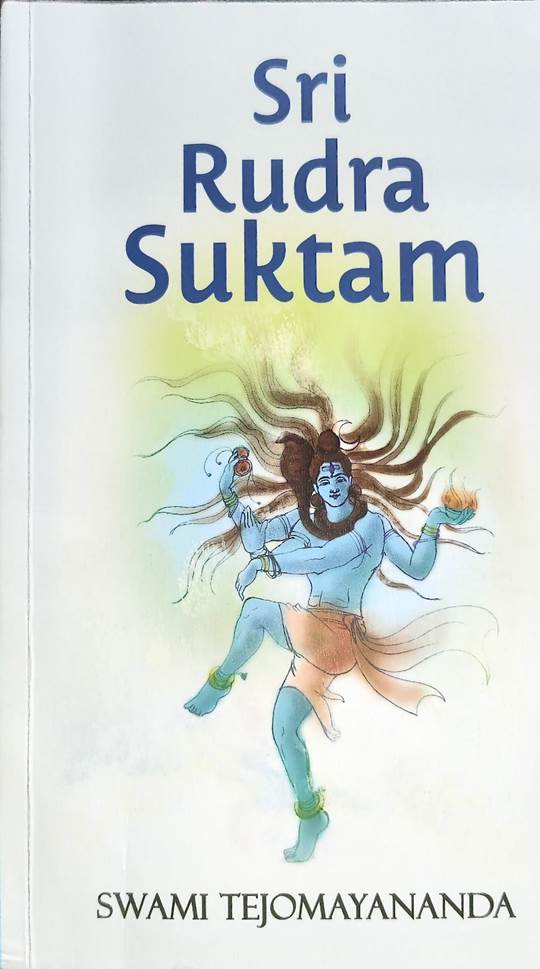
Sri
Rudra
Suktam
Commentary by
Swami Tejomayananda
Central Chinmaya Mission Trust
©Copyright Reserved Central Chinmaya Mission Trust
All rights reserved. No part (either whole or part) may be reproduced, copied, scanned, stored in a retrieval system, recorded or transmitted in any form or by any means, including but not limited to electronic and mechanical means, without the prior written permission of the publisher.
First Edition - February 2023 to August 2023 - 3,000 copies
Reprint - February 2025 -3,000 copies
Published by:
Chinmaya Prakashan
The Publications Division of Central Chinmaya Mission Trust
Sandeepany Sadhanalaya
Saki Vihar Road, Powai, Mumbai 400072, India
Tel.: +91-22-2803 4900
Email: ccmtpublications@chinmayamission.com
Website: www.chinmayamission.com
Distribution Centre in the USA:
Chinmaya Publications West
560 Bridgetown Pike
Feasterville, PA 19053-7240, USA
Tel.: (215) 396-0390, Fax: (215) 396-9710
Email: publications@chinmayamission.org
Website: www.chinmayapublications.com
Designed by: Chinmaya Kalpanam, Mumbai
Printed by: SAP Print Solutions Pvt. Ltd., Mumbai
ISBN 978-81-7597-815-7
CONTENTS
Transliteration and Pronunciation Guide
In this book, Devanagari characters are transliterated according to the scheme adopted by the International Congress of Orientalists at Athens in 1912. In it one fixed pronunciation value is given to each letter, fq.w. x and z are not called to use.
|
Devanagari |
Translit-eration |
Sounds Like |
Devanagari |
Translit-eration |
Sounds Like |
|
अ |
a |
so̱n |
ट |
ṭa |
ṯank |
|
आ |
ā |
fa̱ther |
ठ |
tha |
- |
|
इ |
i |
di̱fferent |
ड |
ḍa |
- |
|
ई |
i̱ |
fe̱e̱l |
ढ |
ḍha |
aḏẖ̱esive* |
|
उ |
u |
fu̱ll |
ण |
ṇa |
uṉder |
|
ऊ |
ū |
bo̱o̱̱t |
त |
ta |
ṯabla |
|
ऋ |
ṛ |
ṟhythm |
थ |
tha |
ṯẖumb |
|
ॠ |
ṝ |
** |
द |
da |
ṯẖis |
|
लृॅ |
ḷ |
** |
ध |
dha |
Ganḏẖi |
|
ए |
e |
eva̱de |
न |
na |
ṉ̱ose |
|
ऐ |
ai |
deli̱ght |
प |
pa |
p̱en |
|
ओ |
o |
co̱re |
फ |
pha |
p̱ẖantom* |
|
औ |
au |
no̱w |
ब |
ba |
ḇoil |
|
क |
ka |
c̱alm |
भ |
bha |
aḇẖor |
|
ख |
kha |
ḵẖan |
म |
ma |
m̱ind |
|
ग |
ga |
g̱ate |
य |
ya |
y̱es |
|
घ |
gha |
g̱ẖost
|
र |
ra
|
ṟight |
|
ङ |
ṅa |
a̱ṉkle* |
ल |
la |
ḻove |
|
च |
ca |
c̱ẖuckle |
व |
va |
v̱ery |
|
छ |
cha |
witc̱ẖ |
श |
śa |
s̱ẖut |
|
ज |
ja |
j̱ustice |
ष |
sa |
s̱ugar |
|
झ |
jha |
j̱ẖansi |
स |
sa |
s̱imple |
|
ञ |
ña |
baṉy̱an |
ह |
ha |
ẖappy |
|
ं |
ṁ |
im̱provise |
क्ष |
kṣ |
acṯion |
|
ः |
ḥ |
- |
त्र |
tr |
ṯẖree |
|
S |
' |
A silent ‘a’ |
ज्ञ |
jñ |
gṉosis |
*These letters don't have an exact English equivalent. An approximation is given here.
**These sounds cannot be approximated in English words.
Preface
Listening to Vedic chanting of the Süktams (hymns) with the right intonations (svaras) is an enchanting experience. Chanting them is even more so. Listening and chanting with meaning is both inspiring and elevating. Reflecting and meditating on their meaning is deeply absorbing and leads to realization of the supreme Truth that they convey.
Vedic chanting is a part of the daily morning routine in all Chinmaya Mission Vedānta Courses at Sandeepanis (Gurukulas). The Rishi Putras (students) learn, among other Vedic hymns, the famous Puruşa Sūktam and Sri Rudra Sūktam. Pujya Gurudev's commentary and my notes on the Puruşa Sūktam is already in print. In the present Vedānta Course (2021-2023) at Sandeepany Sadhanalaya, Mumbai, I decided to study, reflect and teach the beautiful meaning of Śri Rudra Sūktam to the Rishi Putras, who had already learnt to chant it. It was truly a revealing and inspiring experience for me. May it also be so for all of you.
I well appreciate the hard and patient labour of love and dedication that goes into the making of a book, right from the recording of my talks, transcribing, editing, re-editing, repeated proof-reading, pagination, designing, financing to the final printing of a book. I sincerely thank all whom I am aware of and unaware of, who worked for bringing out Sri Rudra Sūktam in this beautiful form. A special thanks to Shri Ravi & Smt. Nandini Nene for sponsoring the first print of Sri Rudra Suktam. May the blessing of Rudra Bhagavān and Pujya Gurudev be on all of them and their families.
The entire Sri Rudra Süktam (Namakam and Camakam), along with the meditation verses and nyāsa, etc., with the intonation marks as per the Krsna Yajur Veda, is given at the end of this book for easy reference and chanting. May we all chant Sri Rudra Sūktam with right intonation and meaning, worship Śrī Rudra with faith and devotion, and study, reflect and meditate to realize our true Self as Śri Rudra Bhagavān Himself.
Wherever footnotes are given in Sanskrit Devanagari scripts, their English transliterations are given at the end of this book to facilitate the readers.
Swami Tejomayananda
Mahāśivarātri
18th February, 2023
Mumbai 400072
Introduction
The Vedas: Vedas are the realizations of eternal Truths that guide creation, revealed to Sages in their seat of meditation. The entire body of the knowledge enshrined in the Vedas are called mantras, as are individual sentences, verses and sections. Vaidika mantras are, therefore, not man-made (apauruşeya), and are eternal (nitya). They have remained unchanged in their pristine glory over thousands of years as they were handed down through an unbroken lineage of the teacher and the taught (guru-śiṣya paramparā).
Vaidika Mantras: They are composed in prose, poetry and song and are chanted with particular intonations. According to the science of pronunciation (śikṣā), they should be recited with the correct alphabetic pronunciation (varna) and the right accent (svara) (consisting of the elevated (udātta), lower pitched (anudātta) and unaccented intonations (svarita)). 'They are chanted with the correct time (mātrā) required to pronounce be it short, normal or long and with the right emphasis and effort (balam). There should be uniformity and right conjoining of the letters (santāna).1 The right chanting should be learnt from an adept teacher. Such recitation has enabled the Vaidika mantras to retain their purity of words and meaning. The mere chanting of the Vaidika mantras has a tremendous effect on the body and mind. However, it is better to say the mantras without intonations than to chant them wrongly.
Vaidika Hymns: The Vedas enshrine hymns to all forms of God like Vişnu (Narayana Saktam), Laksmi (Sri Süktam) and even to the deities of Night (Ratri Süktam) and Fortune (Bhagya Suktam). However, two of the most famous ones are the Purusa Sūktam (God as the Cosmic Form) and Sri Rudra Suktam (God as Rudra/Siva). The former is found in all the four Vedas and the latter in the Yajur Veda.
Purusa Sūktam and Sri Rudra Sūktam: Sri Krsna says, "For one who sees Me (God) in all and all in Me, I am one with him and he is one with Me.2 The Puruşa Sūktam describes the entire world of things and beings as the Cosmic Form of God, the process of creation from God through Yajña and the essential Truth manifested as creation to be realized as the pure Self.3 It is the 'all in one' vision, akin to the Cosmic Form of countless beings shown to Arjuna by Śrī Krsna (Gītā Chapter 11 - Viśva-rūpa-darśana Yoga).
Śri Rudra Sūktam describes how to see the entire creation as God. It is the 'one in all' vision akin to the cosmic tour given by Śrī Kṛṣṇa to Arjuna showing His glory everywhere (Gītā Chapter 10 - Vibhūti Yoga).
Hindus worship God through the ritualistic fire worship (homa/havana/yajña) and the sixteen- _______________________
1 वर्णस्स्वरः। मात्रा बलम् । साम सन्तानः। इत्युक्तश्शीक्षाध्यायः । तैत्तिरीय उपनिषद्-१.२
2 यो मां पश्यति सर्वत्र सर्व च मयि पश्यति। तस्याहं न प्रणश्यामि स च मे न प्रणश्यति ॥ भगवद् गीता-६.३०
3 सहस्रशीर्षा पुरुषः । सहस्राक्षः सहस्त्रपात्... तस्मात्यज्ञात्सर्वहतः । ऋचः सामानि जज्ञिरे . बेदाहमेतं पुरुषं महान्तम्... पुरुष सूक्तम्-१-४-७
step ritual worship (sodaśopacāra pūjā). The Puruşa Süktam and Sri Rudra Sūktam are employed for both forms of worship. It is said that God as Vişnu is fond of decoration (alańkāra priya), as the sun-god Sürya, He is fond of prostrations (namaskāra priya), and as Rudra/Siva, He is fond of the special ritualistic bath (abhişeka priya). Hence to please Śiva, abhişeka with various materials like sandal paste, ashes, clarified butter and most commonly milk and water is performed with the chanting of Puruşa Saktam or Śri Rudra Suktam.
Śrī Rudra Sūktam: Śri Rudra Saktam is found in both the Sukla Yajur Veda and the KrsnaYajur Veda. It is variously called Rudra, Rudrādhyāya, Rudra-praśna and Rudropaniṣad. Since Rudra is worshipped through hundreds of His names, it is also called Satarudrīyam. There are hundreds of commentaries on Śri Rudra Süktam. The commentary of the famous Sayaņācārya (the brother of the equally famous Swami Vidyāranya) is noteworthy among them.
Śri Rudra Sūktam has two parts each with eleven sub-section (anuvāka). Eleven symbolizes the eleven Rudras Manyu, Manu, Mahīnasa, Mahāna, Śiva, Rtudvaja, Ugraretā, Bhava, Kāma, Vāmadeva and Dhṛtavrata. Elsewhere the eleven Rudras are given as Aja, Ekapāda, Ahirbudhnya, Tvaşță, Rudra, Hara, Śambhu, Tryambaka, Aparajita, Iśāna and Tribhuvana.
A hymn (sūktam) is a praise of God (stuti) with a prayer (prārthana). The first part of the Sri Rudra Süktam is called Namakam as there is a praise of Rudra with prostrations (namah) to His various forms. The second part is called Camakam as there is a prayer asking for various things (ca me) from God.
The entire world works on give and take (adana and pradana). What can we give to God as everything already belongs to Him? We can only offer prostrations in recognition of His greatness and glory. He, in turn, can bless us with endless tidings all that we ask for, all that is good for us, all that we can never even imagine. Our head again bows down before Him in gratitude when we realize all that we have is already received from Him.
Śrī Rudra Sūktam Upāsanā: Sri Rudra Sūktam can be chanted each day as a daily chant (pārāyaņa) or can be chanted in ritual fire worship (havan) or worship (pūjā) or during special ritual bath (abhiseka). There are many traditions of the employment of Sri Rudra Sūktam. One way is to chant the entire namakam with each anuvāka of the camakam. Another way is given below. One round of chanting of Srt Rudra Sūktam (eleven anuvākas of namakam and camakam) is called 'rūpa'.
11 x 1 (namakam and camakam) = 1 rūpa (1 time)
11 x 1 rūpa = 1 rudrī (11 times)
11 x 1 rudri = 1 laghu-rudra (121 times)
11 x 1 laghu-rudra = 1 mahā-rudra (1331 times)
11 x 1 mahā-rudra = 1 atirudra (14641 times)
Many priests chant the Sri Rudra Süktam together as they offer different oblations in the fire in the performance of laghu-rudra, mahā-rudra and atirudra. 'Rūpa' is done by thousands even to this day as a daily spiritual practice Rūpa, rudrī and laghu-rudra are done during special occasions like Śivarātrī, and mahārudra and atirudra are rare, but still performed. In the past, these elaborate rituals were more common and sponsored even by kings. They went on conquests (digvijaya yātrā), and after their conquest, as a gratitude to the deities for answering their prayers, they performed these yagnas, the proceeds of which were distributed to all as their benevolence.
Śrī Rudra Sūktam fire worship (homa): The fire-god 'Agni' is most respected and the first to be worshipped. Fire is the first visible element of the five elements-space, air, fire, water and earth. The most ancient scripture of the world, the Rg Veda starts with the invoking of Agni (agnimile purohitam ...). God is everywhere and can be invoked anywhere. We invoke God in the fire with mantras. When we perform a Gayatri homa we chant the Gayatri mantra, and Mṛtyuñjaya homa is done with the Mṛtyunjaya mantra. Similarly, while performing a Rudra homa (rudrī, laghurudra, etc.) we consider Agni as Rudra (eşa agni rudraḥ) and chant the Śrī Rudra Sūktam. Agni is the cosmic courier who delivers our offering and oblations to whichever deity we invoke in the fire. For example, the offering with the chanting 'indrāya svāhā' goes to Indra.
The scriptures (āgama śāstras) specify in great details the size and shape of the homa kunda, the bricks to be used to make it, the mantras to be used, the offerings and their sequence for the performance of Sri Rudra Sūkta homa, and so on.
Śrī Rudra Sūktam ritual bath (abhişeka): The Śiva linga is the most commonly worshipped form of Śiva and is most dear to all Śiva devotees. The abhişeka or the ritualistic bath with the chanting of the Sri Rudra Süktam is usually performed to the Śiva linga.
Who is Rudra? There exists the one infinite Truth one alone, without a second.4 That absolute Truth alone with its inherent, immeasurable and inexplicable power, known as māyā, is called God or Iśvara. Its further manifestation as the Total Mind is called Hiranyagarbha or Sūtrātmā and as the Total Gross World is the Virat - the Cosmic Form. Iśvara, Hiranyagarbha and Virāț are only names of the manifestations of the absolute Truth (Brahman) in reference to the conditionings of māyā, total subtle world and total gross world respectively. In this sūktam, Brahman and its manifestations as Iśvara, Hiranyagarbha and Virăț are called Rudra. As Iśvara/God, He is omniscient, omnipotent and omnipresent (sarvajña, sarvaśaktimān, sarvavyāpī). He is the Lord and the creator, sustainer and destroyer of countless cosmoses (ananta-koți-brahmānda-nāyaka, srşți-sthiti-samhāra-kāraka). 'With the preponderance of rajo guņa, Rudra is referred to as the creator of the world Brahmā/Bhava. With the preponderance of tamo guna, He is called the destroyer Śiva/Maheśa (Hara), and with the preponderance of sattva guna, He is the sustainer of the world Vişnu (Mrda). Also, He alone is the substratum of the three, the supreme Truth free of all attributes (gunas).5 Śiva/God is well known specifically as the destroyer of the universe. He alone manifests as the eleven Rudras.
God as Vişnu has many incarnations. So does God as Rudra/Śiva. Unlike Vişnu, who incarnates as the son of Devaki and Vasudeva as Śrī Kṛṣṇa and as the son of Kausalyā and _______________________________
4 एकमेवाद्वितीयं ब्रह्म ।
5 बहुलरजसे विश्वोत्पत्तौ भवाय नमो नमः प्रबलतमसे तत्संहारे हराय नमो नमः। जनसुखकृते सत्त्वोद्रिक्तौ मृडाय नमो नमः प्रमहसि पदे निस्बैगुण्ये शिवाय नमो नमः ॥ शिवमहिम्नः स्तोत्रम्-३०
Daśaratha as Śrī Rāma, Śiva's incarnations are self-born (svayambhū). Śiva Purāņa relates a story of how amused Śiva was when asked who His parents were at the time of His
marriage. He said, "Brahma, the Creator, is my father; Vişņu, the Sustainer, is my grandfather; and I myself am the great-grandfather!" Śrī Kṛṣṇa also says, "I myself am the mother, father, provider and grandfather of the world.6
One of Rudra/Śiva's most revered incarnation is as the Guru Dakşiņāmūrti7 and in more recent times as Śrī Ādi Śańkarācārya³, the son of Āryāmbā and Śivaguru.8
His beautiful dancing form as Națarāja represents the five functions of God creation (srşți), sustenance (sthiti), destruction (samhāra), benediction or blessing (anugraha) and punishing or disciplining (nigraha). In whatever form He manifests - the meditating Śiva or the frightening Virabhadra - He is the embodiment of compassion (karuņāvatāram) and beauty (satyam śivam sundaram). He is easily pleased, easy to worship and quick to respond (āśutoșa).
The name Rudra: There are many meanings of the name Rudra. People are fearful and cry even at the thought of death. Rudra is one who makes all cry at the time of death and at the time of the great deluge.9 He gives us the speechto express ourselves and is therefore called Rudra.10 All we get in life is the result of what we do. We cry when we get the unwanted and the painful. God is the giver of the result of our actions - even the painful and unpleasant ones; hence,He is called Rudra. But He alone is the one who makes them bearable and even removes them; hence, He is Rudra.11 It is not that we always cry in pain, we even cry when our heart melts in love. Rudra is one who melts the heart of the devotees and makes them cry with love (rodayati bhaktān). The Gopis cried in separation from God, and Vidura cried as he remembered His glories and greatness. Rudra is also the one who destroys our diseases (rujam drāvayati iti), physical and mental and most importantly the disease of samsāra (bhava roga). Rudra is also called the doctor that cures the disease of samsāra with the medicine of Self-knowledge.12
God 'as though' cries when He sees us harm ourselves with wrong thoughts, words and deeds and suffers; hence, He is called Rudra (roditi iti). God is said to have roared at the time of creation and hence is called Rudra.
____________________________________
6 पितामहस्य जगतः माता धाता पितामहः। भगवद् गीता-९-१७
7 गुरवे सर्वलोकानां दक्षिणामूर्तये नमः। दक्षिणामूर्ति स्तोत्र ध्यान श्लोक-४
8 शङ्करं शङ्कराचार्यम् ।
9 संहारकाले प्रजाः संहरन् रोदयतीति। विष्णुसहस्रनाम शाङ्कर भाष्य-११४
10 रुदं राति ददातीति । विष्णुसहस्रनाम शाङ्कर भाष्य-११४
11 रुर्दुःखं दुःखकारणं वा, द्रावयतीति वा रुद्रः। विष्णुसहस्रनाम शाङ्कर भाष्य-११४
12 भिषजे भवरोगिणाम् । दक्षिणामूर्ति स्तोत्र ध्यान श्लोक-४
Śrī Rudra Sūktam Upāsanā (viniyoga): The Vedas have three main sections:
1. Karma Kāņda, which has mantras regarding the what, how, why, where and when of ritualistic worship.
2. Upāsanā Kāņda, which has mantras regarding worship and meditation.
3. Jñāna Kända, which has mantras meant for enquiry and deep contemplation.
Sri Rudra Süktam is employed for all the three purposes. The former two give specific worldly and other worldly results and also makes the mind pure, subtle and concentrated, which is a preparation for the last section.
Contemplation on the subtle implied meaning of the sūktam leads to the Realization of the Truth.
Sri Rudra Sūktam mantras, like all Veda mantras, can be understood at three levels:
1. Ādhidaivika Worship of Rudra/Śiva as God, His manifestation as various incarnations and the different deities that govern creation.
2. Ādhibhautika - God manifests as this entire creation - be it stone, plant, animal or human. Worship of the world we see around us in terms of lovingly serving others, conservation of nature and living by the values and laws that govern creation and society (following dharma).
3. thi Adhyatmika God and His manifestation as the deities that govern nature also govern our body, senses, mind and intellect. For example, the eleven Rudras also govern our individual five sense organs of action (hands, legs, speech, procreation and excretion), the five organs of perception (seeing, hearing, tasting, smelling, feeling) and the mind (thoughts of volition, determination, memory and ego). With this understanding we invoke and worship Rudra within us and pray to empower ourselves. God is also understood as the indweller and the Self of the seeker.
Grand vision of Śrī Rudra Süktam: As the vision, so the world appears to us.13 Śrī Rudra Sūktam presents before us the vision of a Master who has realized the supreme Truth and sees the entire world as His manifestation. Just as the mother sees even her dirt covered infant as 'my baby', the Master sees everything in the world - the good, bad and the ugly as God's manifestation. Just as the x-ray machine sees what is inside us, the Master sees the divine essence within us. When Sage Aşțāvakra entered the court of King Janaka, everyone laughed at his crooked body. Sage Aşțāvakra said, "I had heard that the court of King Janaka had great men of wisdom, but I see only cobblers who see skin and flesh and not the Truth within. Are you laughing at the creation or the Creator who made this creation?" Most of us behave with others only based on outer appearances and fail to see the virtues and values of a person, much less their divine nature. The Sri Rudra Sūktam gives us this divine vision.
The Master has the vision of divinity in everything. We can start by seeing God in one thing at a time. In the Śrī Rudra Sūktam there is something to appreciate for everyone. The foody
________________________
13 यथा दृष्टिः तथा सृष्टिः ।
can worship Him as the Master of food (annānām pataye namah), the forest lover can worship Him in and as the forests and Master of forests (vanānām pataye namaḥ), the business minded as a Master businessman and Master of all businessmen (vāņijāya pataye namah), the war mongers and the army lovers as the battle cries and commander of all foot soldiers (namah uccairghoşaya-ākrandayate pattīnām pataye namaḥ).
The Vibhūti Yoga of Gītā shows us God as His extraordinary, wonderful and divine glories among the ordinary things of the world. For example, Śrī Kṛşņa says, 'Amongst all the rivers, I am the sacred Ganga, amongst the mountain ranges I am the grand Himālayas, and amongst the birds I am the divine and mighty Garuda the vehicle of Vişnu.14
Śri Rudra Sūktam gives us the vision to see God in even the most insignificant and ordinary things, for example, in an atomic particle and in the dust under our feet (namah pāgṁ savyāya ca rajasyāya ca). He alone is seen and saluted in all the opposites of life, like the old and the young (namo jyeşṭhāya ca kanişṭhāya ca), the first and the last (namah pūrvajāya cāparajāya ca). God manifests as heavenly deities (namah somāya), ordinary householders (grhyāya namah), animals like horses (namo aśvebhyaḥ), as trees (namo vrkşebhyaḥ) and even in the grain of sand (namah sikatyāya). We can see God in our most ordinary actions like sitting and sleeping (nama āsīnebhyaḥ śayānebhyaśca vo namah) and in the phenomenal forces like lightning (vidyutyāya namaḥ). He is seen in holy places (namah tīrthyāya) and in dark caves (gahvareşṭhāya namaḥ). He can be seen even in the robber that steals and as a master of all robbers (stenānām pataye namah), in the despicable (namo grtsebhyaḥ), the virtuous (nama uganābhyaḥ) and in the divine (namaḥ śivāya).
God is the substratum of the universe of names, forms and qualities. All appear in Him as Him, but He remains free from their limitations. Śrī Kṛşņa says, "All things and beings be they sättvika (noble), rājasika (dynamic) and tāmasika (inert) come from Me (God). They depend on Me, but I remain untouched by them.15 When we too have this grand vision of Truth, we can rid ourselves of all divisive thoughts, likes, dislikes and prejudices and see divinity in all.
Most of us are on the fast, super-fast or bullet trains as we journey through life, missing out on all the interesting sights seen by the traveller in the passenger train which stops at every station and even in between! 'What is this life if, full of care, we have no time to stand and stare. No time to see the woods we pass, where squirrels hide their nuts in grass' - W. H. Davies. Śrī Rudra Sūktam not only inspires us to pause and care, but see God in all, as we stand and stare.
It is said that we should look before we walk, correct our vision before we interact, be informed before we make opinions or speak and be alert as we move about in the world.16 ___________________________
14 स्रोतसामस्मि जाह्नवी, स्थावराणां हिमालयः, वैनतेयश्च पक्षिणाम्। भगवदु-गीता-१०.३१,२५,३०
15 ये चैव सात्त्विका भावा राजसास्तामसाश्च ये ।
मत्त एवेति तान्विद्धि न त्वहं तेषु ते मयि ॥ भगवद् गीता-७.१२
16 दृष्टिपूतं न्यसेत् पादम् ।
What better than to look at the world through the crystal clear, elevating and inspiring vision
of Sri Rudra Saktam!
Glory of Sri Rudra Süktam (mahima): The Brahmottara- khanda of Skanda Purāņa has an interesting story. Once upon a time, more and more people started chanting the Śri Rudra Süktam. As a result, there were no new entrants in hell. Brahma then created faithlessness (aśraddhā) and sinful intellect (durmedhā) and hell started refilling!
Glorious Mantras: Every mantra of the Sri Rudra Sūktam is great. However, two of the most famous mantras of the Vedas, especially for the devotees of Śiva are found here. They are the Mṛtyuñjaya Mantra (tryambakam yajāmahe...) and the Pañcākşara Mantra (namaḥ śivāya). These have been chanted by millions of people, trillions of times, over several millenniums.
Glorious Result (phala śruti): The Kaivalya Upaniṣad says, 'One who repeats the Rudrī a hundred times or once daily attains the same purity as gained by the performance of agnihotra (agnipūto bhavati), prāṇāyāma (vāyu-pūto bhavati) and meditation (ātmapūto bhavati), and he is purified from sins due to drinking alcohol (surāpānāt-pūto bhavati), killing a noble person (brahmahatyāḥ pūto bhavati), stealing and due to actions of commission and omission. He attains the refuge of God (Śiva). Therefore, a renunciate (or one renouncing everything), should chant it at all times or once daily. The knowledge gained by its study, dries the ocean of samsāra, and one attains the results of Liberation (Kaivalya). Indeed, one attains Liberation.17 The above is not a license to steal or kill. It also does not mean that we do not receive the results of such actions. It only means that the Sri Rudra Sūktam has the power to cleanse us of all sinful thoughts and actions.
______________________
17 यः शतरुद्रीयमधीते सोऽग्निपूतो भवति स वायुपूतो भवति स आत्मपूतो भवति स सुरापानात्पूतो भवति स ब्रह्महत्यायाः पूतो भवति स सुवर्णस्तेयात्पूतो भवति स कृत्याकृत्यात्पूतो भवति तस्मादविमुक्तमाश्रितो भवत्वित्याश्रमी सर्वदा सकृद्धा जपेत्। अनेन ज्ञानमाप्नोति संसारार्णवनाशनम् । तस्मादेवं विदित्वैनं कैवल्यं पदमश्नुते कैवल्यं पदमश्नुत इति ॥ - कैवल्य उपनिषद्-२.५
Śrī Rudra Sūktam - Laghunyāsa
The chanting of the Sri Rudra Süktam starts with the chanting of laghunyāsa. It is said - śivo bhūtvā śivaṁ yajet - being Śiva, worship Śiva. It means that making our mind auspicious, we worship Śiva who is an embodiment of auspiciousness, and invoking the Śiva who resides within us, we worship or meditate on the Śiva outside as a Siva Linga or an idol or as His manifestation as the world. Nyāsa has two opposite meanings to renounce and also to establish. In the nyāsa ritual described hereafter, we give up the inauspicious and ignoble and establish or invoke the auspicious and divine within us.
Initial Meditation Verses:
ॐ अथात्मानं शिवात्मानं श्रीरुद्ररूपं ध्यायेत् ॥
शुद्धस्फटिकसङ्काशं त्रिनेत्रं पञ्चवक्रकम् ।
गङ्गाधरं दशभुजं सर्वाभरणभूषितम् ॥ १ ॥
नीलग्रीवं शशाङ्काङ्क नागयज्ञोपवीतिनम् ।
व्याघ्रचर्मोत्तरीयं च वरेण्यमभयप्रदम् ॥ २॥
कमण्डल्वक्षसूत्राणां धारिणं शूलपाणिनम् ।
ज्वलन्तं पिङ्गलजटाशिखामुद्योतधारिणम् ॥ ३॥
वृषस्कन्धसमारूढं उमादेहार्धधारिणम् ।
अमृतेनाप्लुतं शान्तं दिव्यभोगसमन्वितम् ॥ ४ ॥
दिग्देवतासमायुक्तं सुरासुरनमस्कृतम् ।
नित्यं च शाश्वतं शुद्धं ध्रुवमक्षरमव्ययम् ॥ ५॥
सर्वव्यापिनमीशानं रुद्रं वै विश्वरूपिणम् ।
एवं ध्यात्वा द्विजस्सम्यक् ततो यजनमारभेत् ॥ ६ ॥
om athātmānam śivātmānaṁ śrī-rudra-rūpam dhyāyet.
śuddha-sphațika-sankāśam trinetram pañca-vaktrakam,
gangadharam daśa-bhujam sarvābharaṇa-bhūṣitam. (1)
nilagrīvam śaśānkāńkam nāga-yajñopavitinam,
vyāghra-carmottariyam ca varenyam-abhayapradam. (2)
kamandalvakşa-sūtrāņām dhāriņam śūla-pāņinam,
jvalantam pingala-jațā-śikhām-udyotadhāriņam. (3)
vrşa-skandha-samārūdham umā-dehārdha-dhāriņam,
amṛtenāplutam śāntam divya-bhoga-samanvitam. (4)
dig-devatā-samayuktam surāsura-namaskṛtam,
nityam ca śāśvatam śuddham dhruvam-akşaram-avyayam. (5)
sarvavyāpinam-iśānam rudram vai viśva-rūpiņam,
evam dhyātvā dvijas-samyak tato yajanam-arabhet. (6)
Om. We should meditate on the auspicious Self as Śiva in the form of Rudra.
1. He is pure and clear like crystal, three-eyed, five faced, holding Ganga on His head, with ten arms and decorated with all jewellery.
2. He is blue-throated, bears the crescent moon on His head, wears the snake as the sacred thread, wears the tiger skin as upper cloth, is great and bestows fearlessness.
3. He wears the necklace of rudrākşa and has the kamandalu, holds the trident, is bright and bears Gangā within His golden hued locks.
4. He appears seated on the shoulder of Nandi, with Uma as half His body, drenched in nectar (from the moon on His head), enjoying divine pleasures.
5. He is surrounded by the guardians of the directions, is worshipped by the deities and demons, is eternal, ever-pure, firm, indestructible and immutable.
6. Thus, meditation on the all-pervading Lord Rudra of the Cosmic Form, the seeker should start His worship.
Creating a protective shield (kavaca)
प्रजनने ब्रह्मा तिष्ठतु। पादयोर्विष्णुस्तिष्ठतु । हस्तयोर्हरस्तिष्ठतु । बाहोरिन्द्रस्तिष्ठतु । जठरेऽग्निस्तिष्ठतु । हृदये शिवस्तिष्ठतु । कण्ठे वसवस्तिष्ठन्तु । वत्रे सरस्वती तिष्ठतु। नासिकयोर्वायुस्तिष्ठतु । नयनयोश्चन्द्रादित्यौ तिष्ठेताम् । कर्णयोरश्विनौ तिष्ठेताम् । ललाटे रुद्रास्तिष्ठन्तु । मूर्ध्यादित्यास्तिष्ठन्तु । शिरसि महादेवस्तिष्ठतु । शिखायां वामदेवस्तिष्ठतु । पृष्ठे पिनाकी तिष्ठतु । पुरतः शूली तिष्ठतु । पार्श्वयोः शिवाशङ्करौ तिष्ठेताम् । सर्वतो वायुस्तिष्ठतु । ततो बहिः सर्वतोऽग्निर्ध्वालामालापरिवृतस्तिष्ठतु । सर्वेष्वङ्गेषु सर्वा देवता यथास्थानं तिष्ठन्तु । सर्वान् महाजनान् रक्षन्तु । मां रक्षन्तु ॥
prajanane brahmā tişthatu, pādayor-vişnus-tişthatu, hastayor-haras-tişthatu, bāhvor-indras-tişthatu, jathare'gnis-tisthatu, hrdaye śivas-tişthatu, kanthe vasavas-tişthantu, vaktre sarasvati tişthatu, nāsikayor-vayus-tişthatu, nayanayoś-candrādityau tişthetam, karnayor-aśvinau tişthetam, lalațe rudras-tişthantu, mūrdhnyādityās-tişthantu, śirasi mahadevas-tişthatu, śikhāyām vāmadevas-tisthatu, prsthe pinaki tişthatu, purataḥ śūli tişthatu, pārśvayoḥ śivā-śankarau tişthetām, sarvato vāyus-tişthatu, tato bahih sarvato'gnir-jvala-mala-parivrtas-tişthatu, sarveṣvańgeşu sarvā devatā yathā-sthānam tişthantu, sarvān mahājanan rakşantu, mām rakşantu.
May Brahma reside in my reproductive organs. May Vişnu reside in my feet. May Hara reside in my hands. May Indra reside in my arms. May Agni (Fire-god) reside in my stomach. May Śiva reside in my heart. May Vasava reside in my throat. May Sarasvati reside in my mouth (speech). May Vayu (Air-god) reside in my nose (breath). May Candrama (Moon-god)= and Aditya (Sun-god) reside in my eyes. May the Aśvinī twins reside in my ears. May the Rudras reside in my forehead. May the Adityas reside on the top of my head. May Mahādeva reside in my head. May Vamadeva reside in my śikhā (tuft). May Pināki reside in my back. May Śūlī reside in the front. May Śiva (Parvati) and Sankara reside in my left and right sides. May Vayu (Wind-god) reside on all sides. May the garland of flames of Agni (Fire-god), surround me outside. May all the deities reside in their appointed places. May they protect all the great men. May they protect me.
Establishing the deities in different parts of the body thereby reinforcing the oneness between the individual Self and the supreme Self/Truth
अ॒ग्निर्मे॑ वा॒चि श्रि॒तः । वाग्हृद॑ये । हृद॑यं॒ मयि॑ । अ॒हम॒मृते᳚ । अ॒मृतं॒ ब्रह्म॑णि ।
वा॒युर्मे॑ प्रा॒णे श्रि॒तः । प्रा॒णो हृद॑ये । हृद॑यं॒ मयि॑ । अ॒हम॒मृते᳚ । अ॒मृतं॒ ब्रह्म॑णि ।
सूर्यो॑ मे॒ चक्षुषि श्रि॒तः । चक्षु॒हृद॑ये।हृद॑यं॒ मयि॑ । अ॒हम॒मृते᳚ । अ॒मृतं॒ ब्रह्म॑णि ।
च॒न्द्रमा॑ मे॒ मन॑सि श्रि॒तः। मनो॒ हृद॑ये। हृद॑यं॒ मयि॑ । अ॒हम॒मृते᳚ । अ॒मृतं॒ ब्रह्म॑णि ।
दिशो॑ मे॒ श्रोत्रे॑ श्रि॒ताः। श्रोत्र॒ग्ं॒ हृदये। हृद॑यं॒ मयि॑ । अ॒हम॒मृते᳚ । अ॒मृतं॒ ब्रह्म॑णि ।
आपो॑ मे॒ रेत॑सि श्रि॒ताः। रेतो॒ हृद॑ये। हृद॑यं॒ मयि॑ । अ॒हम॒मृते᳚ । अ॒मृतं॒ ब्रह्म॑णि ।
पृ॒थि॒वी मे॒ शरी॑र श्रि॒ता । शरीर॒ग्ं॒ हृद॑ये। हृद॑यं॒ मयि॑ । अ॒हम॒मृते᳚ । अ॒मृतं॒ ब्रह्म॑णि ।
ओ॒ष॒धि॒व॒न॒स्प॒तयो॑ मे॒ लोम॑सु श्रि॒ताः। लोमा॑नि॒ हृद॑ये। हृद॑यं॒ मयि॑ । अ॒हम॒मृते᳚ । अ॒मृतं॒ ब्रह्म॑णि ।
इन्द्रो॑ मे॒ बले॑ श्रि॒तः । बल॒ग्ं॒ हृद॑ये । हृद॑यं॒ मयि॑ । अ॒हम॒मृते᳚ । अ॒मृतं॒ ब्रह्म॑णि ।
प॒र्जन्यो॑ मे॒ मू॑र्ध्नि श्रि॒तः। मू॒र्धा हृदये। हृद॑यं॒ मयि॑ । अ॒हम॒मृते᳚ । अ॒मृतं॒ ब्रह्म॑णि ॥
ईशा॑नो मे॒ मन्यौ श्रि॒तः। म॒न्युहृद॑ये। हृद॑यं॒ मयि॑ । अ॒हम॒मृते᳚ । अ॒मृतं॒ ब्रह्म॑णि ।
आ॒त्मा म॑ आ॒त्मनि॑ श्रि॒तः। आ॒त्मा हृद॑ये। हृद॑यं॒ मयि॑ । अ॒हम॒मृते᳚ । अ॒मृतं॒ ब्रह्म॑णि ।
पुन॑र्म आ॒त्मा पुन॒रायु॒रागा॑त्। पुन॑: प्रा॒णः पुनराकू॑तमागा॑त्। वै॒श्वा॒न॒रो र॒श्मिभिर्वावृधा॒नः । अ॒न्तस्ति॑ष्ठत्व॒मृतस्य गोपाः ॥
a̱gnir-me̍ vā̱ci śri̱̱taḥ, vāg-hṛda̍̍ye, hṛda̍ya̱ṁ mayi̍, a̱ham-a̱mṛte̎, a̱mṛta̱ṁ brahma̍ṇi,
vāyur-me̎ prā̱ṇe śri̱taḥ, prā̱ṇo hṛda̍ye, hṛda̍ya̱ṁ mayi̍, a̱ham-a̱mṛte̎, a̱mṛta̱ṁ brahma̍ṇi,
sūryo̍ me̱ cakṣuṣi śri̱taḥ, cakṣu̱r-hṛda̍ye, hṛda̍ya̱ṁ mayi̍, a̱ham-a̱mṛte̎, a̱mṛta̱ṁ brahma̍ṇi,
ca̱ndramā̍ me̱ mana̍si śri̱taḥ, mano̱ hṛdaye, hṛda̍ya̱ṁ mayi̍, a̱ham-a̱mṛte̎, a̱mṛta̱ṁ brahma̍ṇi,
dis̀o̍ me̱ śrotre̎ śri̱tāḥ, śrotra̱gṁ hṛdaye, hṛda̍ya̱ṁ mayi̍, a̱ham-a̱mṛte̎, a̱mṛta̱ṁ brahma̍ṇi,
apo̍ me̱ reta̍si śri̱taḥ, reto̱ hṛdāye, hṛda̍ya̱ṁ mayi̍, a̱ham-a̱mṛte̎, a̱mṛta̱ṁ brahma̍ṇi,
pṛ̱thi̱vī me̱ sarire śri̱tā, śarī̍ra̱g̱ṁ hṛda̍ye, hṛda̍ya̱ṁ mayi̍, a̱ham-a̱mṛte̎, a̱mṛta̱ṁ brahma̍ṇi,
oṣa̱dhi̱-va̱na̱spa̱tayo̍ me̱ lomásu śri̱tāḥ, lomā̍ni̱ hṛda̍ye, hṛda̍ya̱ṁ mayi̍, a̱ham-a̱mṛte̎, a̱mṛta̱ṁ brahma̍ṇi,
indro̍ me̱ bale̎ śri̱taḥ, bala̱g̱ṁ hṛda̍ye, hṛda̍ya̱ṁ mayi̍, a̱ham-a̱mṛte̎, a̱mṛta̱ṁ brahma̍ṇi,
pa̱rjanyo̍ me mū̍rdhni śri̱taḥ, mū̱rdhā hṛda̍ye, hṛda̍ya̱ṁ mayi̍, a̱ham-a̱mṛte̎, a̱mṛta̱ṁ brahma̍ṇi,
īs̀ā̍no me ma̱nyau śri̱taḥ, ma̱nyur-hṛda̍ye, hṛda̍ya̱ṁ mayi̍, a̱ham-a̱mṛte̎, a̱mṛta̱ṁ brahma̍ṇi,
ā̱tmā ma̍ ā̱tmani̍ śri̱taḥ, ā̱tmā hṛda̍ye, hṛda̍ya̱ṁ mayi̍, a̱ham-a̱mṛte̎, a̱mṛta̱ṁ brahma̍ṇi,
punárma ā̱tmā puna̱rāyu̱rāgā̎t, puna̍ḥ prā̱ṇaḥ puna̱rākū̍ta̱māgā̎t, vai̱śvā̱na̱ro ra̱śmibhi̍r-vāvṛdhā̱naḥ, a̱ntasti̍ṣṭhatva̱mṛtásya go̱pāḥ.
Agni (Fire-god) is established in my speech. Speech is in my heart. The heart is in me. I am in immortality and immortality is one with the supreme Self/Truth.
Vāyu (Wind-god) is established in my prāņa (breath). Breath is in my heart
Sūrya (Sun-god) is established in my eye. The eye is in my heart
Candramā (Moon-god) is established in my mind. The mind is in my heart
Diśa (Space) is established in the ears (hearing). The ears are in the heart
Apa (Water) is established in semen (ovum). The semen is in the heart
Pṛthivī (Earth) is in the body. The body is in my heart
Osadhi-vanaspataya (Herbs and Plants) are established in the body hair. The body hair is in the heart ...
Indra is established in my strength (arms). The strength is in the heart
Parjanya (Rain-god) is established in the head. The head is in the heart
Iśāna is established in my anger. The anger is in my heart
Ātma (I), the individual is established in the body. The body is in the heart. The heart is in me. I am in immortality and immortality is in one with the supreme Self/Truth. By such thoughts, I have gained a longer life and awareness. I have been revitalized and have gained good thoughts. My digestive fires have been rekindled. May God who protects immortality reside in me.
Invoking the grace of the Seer (Sage) of Śrī Rudra Sūktam and taking his permission to use the mantra for japa/homa
अस्य श्री रुद्राध्यायप्रश्नमहामन्त्रस्य अघोर ऋषिः, अनुष्टुप्छन्दः सङ्कर्षणमूर्तिस्वरूपो योऽसावादित्यः परमपुरुषः स एष रुद्रो देवता। नमः शिवायेति बीजम् । शिवतरायेति शक्तिः । महादेवायेति कीलकम्। श्री साम्बसदाशिवप्रसादसिद्धयर्थे जपे विनियोगः ॥
asya śri rudrādhyāya-praśna-mahā-mantrasya aghora rsih, anuştup-chandah, sankarşana-mūrti-svarūpo yo'savādityah parama-puruşah sa eşa rudro devatā, namaḥ śivāyeti bījam, śivatarāyeti śaktih, mahādevāyeti kīlakam, śrī sāmbasadāśiva-prasāda-siddhyarthe jape viniyogah.
The Seer of this Śrī rudra-adhyāya-mahā-mantra is Aghora, the metre is anustup, the deity worshipped is Rudra that is of the form of Sankarşana who is Aditya the Supreme Self, 'namaḥ śivāya' is the seed (bija), 'śivataraya' is the power (sakti), 'mahādevāya' is the nail (kilaka that protects its power). This (Sri Rudra Sūktam) is used for japa/homa, for pleasing Śiva-Parvati.
Establishing the mantra in the hands (kara nyāsa)
ॐ अग्निहोत्रात्मने अङ्गुष्ठाभ्यां नमः । दर्शपूर्णमासात्मने तर्जनीभ्यां नमः । चातुर्मास्यात्मने मध्यमाभ्यां नमः। निरूढपशुबन्धात्मने अनामि-काभ्यां नमः। ज्योतिष्टोमात्मने कनिष्ठिकाभ्यां नमः । सर्वक्रत्वात्मने करतलकरपृष्ठाभ्यां नमः ॥
'om agnihotrātmane angusthābhyām namah' - prostrations to the thumbs (of both hands).
'darśapūrṇamāsātmane tarjanībhyām namah' prostrations to the index fingers.
'caturmāsyātmane madhyamābhyām namah' prostrations to the two middle fingers.
'nirudha-paśubandhātmane anāmikābhyām namah' - prostrations to the two ring fingers.
'jyotiştomātmane kanişṭhikābhyām namah' - prostrations to both little fingers.
'sarva-kratvātmane
karatalakarapṛṣṭhābhyām namah' prostrations to the both palms and back of hands.
Establishing the mantra in the body (anga nyāsa)
अग्निहोत्रात्मने हृदयाय नमः । दर्शपूर्णमासात्मने शिरसे स्वाहा। चातुर्मास्यात्मने शिखायै वषट् । निरूढपशुबन्धात्मने कवचाय हुम् । ज्योतिष्टोमात्मने नेत्रत्रयाय वौषट् । सर्वक्रत्वात्मने अस्त्राय फट् । भूर्भुवस्सुवरोमिति दिग्बन्धः ॥
'agnihotrātmane hrdayāya namah' prostrations to the heart.
darśapūrnamāsātmane śirase svāhā' - prostrations to the head
'caturmāsyātmane sikhāyai vaşat' – prostrations to the tuft.
'nirūdha-paśubandhātmane kavacāya hum' - prostrations to the chest (which is like a shield).
jyotiştomātmane netra-trayāya vauşat' – prostrations to the three eyes.
sarva-kratvātmane astrāya phat' - prostrations to the weapons.
bhür-bhuvas-suvarom-iti digbandhah' lock to the directions (so that no disturbance comes from any directions).
Meditation verses (dhyānam)
आपाताळनभः स्थलान्तभुवनब्रह्माण्डमाविस्फुरत् ज्योतिः स्फाटिकलिङ्गमौळिविलसत्पूर्णेन्दुवान्तामृतैः । अस्तोकाप्लुतमेकमीशमनिशं रुद्रानुवाकाञ्जपन् ध्यायेदीप्सितसिद्धये ध्रुवपदं विप्रोऽभिषिञ्चेच्छिवम् ॥ १ ॥
āpātāļa-nabhaḥ sthalānta-bhuvana-brahmāndam-avisphurat jyotih sphātika-linga-mauli-vilasat-pārņenduvāntāmṛtaiḥ, astokāplutam-ekam-iśam-aniśam rudrānuvākāñjapan dhyāyed-ipsita-siddhaye dhruva-padam vipro'bhişiñcecchivam. (1)
One should meditate and daily worship Siva with 'abhiseka with the chanting of the anuvakas of the Rudra for the gain of any desired results. His head shines like the crystal linga and encompasses the entire cosmos from the nether land to the end of space. He who is the one Lord who is drenched by the nectar-like rays that emanate from the full moon which adorns His head.
ब्रह्माण्डव्याप्तदेहा भसितहिमरुचा भासमाना भुजङ्गैः कण्ठे कालाः कपर्दाकलितशशिकलाश्चण्डकोदण्डहस्ताः । त्र्यक्षा रुद्राक्षमालाः प्रकटितविभवाः शाम्भवा मूर्तिभेदा रुद्राः श्रीरुद्रसूक्तप्रकटितविभवा नः प्रयच्छन्तु सौख्यम् ॥ २ ॥
brahmanda-vyāpta-dehā bhasita-himarucā bhāsamānā bhujangaih kanthe kalah kapardā-kalita-śaśikalāś-canda-kodanda-hastāh, tryakşā rudrākşa-mālāḥ prakațita-vibhavāḥ śambhavā mūrtibhedā rudrāḥ śrī-rudra-sūkta-prakațitavibhavā nah prayacchantu saukhyam. (2)
May Sambhu/Siva whose glory manifests in the various forms in the Sri Rudra Sūktam, bestow us with happiness. His body pervades the entire cosmos, He shines with the holy ashes smeared on His body and the rays of the moon. Black snakes adorn His neck. His matted locks are adorned by the crescent moon. Не holds the mighty bow named Pināka, He is three-eyed and He wears the necklace of rudrākṣa.
Invocation of Gaņeśa
ॐ ग॒णानां᳚ त्वा ग॒णप॑ति ꣳ हवामहे
क॒विं क॑वी॒नामु॑प॒मश्र॑वस्तमम् ।
ज्ये॒ष्ठ॒राजं ब्रह्म॑णां ब्रह्मणस्पत॒
आन॑श्शृ॒ण्वन्नू॒तिभि॑स्सीद॒ साद॑नम् ॥
महागणपतये॒ नमः ॥
om gananam ton ganapatigim havāmahe kavim kavīnām. upamaśravastamam, jyestha-rajam brahmaņām brahmanaspata a nah syuvannutibhissida sadanam. mahāganapataye namah.
O Master of our speech! We welcome the Lord of all deities the greatest of the Seers, the one of unique fame, the greatest among the praiseworthy, the Lord of all mantras. Listening to our praises, please do be seated in our place of worship, along with al Your powers. Prostrations to Śrī Mahāganapati.
ॐ शान्तिः शान्तिः शान्तिः ।
om śāntiḥ śāntiḥ śāntih.
May peace be from all phenomenal forces, from our surroundings and from within us.
Śrī Rudra Sūktam
Namakam.
Anuvāka I.1
Our heads automatically bow down when we see, acknowledge and experience greatness in someone. We appreciate in humility that it is 'not my' (na ma) greatness but yours alone. As mentioned before, in the first part of Śrī Rudra Sūktam, the Namakam, . m…m of manifestations of God as Rudra are praised and prayed to with prostrations (namaskāra).
ॐ नमो भगवते रुद्राय । ॥
om namo bhagavate rudrāya.
Prostrations to God Rudra.
One with 'bhaga' (fortune or virtue) is called Bhagavan (God). He has the six virtues of righteousness (dharma), lordship (aiśvarya), wealth (śrī), glory or fame (yaśa), knowledge (jñāna) and dispassion (vairāgya). Being a part of God, we too have these - more or less. However, God has them in limitless and absolute measure. Prostrations to the great God Rudra.
We are frightened of a strong and angry person and that too one who is armed. Our first reaction is to ask him to calm down and lay aside his weapons. Once the person is calm, we ask him to remain so and use their might to protect us from others. The first mantra of the first of the eleven sections (anuvāka) of the Namakam, is a prostration to the mighty, armed and angry Rudra.
ॐ नम॑स्ते रुद्र म॒न्यव॑ उ॒तो त॒ इष॑वे॒ नम॑ : ।
नम॑स्ते अस्तु धन्व॑ने बाहुभ्या॑ मुतते॒ नम॑ :॥ १
om nama̍ste rudra ma̱nyava̍ u̱tota̱̱ iṣa̍ve̱ nama̍ḥ,
nama̍ste astu̱ dhanva̍ne bā̱hubhyā̍mu̱ta te̱ nama̍ḥ. (1)
1. O Rudra! Prostration to You, to Your anger and also to Your arrow. Prostration to (Your) bow and also to both the arms (that hold the bow and the arrow). Prostration to You (again).
Does God get angry? God does not get angry, but appears so to the sinner. God is omniscient and omnipotent and presides over all our actions (karmādhyakşa) and is the giver of the fruits of action (karma-phala-dātā). The unerring combination of actions and their commensurate results signify the many arrows shot at us from God's bow. We fail to understand where they come from and are surprisingly surprised! When the results are conducive and great, we think of them as a blessing from a kind God; but when they are the opposite, we imagine an angry God dispensing a cruel punishment. However, a true devotee sees only a loving and compassionate God, whatever form He assumes.
Lakṣmī, the consort of Vişnu, was afraid to approach the fierce-looking Narasimha (half-man half-lion incarnation of Visnu) after He had killed the demon Hiranyakaśipu. However, His great child-devotee, Prahlada, fearlessly sat on His lap - the same lap on which Hiranyakaśipu was killed shortly before.
Prostrations to God's anger (manyave namah): When does God appear angry? When we flout His norms of right conduct. Are not the increasing number of forest fires and scorching summers, the direct result of global warming caused by human beings flouting nature's laws? We should take heed of His global warning through the global warming we are witnessing!
On one hand, Rāvaņa appeared to be a devotee of Śiva, yet he brazenly perpetrated wicked actions, troubled and disturbed saints and subjugated even the deities of heaven. His actions resulted in his own extermination and destruction of his kingdom.
God appears angry when His devotees are insulted and the good people are troubled. Śiva did not get angry when He was insulted in Dakşa Prajāpati's Yajña, but He appeared as the fierce Virabhadra and destroyed the Yajña when His devoted wife was insulted. God does not brook any insolence towards His devotees. Kākabhuśundi, in his previous birth as a śūdra, showed disrespect to his Guru, and that angered Śiva who punished him.
To be angered when our selfish desires are not fulfilled is not praiseworthy. However, righteous anger, for a noble cause arising when God is insulted, a wrong is committed or when someone is exploited, is to be saluted. Also, anger has its own strength and the might of the mighty is to be saluted.
Prostrations to the bow, arrows and the arms that hold them (işave, dhanvane, te bāhubhyām namah): We salute God who presides over actions and unerringly dispenses the results of actions. God is omnipotent (mighty armed) and has mighty weapons which are infallible. They have the power to destroy the wicked and protect the good.
Salutations to God's anger, might and weapons. May they be directed towards our enemies and detractors and not towards us.
—------
The second mantra is a prayer to Rudra to give us joy.
या त॒ इषु॑: शि॒वत॑मा शि॒वं ब॒भूव॑ ते॒धनु॑ :।
शि॒वा श॑र॒व्या॑ यातव॒ तया॑नो रुद्र मृडय ॥ २
yā ta̱ iṣuḥ śi̱vata̍mā śi̱vam ba̱bhūva̍ te̱ dhanu̍ḥ,
śi̱vā śa̍ravyā̍ yā tava̱ tayā̍ no rudra mṛḍaya. (2)
2. O Rudra! That arrow of Yours has quietened, so has Your bow quietened. So too Your quiver. With these (quietened bow, arrow and quiver), make us happy.
The first thing one would beg a person who is ready to shoot at us, is to take the finger off the trigger and lower the gun. By our sincere prayer and prostrations (in the first mantra), the angry appearance of Rudra is quietened and His bow and arrows are replaced in the quiver. This has made us happy.
Does that mean that we can do any wrong action and then through prayer escape from its result? Should we flout God's rules and then expect Him not to appear angry? Should we keep doing wrong, time and time again, and then pray for clemency?
We rarely understand the total consequence of the wrongs that we do. It is only realized when we actually face them. A thief understands that he can be jailed if he is caught thieving, but only when he is caught, sentenced and jailed, he realizes the hardships and torture of being jailed, the pain he has caused his family and friends, the harm he has caused to those from whom he stole, and so on.
Here is a prayer of a sincere seeker or devotee, who realizes that he does wrong sometimes knowingly, sometimes out of habit - regrets deeply, and prays to be forgiven. He appeals to Rudra to be kind and patient with his erring ways. He prays to God to pardon him, be lenient in dispensing the results or at least stagger them in bearable doses.
Everything about God is auspicious even His weapons - the bow, arrows and the quiver that holds them. The devotee considers all that he gets in life as an auspicious gift from God. That is why the great devotee Mīrābāī drank the poison sent by her relative, which because of His grace, turned to nectar.
—------
The third mantra is a prayer for knowledge.
या ते॑ रुद्र शि॒वा त॒नूरघो॒राऽपा॑पकाशिनी ।
तया॑ नस्त॒नुवा॒ शन्त॑मया॒ गिरि॑शन्ता॒भिचा॑कशीहि ॥ ३॥
yā te̍ rudra śi̍vā tanūragho̱rā pā̍pakāśinī,
tayā̍ nasta̱nuvā̱ śanta̍mayā̱ giri̍santā̱bhicā̍kaśīhi. (3)
3. O Rudra! O Girisanta! Through Your gentle and peaceful form that removes all our sins, please give us knowledge (that liberates us).
In this mantra, Śiva is addressed as Rudra and Giriśanta.
Giriśanta: Rudra is called Giriśanta as He dwells on the Kailāsa Mountain extending auspiciousness everywhere to everyone.18 He resides in our speech and also in the words of the Vedas and spreads its auspicious meaning.19
Two Forms of Rudra: The two forms of Rudra are the terrible (ghora) and the peaceful, gentle and graceful (aghora). He, in His own true nature, is full and fulfilled and without any likes or dislikes. Yet He appears before us as terrible action, terrible attachment and terrible anger.20
._________________
18 गिरौ कैलासे स्थित्वा लोकानां शं तनोतीति गिरिशन्तः ।
19 गिरि वाचि स्थित्वा वेदे तिष्ठन्नर्थरूपेण शं तनोति ।
20 कर्म रौद्रम्, रागश्च रौद्रः, कोपश्च रौद्रः, यस्य रौद्रत्रयं नास्ति अवाप्तसर्वकामत्वेन रागद्वेषादेरभावात् स अरौद्रः । - विष्णु सहस्रनाम शङ्कर भाष्य - ९०६
Prayer: O Rudra, You may be dwelling in Kailāsa, but You spread auspiciousness everywhere. You may appear terrible, but You are truly the embodiment of peace. Siva is considered to be five-faced, wherein one of them is called Aghora. He shows His gentle face (aghora) to sättvika people, devotees and seekers, His fierce forms (ghora) to rājasika people who are lustful and greedy and His terrible and terrifying form (ghora-ghoratara) to those who are tămasika - criminal and destructive.21
Goodness and knowledge does not abide when our minds are full of vāsanās. I appeal to Your gentle and peaceful form which removes all our sins (vāsanās). It is You alone who illumines such a pure mind (apāpa-kāśinī). This limitless joy-giving form of Yours gives us knowledge that liberates us. Do bestow us with knowledge of the supreme Self.
—------------
The previous mantras were for protection for oneself. Now is a prayer for protection of our family and our world.
यामिषुं॑ गिरिशन्त॒ हस्ते॒ बिभ॒र्म्यस्त॑वे ।
शि॒वां गि॑रित्र॒ तां कु॑रु॒ मा हिगूं॑सीः॒ पुरु॑षं॒ जग॑त् ॥ ४ ॥
yāmiṣu̍ṁ giris̀anta̱ haste̱ bibha̱rṣyasta̍ve,
śivāṁ gi̍ritra̱ tāṁ kuru̱ mā hig̍msi̱ḥ puru̍ṣaṁṁ jaga̍t. (4)
4. O Giriśanta! O Giritra! Make that arrow that You are holding in Your hand for shooting, auspicious. Please do not hurt us, our family and that which constitutes our immediate world.
Rudra is addressed in this mantra as Giriśanta and Giritra.
Giritra: He is not just the dweller of Kailasa Mountain, but also its Lord (Kailasa-pati) and protector (Giritra).22 He also resides in our speech and protects us from speaking untruth, or harsh words.23
Prayer (mā higmsīḥ puruşam jagat): We have faith that our well-wishers will not harm us and those we care for, and that we will always be spared from their wrath and be reprieved. We see that You have already taken on the arrow for shooting, but we appeal to Your kindness. Please spare not just us, but our family (puruşam) and that which constitutes our immediate world (jagat), including our home, property, vehicles and wealth. In the present times, it would include our stocks, bitcoins and our mobiles! May Your arrows become favourable towards us. May their piercing sharpness be blunted and their impact become negligible.
_____________
21 अघोरेभ्योऽथ घोरेभ्यो घोरघोरतरेभ्यः । - महानारायण-उपनिषद्-१९
22 गिरि कैलासाख्यं त्रायते पालयतीति गिरित्रः ।
23 गिरि वाचि स्थित्वा त्रायते इति गिरित्रः ।
"How should My arrows become favourable?" We pray-
शि॒वेन॒ वच॑सा त्वा॒ गिरि॒शाच्छा॑वदामसि ।
यथा॑ नः॒ सर्व॒मिज्जग॑दय॒क्ष्मं सु॒मना॒ अस॑त् ॥ ५॥
śi̱vena̱ vacasă tvā̱ giri̱śācchāvadāmasi,
yathā̍ na̱ḥ sarva̱mijjaga̍daya̱kṣmagm su̱manā̱ asa̍t. (5)
5. O Girisa! O Accha! May we always praise You with auspicious words and thereby become free from diseases and have a happy mind.
Rudra is worshipped in this mantra as Giriśa and Accha.
Giriśa: Since He resides in Kailāsa, He is called Giriśa. He also resides in my speech (Giriśa). Rudra resides in my speech (Giriśa), makes it auspicious (Giriśanta) and also protects my speech (Giritra). He also resides in the words of the Vedas.24
Accha: It means both 'pure' and 'to gain'. God is purity personified and also the best purifier. His grace can be gained through His praise and auspicious words (śivena vacasă). Saint Tulasīdāsa says, 'I worship Rāma by singing His praise to purify my speech.'25
Worship through speech (vāk-pūjā): In the previous mantras, we worshipped Rudra through prostrations. Here, we worship Him through our words. Since God resides in my speech, I am able to worship God through auspicious words. Also, since He resides in the words of the Vedas, I can invoke Him with the chanting of the Veda mantras.
Prayer: May we always praise You with auspicious words. May we and our world (family, friends, etc.) be free from diseases and be happy. 'May our minds have auspicious thoughts and noble intentions 26 'May auspicious thoughts come to us from all sides.27 'May my thoughts always be connected with that which is auspicious.28
It is important to note that the pronoun 'nah' is used and not 'me'. It is a prayer for 'us' and not just for 'me'. Will not the corona virus attack me when there is a raging pandemic? How can me and my world be happy, when others around me are not so?
The next mantra is a prayer for protection from harmful beings.
अध्य॑वोचदधिव॒क्ता प्र॑थ॒मो दैव्यो॑ भि॒षक् ।
अहीग्श्च॒ सर्वा॑ञ्ज॒म्भय॒न्त्सर्वा॑श्च यातुधा॒न्यः॑ ॥ ६ ॥
________________
24 गिरी कैलासे शेते तिष्ठति । गिरि वाच्चि वेदेषु वा शेते तिष्ठति ।
25 निज गिरा पावन करन कारन राम यस तुलसी कह्यो। रामचरितमानस-१.३६१
26 तन्मे मनः शिवसङ्कल्पमस्तु । - शिव-सङ्कल्प सूक्तम्-१
27 आ नो भद्राः कतवो यन्तु विश्वतः। ऋग् वेद संहिता-१.८९१
28 स नो बुद्धया शुभया संयुनक्तु। श्वेताश्वतरोपनिषद्-४.१
adhya̍vocad-adhiva̱ktā pra̍tha̱mo daivyo̍ bhi̱sak,
ahīg̍śca̱ sarvā̎n-ja̱mbhaya̱nt-sarvā̎śca yātudhā̱nyaḥ. (6)
6. The one who stands by, accepts and speaks for His devotees and is the divine and greatest of all doctors, please destroy all snakes (all harmful beings seen around us) and evil unseen forces like demons and ghosts (that persecute and trouble us).
The power of Your acceptance (adhyavocad-adhivaktā): We expect those we love and those who love us, to take our side. When a mighty person claims that we are his, others who may want to harm us, leave us alone. A diplomat gets diplomatic immunity and cannot be
prosecuted or persecuted in a foreign country. When we tell God, 'I am Yours', and He accepts, You are mine', especially in presence of others, it is wonderful! O God! Please claim me as Yours. Your words, He is my', will scare away all seen and unseen, gross and subtle harmful beings and thoughts. Your words, "He is mine" will become my protection (kavaca), as they did for Vibhişana and Sugrīva against Rāvaņa and Vāli respectively. Tulasidāsa says, "O Hanuman, no ghost or goblin will come near us, when they hear Your name."29
The Doctor: O God, You are the greatest amongst all divine beings (prathamo daivyo). You are the divine doctor Dhanvantari (daivyo bhisak). You are divine and the greatest of all doctors (prathamo daivyo bhisak). Not only do You have the cure for all physical ailments but also mental sins and troubles and most importantly the disease of samsāra.30 All doctors get their knowledge and skill only from You. They become Your instruments for our cure, so You alone are the foremost doctor (prathamo bhişak).
Destroy all harmful beings (sarvān jambhayan): Scorpions, snakes, alligators, bears, tigers and the like are sighted near homes in rural areas and forests and are known to attack us and our domestic animals. We are also attacked by deadly diseases, and our vegetation and crops are attacked by bugs and locusts. O God! Please destroy all those harmful beings seen around us (adhibhautika). You are the best of doctors, so when stung and attacked by them, please cure us.
Also, evil unseen forces like demons and ghosts can persecute and trouble us (yätudhāna).31 We are incapable of protecting ourselves from them since we do not even see them. We can only pray to You. You please destroy them. Our own subtle vāsanās and evil tendencies persecute us.32 Please destroy them.
Till now, prostrations were offered to the unseen form of Rudra. The next three mantras are a praise, prayer and salutations to Rudra as the Sun, directly seen by all of us (pratyakşa rūpа).
_________________
29 भूत पिसाच निकट नहिं आवै। महावीर जब नाम सुनावै । हनुमान् चालीसा-२४
30 भिषजे भवरोगिणाम् । - दक्षिणामूर्ति स्तोत्र ध्यान श्लोक-४
31 यातयन्ति दुःखयन्ति निवासेन इति यातुधान ।
32 अनन्तजन्मसञ्चिताः वासनाः ता यत्र निधीयन्ते ताः यातुधान्यः ।
अ॒सौ यस्ता॒म्रो अ॑रु॒ण उ॒त ब॒भ्रु: सु॑मङ्गलः॑ ।
ये चे॒माग्ंरु॒द्रा अ॒भितो॑ दि॒क्षु श्रि॒ताः स॑हस्र॒शोऽवै॑षां॒ग्ं॒ हेड॑ ईमहे ॥ ७ ॥
अ॒सौ यो॑ऽव॒सर्प॑ति॒ नील॑ग्रीवो॒ विलो॑हितः।
उ॒तैनं॑ गो॒पा अ॑दृश॒न्नदृ॑शन्नुदहा॒र्यः॑ ।
उ॒तैनं॒ विश्वा॑ भू॒तानि॒ स दृ॒ष्टो मृ॑डयाति नः ॥ ८ ॥
नमो॑ अस्तु॒ नील॑ग्रीवाय सहस्रा॒क्षाय॑ मी॒ढुषै॑ ।
अथो॒ ये अ॑स्य॒ सत्त्वा॑नो॒ऽहं तेभ्यो॑ऽकर॒न्नमः॑ ॥ ९॥
a̱sau yastā̱mro a̍ru̱ņa u̱ta ba̱bhruḥ sumangala̍ḥ,
ye ce̱māgm ru̱drā abhito̍ di̱kșu śri̱tāḥ sahasra̱̱śo̍ vaiṣā̱gṁ heḍa īmahe. (7)
a̱sau yo̍ va̱sarpati̱ nila̍grīvo̱ vilohitaḥ,
u̱taina̍ṁ go̱pā a̍dṛs̀annudahā̱rya̍ḥ,
u̱taina̱ṁ viśvā̍ bhū̱tāni̱̱ sa dṛṣṭo mṛḍayāti naḥ. (8)
namo̍ astu̱ nīla̎grīvāya sahasrā̱kṣāya mi̱dhuşe̎,
atho̱ ye a̍sya sattvano̍ haṁ tebhyo̍ kara̱nnamaḥ. (9)
7,8,9. The sun who takes on a reddish hue (when it rises), a light red (thereafter), then a golden hue, is this same Rudra (praised in the previous mantras) who is auspicious and in the form of thousands of rays spread on all sides, in all directions. We pacify the anger of that Rudra with our praise and salutations. This (Rudra) in the form of the sun with reddish hue and blue neck moves (in the sky), so that the cowherd boys and also the women fetching water see Him. The entire universe sees Him. May He who is seen thus make us happy. Salutation to that blue-necked Rudra, with a thousand eyes, who gives the things prayed for. Further, I offer my salutation to those attendants of Rudra.
Beauty and glory of the sun: Each day we witness a unique and spectacular display of beauty and glory of the sun, right from its first sighting as it emerges from the eastern horizon, till it merges in the western horizon. It imparts beautiful hues to the sky at dawn and dusk and itself takes on a reddish hue when it rises (tämra), a light red (aruņa) thereafter, then a golden hue (babhru). Blinded by its brightness, we are unable to see the midday sun. The sun and its thousands of rays enliven, nourish and brighten our days, lives and our world. Its various moods, qualities and movement are indeed praiseworthy, auspicious, worshipful and joyful.
Blue-neck (nilagrīva): The Scriptures give us many images of the Cosmic Form for us to worship. In one, the heaven is considered as God's head, the blue sky His neck (nilagrīva), the air His breath, and the earth, His feet.
Directly seen (drşța): God as the sun is seen daily by all beings, including the plants, animals and humans (viśvā bhūtāni), be they the simple village folks like the cowherds (gopa) or the damsels who carry pots of water (udahāryaḥ). The birds sing in anticipation of its emergence when 'the dawn is still dark'. The lotus blooms in its light, animals forage in the daytime, and we go about our daily chores and duties throughout the day.
Thousand-eyed (sahasrākṣa): Every eye that sees is God's eye. Rudra is therefore called Sahasrākṣa. The sun with its innumerable rays illumines the entire world, and therefore, Rudra is called Sahasrākṣa. His vision is infinite and all-inclusive whereas ours is finite and often divisive. These rays give warmth, nourishment and life to all.
Sūrya Upāsanā: Worship of the Sun God (sandhyā vandana) is considered as a daily duty for those initiated to the Gayatri Mantra. Thousands worship Him by prostrations (sūrya namaskāra) and through various chants and offering of water (arghya).
Prayer: O Rudra as the Sun-god, we praise and worship You in many ways. Delight us always with Your beautiful form. We prostrate to You and Your followers (satvāna) - the Śiva ganas. The rich, glamorous and powerful have millions of followers. However, the noble ones who serve and follow the great and the divine, are worthy of our prostrations. The seeker prays, "O Sun, Your true nature is hidden from us by many desires and pleasures. Do remove them and withdraw Your scorching rays so that we may see Your most benevolent form - Your true nature which is my own Self."33 The next three mantras are a prayer to God to dismantle and disarm all His weapons.
प्रम॑श्च॒ धन्व॑न॒स्त्वमुभयो॒रानि॑यो॒ र्ज्याम् ।
याश्च॑ ते॒ हस्त॒ इष॑व॒: परा॒ता भ॑गवो वप ॥ १०
Pramuñca dhanvanas tvam ubhayor ārtniyor jyām
Yāś ca te hasta iṣava ḥ parā tā bhagavo vapa (10)
10. O Bhagava! Please untie the strings from both the sides of the bow. Please keep away all the arrows that You wield in Your hand.
Śiva's bow: Vişnu can manifest His bow at will. Vişnu's incarnation, Śrī Rāma always carries the divine bow Säranga. Śiva too manifests the divine bow Pināka at will. Both their bows are very powerful and created by God as the divine architect Viśvakarmā. Śiva used it to destroy the three cities, Tripuras, and the three demons who ruled over them. In order to win Sitä's hand in marriage, many kings, including the mighty Ravana, tried to string Śiva's bow. Most could not even lift it, leave alone string it. God, as Śrī Rāma, not only strung it but also broke it. It is God alone who creates and wields His weapons, and He alone can dismantle and destroy them. Hence the prayer.
Prayer: We can disarm someone with our charm. God is disarmed by our sincere and heartfelt prayers. A bow cannot be used if the string is loosened or one side is untied. "O Bhagavān, I am scared. Please untie the strings from both the sides and keep away all the
______________________
33 हिरण्मयेन पात्रेण सत्यस्यापिहितं मुखम् । तत्त्वं पृषन्नपावृणु सत्यधर्माय दृष्टये ॥
पृषन्नेकर्षे यम सूर्य प्राजापत्य व्यूह रश्मीन् समूह तेजो यत्ते रूपं कल्याणतमं तत्ते पश्यामि ।
योऽसावसौ पुरुषः सोऽहमस्मि ॥ - ईशावास्य-उपनिषद्-१५, १६
arrows that You wield in Your hand which are ready to be shot at me. You alone can disarm the bow of karma and the arrows of karmaphala (results of actions)."
Furthermore,
अ॒व॒तत्य॒ धनु॒स्त्वगꣳ सह॑स्राक्ष शते॑षुधे ।
नि॒शीय॑ ॑ श॒ल्यानं मु॒खा॑ शि॒वो न॑: सु॒मना॑ भव ॥ ११
Avatatya dhanu ḥ tvam sahasrākṣa śateşudhe
Niśīrya śalyānā ṁ mukhā śivo na ḥ sumanā bhava (11)
11. Sahasrākṣa! O Śateşudhi! Untying the strings of Your bow and making Your arrows blunt, please be auspicious and have a blessing disposition towards us.
Rudra is addressed as Sahasrākṣa and Sateşudhi.
Satesudhi (one with hundreds of quivers): An archer carries one quiver full of arrows. He cannot shoot when he runs out of arrows. Śrī Rāma's divine arrows returned back to His quiver, and Arjuna was blessed so that his quiver never became empty. Śiva has countless quivers with countless arrows.
Prayer: Nothing is impossible for the mighty God. He can shoot an arrow even without a bow. O all-seeing God (Sahasrākṣa)! You may have untied the strings of Your bow, please also make Your arrows blunt. Just like the airbag takes the shock of the accident, do reduce the impact of our karmaphalas. Please do show us only Your pleasing look and blessing disposition (sumanā bhava).
Now is a prayer for total dismantling and disarmament of God's weapons.
विज्यं॒ धनु॑: कप॒र्दिनो॒ विश॑ल्यो॒ बार्ण॑वांगꣳ उ॒त ।
अने॑शन्न॒स्येष॑व आ॒भु॒र॑स्य निष॒ङ्गथ॑: ॥ १२
Vijya ṁ dhanu ḥ kapardino vīśalyo bā ņ avā uta
Aneśan asya iṣava abhurasya niṣa ṅ gathi ḥ (12)
12. May the bow of Rudra, the one with the matted locks, be bereft of string. Also, may the quiver be devoid of arrows. May the arrows (outside the quiver) of Rudra be destroyed. May the scabbard of Rudra lose its power (to hold a sword).
This mantra refers to Rudra as Kapardi - one with matted locks or braided hair.
Prayer: An empty quiver, an empty scabbard and bow without strings are like an armoury with only scrap metal. Even a blunt arrow when thrown with force can hurt. O God! Please destroy all the arrows inside and outside the quiver and also the sword inside and outside the scabbard.
The next mantra is a prayer for protection.
या ते॑ हे॒तिर्मीढुष्टम॒ हस्ते॑ ब॒भूव॑ ते॒ धनु॑: ।
तया॒स्मान् वि॒श्वत॒स्त्वम॑ य॒क्ष्मया॒ परि॑ब्भुज ॥ १३
Yā te hetir mī ḍ huṣ ṭ ama haste babhūva te dhanu ḥ
Tayā asmān viśvatas tvam ayakṣmayā paribhuja (13)
13. O Midhustama! With Your weapons in hand and the bow of Yours, which are the cause of health, please protect us, from all troubles.
Here, Rudra is addressed as Midhuşţama.
Midhustama (fulfiller of all desires): All conscious actions are born from desires, and all actions give results. We read this book with a desire to gain knowledge and thereafter gain knowledge. Being the giver of the results of all actions (karma-phala-data), God is the fulfiller of all desires. Also, He fulfils the valid and auspicious desires of all - especially His devotees.
Prayer: A stick in the hand is enough to scare away a stray dog from attacking. O fulfiller of all desires! May the weapons in Your hands, even an unstrung bow or blunt arrow, protect me from all troubles - especially from ill health.
The next mantra is a prostration to the potential power of Rudra's weapons.
नम॑स्ते अ॒स्त्वायु॑धा॒ याना॑तताय धृ॒ष्णवे᳚ ।
उ॒भाभ्या॑मु॒त ते॒ नमो॑ बाहु॒भ्यां॒ तव॒ धन्व॑ने ॥ १४
Namaste astu āyudhāya anātatāya dh r ṣ ņ ave
Ubhābhyām uta te namo bāhubhyā m tava dhanvane (14)
14. Salutation to Your weapon that is at rest and that has the potential power to strike. Further, salutation to both Your arms and also to Your bow.
God's power: Rudra is omnipotent. This endless creation is only a fraction of His potential creativity. The potential power of His weapons and the arms that wield them is unfathomable. Even a weapon at rest has the potential to be used at any time. O God! Salutations to Your weapons at rest, their potential power and the arms that wield them.
God's laws of Karma, like 'every action has a result', 'the doer of action alone is the enjoyer or sufferer of the results' and 'good begets good and bad actions result in sorrow', are infallible. God's bow and His arms represent the means of dispensing the results. Prostrations to Your infallible laws and the means by which You faultlessly dispense them.
The last mantra of the first anuvāka is a prayer for destruction of our enemies.
परि॑ ते॒ धन्व॑नो हे॒तिर॒स्मान् वृ॑णक्तु वि॒श्वत॑: ।
अथो॒ य इ॑षु॒धिस्तवा॒रे अ॒स्मन्निधे॑हि॒ तम् ॥ १५
Pari te dhanvano hetir asmān v ṛṇ aktu viśvata ḥ
Athō ya iṣudhi ḥ tavāre asmān nidhehi tam (15)
15. (O Rudra!) Let the arrow set on Your bow avoid us from all directions. Further, let the (arrows in the) quiver of Yours, target our enemies.
It is said that one should hate the sin and not the sinner. It is the host of enemies within us like anger, jealousy, lust and hatred that make us sin and suffer. Hence, they are our real enemies.
Prayer: O God! Please do not target us with Your weapons, but let them destroy all the self-destructing enemies within us.
There are enough nuclear warheads and biological weapons stockpiled to destroy the world many times over. Countries in conflict have large defence budgets, and heavy weapons are being produced, stocked and sold officially and unofficially in unbelievably large numbers. How can we avoid war when all are armed to the teeth and are very willing to use force? Therefore, international peace conferences focus on arms control and disarmament. An appeal to lay down arms - a ceasefire - is a prerequisite for peace talks to succeed and peace to prevail. With so much hatred, revenge, greed and prejudice in us, there is bound to be violence - at home, in society, between communities and between nations. O God! May wars cease and internal and external peace reign in the world. That is Your true auspicious form! This entire anuvāka is in praise of and a prayer to Rudra to show His auspicious form.
The following beautiful and famous mantra is usually chanted at the end of the first anuvāka.
ॐ शम्भ॑वे॒ नमः॑ । नम॑स्ते अस्तु भगवन्विश्वेश्व॒राय॑ महादे॒वाय॑ त्र्यम्ब॒काय॑ त्रिपुरान्त॒काय॑ त्रिकालाग्निका॒लाय॑ कालाग्निरु॒द्राय॑ नीलक॒ण्ठाय॑ मृत्युञ्ज॒याय॑ सर्वेश्व॒राय॑ सदाशि॒वाय॑ श्रीमन्महादे॒वाय॒ नमः॑ ॥ १६ ॥
om s̀ambha̍ve namaḥ, nama̍ste astu bhagavan-viśveśva̱rāyá mahāde̱vāya tryamba̱kāya tripurānta̱kaya̍ trikālāgnikālāya̍ kālāgniru̱drāya̍ nīlaka̱ṇṭhāya̍ mṛtyuñja̱yāya̍ sarveśva̱rāya̍ sadāśi̱vāya̍ śrīman-mahādevāya namaḥ. (16)
16. Salutation to the auspicious one. May salutation be unto You O God, who is the Lord of the universe, who is the self-effulgent one, who is three-eyed, who is the destroyer of the three cities, who is the consumer of the fire of three periods of time, who is Rudra of the nature of the fiery time, who is blue-necked, who is the victor of death, who is the Lord of all, who is always auspicious, who is endowed with all wealth and who is the great God.
Rudra - the three-eyed (tryambaka): The two eyes of Śiva symbolize justice and compassion. He uses both when He presides over our actions and dispenses the results. Justice without compassion would be harsh and heartless, and compassion without justice would be sentimental and unjustified. Śiva has the third eye of wisdom by which He balances between them. Salutations to the omnipotent and omniscient Rudra, who wisely dispenses the results of our actions with justice and compassion.
Rudra the destroyer of the three cities (tripurāntaka): The three sons of the demon Tārakāsura Vidyunmālī, Tārakākşa and Kamalākşa - did severe austerities and were given a boon by Brahma, the Creator. They asked for three different palaces to be built in three different cities made of gold, silver and iron respectively. They desired to meet once in a thousand years in one place and could be killed only when they were together and that too by someone as mighty as Siva. Their boon was granted. Thinking themselves to be invincible separately and together, they became arrogant and troubled everyone. The deities pleaded with Śiva to save them. Once when they met, Śiva shot all three of them with one arrow, destroying not just the three of them, but also their three palaces and cities. He is therefore called Tripurāntaka, Tripurārī or Purārī.
The three cities are the three states of waking, dream and deep sleep and Vidyunmālī, Tārakākṣa and Kamalākşa are the waker, dreamer and deep sleeper respectively. It is the jiva (the ego) that experiences these states. Their coming together is possible in meditation. When the arrow of knowledge is shot, the finite individuality ends, along with its identification with the three palaces of gross, subtle and causal bodies, the cities of the waking, dream and deep sleep states and the assumed entities of waker, dreamer and deep sleeper. Salutations to Rudra, the destroyer of the demons and the destroyer of ignorance.
Rudra - the consumer of the fire of three periods of time (trikālāgnikāla): The three periods of time are the past, present and future, which are like the all-consuming fire.34 Everything is subject to change and is destroyed in time. The past and the future are experienced in the present, and the present too is experienced due to the presence of the changeless and timeless Truth or Śiva. Being the very Lord of time, He is called Mahākāla and worshipped as Mahākāleśvara in Ujjain. Salutations to the ageless, eternal Rudra- the very essence of time.
Rudra - the fiery time (kālāgnirudra): Rudra is not just the timeless, but also time itself. Bad times make us weep, and hard times make us weak. We are scared when our time of death comes, and most of us are consumed by thoughts of aging and running out of time. We burn with regrets of the past, anxieties of the future and agitations in the present. Salutations to Rudra, the fire of time, who can not only make us cry but also burn away our regrets, anxieties, agitations and fears.
There are many types of fires like dāvāgni (forest fire), vadavāgni (oceanic fire), pralayāgni (fire of deluge), jatharāgni (digestive fire), krodhāgni (fire of anger) and śokāgni (fire of grief). Śrī Hanuman leapt across the ocean, burnt the city of Lanka and doused the fire of sorrow (śokāgni) in Mother Sītā, caused due to her separation from her beloved Śrī Rāma.35 The third eye of Rudra represents the fire of knowledge (jñānāgni) which burns away
_____________________
34 कालो जगद्भक्षकः । - शिवापराध क्षमापण स्तोत्रम्-१२
35 उल्लङ्घय सिन्धोः सलिलं सलीलं यः शोकवहिं जनकात्मजायाः। वाल्मीकी रामायण ध्यान श्लोक
the ignorance, ignorance born actions and their vast account of future results.36 Salutations to Rudra who is the fire of knowledge.
Fire is that which leads us from front, as does time. Salutations to Rudra, who as fire and time leads us on the right path towards prosperity and removes our sins.37
Rudra-blue-necked God (nilakantha): Siva is all capable and effortlessly takes up impossible tasks without getting the least bit affected. This is illustrated in a story from the Puranas of how Śiva became blue-necked. When the demons and deities churned the milky ocean, the terrible destructive poison (halāhala) emerged. Knowing that none except Śiva could consume it and save the world, they went to Him. Out of compassion for all beings, Śiva consumed it and retained it in His throat and thus became blue-necked. He did not allow either His head or heart to be poisoned. His blue-neck thus became an ornament. Salutations to the blue-necked compassionate Rudra, who is willing to help all who come to Him and save them from the most terrible problems.
Rudra - victor of death (mṛtyuñjaya): One who survives death has conquered death. Rudra is timeless and changeless, and therefore, birthless and deathless.
Fear of death is inborn and invincible, and we are all plagued by it. Śrī Ramana Maharshi urges us, who are scared of death, to surrender to Śiva, the conqueror of death. When one who is fearful, merges with the immortal Śiva, there remains no more the fear from death as the Self of one who surrenders is the immortal Śiva.38 Young Markandeya held on to Siva and attained immortality. Dhruva put his foot on the bowed head of death and became immortal. Salutations to Rudra, the conqueror of death.
_____________________
36 ज्ञानाग्निः सर्वकर्माणि भस्मसात्कुरुते तथा। भगवद् गीता-४.३७
37 अग्ने नय सुपथा राये अस्मान् विश्वानि देव वयुनानि विद्वान् । युयोध्यस्मज्जुहुराणमेनो भूयिष्ठां ते नम उक्तिं विधेम ॥ ईशावास्य-उपनिषद्-१८
38 मृत्युञ्जयं मृत्युभियाश्रितानाम् अहं मतिर्मृत्युमुपैति पूर्वम् । अथ स्वभावादमृतेषु तेषु कथं पुनर्मृत्युधियोऽवकाशः। - सद्दर्शनम्-२
Anuvāka I.2
God is all (sarva), He is all-pervading (sarva-vyāpi), the essence of all (sarvātmā), the Lord of all (sarveśvara) and the indweller in all (sarvāntaryami). The next eight sections (anuvākas) are a prostration to the Cosmic Form signifying these aspects of Rudra. A paint company's advert had the words-'Wherever you see colour, think of us.' The following mantras showcase Rudra in all that we see and as whatever we think. So, never ask, "Where is God?" Say, "Where is He not." Each mantra of the next three sections (second to fourth) starts and ends with a prostration (namah). Each mantra of this second section starts with 'namah' and ends with 'pataye namah'.
नमो॒ हिर॑ण्यबाहवे सेना॒न्यें दि॒शां च॒ पत॑ये॒ नम॑: ॥ १
namo hirányabāhave senānye diśām ca pataye namah (1)
1. Salutation to the one who has arms decorated with golden ornaments, who is the leader of the armies and who is the Lord and protector of all the directions.
hiranyabāhave namah: Prostrations to Rudra whose arms are decorated with golden ornaments, whose arms and entire body shines like gold and who is of the very nature of Consciousness (rukma varna).
senänye namah: All abilities come from God. A leader must have the ability to lead, guide, protect, nourish, empower and inspire all who follow him. He must be mighty, fearless and brave - especially if he leads an army into war. God is the ultimate leader of all - the demons, deities, siddhas, gandharvas and humans. Prostrations to the universal leader of all armies. Prostrations also to Rudra, who led the army to kill Tripurasura and all Generals who lead armies and leaders in every field of activity. Prostrations to Skanda, the son of Siva, who is considered as the best among all army generals.39
diśām pataye namaḥ: The guardians or rulers of the eight directions (aşta-dikpāla) are Kubera (N), Īśāna (NE), Indra (E), Agni (SE), Yama (S), Nirrti (SW), Varuna (W) and Vayu (NW). Together with Brahma (upwards) and Vişnu (downwards), there are ten deities of directions (daśa-dikpālas). So, whichever direction I face, I face God alone. Prostrations to Rudra who is the Lord and protector of all deities including the Dikpalas.
नमो॑ वृ॒क्षेभ्यो॒ हरि॑केशेभ्यः पशू॒नां पत॑ये॒ नमः ॥ २
namó vrkşebhyo harikeśebhyaḥ paśūnām pataye namah (2)
2. Prostration to the one as the trees with green leaves and as the Lord and protector of all beings.
_______________________
39 सेनानीनामहं स्कन्दः । - भगवद् गीता-१०.२४
vṛkṣebhyo harikeśebhyo namah: This mantra helps us see trees not just as verdant, beautiful, shade-giving, life-sustaining, eco-supporting beings, but as divinity itself. Śrī Kṛṣṇa describes this ever-changing world as an upside-down banyan tree with divine roots and the scriptural mantras as its innumerable leaves.40 Prostrations to Rudra as the millions of trees bearing innumerable unique leaves of all shapes, sizes and colours.
paśūnām pataye namah: Paśu literally means animal. Rudra is the lord (pati) of all beings (paśu) - plant, animal or human. One who 'sees' is called 'paśu' (paśyati iti). One who thinks what he sees alone is real and takes everything at face value is called 'paśu'. Rudra is the protector of even the most dull-witted, animalistic and superficial among us. Rudra is worshipped as Paśupatinātha in a famous temple in Nepal. Prostrations to Pasupati - the Lord and protector of all beings.
नम॑: स॒स्पिञ्ज॑राय॒ त्विषी॑मते पथी॒नांपत॑ये॒ नम॑: ॥ ३
namassaspiñjarāya tvişimate pathīnām pataye namah (3)
3. Prostration to the one who has the colour of tender grass that is a mixture of red and yellow, who is bright and who is the Master and protector of all paths.
saspiñjarāya namaḥ: Tenderness has both a beauty and strength. An infant has the might to bring anyone to his knees in tenderness. The tender shoot of grass breaks the hard ground and expresses its joy and freedom in beautiful colours, spoken of here as red and yellow. Prostrations to Rudra as this most tender grass!
tvisimate namah: Prostrations to Rudra, who is flaming bright and illumines our path.
pathinām pataye namah: There are many religious and
spiritual paths spoken about in the Scriptures. One category is the Path of Devotion (Bhakti Yoga), the Path of Action (Karma Yoga), the Path of Meditation (Dhyana Yoga) and the Path of Knowledge (Jñana Yoga). Some follow the Vaidika path and some the Tantrika path. Also, the individual is led to the after-world by the path of Uttarayana or Dakşiņāyana, depending on the good deeds and spiritual practices that he has done in this world. Then, there is the path of Liberation (mokşa mārga), which is a path of no return.
At the material level also, there are many paths. For example, political ideologies like Socialism, Communism and Democracy. God is the founder, the expounder, the initiator and the leader of all paths - secular, religious or spiritual. Prostrations to Rudra, the Master and protector of all paths.
The path we take to reach a destination is important. Prostrations to Rudra, the guide who leads us on the path to success.
___________
40 ऊर्ध्वमूलमधः शाखमश्वत्थं प्राहुरव्ययम्। छन्दांसि यस्य पर्णानि ...। भगवद् गीता-१५१
नमो॑ बभ्लु॒शाय॑ विव्या॒धिनेऽन्नना॑ना॒ पत॑ये॒ नम॑: ॥ ४
namo̍ babhlu̱śāya̍ vivyā̱dhine̍ nnā̍nā̱ṁ pata̍ye̱ namāḥ. (4)
4. Prostration to the one who rides on the bull, who is the special destroyer and who is the Master and protector of all foods.
babhluśāya namaḥ: One who nourishes is babhlu (bibharti iti). One who rides on babhlu Nandi is Babhluśa (tasmin śete tişthati iti). Śiva rides on Nandi, the bull, and is therefore called Babhluśa. Nandi means one who gives joy. Nandi also represents Dharma - righteousness which nourishes and gives joy in life. Dharma, Śiva's vehicle, takes us towards mokşa Liberation. When Śiva is not riding on Nandi, he always sits facing Śiva. Prostrations to Rudra whose vehicle is Nandi and prostrations to Nandi who is the chosen one fit to be His vehicle.
vivyādhine namah: The mighty demons like Hiranyakaśipu get special boons which make them 'almost' impossible to be destroyed. Since no one except God is immortal, He finds unique and special ways to destroy them (viśeşa vyādhi). Hiranyakaśipu could not be killed in the day or night, inside or outside, on earth or in the sky and by deities, man or animal. God took the form of Narasimha half-man-half-lion - and killed him at dusk, placing him on His lap, while sitting on the threshold. Prostrations to Rudra, the special destroyer.
Were it not for hunger and thirst tormenting us each day, we would never work and progress. Our fructifying actions too torment us, but were it not for them, we would never put in efforts to overcome difficulties and progress. Most tormentors only do so to trouble us but God is compassionate. Prostrations to Rudra, the special compassionate tormentor.
annānām pataye namah: Not only does God give us hunger body and and thirst, but He also provides the food and water to mind. Food also symbolizes all material wealth. God is the Lord of all material wealth and its giver as well. Prostrations to Rudra, the Master and protector of food. alleviate them and nourish and strengthen our
नमो॒ हरि॑केशायोपवी॒तिने॑ पु॒ष्टानां पत॑ये॒ नम॑: ॥ ५
namo̱ hari̍keśāyopavīti̱né pu̱ṣtānā̱ṁ pata̍ye̱ namaḥ. (5)
5. Prostration to the one, who has green hair, who has the holy thread (upavita) and who is the Lord and protector of all those who are nourished.
harikeśāya namaḥ: In the second mantra of this subsection, 'harikeśa' was used as an adjective with the meaning 'evergreen leaves', and God as the trees with evergreen leaves (harikeśaḥ vṛkṣaḥ - 1.2.2). Here, it refers to God with green locks of hair. Just like our clothes look different coloured in different light, Śiva's matted locks look green, blue, golden and black in the changing light of the sun. In the present day, people tint and dye their hair with different colours. Śiva's hair could be any colour and still be beautiful. Our hair grey and fall in time. Śiva's locks are ever green - young, strong and beautiful. He manifested the powerful Virabhadra from a teach Dakşa Prajāpati a lesson. Prostration to Rudra with green hair. single hair.
upavītine namah: During the Upanayana ceremony, a child is given the sacred thread (upavīta or yajñopavita) and initiated into the ritual of daily worship (sandhyā vandanam) and the famous Gayatri Mantra. He is, thereafter, called a dvija (twice born).
The upavita is made by nine threads knotted in three strands of three, representing the three qualities (sattva, rajas, tamas) and the deities. It bestows long life, strength, nobility and vitality.41 All Gods and Goddesses of India are seen wearing the sacred thread. Even in the daily worship, the upavīta is offered to God. Prostrations to Rudra, who is adorned by the upavīta and all it symbolizes.
puştānām pataye namah: God is the nourisher of all and the Lord of all those who are nourished. Food nourishes our body, and noble qualities like love and compassion nourish our soul. God is full of noble qualities (sadguņa sampanna). Prostrations to Rudra, the Lord and protector of all nourishment.
नमो॑ भ॒वस्य॑ हे॒त्यै जग॑तां॒ पत॑ये॒ नम॑: ॥ ६
namo̍ bha̱vasya̍ he̱tyai jagatā̱m pata̍ye̱ namaḥ. (6)
6. Prostration to the one as the destroyer of the world and as the Lord and protector of the world.
bhavasya hetyai namah: The world is in a constant stateof becoming (bhava). There is continuous creation and destruction. Earlier forms are destroyed and new forms are created. A child, when chided by his mother for breaking a crystal vase said, "I may have destroyed the vase, but I also created a lot of crystal pieces!" God is the creative destroyer of this world. Prostrations to Rudra, the destroyer of the world.
We too are part of the world and are therefore, in a constant state of becoming - someone or the other, to someone or the other, for some reason or the other. It is ignorance of our true nature (avidyā), ignorance born desires (kāma) and desire-prompted actions (karma) that keeps us bound to the world, expressed as this 'state of becoming'. Through the weapon of Self-knowledge, God destroys this 'state of becoming' and we realize our true nature as a 'state of being'. Prostrations to Rudra, the destroyer of our worldly bondage.
jagatām pataye namah: Not only does God create and destroy, but He alone protects this world. Prostrations to Rudra, the Lord and protector of the world.
How ready and willing is God to protect us?
___________________
41 यज्ञोपवीतं परमं पवित्रं प्रजापतेर्यस्सहजं पुरस्तात् । आयुष्यमग्रचं प्रतिमुञ्च शुभ्रं यज्ञोपवीतं बलमस्तु तेजः ॥ - ब्रह्मोपनिषद्-५
नमो॑ रु॒द्राया॑तता॒विने॒ क्षेत्रा॑णां पत॑ये॒नम॑: ॥ ७
namo̍ ru̱drāyā̍tatā̱vine̱ kşetrā̍ņāṁ pata̍ye̱ nama̍ḥ. (7)
7. Prostration to Rudra, who is ever ready to protect us and who is the Lord and protector of all holy places.
rudrāya-ātatāvine namah: God is ever ready and always willing to remove our sorrows and protect us. Sri Hanuman is seen sitting in 'vīrāsana' and Śrī Rāma always carries a bow with a quiver full of arrows even when He is posing for a family picture immediately after His coronation! A doctor on a house call came out of the patient's room and asked for a screw driver and a hammer. The terrified family members asked what was wrong. The doctor said, "I am trying to open my locked bag which has the stethoscope!" Śiva's arrow is set on the bow, ready to shoot immediately (atāto dhanuşă avati rakşatīti). Prostrations to Rudra, who is ever ready to protect us.
kşetrāņām pataye namah: Kşetra means a place, like Annakşetra (dining hall), Kalākşetra (art centre), Karma-kşetra (place of work) or an agricultural land which gives crops. This body too is called kşetra42 since it can be protected from injury (kşata-trāṇāt), since it slowly decays (kṣayāt), dies (kşaranāt) and is like a field where we experience the crop of the results of our actions (kşetravad asmin karmaphala nivṛtteh). God protects all places and all bodies from the unicellular amoebic body to the complex human body. The great Saint Tukārām was tasked to protect the fields. He kept singing the glories of God and not only was he saved from the wrath of his employer, but the fields yielded a bumper crop. Prostrations to Rudra, the protector of every place and everybody. Prostrations to Rudra, the Lord of all holy places (tirtha-kşetra), and who especially resides and protects us in places like Kashi, Prayag and Rameswaram.
नम॑: सू॒तायाह॑न्त्याय॒ वना॑नां॒ पत॑ये॒ नम॑: ॥ ८
nama̍ḥ sū̱tayāha̍ntyāya̱ vanā̍nāṁ pata̍ye̱ namáḥ. (8)
8. Prostration to Rudra as the charioteer, as the one who cannot be destroyed by any enemies and as the Lord and protector of the forests.
sūtāya namaḥ: Sūta is the great disciple of Śrī Veda Vyāsa, who was entrusted with the task of expounding of the Purăņas. Sūta is also a class of people who are charioteers by vocation. The world is described as a chariot and God it's charioteer (sārathi). The body is described as a chariot and the intellect its charioteer.43 God as Śrī Kṛṣṇa became the charioteer of Arjuna in the Mahābhārata war and led him to victory. Prostrations to Rudra the driver, the one who drives the world and guides us from within.
__________________________
42 इदं शरीरं कौन्तेय क्षेत्रमित्यभिधीयते। भगवद् गीता-१३.१
43 बुद्धिं तु सारथिं विद्धि । - कठोपनिषद्-१.३.३
ahantyāya namaḥ: Prostrations to Rudra, the invincible charioteer, the one who cannot be destroyed by any enemies and is therefore always victorious.
vanānām pataye namah: Forests are vital for life on earth. They purify the air, filter the water and prevent erosion and detrimental climate change. There are thousands who protect forests and are involved in reforestation. God is the Lord of the forests. Prostrations to Rudra, the Lord and protector of the forests.
'Vanam' also means one who is adorable and worshipful. God Himself is the most adorable and worshipful (sambhajanīyam) and is the Lord of all who are adorable and worshipful. Salutations to Rudra, the Lord and protector of all that is adorable and worshipful in this world.
नमो॒ रोहि॑ताय स्थ॒पत॑ये वृ॒क्षाणां॒ पत॑ये॒ नम॑: ॥ ९
namo rohitāya sthapataye vṛkṣāņām pataye namah (9)
9. Salutation to the one, who is red in colour, who is the architect who sustains, protects and empowers all and who is the Lord and protector of all trees.
rohitāya namaḥ: Salutations to Rudra, who is red in colour.
sthapataye namah: One who sustains and protects is called a 'sthapati' (sthātā ca asau pātā ceti). An architect, civil engineer and constructor is also called 'sthapati'. Viśvakarmā is the divine architect. God as the designer, creator and constructor of this universe is the ultimate architect who inspires and empowers all others. Salutations to Rudra, the architect, who sustains, protects and empowers all.
vṛkṣāņām pataye namaḥ: It was already said in this section that Rudra is the evergreen trees (harikeśa vṛkşa - 1.2.2) and the Lord of all forests (vanānām pataye namaḥ - 1.2.8). The sap keeps the trees alive from within and the soil and water from outside. Salutations to Rudra, the Lord and protector of all trees - in the forests and elsewhere.
नमो॑ म॒न्त्रिणे॑ वाणि॒जाय॒ कक्षा॑णां॒ पत॑ये॒ नम॑: ॥ १०
namo̍ ma̱ntriṇe̍ vāṇi̱jāya̱ kakṣāņā̱ṁ pata̍ye̱ nama̍ḥ (10)
10. Salutation to the one as the ministers, as all business and businessmen and as the Lord and protector of inaccessible places.
mantrine namah: There are seven crore mantras in our Scriptures. Salutations to Rudra, the mantras, revealer of mantras and Lord of all mantras. It is the job of ministers (mantri), consultants and counsellors to give right advice. The king/head cannot succeed if his advisors are corrupt, ill-advised or incompetent. Salutations to Rudra as the wise ministers and the Lord and guide of all ministers.
vānijāya namaḥ: The industrialists, businessmen, traders, farmers are all resource creators of society. Salutations to Rudra as the businessmen and the Lord and protector of all business and businessmen.
kakşāņām pataye namah: 'Kakşa' means a dense forest or an inaccessible place. It also means a room or a category. God is the Lord and protector of the most inaccessible places. He is also the Lord and protector of all categories and rooms, including the classrooms where we receive knowledge that protects and guides us in life. Salutations to Rudra, the protector and Lord of all the inaccessible dense forests and enclosed spaces.
नमो॑ भुवं॒तये॑ वारिवस्कृ॒तायौष॑धीनां॒ पत॑ये॒ नम॑: ॥ ११
namo̍ bhuva̱ntaye̍ varivaskṛ̱tāyauşa̍dhīnā̱ṁ pataye nama̍ḥ. (11)
11. Salutation to the Creator of the fourteen worlds, the one who abides in the devotees (who serve Him) and the Lord and protector of all vegetation.
bhuvantaye namah: The fourteen realms of experience (caturdaśa bhuvana) described in the Scriptures are the seven upper worlds (Bhū, Bhuva, Suva, Maha, Jana, Tapa and Satya) and the seven lower worlds (Atala, Vitala, Sutala, Rasātala, Talātala, Mahātala and Pātāla). God expands as these realms (bhuvanam tanotīti). Salutations to Rudra, the creator of the fourteen worlds.
vārivaskṛtāya namaḥ: One who serves and worships is called 'varivas' (vārivasya tu suśruşā). One who stays close and abides in such devotees is called 'vārivaskṛta'. God is always close to us. Do we not feel close to Him when we serve and worship Him? Salutations to Rudra, who is always close to the devotees who serve Him.
'Väriva' also means wealth. Salutations to Rudra, the creator of all wealth. Vārivaskṛta also means one who stays in water (vārīņi tişthatīti). Prostrations to Rudra as all beings that stay in water and is also their Lord and protector.
auşadhīnām pataye namah: Trees, plants and herbs are the wealth of the earth. They cure us of illnesses and sustain and nourish life. Salutations to Rudra, the Lord and protector of all vegetation.
नम॑ उ॒च्चैर्घो॑षायाऽऽक्र॒न्दय॑ते पत्ती॒ना॑ पत॑ये॒ नम॑: ॥ १२
nama̍ u̱ccairgho̍ṣāyākrandaya̍te pattī̱nāḿ pataye namaḥ (12)
12. Salutation to the one as all great loud sounds, who makes the enemy cry and who is the commander and protector of foot-soldiers.
uccairghoṣāya namaḥ: All natural loud sounds like the crack of lightning, thunder, stormy oceans and strong winds are powerful and awe-inspiring. All loud animal sounds like the roar of a lion or the trumpet of an elephant can also be scary. The Kenyan unification call 'Harambe' which in Swahili language now means 'pull together' is derived from the words 'Har Ambe' shouted by Indians to pull heavy loads when they were building the railways in Kenya. There is also the loud plea of devotees to God for mercy like 'pāhi mām, trāhi mām' (Do protect me, remove my afflictions). The loud band and war cries like 'Hara Hara Mahadeva' fill the army with courage and enthusiasm. The loud cry of victory to God (jai jaikāra) by devotees fills their heart with love.
Bhīşmācārya declared war with the loud blowing of the conch, accompanied by different war instruments. The Pandavas along with Śrī Krsna and their commanders, responded by blowing their respective conches.
This heart-rending sound reverberated in the entire battlefield and filled their enemies, the Kauravas and their army, with fear.44 Salutations to Rudra as all great loud sounds.
akrandayate namah: Salutations to Rudra, who makes the enemy quiver and cry in fear and make the devotees cry in love.
pattīnām pataye namah: A 'patti' consisted of chariots, elephants, horses and foot soldiers in the proportion 1:1:3:5. For example, one platoon 'akşauhini' consisted of 21,870 chariots, 21,870 elephants, 65610 horses and 109,350 foot-soldiers. Imagine the scale of the Mahabharata war in which eighteen akşauhinis participated! Salutations to Rudra, who is the commander and protector of every unit of foot-soldiers, a platoon, a battalion or a brigade.
नम॑: कृत्स्नवी॒ताय॒ धाव॑ते॒ सव॑नां॒ पत॑ये॒ नम॑: ॥ १३
namaḥ kṛtsnavītāya dhāvate sattvanām pataye namaḥ. (13)
13. Salutation to the one who surrounds all, who runs and who is the Lord and protector of all noble and virtuous people.
kṛtsnavītāya namaḥ: The defence forces in the present day consists of the army, navy and the air force, each with many different sections. The internal and external defence of the country, especially one which is under threat like India, has a truly huge defence machinery. God is the one who surrounds the enemies from all sides using this machinery (kṛtsnam sainyaṁ veśitam iti). Prostrations to Rudra, the all surrounding defender and commander of all defence forces. Also, salutations to Rudra who is all pervading (kṛtsnam veśitam).
dhavate namah: Salutations to Rudra who runs after the enemy or chases away the enemy in war and also chases them away from His devotees. He also runs to protect and save His devotees. When Draupadi called out to Sri Krsna for help, He came dressed as He was and protected her chastity. He ran carrying the chariot wheel towards Bhīṣmācārya in order to protect Arjuna from his arrows. As a cowherd, He ran behind the cows in order to tend them. Salutations to Rudra, who runs to protect and save His devotees.
_______________________
44 स घोषो धार्तराष्ट्राणां हृदयानि व्यदारयत् । नभश्च पृथिवीं चैव तुमुलो व्यनुनादयन् ॥ - भगवद् गीता-१.१९
Śrī Kṛṣṇa considered it wiser to withdraw from the battle with Jarasandha and leave Mathurā along with its people to save them. Jarasandha called Him Ranachoda one who ran away or left the battlefield. However, that which is a slur for a coward who runs away from a challenge, became His adored epithet.
sattvanām pataye namah: Salutations to Rudra, who is the Lord and protector of all noble and virtuous people.
Anuvāka 1.3
नम॒: सह॑मानाय निव्या॒धिन॑
आव्या॒धिनी॑नां॒ पत॑ये॒ नम॑: ॥ १
Nama ḥ sahamānāya nivyādhinā
āvyādhinīnā ṁ pataye namo nama ḥ (1)
1. Salutation to the one who defeats enemies and forbears, who totally vanquishes the enemies and who is the commander and protector of all army encirclements and sieges.
sahamānāya namaḥ: Salutations to Rudra who defeats all the enemies outside and inside us.
Forgetting God who has given us everything is a huge mistake. Yet He never forgets us. Not only does God forbear all the wrongs we do, but He also forgives us for the wrong we do. We get and forget, whereas He gives and forgives! Salutations to Rudra who forbears and forgives and also gives us the strength to forbear and forgive.
nivyādhine namah: Even a defeated and weakened enemy can regroup, empower and then attack. Salutations to Rudra who decides and then totally vanquishes the enemies (niścayena viśeşa vyādhim).
āvyādhinīnām pataye namah: Some armies attack a few strategic targets that causes the defeat of the army, like the bombing of Hiroshima and Nagasaki. Some armies surround the enemy from all sides cutting out their supplies and reinforcement, forcing their surrender and defeat, like in the Battle of Tikrit against ISIS or the Cakravyūha in the Mahabharata war. Salutations to Rudra, who is the commander of all army encirclements and sieges.
The following seven mantras (2nd to 8th) are very interesting and unique. Here, Rudra as God is saluted as various types of thieves and as their protector and Master. This needs some understanding.
The whole universe is the Cosmic Form of God. This includes all living beings the good, bad and the ugly. Hence, all criminals too are His forms. Does that make God a criminal? No. He is all forms, yet transcends all forms. For example, everything made of gold is gold - even an idol of Satan. That does not make gold a Satan or satanic.
The following mantras give us a vision to see beyond names and forms and realize the divinity inherent in all -even in criminals.
Creation is made up of the five elements and the three qualities noble and knowledge (sattva), active and passionate (rajas) and the ignoble and dull (tamas). Prompted by rajas and tamas, people do criminal activities. God enlivens, sustains and nourishes all. He does not stop the air supply to the criminal. He has given the choice and freewill to humans to make or mar their lives, but has also given us a conscience that tells us what is right and wrong and a will to avoid the wrong. He is the indweller in all and a guide to all who seek Him - even a criminal. In fact, all pray to Him the criminal, to succeed in his crime; the victim, to be saved from the criminal; and the police, to succeed in catching the criminal. All receive results of actions as ordained by Him. Also, no one is a thief 24/7. Only when a person is thieving, he is a thief. That, of course, does not give him the right to say, "I was a thief last night, but I am a different person today and therefore innocent." However, Śrī Kṛşņa says, "One may top the list of criminals, but if he decides to change and worships Me (follows Dharma), I consider him good as he has given a new direction to his life."45 No one is beyond redemption. Saint Ekanātha said, "Indeed God takes care of all beings"46 - even the ferocious, violent, cunning and deceptive.
The power of the name of God is such that even if a criminal chants His name, his sins get exhausted as also his sinful tendencies.
नम॑: ककु॒भाय॑ निष॒ङ्गिणे॑ स्ते॒नानां पत॑ये॒ नम॑: ॥ २
namaḥ Kakubhāya niāṣan gi ņe stenānā ṁ pataye nama ḥ (2)
2. Salutation to the one who is eternally great, who holds the sword and who is the Lord and protector of thieves who steal, keeping their identity hidden.
kakubhāya namaḥ: Great men have fallen in the eyes of people through one actual or seemingly wrong act. But, Sri Krsna remains the darling of His devotees when He steals butter and pranks the gopis. Salutations to the eternally great Rudra.
nisangine namah: An 'astra' is a weapon released by a machine like an arrow shot from a bow or a missile launched from a missile launcher. It can also be a hand grenade thrown by the hand. A 'śastra' is a weapon like a sword which is used by keeping it in the hand. Salutations to Rudra who holds the sword.
stenānām pataye namah: There are many types of thieves. Here, the word 'stena' is used for those who keep their identity hidden with masks and the like, and steal at night (gupta cora). They may be house breakers or cat burglars who climb walls and enter through upstairs windows or doors. They may be armed and may even harm. Those who plagiarize are called 'sāhittika cora', those who evade taxes are called 'kara cora', and those who avoid work are called "kama cora'! God is the protector of all. In ancient Greek mythology, Hermes is considered as the god of thieves for his cunning insight and is also considered the protector of travellers. Salutations to Rudra, the master and protector of all-even thieves and the arms like swords used in carrying out their robbery.
__________________
45 अपि चेत्सुदुराचारो भजते मामनन्यभाक् । साधुरेव स मन्तव्यः सम्यग्व्यवसितो हि सः ॥ भगवद् गीता-९३०
46 सकल जीवांश्च करितो सम्भाल ।
who do not share the profits with all who have worked to achieve success are thieves (sthena)47.
Those ungrateful people who do not give due credit to those who help them achieve success and usurp all the name and fame for themselves are also called 'stena.' Also, selfish people Salutations to Rudra who is the master and protector of even ungrateful and selfish people.
नमो॑ निष॒ङ्गिण॑ इषुधि॒मते॒ तस्क॑राणां॒ पत॑ये॒ नम॑:॥ ३॥
namo̍ Niṣa ṅ gi ṇa ișudhimate taskarā ṇ ā ṁ pataye nama ḥ(3)
3. Salutation to the one who has set His arrow on the bow, who has a quiver (full of arrows) and who is the Master and protector of thieves who thieve in broad daylight.
nişangiņa işudhimate namah: It was said earlier that Rudra protects with a bow, ever ready to be used (ātatāvin - 1.2.7). Here, nişangiņa means one who has set his arrow on the bow. He also has a quiver full of arrows. Salutations to Rudra who is well armed and ever ready for any challenge.
taskarāņām pataye namah: 'Taskara' means a smuggler, a drug runner or one who thieves in broad daylight. Salutations to Rudra who appears as the master thief and who is the protector of all such thieves.
नमो॒ वञ्च॑ते परि॒वञ्च॑ते स्तायू॒नां पत॑ये॒ नम॑: ॥ ४
namo Vañcate parivañcate stayūnā ṁ pataye namaḥ(4)
4. Salutation to the one who is an occasional cheater, who is a habitual cheater and who is the Lord and protector of those who cheat remaining close by.
vancate namah: One who gains trust of another and uses it to deceive and steal from them is called 'vañca'. Such cheating is also done online in today's world. An embezzler converts property entrusted to his care and fraudulently uses it for himself. A shoplifter pretends to be a customer and robs despite guards and cameras. One such person was asked by the salesman what he was looking for. He said, "An opportunity!" Another known shoplifter was scrutinized for all 'in' his trolley. He was actually stealing the trolley! Salutations to Rudra who appears as the opportunist and occasional cheater, and master and protector of all opportunist cheaters.
parivañcate namah: There are some who are habitual cheaters and do so at every opportunity and in all their transactions. They live on dishonesty, deception and stealth. Salutations to Rudra, who appears as the habitual cheater and the master and protector of such habitual cheaters.
__________________
47 तैर्दत्तानप्रदायेभ्यो यो मुझे स्तेन एव सः। भगवद् गीता-३१२
stäyūnām pataye namah: Then there are the professional and master cheaters who live among us and scam hundreds of people in a big way. Victor Lustig, a con artist, sold the Eiffel Tower twice! God's māyā, deceives us and robs us of our peace and happiness. Salutations to Rudra, who appears as the master deceiver (Mayavi) and the master and protector of all con men and swindlers.
नमो॑ निचे॒रवे॑ परिच॒रायार॑ण्यानां॒ पत॑ये॒ नम॑: ॥ ५
namo nicerave paricarāya āra ṇ yānā ṁ pataye nama ḥ (5)
5. Salutation to the one who steals from those he serves, who moves around and steals in public places and who is the Lord of all dacoits and bandits.
nicerave namah: These are people who serve us and then steal from us. The lady of the house did not want to embarrass the maid who had stolen a ring, so she took it back and replaced it in the cupboard. The maid in indignity said, "I resign. I do not want to work for those who steal back!" God serves us by stealing our pride. Salutations to Rudra in the form of one who steals from those he serves.
paricarāya namaḥ: Those that move around and steal in public places are 'paricara'. Pickpockets like magicians use sleight of hand, distraction, misdirection and speed to rob people even in crowded places. Muggers attack and rob in public places whereas heisters hold up people and rob. There are hijackers who steal goods in transit and kidnappers who abduct people and hold them captive for ransom. Salutations to Rudra, who appears as the master stealer and master and protector of all master stealers.
aranyānām pataye namah: There are bandits and dacoits who rob, and if resisted, even murder people in isolated places like forests. Pirates hijack ships in high seas and loot them, and highway robbers loot travelers in less travelled roadways. The transformation of the notorious dacoit, Ratnākara, into the famous Sage Välmīkī, the author of Rāmāyaņa is noteworthy. He was such a die-hard dacoit that when he was asked to chant God's name 'Rāma Rāma' by Sage Nārada, he could only say mară marā (kill and die).
However, God is indeed the savior of all, Sri Krsna says that even the worst among us can be saved from the worst of our sins by Self-knowledge received by His blessings.48 Salutations to Rudra, the Master and protector of all dacoits and bandits.
नम॑: सृका॒विभ्यो॒ जिघाँ॑सभ्दयो मुष्ण॒तां पत॑ये॒ नम॑: ॥ ६
namass ṛ kāvibhyo jighāsadbhyo muṣ ṇ atā ṁ pataye namo nama ḥ(6)
_______________________
48 सर्व ज्ञानप्लवेनैव वृजिनं सन्तरिष्यसि । - भगवद् गीता-४.३६
6. Salutation to the one who appears as those who possess weapons for their protection, who are desirous of destroying others and who is the Lord and protector of all looters and plunderers of grains.
sṛkävibhyo namah: One who carries a weapon (srka) for one's protection, especially the vajra - is called 'sṛkāvi'. Salutations to Indra who carries the thunderbolt thunderbolt. Everyone has the right to protect themselves. Many learn defense tactics like judo and karate, and some possess pepper sprays or even guns. Salutations to Rudra, who appears as those who possess weapons for their protection.
jighāgmsadbhyo namah: Those who have scarce value for life and are violent by nature, kill and loot. The poachers kill an elephant or a rhino, just for its tusk. The infamous Veerappan, killed more than a hundred people, over 2000 elephants and smuggled millions of rupees worth of sandalwood and ivory. Salutations to Rudra, who is both, those who carry weapons to protect themselves and those who kill others with weapons and loot them.
muşņatām pataye namah: Some loot grains from granaries, steal crops from fields when they are ready for harvesting or loot trees that are laden with fruits. Some loot and plunder during wars and riots, from fields, stores and homes. Ramayana speaks of the army of monkeys under Angada, who in a victorious mood ate their fill of the fruits in the Madhuvan orchards, despite being prohibited by the guards. When reported, Sugrīva, their king, realized that their mission was accomplished and so did not mind their impetuous behaviour. Salutations to Rudra, the Master and protector of all looters and plunderers of food and grains.
नमो॑ऽसिमद्भयो॒ नक्त्तं च॑रभ्दयः प्रकृ॒न्तानां पत॑ये॒ नम॑: ॥ ७
namo'simadbhyo nakta m caradbhya ḥ prakr ntānā ṁ pataye nama ḥ(7)
7. Salutation to (the one who appears as) those who carry a sword, who wander in the night and who is the Lord and protector of all those who kill and rob.
asimadbhyo namah: Salutations to the sword-bearing Rudra.
naktañcaradbhyo namah: Some robbers prowl dark lanes at night, attacking and robbing people. Salutations to Rudra, the night prowling robber.
prakentānām pataye namah: Salutations to Rudra, the Master and protector of all who kill and rob.
नम॑ उष्णी॒षिणे॑ गिरिच॒राय॑ कुलु॒ञ्चानां॒ पत॑ये॒ नम॑: ॥ ८
nama uṣ niṣine giricarāyakuluñcānā ṁ pataye namo nama ḥ(8)
8. Salutation to (Rudra as) the turban wearing robber, the mountain-dwelling robber and the Lord and protector of property thieves.
uşnişine namah: In the olden days, in India, people wore topis and turbans like they wore hats in England. These were signs of being respectable and gentlemanly. Those who cheat and rob using such garbs of respectability, were called 'uşnişi'. Salutations to Rudra, the turban wearing robber.
giricarāya namaḥ: Mountains and forests are good hiding places. Also, it is easy to rob those who are camping or travelling in such places. Salutations to Rudra, the mountain-dwelling robber.
kuluñcānām pataye namah: Those who encroach or grab land illegally are 'kuluñcas'. Some forge, create false documents or bribe to get ownership of land and property. Salutations to Rudra, the Master and protector of property thieves.
Stolen identity: Claiming or taking away something that does not belong to us, without permission from the owner and claiming it to be ours is called stealing. At the most fundamental level, we are all thieves. It is said that we as individuals are in essence the supreme infinite Truth.49 The body, mind and intellect are made up of the five elements and the three qualities. These belong to God, His prakṛti or māyā. Can we say that the air we breathe is 'I' or 'mine'? Yet we claim the body-mind-intellect as 'I' and 'mine'. Is this not a false claim, a misappropriation?
The reflection of the sun in a lake is due to the coming together of the sun and water. The 'I' notion, similarly, comes into play because of the pure Self (Existence-Consciousness-Bliss) reflected in the body-mind-intellect. So, to whom does the 'I' notion belong to the Self or to the inert matter? So, is not my basic identity, the 'I' notion, a stolen one? Once we realize our true identity as the pure Self, all false claims are given up. Salutations to Rudra, the Self of all and the one who appears as the imposter, cheater, robber, and so on.
The next four mantras depict Rudra in the different stages of the use of His bow and arrow.
नम॒ इषु॑मद्भयो धन्वा॒विभ्य॑श्च वो॒ नम॑: ॥ ९
नम॑ आतन्वा॒नेभ्य॑: प्रति॒दधा॑नेभ्यश्च वो॒ नम॑: ॥ १०
नम॑ आ॒यच्छ॑द्भयो विसृजद्भय॑श्च वो नम॑: ॥ ११
नमोऽस्स॑द्भयो॒ विद्य॑द्भयश्च वो॒ नम॑: ॥ १२
____________________
49 जीवो ब्रह्मव नापरः। ब्रह्मज्ञानावलीमाला-२०
namo iṣumadbhya o dhanvāvibhyaś ca vo namaḥ (9)
nama̍ ātanvānebhyaḥ prati̱dadhā̍nebhyaśca vo̱ namaḥ (10)
namá ā̱yaccha̍dbhyo visṛ̱jadbhya̍śca vo̱ namaḥ (11)
namo̍ sya̍dbhyo̱ vidhya̍dbhyaśca vo̱ namáḥ(12)
9, 10, 11, 12. Salutation to (Rudra as) those who have arrows and to those who hold bows; to those who string the bow and to those who set the arrow on the bow; to those who draw back the string of the bow and to those who release the arrow; and to those who send the arrow that reaches the target and those who pierce the target.
The forms of Śiva more popular in the present day are Śiva-Pärvati riding on Nandi, Śiva-Pārvatī as Ardhanārīśvara, Šiva in meditation, the dancing Śiva, and of course, the very common Śivalinga.
The bow-arrow bearing tribal form of Śiva - Kirāta rūpa which He assumed to battle with Arjuna and the bow-arrow bearing Śiva who killed the Tripurasuras is not that commonly seen. However, the Sage of Sri Rudra Sūktam seems to have realized and seen the bow-arrow bearing Śiva, as we see many mantras indicating this.
The strings of a string instrument are tightened 'just right' before it is played. The gun user cleans and prepares the gun, loads it, then aims and shoots the target. Similarly, one with bow and arrow (isumad, dhanvāvi), strings the bow (atanväni), then sets the arrow on the bow (pratidadhāni), then draws back the string poised to shoot (ayacchad), aims and releases the arrow (visrjad) which then shoots towards the target (asyad) and finally pierces it (vidhyad). Human effort is seen only till the arrow is released. The travelling of the arrow and its piercing the target happen by the laws of nature. We can see God in the skill and strength of the archer and his instruments and in the laws of nature that govern all actions - from start to finish. Salutations to Rudra as the skilled archer Kirāta and all skilled archers.
An action does not stop with our seen effort. It ends when we get its result. For example, between giving the exam and getting the result, there are many things that can happen which are not in our hands. God is the one that presides over all actions till they culminate in the results that we reap. Salutations to Rudra as the one who presides over actions (karma-adhyaksa) and is the giver of results (karma-phala-dātā).
Meditation and Realization is beautifully described with the metaphor of the bow and arrow. Om or the Upaniṣad mantra is like the bow, the meditator is like the arrow and the supreme Truth is the target. With an alert mind we meditate on Om and thereby the individual, like the arrow piercing the target, becomes one with the supreme Truth.50 He realizes his true nature. Salutations to Rudra, the meditator, the realizer, the realized Truth and the one who makes it happen.
_____________
50 प्रणवो धनुः शरो ह्यात्मा ब्रह्म तल्लक्ष्यमुच्यते । अप्रमत्तेन वेद्धव्यं शरवत्तन्मयो भवेत् ॥ मुण्डक उपनिषद्-२.२.४
The next three mantras (13-15) enable us to see God in the most ordinary activities of our own life and in others.
नम॒ आसी॑नेभ्य॒: शया॑नेभ्यश्च वो नम॑: ॥ १३
नम॑: स्व॒पद्भयो॒ जाय॑द्भयश्च वो॒ नम॑: ॥ १४
नम॒स्तिष्ठ॑द्ध्यो धाव॑द्भयश्च वो॒ नम॑: ॥ १५
nama̱āsī̍nebhya̱ḥ śayā̍nebhyaścavo̱ nama̍ḥ (13)
nama̍ḥ sva̱padbhyo̱̱ jāgra̎dbhyaśca vo̱ namáḥ(14)
nama̱stiștha̍dbhyo̱ dhāvadbhyaśca vo̱ namaḥ (15)
13, 14, 15. Salutation to (Rudra as) those who are sitting and to those who are in a reclining posture; to those who are sleeping (dreaming) and to those who are awake; and to those who are standing and to those who are running.
'In birth, life and death and in all experiences - sättvika, rājasika and tāmasika - the wise men see God/Truth with the eye of knowledge, whereas, the deluded ones see not this most evident Truth."51 Actions and the instruments of action are inert and dependent on God/Consciousness.52 When asked by a devotee to show God, Śrī Ramana Maharshi said, "I can show, but you may not see." When he was insisted upon, he moved his finger and said, "See God!" The devotee was puzzled. Śrī Ramana Maharshi explained, "Were it not for life/Consciousness, this finger could not move nor would you have seen it." Salutations to Rudra who is seen as all those who perform ordinary daily activities like sitting, sleeping, dreaming, waking, standing and running. Salutations also to those sitting in meditation, standing guard on duty, running marathons, and so on.
We see Śiva seated on the Nandi, Vişņu reclining on the thousand-hooded serpent, Hanuman standing ever ready to serve and Śrī Kṛşņa running to save Draupadi. Salutations to Rudra in all these divine forms.
It is said that the fortune or luck of those who are inactive or lazy, sleeps, of those who sit, sits, of those who stand, stands and of those who start walking, walks.53 Therefore, we are asked to 'walk the talk' and we should always keep moving forward and work hard.54 Salutations to Rudra in all these forms.
_____________________________
51 उत्क्रामन्तं स्थितं वापि भुञ्जानं वा गुणान्वितम्।
विमूढा नानुपश्यन्ति पश्यन्ति ज्ञानचक्षुषः ।॥ - भगवद् गीता-१५१०
52 कर्म किं परं कर्म तज्जडम्। उपदेश सार-१
53 आस्ते भग आसीनस्य शेते भाग्यं शयनस्य । तिष्ठद्भयो तिष्ठतस्य चरति चरतो भगः ॥ सुभाषितम्
54 चरैवेति चरैवेति । ऋगू वेद ऐतरेय ब्राह्मणम्-७.१५
The wisemen are ever awake to the Truth, to which the ordinary ignorant person is asleep or unaware.
The ordinary person is ever awake to the false world, to which the wisemen are asleep or are unaware.55 Therefore, the Upaniṣads say, "Arise, awake and attain the highest Truth."56 Salutations to Rudra as both the wisemen and the ignorant men.
नम॑: सु॒भाभ्यः स॒भाप॑तिभ्यश्च वो॒ नम॑: ॥ १६
nama̍ssa̱̱bhābhya̍ssa̱̱bhapa̎tibhyaśca vo̱̱ namaḥ (16)
16. Salutation to (Rudra as) all assemblies and the head of all assemblies.
sabhābhyo namah: A hall, court gathering, an assembly of people or a meeting of people of authority is called a 'sabha'. We see many parliament sessions or important gatherings, where instead of civil discussions, those assembled are unruly, disrespectful, rude and disruptive. The Mahabharata says, 'An assembly is no true assembly if there are no wise and experienced people who speak what is right and the truth and are not deceptive.'57 Salutations to Rudra as all assemblies and all those gathered in such assemblies.
sabhāpatibhyaśca namah: The speaker of the assembly guides the proceedings of the assembly. Without the presence of a King, President or Chairman of the board, the laws passed or decisions taken are invalid. Salutations to Rudra, the king, leader, head and convener of all assemblies.
The sanctum sanctorum of the Chidambaram Temple in Tamil Nadu, India, is called 'Chit Sabha'. Śiva is worshipped here as the space of pure Consciousness and the element of space (Cid-ambara). God is also worshipped as a Śivalinga. Here, in the presence of great sages, saints, deities and devotees, Śiva as Națarāja, performs the Cosmic Dance (tandava nṛtya). He is therefore called Cidsabheśa or Sabhāpati. Salutations to Rudra as Națarāja, the Lord of the Chidambaram Temple.
नमो॒ अश्वे॒भ्योऽश्व॑पतिभ्यश्च वो॒ नम॑: ॥ १७
namo̱ aśvebhyo̍śvapatibhyaśca vo̱ namaḥ (17)
17. Salutation to (Rudra as) all horses and to the master of all horses.
___________________
55 या निशा सर्वभूतानां तस्यां जागर्ति संयमी ।
यस्यां जाग्रति भूतानि सा निशा पश्यतो मुनेः ॥ भगवद् गीता-२.६९
56 उत्तिष्ठत जाग्रत प्राप्य वरान्निबोधत। कठोपनिषद्-३.१४
57 न सा सभा यत्र न सन्ति वृद्धा न ते वृद्धा ये न वदन्ति धर्मम् । नासौ धर्मों यत्र न सत्यमस्ति न तत्सत्यं यच्छलेनानुविद्धम् ॥ - महाभारत उद्योग पर्व-३५.५८
aśvebhyo namah: In the past, horses and horse-driven chariots were one of the main forms of transport. The horses not only have a lot of horsepower, but are swift and trainable. They were used extensively in wars and hunting. Horse races and polo are a form of sport even to date. Salutations to Rudra, as all horses.
Hayagrīva is the horse-faced incarnation of Vişnu who killed the demon and restored the Vedas. He is considered as knowledge incarnate (jñānāvatāra) who destroys our ignorance. Salutations to Rudra as Hayagrīva.
aśvapatibhyaśca namah: Horse riders, horse owners, soldiers of the cavalry and kings who command all cavalries are 'aśvapatis'. A cavalier attitude may be off hand and unconcerned, but a cavalier (horseman) cannot afford to be so. Salutations to Rudra as the rider, master and protector of all horses.
___________________
Anuvāka I.4
नम॑ आव्या॒धिनना॑॑भ्यो वि॒विध्य॑न्तीभ्यश्च वो॒ नम॑: ॥ १
namá avyādhi̋nībhyo vi̱vidhya̍ntībhyaśca vo̱ namaḥ (1)
1. Salutations to the one whose army destroys from all sides and twhose army destroys in special ways.
āvyādhinībhyo namah: Rudra was saluted as one who defeats the enemies, totally vanquishes them and destroys them by surrounding them (namah sahamānāya nivyādhina ävyädhinīnām pataye namah 1.3.1). Here, His army that destroys from all sides (āvyādhini) and defeats the enemies in various ways (vivyādhini) is saluted.
God is neither a man or a woman and so can appear as either. In India, God is widely worshipped in all feminine forms. The feminine forces like dākinī, hākinī, piśācinī, who by their mere look or sighting can trouble and destroy, are also called 'ävyādhinis'. Salutations to Rudra in the form of such forces and one who protects us from such forces when directed at us.
vividhyantībhyaśca namah: The feminine forces like Śītalā, Mariammā and Viśūcikā, who can trouble and destroy in different ways, are also indicated here as 'vivyādhinīs'. They are worshipped for their ability to cure diseases like small pox, chicken pox and cholera. Salutations to Rudra in the form of these destructive and curative forces.
नम॒ उग॑णाभ्यस्तृगꣳ ह॒तीभ्य॑श्च वो नम॑: ॥ २
nama̱ uga̎ṇābhyastṛm̐ha̱̱tībhya̍śca vo̱ namaḥ (2)
2. Salutation to the one who appears as great followers like the seven great feminine powers that bless and who appears as all harmful and destructive forces like Durgā.
uganābhyo namah: The Sapta Mātṛkās, the seven mother figures, being great powers that bless (utkrsta gaņā), especially in conception, birth and protection of children, are referred to here as 'ugaņā.' They are Brahmāņi, Māheśvarī, Kaumārī, Vaişņavī, Vārāhī, Indrānī and Camunda. They adopted and took care of Skanda, the child of Siva and Pārvati. In Varaha Purāņa it is said that the Sapta Mātṛkās symbolize Self-knowledge (ātmavidyā) that killed the demon Andhakāsura (darkness of ignorance). Salutations to Rudra, as the caring and motherly protector and destroyer of ignorance.
trmhatībhyaśca namah: The feminine forces which appear ferocious and can harm and destroy like Durgā, Bagalamukhī and Chinnamastā are indicated here as trmhanā. It is important to note that all forces that can destroy can also bless and vice versa. Love can empower and attachment can harm. Salutations to Rudra as all harmful and destructive forces.
नमो॒ गृ॒त्सेभ्यो॑ गृ॒त्सप॑तिभ्यश्च वो॒ नम॑: ॥ ३
namo̍ gṛ̱tsebhyó gṛtsapátibhyaśca vo̱ namaḥ (3)
3. Salutation to the one in the form of all the greedy and indulgent ones and as the master of such people.
grtsebhyo namah: Those who are greedy and indulgent (gardhanaśila) are called 'grtsa'. Like fuel to fire, the greed of the greedy and the pleasure-seeking of the indulgent grows more when fed. God alone is full and ever-fulfilled, and therefore, all those who try to fulfil themselves with wealth and pleasure, unknowingly, seek God alone. Salutations to Rudra who is all the greedy and indulgent ones and their ultimate goal of total fulfilment.
grtsapatibhyo namah: The feeling of enoughness or satisfaction controls greed. Salutations to Rudra as the Master and proctector of greedy and indulgent people and also the fulfilled and satisfied people.
नमो॒ व्राते॑भ्यो॒ व्रात॑पतिभ्यश्च वो॒ नम॑: ॥ ४
namo̱ vrăte̋bhyo̱ vrāta̍patibhyaśca vo̱̱ nama̍ḥ (4)
4. Salutation to the one in the form of associations of all professions and communities and as their guide and head.
vrătebhyo namah: A professional association or community group is called 'vrăta' (jati sangha). We have groups like Merchants Chamber, Engineers Association and Film Federation and communities like sonis (goldsmith), kumbhārs (potters) and lohärs (blacksmiths). Salutations to Rudra who appears as the associations of all professions and communities.
vrātapatibhyo namah: Some are nominated, some appointed by vote and some buy their way to become heads of professional associations as they have a big influence, power, name and fame associated with the post. Salutations to Rudra, as the guide, head and protector of all professional and community groups.
नमो॑ ग॒णेभ्यो॑ ग॒णप॑तिभ्यश्च वो॒ नम॑: ॥ ५
namo̍ ga̱nebhyo̍ ganapa̍tibhyaśca vo̱ namaḥ (5)
5. Salutation to the one in the form of all ganas (attendants) and as their head.
ganebhyo namah: Just as we have professional, religious, social, political and community groups, the deities, demons, celestials, musicians, etc., too have their groups (gana). Śiva has His own entourage of close devotees like Nandi, Bhṛngi, Canda, Kundodara, Vyāghrapāda and Patañjalī and other groups of followers (ganas) like Bhūtas, Pretas, Piśācas, Vetālas, Vināyakas and Pramathas. Salutations to Rudra as all ganas, especially Siva ganas.
ganapatibhyo namah: God is the guide, master and protector of all groups, especially the Siva ganas. Salutations to Rudra, the head of all groups.
नमो॒ विरू॑पेभ्यो वि॒श्वरूपेभ्यश्च वो नम॑: ॥ ६
namo̍ virúpebhyo viśvarūpebhyaśca vo̱ namaḥ (6)
6. Salutation to the one who appears as all who are disfigured and as all diverse forms.
virūpebhyo namah: God appears as all forms, even deformed and disfigured forms (vikṛta rūpa). Śiva gaņas as ghosts and goblins look scary and act weird but are still accepted and loved by Śiva. Śiva Himself looks scary with a bare body smeared with ashes from the cremation ground, a necklace of skulls, snakes as ornaments, a face with three eyes and trident in hand. Menāvati fainted when she first saw Śiva, her future son-in-law, but Pārvatī, her daughter, performed severe austerities to attain Śiva as her husband. Some people with weird tattoos, piercings and hairstyles could look quite scary and to some, quite ugly. Salutations to Rudra, who looks quite terrible to some and who appears as all who are disfigured, deformed, ugly and terrible.
viśvarūpebhyo namah: God is the Cosmic Form (viśva rūpa), and therefore, all different forms (vividha rūpa), celestial, human or animal, are His forms. Also, because He is in essence without form (virupa), He can assume any and every form (viśva rūpa). Siva Himself incarnates in different forms like Națarāja, Kirāta and Dakşiņāmūrti. Salutations to Rudra, who appears as all different forms.
नमो॑ मह॒द्भय॑: क्षुल्ल॒केभ्य॑श्च वो॒ नम॑: ॥ ७
namo̍ mahadbhyaḥ kṣullakebhyaśca vo̱ namaḥ (7)
7. Salutation to the one who appears as the greatest and great among all and as the not so great among all.
mahadbhyo namah: The great, extraordinary, brilliant prodigies, geniuses, highly educated, wise and powerful people are worshipped and respected everywhere.58 In India, elders too are respected. Salutations to Rudra, the greatest and the great among all (aiśvarya yukta).
kşullakebhyo namah: God is also the not-so-great, the ordinary, the dullard, the uneducated, foolish, weak and childish persons. Salutations to Rudra who appears as the not so great among us.
__________________
58 विद्वान् सर्वत्र पूज्यते । - सुभाषितम्
नमो॑ र॒थिभ्योऽर॒थेभ्य॑श्च वो॒ नम॑: ॥ ८
नमो॒ रथे॑॑भ्यो॒ रथ॑पतिभ्यश्च वो॒ नम॑: ॥ ९
namo̍ rathibhyo' rathebhyaśca vo̱ namaḥ (8)
namo̍ rathebhyo rathapatibhyaśca vo̱ namaḥ (9)
8. 9. Salutations to the one who appears in the form of those who come in chariots and as others who are without chariots; who appears as the chariots and as the master of the chariots.
rathibhyo, arathebhyo, rathebhyo, rathapatibhyo namah: From a simple one horse drawn buggy, a two-horse drawn war chariot to an eight-horse drawn royal carriage, there are many types and forms of chariots. The chariot, the one riding the chariot, the one without the chariot and the owner, protector and master of the chariot, are all God. Some own vehicles and are driven by chauffeurs while most owners drive themselves. Some ride on public transport and some walk to reach their destination. Salutations Rudra in all these forms.
The Kathopaniṣad has a beautiful metaphor. The body is like the chariot (vehicle), 'I' the sentient individual is its owner, the intellect is its driver and the thoughts of the mind are the reins by which the horses of the senses are controlled by the driver. The chariot traverses the roads of the sense pleasures, and because of the owner's identification with the vehicle, he becomes the doer of actions and the enjoyer and sufferer of the results.59 Tulasīdāsa says that Rāvaṇa came to the battle with a chariot and Śrī Rāma without one.60 The ignorant ones like Rāvana identify with the body (rathi), whereas the Realized Masters like Śrī Rāma (viratha) and King Janaka of Mithila (Videha) do not. They become victorious in the battle of life. Salutations to Rudra as the body, the mind, intellect, senses and the individuals who own it and ones who do not identify with it and their Master and protector.
नम॒: सेना᳛भ्यः सेना॒न्निभ्य॑श्च वो॒ नम॑: ॥ १०
namassenābhyaḥ senānibhyaśca vo̱ namaḥ (10)
10. Salutation to the one who appears as the entire army and as their commanders.
senābhyaḥ senānibhyaśca namah: Salutations to Rudra as the entire army and the commanders and protectors of its different units.
________________
59 आत्मानं रथिनं विद्धि शरीरं रथमेव तु । बुद्धिं तु सारथिं विद्धि मनः प्रग्रहमेव च ॥ इन्द्रियाणि हयानाहुर्विषयांस्तेषु गोचरान्। आत्मेन्द्रियमनोयुक्तं भोक्तेत्याहुर्मनीषिणः ॥ - कठोपनिषद्-१.३३-४
60 रावतु रखी विरथ रघुवीरा । - रामचरितमानस-६.७९१
नम॑: क्ष॒त्तृभ्य॑: संग्रही॒तृभ्य॑श्च वो॒ नम॑: ॥ ११
namaḥ kṣattrbhyassangrahītrbhyaśca vo̱ namaḥ (11)
11. Salutation to the one who trains charioteers and who wields the reins of the chariots.
"The more you sweat in peacetime, the less you bleed in war.' Training and practice are important not just for the army but for every job, skill and profession. One who holds the reins well or one in total control of the chariot is called 'sangrahītr'. Training given by an expert and the trainer who is 'hands on' is even more effective. Salutations to Rudra, the one who trains charioteers and is Himself the expert charioteer.
An alert and discerning intellect is like the expert charioteer with complete control of the reigns of the horses and can lead us to our ultimate goal.61 Salutations to Rudra who trains our intellect and trains thinkers, as He is Himself the expert intellect and Master thinker.
नम॒स्तक्ष॑भ्यो रथका॒रेभ्य॑श्च वो॒ नम॑:॥ १२
nama̱stakṣa̍bhyo rathakā̱rebhyaśca vo̱ namaḥ(12)
12. Salutation to the one in the form of carpenters and chariot makers.
The architect designs the house and the constructor builds it. God is the carpenter (manufacturer) who makes the chariot (all vehicles) and their designer. Salutations to Rudra who is both the chariot maker and designer.
नम॒: कुला॑लेभ्यः कुमारि॑॑भ्यश्च वो॒ नम॑: ॥ १३
namaḥ kulā̍lebhyaḥ karmārebhyaśca vo̱ namaḥ (13)
13. Salutation to the one as pot-makers and blacksmiths.
Indian villages were self-sufficient in the sense that they could satisfy the basic material needs - food and products - of its villagers. Farmers, potters, goldsmiths, blacksmiths and the like were an integral part of this self-sufficient system. In the present day, everything is imported and outsourced, and therefore, there is much more inter-dependency. Even the most ordinary skilled workers, the experts and artists are all God's forms. Salutations to Rudra who appears as the pot makers, the blacksmiths and all other skilled workers, professionals and experts.
_____________________
61 विज्ञानसारथिर्यस्तु मनः प्रग्रहवान्नरः ।
सोऽध्वनः पारमाप्नोति तद्विष्णोः परमं पदम् ॥ - कठोपनिषद्-१.३.९
नम॑: पु॒ञ्जिष्टे॑भ्यो निषा॒ देभ्य॑श्च वो॒ नम॑: ॥ १४
नम॑: इषु॒कृद्भयो॑ धन्व॒कृद्भय॑श्च वो॒ नम॑: ॥ १५
नमो॑ मृग॒भ्य॑: श्वनिभ्य॑श्च वयो॒ नम॑: ॥ १६
namaḥ puñjiştebhyo niṣādebhyaśca vo̱ namaḥ (14)
nama̍ iṣu̱kṛdbhyo dhanvakṛdbhyaśca vo̱ namaḥ (15)
namo̍ mṛga̱yubhya̍śśva̱nibhya̎śca vo̱ namaḥ (16)
14, 15, 16. Salutations to the one as bird catchers and fishermen; as the makers of arrows and bows; as those who hunt animals and those who lead dogs.
Men have hunted from time immemorial for sustenance - as a training, for work and as a sport. They have shot birds flying in the sky, caught fish in waters and hunted animals on land.
The primitive hunting tools and tools of the past like fishing nets have now taken forms of fishing trawlers which catch tons of fishes with each trip into the sea. Also, the hunting accessories like hunting dogs have now become sophisticated drones. Hunting of birds and animals, especially for pleasure is no more considered legal or moral;
however, fishing goes on unrestricted. God appears as all forms of hunters, the makers of hunting tools, the hunting tools and their accessories. Salutations to Rudra, as all of them.
नम॒: श्वभ्य॒: श्वप॑तिभ्यश्च वो॒ नम॑: ॥ १७
namaḥ śvabhyaḥ śvapatibhyaśca vo̱ namaḥ (17)
17. Salutation to the one in the form of dogs and as their masters.
Dogs are the most popular pets and considered man's best friend as they are loving, friendly and faithful. They are bred, groomed and cared for in this day at a lot of expense. All pet dogs are house trained. Police dogs are trained by experts to apprehend criminals and detect drugs and bombs. An encounter with a fierce looking large sniffing dog at the airport can be quite scary if you are not a dog-lover or if you or are carrying drugs! Service dogs are trained to take care of the visually challenged or physically disabled people. Sheep dogs are trained to keep the sheep in check and hunting dogs to hunt. Salutations to Rudra who appears as the different types of dogs and their trainers, protectors, owners and masters.
Anuvāka I.5
Each mantra of the following five anuvākas (5th to 9th) starts with a namah (prostration), but does not end with a namah as in the previous three anuvākas. The following anuvāka describes the special forms meant for worship and meditation (asādhāraņa upāsya rūpa).
नमो॑ भ॒वाय॑ च रु॒द्राय॑ च॒ ॥ १ ॥
namo̍ bha̱vāya ca ru̱drāya̍ ca̱ (1)
1. Salutation to the one from whom the whole world emerges and who is the remover of sorrows.
One from whom the whole world emerges is 'Bhava'.62 Salutations to Rudra, the creator of the universe.
Rudra is the one who removes all diseases and sorrows of worldly existence.63 Self-knowledge alone removes all sorrows.64 Salutations to Rudra, the remover of sorrows and the giver of Self-Knowledge.
नम॑श्श॒र्वाय॑ च पशु॒पत॑ये च॒ ॥ २ ॥
namássa̱rvāya ca paśu̱pata̍ye ca̱. (2)
2. Salutation to the one who destroys and who is the master of all ignorant beings.
sarvāya namaḥ: One who destroys all at the time of deluge and one who destroys all our sins is called 'Sarva'. Salutations to Rudra, the destroyer.
paśupataye namah: It was already said - salutations to Rudra, the Lord and protector of the dull witted and animalistic beings (paśūnām pataye namah - 1.2.2). One who only sees but does not think is a paśu (paśyati na tu cintayati). We do not think deeply about the most important and fundamental aspects of life and are ignorant about who or what we are in our true nature and the ultimate goal of our human life. Salutations to Rudra, the master and protector of all ignorant individuals.
नमो॒ नील॑ग्रीवाय च शिति॒कण्ठा॑य च॒ ॥ ३ ॥
namo̍ nila̍grīvāya ca śi̱tikaṇṭhā̍ya ca̱. (3)
_______________________________
62 यस्मात् सर्व जगत् भवतीति ।
63 संसाररुजं च दुःखं द्रावयतीति ।
64 तरति शोकमात्मवित् । - छान्दोग्य उपनिषद्-७.१.३
3. Salutation to the one who appears as both the blue-necked and the white-necked.
The blue neck of Rudra as blue sky of the Cosmic Form (1.1.8-9) and the one who forbears the troubles for the sake of others was mentioned earlier (1.1.16).
Śiva has a fair complexion (karpūra-gauram); so, His throat too is fair (śitikantha). When He swallowed poison, His throat became blue (nilagrīva). Some get agitated by a tiny pimple on the face. God is beautiful and unaffected whether He is white-necked or blue-necked.
Anti-venom is made from snake poison. We too, like Śiva, have the antidote for all our problems. The poison that the world gives belongs to the world, not to us, even if we have to take it. Like Śiva, we too should not possess it; just forbear it, as what is taken on can also be given up. Salutations to God as Rudra, who appears as both the blue-necked and the white-necked.
नमः कप॒र्दिने॑ च॒ व्यु॑प्तकेशाय च॒ ॥ ४ ॥
nama̎ḥ kapa̱rdine̍ ca̱ vyu̍ptakeśāya ca̱. (4)
4. Salutation to the one who is with matted locks and to the one who is clean-shaven.
Siva with the matted locks is called 'Kapardi'. Here, it also represents Śiva's incarnation - Virabhadra - and all renunciates who perform austerities. 'Vyupta-keśa' is one who is clean-shaven. This also refers to Śiva's incarnations like Durvāsā and great renunciates who propagate the supreme knowledge like Ādi Śańkarācārya. Salutations to Rudra as one who is with matted locks, one who is clean-shaven and all renunciates who come in different guises.65
नम॑स्सहस्रा॒क्षाय॑ च श॒तध॑न्वने च॒ ॥ ५ ॥
namassahasrākṣāya ca śatadhanvane ca̱. (5)
5. Salutation to the one with thousand eyes and who has countless weapons (bows).
Earlier, Rudra as the Sun with thousands of rays was called 'Sahasrākşa' (1.1.9). God has thousands of eyes. It means that He sees everything and everyone. He is omniscient. Also, Indra appears with thousand eyes. God has hundreds of bows (śatadhanvani). It means that He is omnipotent and wields all forms of weapons. Physical weapons bring physical destruction, but knowledge destroys ignorance, and virtues destroy vices. Salutations to Rudra who is the omniscient and omnipotent, and also one who appears as the thousand-eyed Indra and bears all weapons.
_______________
65 जटिलो मुण्डी लुधितकेशः काषायाम्बरबहुकृतवेषः । - भज गोविन्दम्-१४
नमो॑ गिरि॒शाय॑ च शिपिवि॒ष्टाय॑ च॒ ॥ ६ ॥
namo̍ giri̱śāya̍̍ ca śipiviştāya ca̱. (6)
6. Salutation to the one who lives on the mountain and who pervades and dwells in all beings.
God lives in all mountains and has His special abode in Mount Kailāsa. He pervades all beings and dwells in all and is, therefore, called Śipivişța.66 This name also refers to God as Vişnu. Also, one who enters the rays of the sun is called Śipivişța.67 Salutations to Rudra as Kailasa-pati and Vişnu, the indweller of all.
नमो॑ मी॒ढुष्ट॑माय॒ चेषु॑मते च॒ ॥ ७ ॥
namo̎ mi̱dhuṣṭa̍māya̱ ceșu̍mate ca̱. (7)
7. Salutation to the one who appears as rains that showers us with plenty of food and prosperity and who has a bow.
In the first anuvāka, Śiva was addressed as 'Midhuştama' the fulfiller of all desires (I.1.13). Here, Midhuştama means God who appears as the rains that showers us with plenty of food and prosperity and showers plentifully as grace and joy.68 It also means God, who imparts the seed of creation (Hiranyagarbha).69 Salutations to Rudra, the bow and arrow wielding God, who appears as abundance of rains of prosperity and grace and the creator of the world.
The world is full of opposites and contradictions. The next three mantras show us that God and His greatness is very evidently seen in them.
नमो॑ ॑ ह्र॒स्वाय॑ च वाम॒नाय॑ च॒ ॥ ८ ॥
नमो॑ बृह॒ते च॒ वर्षी॑यसे च॒ ॥ ९॥
नमो॑ वृ॒द्धाय॑ च सं॒वृध्व॑ने च॒ ॥ १० ॥
namo̎ hra̱svāya̱ ca vāmanāya ca̱. (8)
namo̍ bṛha̱te ca̱ varṣī̍yase ca̱. (9)
namo̍ vṛddhāya̍ ca saṁ̱vṛdhva̍ne ca̱. (10)
___________________________
66 शिपयः पशवः प्रविष्टः इति ।
67 शिपयो रश्मयस्तेषु निविष्ट इति। विष्णुसहस्रनाम शङ्कर भाष्य-२७३
68 यदा त्वमभिवर्षस्यथेमाः प्राण ते प्रजाः। आनन्दरूपास्तिष्ठन्ति कामायान्नं भविष्यतीति ॥ प्रश्नोपनिषद्-२.१०
69 मीढवान् सेचकः। अतिशयेन सेक्ता मीढुष्टमः ।
8, 9, 10. Salutation to the one who is short and who is small, the big and the one full of virtues, the virtuous elderly and the wise.
God is the dwarf (hrasva) and the giant (brhat), the small (hrasva) and the big (brhat), the child (hrasva) and the elderly (vṛddha). He incarnated as Vāmana, a short form and then took the huge form of Trivikrama. Whatever be His form, He is adorable and beautiful (vāmana sambhajanīya), virtuous (varṣīya) and wise (samvṛddha).
Sage Aşțāvakra, even when very young, defeated the great scholar Bandi, in the court of King Janaka, in scriptural debate (śāstrārtha). He was wise beyond his age. It means that we should respect knowledge, virtues and wisdom irrespective of age and other outer considerations.
As children we are sweet and adorable. As adults we should be virtuous, and as elders, we must grow to become wise. Salutations to Rudra who appears as the short and small, the adorable and sweet, the big and huge, the virtuous elderly and wise.
Space is vast beyond imagination (brhat), but the supreme Truth is the infinite unqualified bigness (brhattamatvāt brahma). It is vämana, the blissful Self, seated in the cave of our heart and worshipped by the senses with the offerings of the sense objects.70 Salutations to Rudra, the infinite Blissful Truth/Self.
नमो॒ अग्रि॑याय च॒ प्रथमाय च॒ ॥ ११ ॥
namo̍ agri̍yāya ca pratha̱māya ca̱. (11)
11. Salutation to the one who exists before everything and who is always the first.
agriyāya namaḥ: God walks ahead and protects His devotees (agrya) and leads seekers to the highest.71 Just as a poet has to exist before he writes a poem, God as the Creator exists before creation. Also, the Truth/Self as the one principle of Existence, exists before any existing objects or creation comes into existence.72 Salutations to Rudra who is ever-existing and exists before everything.
prathamaya namah: God is also the first in everything Since He is the material and sentient cause of the world. He Himself manifests as the world and is therefore, the first born (prathama), Hiranyagarbha. He also appears as the first-born child, the first citizen of a city (Mayor), the one who comes first in any race, is on the top position, and worshipped or honoured the first. In the Rājasūya Yajña, Yudhisthira offered the first worship (agra pūjā) to Śrī Krsna, who is the most worshipful. It is said that the supreme Truth/Self, remaining
___________________
70 मध्ये वामनमासीनं विश्वे देवा उपासते। कठोपनिषद्-२.५.३
71 अयं प्रकृष्टं पदं नयति मुमुक्षुनिति अग्रणीः। विष्णुसहस्रनाम शाङ्कर भाष्य-२१८
72 सदेव सोम्येदमग्र आसीदु । - छान्दोग्य उपनिषद्-६.२.१
stationary, still outruns all fast runners like the senses, speech and mind. Salutations to Rudra who is always the first.
नम॑ आ॒शवे चाजि॒राय॑ च॒ ॥ १२ ॥
nama̍ ā̱śave cāji̱rāya ca̱. (12)
12. Salutation to the one who is all-pervading and who appears as all those who are efficient in movement.
āśave namah: One who is all-pervading is called Āśu (aśnoti vyāpnotiti). God pervades creation space-wise, time-wise and object-wise. Being spaceless, the Truth/Self pervades all. Salutations to the all-pervading Rudra.
ajirāya namaḥ: God as 'Āśu', being all-pervading, moves not, and as 'Ajira', He always moves. Ajira also means undecaying and ageless. God is ageless and efficient in His work and movements (gamana-kuśala), and in His ability to produce results without waste of time or energy. There is no waste in the Totality. Nothing is redundant, and everything is reused and recycled. Salutations to Rudra, the epitome of efficiency and who appears as all those who are efficient in work and movement.
नम॒श्शीघ्रि॑याय च॒ शीभ्या॑य च॒ ॥ १३ ॥
nama̱śśīghriyāya ca̱̱ śībhyā̍ya ca̱. (13)
13. Salutation to the one who is fast and quick and who appears as all aquatic beings.
śīghriyāya namaḥ: There are fast flowing rivers, fast speed bullet trains, quick lightning, fast winds and jet speed travelling. Light is the fastest in the phenomenal world. The mind is faster than light and God is even faster than the mind (manaso javīyah). He moves fast (śīghragāmī) and is quick to help His devotees. He exists as the Truth/Self that can be realized in a blink of an eye. Salutations to Rudra who is fast and quick.
śībhyāya namaḥ: God is in the flowing rivers as the beings - small or big - that thrive in their flow.73 Salutations to Rudra as all aquatic beings.
नम॑ ऊ॒र्म्या॑य चावस्व॒न्या॑य च॒ ॥ १४ ॥
nama̍ ū̱rmyā̍ya cāva̱svanyā̍ya ca̱. (14)
14. Salutation to the one who is the indweller of all waves and wavy water bodies and who appears as the waveless and silent water bodies.
____________________
73 शीभे उदकप्रवाहे भवः शीभ्यः ।
ürmyāya namaḥ: Waves are created by the friction between the wind and surface water. They rise and fall almost at the same place in the ocean, but appear to travel towards the shore. The flow of water and the waves in all water bodies are beautiful. The gentle sound of a ripple, the roar of the waves over the rocks or crash of waves at the beach, is also meditative and relaxing. There are also the sound waves, light waves and the thought waves. Salutations to Rudra, who is the indweller of all waves and wavy water bodies.
avasvanyāya namaḥ: Where there is no wind, there are no waves. The ocean or lakes when they are still, calm and soundless are called 'avasvanya."74 A mind that is still and has no noisy thought waves, is the still and silent lake of Consciousness. Salutations to Rudra, who appears as the waveless and silent water bodies and the thoughtless mind in a state of absorption.
नमस्स्रोत॒स्या॑य च॒ द्वीप्याय च॒ ॥ १५॥
namássrota̱syā̍ya ca̱ dvīpya̱̍ya ca̱. (15)
15. Salutation to the one who (appears as and) dwells in all streams and islands.
srotasyāya namaḥ: 'Šībha' is a huge river and 'srota' is a stream or a rivulet. The source of water or a river is also called srota, like Gomukh is the srota of river Ganga and Amarkantak, of river Narmadā. God is the rivers of thoughts and also the Truth, their source. Salutations to Rudra, who dwells in all streams75 and also in their source.
dvīpyāya namaḥ: Lakes, rivers and oceans have islands. Some countries like Indonesia is an archipelago - made of an extensive group of islands, whereas some countries like Śrī Lańkā are single islands. Islands can be small islets or a huge country like Greenland or a whole continent like Australia. The Purāņas speak of the seven 'dvipas' - islands or continents-which are Jambu, Śaka, Kuśa, Plakşa, Puşkara, Śamala and Kauñca. India or Bharat is part of Jambu dvīpa. Salutations to Rudra, who appears as, and is the indweller of all islands.
______________________
74 अवस्वने ध्वनिरहितजले भवः ।
75 स्रोतसि प्रवाहे भवः।
Anuvāka I.6
नमो᳚ ज्ये॒ष्ठाय॑ च कनि॒ष्ठाय॑ च॒ ॥ १ ॥
नम॑ पूर्व॒जाय॑ चापर॒जाय॑ च॒ ॥ २ ॥
नमो॑ मध्य॒माय॑ चापग॒ल्भाय॑ च॒ ॥ ३ ॥
namo̎ jye̱şṭhāya̍ ca kani̱șṭhāya̍̍ ca̱. (1)
nama̍ pūrva̱jāya̍ cāpara̱jāya ca̱. (2)
namo̍ madhya̱̱māya̍cāpagaḻ̱bhāya ca̱. (3)
1, 2, 3. Salutations to the one who appears as the eldest and the youngest, the cause and the effect, the in-between and the undeveloped and the underdeveloped.
God is the eldest (jyestha), the youngest (kanistha) and every one in between (madhyama). God incarnated as Śrī Rama the eldest son (jyestha putra) and as Śrī Kṛṣṇa the youngest child (kanistha putra). He is the one who is great in virtues, knowledge and power (jyestha) and one who is not so great (kanistha). He is the first and the best (jyestha), the last and the worst (kanistha) and everyone and everything in between (madhyama). He appears as the stablilty and sustenance between creation and destruction (madhyama).
He is the one born earlier (pūrvaja) and thereafter (aparaja). He is the immediate and ultimate cause (pūrvaja) and the immediate and consequent effect (aparaja). The unmanifest Prakṛti is the cause and Hiranyagarbha the effect, which itself is the cause of the gross world, which is its effect. God is the joke and the laughter that follows, the understanding of the joke and the joke of not understanding it!
God is the foetus in the womb and the infant whose senses are not fully developed (apagalbha) and all other beings with undeveloped mind and senses. Salutations to Rudra, who appears as the eldest and the youngest, the cause and the effect, the in-between, the undeveloped and the underdeveloped.
नमो॑ जघ॒न्या॑य च॒ बुध्नि॑याय च॒ ॥ ४॥
namo̍ jaghaṉyā̍ya ca̱̱ budhni̍yāya ca̱. (4)
4. Salutation to the one who appears as animals and plants and trees.
Animals like cows and horses which are born from the hind part are called 'jaghanya'.76 Plants and trees which are born from roots are called budhniya.77
Salutations to Rudra who manifests as all such animals, plants and trees.
नम॑स्सो॒भ्या॑य च प्रतिस॒र्या॑य च॒ ॥ ५ ॥
namasso̱bhyā̍ya ca pratisa̱ryā̍ya ca̱. (5)
5. Salutation to the one who appears as all human beings and as all who wear the ritual thread.
sobhyāya namah: The fructifying results of actions of previous births decide the place (sthāna) and the womb meritorious actions (punya) is births like deities in heaven, (yoni) in which we are reborn. The result of predominantly and the result of predominantly sinful actions (pāpa) is births like animals and demons. The human birth is a result of both in good measure.78 Therefore, human beings are called sobhyaḥ - one born as a result of both merit and sin. Consequently, there is both joy and sorrow in our lives which many take quite philosophically (kabhi dhūpa kabhi chaun). Being human beings ourselves, we have maximum affinity and feelings towards other humans. Understanding that God is in the form of all human beings, hating someone is like hating God, and loving all is like loving God. Salutations to Rudra as all human beings born in the human world.
pratisaryāya namaḥ: 'Pratisara' is a red and yellow ritual thread tied by a priest usually on the right wrist of the man and left wrist of a woman as a protection, a vow or an intent of completing the ritual. When tied during a wedding ceremony, it is a mark of creating a binding relationship. It is also tied around the pot of water (kalaśa) used during rituals. It is also called kańkaņa, kautuka, mauli or rakṣā sūtra. Salutations to Rudra, who appears as all who wear the ritual thread and worship God by performing rituals and by taking up vows.
नमो॒ याम्या॑य च॒ क्षेम्या॑य च॒ ॥ ६ ॥
namo̱ yāmyā̍ya ca̱ kṣemyā̍ya ca̱. (6)
6. Salutation to the one who is the indweller of those in hell and heaven.
Generally, Yamaloka is considered as hell and Kşemaloka is heaven. Salutations to Rudra who is the indweller of those in heaven and hell.
Fear of death disciplines and controls our life. The God of Death (Yama) is therefore, the ultimate controller.79 Kşema means well-being. Liberation (mokşa) is the ultimate well-being for all. Salutations to Rudra who binds and liberates, and who disciplines for our well-being.
_________________
76 जघने पृष्ठभागे भवः जघन्यः ।
77 बुन्ने मूले भवः बुधन्यः ।
78 पुण्येन पुण्यं लोकं नयति पापेन पापं उभाभ्यामेव मनुष्यलोकम्। - प्रश्नोपनिषद्-३.७
79 यमः संयमतामहम् । - भगवद्-गीता-१०.२९
नम॑ उर्व॒र्या॑य च॒ खल्या॑य च॒ ॥ ७ ॥
nama̍ urva̱ryā̍ya ca̱ khalyā̍ya ca̱. (7)
7. Salutation to the one who appears as the crops in the fertile land, the threshing ground and the granary.
A fertile land full of crops is called 'urvarya bhūmi.' After harvesting, the crops are taken to the threshing floor called 'khala sthāna', and the grains thereafter are stored in a granary, also referred to as 'khala'. Salutations to Rudra who appears as the crops in the fertile land, the threshing ground and the granary. Interestingly, Rudra is also the Master and protector of one who steals these crops and grains (muşņatām pati - 1.3.6).
A fertile land gives bountiful crops again and again. Our mind is like a fertile land that produces new thoughts and ideas which become great inventions and creations. The human body is the fertile field through which we produce bountiful crops of karmas which get collected and stored (sañcita). Salutations to Rudra who dwells in all creative minds and their creations and in all human bodies, their actions and their results.
नम॒श्श्लोक्या॑य चाऽवसा॒न्या॑य च॒ ॥ ८ ॥
namaśślokyā̍ya cā̍ vasā̱nyā̍ya ca̱. (8)
8. Salutation to the one who is established in the mantras of the Vedas and the end portion of the Vedas.
God, who is praised through hymns and verses (śloka), is the most praiseworthy (uttama-śloka) and the most auspicious and famous (punya-śloka). He is the one expounded by the mantras of the Vedas (Veda-pratipādya). It is God alone who is established as the infinite Truth by Vedanta (Vedānta-pratipadya) - the end or ultimate portion of the Vedas (avasana). Salutations to Rudra, the famous, praiseworthy God with attribute (Saguna Brahma) and the attributeless Truth (Nirguna Brahma).
नमो॒ वन्या॑य च कक्ष्या॑य च॒ ॥ ९ ॥
namo̱ vanyā̍ya ca̱ kakṣyā̍ya ca̱. (9)
9. Salutation to the one who is the indweller of all that grows in forests and also in creepers (and dead trees found in dense forests).
God has already been saluted as the protector and Master of forests (vanānām pataye namah - 1.2.8), trees (vṛkṣāņām pataye namah 1.2.9) and the dense interiors of forests (kakşāņām pataye namah 1.2.10). Here, 'vanya' refers to all that is born and grows in forests, and 'kakşya' refers to creepers and even dead trees that are found in dense forests. Dead trees too provide food and shelter to many creatures. Salutations to Rudra who is the indweller of all forms of trees, creatures of forests, creepers and dead trees found in dense forests.
नम॑श्श्रवाय॑ च प्रतिश्र॒वाय॑ च॒ ॥ १० ॥
namáśśra̱vāya̍ ca pratiśra̱vāya̍ ca̱. (10)
10. Salutation to the one who is both the sound and its echo.
God is both the sound and its echo. Śrava is what is heard (śrūyate iti). We hear what we speak to others (śrava). They in turn respond through words which come back to us (pratiśrava). We are therefore, told to speak truthful, kind and loving words with a prayer that we too hear auspicious words.80 The words of the great echo in our minds and are often quoted (pratiśrava). Salutations to Rudra who is the words. sound and its echo, words and their response.
नम॑ आ॒शुषे॑णाय चाशुर॑थाय च॒ ॥ ११ ॥
namá āśuṣeṇāya cā̱śurathāya ca̱. (11)
11. Salutation to the one in the form of fast-moving army and fast-moving chariot (vehicles).
God is the fast moving army and the fast vehicles used by the army. He is the rapid response force, the quick surgical strike and the fast surprise and strong blitzkrieg attacking forces. People love fast cars, bullet trains, supersonic aircrafts and speed boats. Salutations to Rudra who appears as all forms of fast armies and fast vehicles.
नमश्शूरा॑य चा॒वभिन्दते च॒ ॥ १२ ॥
nama̱śśūrā̍ya cāvabhinda̱te ca̱ . (12)
12. Salutation to the one who is brave and who breaks and pierces the fort of enemies.
Bravery is a great quality and acts of courage are awarded. Those children who display bravery, armies that break enemy lines, soldiers that pierce the armour of the enemy and their fortified places are all called heroes. Śrī Rāma single handedly killed Khara and Düşaņa along with their large army. Salutations to Rudra, who appears as all the bravehearts and those who break and pierce the enemy armours and their fortified places.
नमो॑ व॒र्मिणे॑ च वरू॒थिने॑ च॒ ॥ १३ ॥
नम॑ बि॒ल्मिने॑ च कव॒चिने॑ च॒ ॥ १४ ॥
________________
80 भद्रं कर्णेभिः शृणुयाम। अथर्व वेद शान्ति पाठ
namo̍ va̱rmiṇe ca varū̱thine̍ ca̱ . (13)
nama̍ bi̱mine̍ ca kava̱cine̍ ca̱. (14)
13, 14. Salutation to the one who has the best armour and who is in the form of secret bunkers, who has the protective helmet and a protective cover.
Police and soldiers wear protective gear (varma) in the line of duty, like body armour (kavaca), bulletproof vests, helmets (bilma), protective gloves and combat shirts. War vehicles like chariots had special protectors (varūtha), in the same way as we have fenders for our cars. Additonal protection in cars is provided by seat belts and air bags. The army also has secret bunkers (varütha) to protect the soldiers. Salutations to Rudra, who is the protective armour, all who don the protective armours, the armoured vehicles and protective shelters.
Devotees chant hymns like Nārāyana Kavaca and Rāma Raksā Stotra as protective armour against seen and unseen enemies outside and within us. Salutations to Rudra who appears as devotees who don the armour of God and His name.
नम॑श्श्रु॒ताय॑ च श्रुतसे॒नाय॑ च॒ ॥ १५ ॥
namáśśru̱tāya̍ ca śrutase̱nāya ca̱. (15)
15. Salutation to the one who is well known through the scriptures and who has an army well known through the scriptures.
God is famous and well known through the scriptures (śruti prasiddha). The army of God too is famous and well known through the scriptures (śruti prasiddha senā). God is famous and is also the famous armies. Salutations to the famous Rudra, who appears as all who are famous and as famous armies.
Anuvāka I.7
नमो॑ दुन्दु॒भ्या॑य चाहन॒न्या॑य च॒ ॥ १॥
namo̍ dundu̱bhyā̍ya cahana̱nyā̍ya ca̱ . (1)
1. Salutation to the one in the form of battle drums and the drum-beating stick.
It was earlier said that God manifests as all the battle cries and the tumultous sound of battle instruments (uccair-ghoşa-1.2.12). The Mahābhārata mentions that these sounds continued from sunrise to sunset with a break whenever a great hero died on the battlefield. The 'dundubhi' along with the śankha (conch) was played to denote the commencement of the day's battle.
Besides battle drums, different types of drums are played in religious ceremonies during festival celebrations, as a worship of God and for cultural events. Pujya Gurudev would love listening to the 'cenda', which is famous in Kerala. Salutations to Rudra, as the drums, the drumsticks and the rhythm and sound that gladdens our heart and makes our feet dance.
नमो॑ धृ॒ष्णवे॑ च प्रमृ॒शाय॑ च॒ ॥ २ ॥
namo̍ dhṛṣṇavé ca pramṛśāya ca̱. (2)
2. Salutation to the one who is brave (and does not run away from the battlefield) and who is a good army advisor.
dhrşnave namah: One of the characteristics of a kṣatriya a soldier or leader is that he does not run away from the battlefield 81 and bravely faces challenges. Salutations to Rudra, the braveheart who does not back away from difficulties and is ready to face all the battles in life.
pramṛśāya namaḥ: There are experts in every country who know all the details and workings of the enemy country or the opposition party. They are able to help decision makers, formulate strategies of war, trade and treaties. They make good advisors because of their analytical ability and clarity of thinking (pramṛśa). 'If you know the enemy and know yourself, you need not fear the result of a hundred battles' - Sun Izu. Salutations to Rudra, as the expert on enemies and opposition parties.
नमो॑ दू॒॑ताय च॒ प्रहि॑ताय च॒ ॥ ३ ॥
namo̍ dū̱tāya ca̱ prahi̍tāya ca̱ . (3)
3. Salutation to the one who is a messenger (in war) and emissary in foreign land.
___________________
81 युद्धे चाप्यपलायनम् । भगवद् गीता-१८.४३
A messenger or courier is called a 'dūta', and one who is commissioned by the ruler or government as their representative and who takes care of their interests is called a 'răjadūta' or 'prahita'. Śrī Hanuman was a very effective messenger of Sri Rama to both Sītāji and Rāvana. He gave solace to Sītāji and filled Rāvana and his army with dread and took care of the best interest of Śrī Rāma by burning Lańkā. He was truly a Rāmadūta a dūta and prahita.
The ruler and government always take special care of their emissaries in foreign lands (prahita). By the grace of Śrī Rāma, Hanuman did not feel the heat of his burning tail as he set fire to Lańkā. Salutations to Rudra who appears as the messengers, the emissaries and their protector.
नमो॑ निष॒ङ्गिणे॑ चेषुधि॒मते॑ च॒ ॥ ४ ॥
नम॑स्ती॒क्ष्णेष॑वे चायु॒धिने॑ च॒ ॥ ५ ॥
नम॑स्स्वायु॒धाय॑ च॒ सु॒॒धन्वने॑ च॒ ॥ ६ ॥
namo̍ niṣangiṇe̍ ceṣudhi̱̱mate̍ ca̱ . (4)
nama̎sti̱kṣṇeṣa̍ve cāyu̱dhine̍ ca̱ . (5)
nama̱ssvāyudhāya̍ ca su̱dhanva̍ne ca̱. (6)
4,5, 6. Salutation to the one with a sword, quiver full of arrows, sharp arrows, all weapons, beautiful weapons and a beautiful bow.
A musician may be proficient in playing many instruments, but he still has one or two instruments which are his favourite. Similarly, God uses all weapons, however, each of His form is usually seen with their weapons of choice (svāyudha). Śiva has Triśūla (trident), Śrī Rāma has the Kodanda (bow) and Indra has the Vajra (thunderbolt). A royal weapon or God's weapon is not just functional, but it is beautiful and well decorated (sundara-āyudha).
The bow and arrows symbolize the mind and the five subtle elements.82 God's bow also symbolize the beautiful five senses83 which enable us to appreciate the beautiful world of sense objects. Salutations to Rudra, who carries beautiful and special weapons and who also appears as such weapons.
नम॒स्सुत्या॑य च॒ पथ्या॑य च॒ ॥ ७ ॥
nama̱ssrutyā̍ya ca̱ pathyā̍ya ca̱. (7)
_____________________
82 मनोरूपेक्षकोदण्डा पञ्चतन्मात्रसायका। ललितासहस्रनाम-१०-११
83 शोभनमिन्द्रियादिमयं शाङ्गं धनुरस्यास्तीति। विष्णुसहस्त्रनाम शाङ्कर भाष्य-५६७
7. Salutation to the one who is the indweller of all who travel on mud paths and highways.
Lanes, by-lanes, mud trails and foot-paths are called 'śruti' (kşudra mārga), and highways or super highways are called 'patha' (praudha mārga). Salutations to Rudra who is the indweller of mud paths and highways and of those who travel on that.
The following four mantras describe Rudra as the indweller (antaryami) of various water bodies.
नमः॑ का॒ट्या॑य च नी॒प्याय॑ च॒ ॥ ८ ॥
नम॒स्सूद्या॑य च सर॒स्या॑य च॒ ॥ ९ ॥
नमो॑ ना॒द्याय॑ च वैश॒न्ताय॑ च॒ ॥ १० ॥
नमः॒ कूप्या॑य चाव॒ट्या॑य च॒ ॥ ११ ॥
nama̍ḥ kā̱tyā̍ya ca ni̱̱pyāya̍ ca̱. (8)
nama̱ssūdyā̍ya ca sara̱̱syā̍ya ca̱ . (9)
namo nādyāya ca vaiśantāya ca̱. (10)
nama̱ḥ kūpyā̍ya cāva̱tyā̍ya ca̱. (11)
8, 9, 10, 11. Salutation to the one present as a trickle of water and canals; as sea and perennial waterfalls; as marsh land and slushy land; as small lakes and large lakes; as seasonal rivers and perennial rivers; as water reservoirs and sacred ponds; and as deep wells and shallow puddles.
Thousands of livng beings thrive on earth because of water; hence, Indians worship all water bodies and use water as a purifier in all rituals. Rudra was described as indweller of large rivers (śībhya), small streams (srotasya), waves (ūrmya) and the still ocean and pond (avasanya) in the fifth anuvaka (1.5).
God is present as a trickle of water and canals (kātya), as the sea and perennial waterfalls (nipya) like the Niagra Falls, as marsh land and slushy land (sūdya), as small lakes and large lakes like the Manasarovara (sarasya), as seasonal rivers and perennial rivers (nādya) like the Brahmaputra, as water reservoirs and sacred ponds (vaiśanta), as deep wells (kūpya) and shallow puddles (avatya). Salutations to Rudra, who is the indweller of all life-sustaining water bodies.
The next three mantras describe Rudra as the indweller of the sources of water.
नमो॒ वर्ष्या॑य चाव॒र्ष्याय॑ च॒ ॥ १२ ॥
नमो॑ मे॒ध्या॑य च विद्यु॒त्याय॑ च॒ ॥ १३ ॥
नम॑ ई॒ध्रिया॑य चात॒प्याय॑ च॒ ॥ १४ ॥
namo̱ varṣyā̍ya cāva̱rṣyāya̍ ca̱ . (12)
namo̍ me̱ghyā̍̍ya ca vidyuṯyaya ca̱ . (13)
namo̍ me̱ghyā̍̍ya ca vidyuṯyaya ca̱ . (14)
12, 13, 14. Salutation to the one as the waters of rains, ocean, rain-bearing clouds, thunder and lightning, snow-white clouds and the scorching heat of the sun.
Rains (varşā) are the source of all water bodies on land, like the rivers and lakes. The ocean, which is also called avarsa, is the main source for rains. God appears as the drizzle, the downpour, the cloudburst and the cyclonic rains. He is the dark rain-bearing clouds (meghya) and the snow-white clouds (idhriya). He is in the thunder and lightning (vidyutya). He is in the summer rains, the monsoon rains, the autumnal rains and the winter rains. He is in the mild heat and the scorching heat of the sun (ātapya). Salutations to Rudra, who is indweller of the source of water the ocean, sun's heat, clouds and rains.
नमो॒ वात्या॑य च॒ रेष्मि॑याय च॒ ॥ १५ ॥
namo̱ vātyā̍ya ca̱ reṣmi̍yāya ca̱ . (15)
15. Salutation to the indweller in the wind and to the power of destruction.
God is in the gentle breeze, the strong winds and the whirlwinds (vātya). He is final dissolution and destruction caused by fire, water and winds (reşmya). Salutations to Rudra, the indweller in wind and dissolution. Salutations to Rudra, also as the storm (vatya)84, the hailstones and snow (reşmya).85
नमो॑ वास्त॒व्या॑य च वास्तु॒पाय॑ च॒ ॥ १६ ॥
namo̍ vāsta̱vyā̍ya ca vāstu̱pāya ca̱. (16)
16. Salutation to the one who dwells in all objects and places and to the protector of all objects and places.
_____________________
84 वातेन सह वृष्टिः वात्यः ।
85 सर्करपाषाणादिसहितो वृष्टिजलविशेषः रेक्यः ।
God dwells in wealth (vāstu) and also as its protector (vāstupa). Kabīradāsa says that "You (God) are the wealth, the treasury and the spender of the wealth."86 He dwells in all objects (vāstu) and protects all places where they are kept (vāstupa). He lives in all dwelling places (vāstu) and also protects them (vāstupa). Salutations to Rudra, the indweller and protector of all objects and places.
_____________________
86 आप माल और आप खजाना, आप हि खर्चनवाला। - कबीरदास
Anuvāka I.8
This anuvāka is considered important and is chanted while offering special riutalistic bath (abhiseka) to Śiva and Šiva linga during worship (pūjā). It also has the famous pañcākşara mantra.
नम॒स्सोमा॑य च रु॒द्राय॑ च॒ ॥ १ ॥
nama̱ssomā̍ya ca ru̱drāya ca̱. (1)
1. Salutation to the one who is with Uma and to the one who removes all sorrows.
"Soma' denotes the moon, the Moon-god and also Śiva along with His consort Umā.87 In Kenopaniṣad, Umā appears as the knowledge of the Truth (Brahmavidyā) and the Guru who teaches it. God is the giver of Knowledge (Soma) and the remover of ignorance and its resulting sorrows (Rudra). The Sage of Kaivalyopaniṣad, therefore, meditates on Rudra as the supreme Lord with Uma to attain the Truth beyond all darkness of ignorance.88 Salutations to Rudra as 'Soma' and one who removes all sorrows.
'Om' consists of the three letters a-u-m. Uma too has these three letters, which represent the entirety of the manifest and unmanifest universe. God is the essence and the Truth immanent in this universe. Salutations to Rudra who is the Truth.
नम॑स्ता॒म्राय॑ चारु॒णाय॑ च॒ ॥ २ ॥
nama̍stā̱̱mrāya cāru̱ṇāya̍ ca̱. (2)
2. Salutation to the one appearing as the pre-dawn and dawn, and also as the pre-dusk and the dusk sun.
This has already been spoken of in the 7th mantra of the first anuvāka (asau yas-tāmro aruņa uta babhruḥ sumangalah). Salutations to Rudra as the pre-dawn and dawn, and also the pre-dusk and the dusk sun.
नम॑श्श॒ङ्गाय॑ च पशु॒पत॑ये च॒ ॥ ३॥
namáśśa̱ngāya̍ ca paśu̱pataye ca̱. (3)
3. Salutation to the one who gives joy and who is the loving protector of all beings.
_______________________________
87 उमया सह वर्तते इति सोमः ।
88 उमासहायं परमेश्वरं प्रभु त्रिलोचनं नीलकण्ठं प्रशान्तम् । ध्यात्वा मुनिर्गच्छति भूतयोनिं समस्तसाक्षि तमसः परस्तात् ॥ -कैवल्योपनिषद्-७
One who gives joy is called 'sanga'.89 We are happy when we are cared for and feel protected (pātīti). Salutations to Rudra who gives joy and is the loving protector of all beings.
नम॑ उ॒ग्राय॑ च भी॒माय॑ च॒ ॥ ४ ॥
nama̍ u̱grāya̍ ca bhī̱māya̍ ca̱. (4)
4. Salutation to the one who appears as the fierce-looking and huge.
No one is scared of one who is tiny and gentle nor do many listen to one who is soft and sweet. God can assume huge and fierce forms like Virabhadra who create fear in the minds of all, especially of evil doers. He is the task master because of whose fear everyone follows His commands and laws including the phenomenal forces like the wind and the sun.90 Śrī Krsna stands with one leg straight and the other crossed. God is kind to those who are straight and is stern with those who are crooked. Salutations to Rudra as the huge and fierce-looking God, and all who are fierce, huge and create fear in us.
नमो॑ अग्रेव॒धाय॑ च दूरेव॒धाय॑ च॒ ॥ ५॥
namó agreva̱̱dhāya ca dūreva̱dhāya̍ ca̱. (5)
5. Salutation to the one who kills from the front and from far.
God is the one who kills the enemies of His devotee who are near and far. He kills the enemies within us and in front of us and by remaining in front of us. Śrī Kṛṣṇa destroyed the enemies of delusion (moha), confusion (sandeha) and grief (śoka) of Arjuna by knoweldge of the Gītā. Also, He guided him how to destroy the enemies in front of him on the battlefield, and became his shield as he faced the enemy weapons.
The knowledge given on the battlefield destroyed Arjuna's confusions and sorrows, each time, wherever he was, all through his life. He also told Arjuna in the battlefield, "I have already killed all the Kauravas, you just be an instrument."91 On one occasion during the war, Arjuna experienced that someone effulgent and carrying a spear was moving in the enemy lines rendering them powerless. He said, "People think that I killed the enemies with my arrows, but they were already killed before my arrows reached them." Later, when Arjuna asked who it was who made the enemies powerless, Śrī Kṛṣṇa replied, "It was Rudra."92 God indeed protects us at all times, in all ways, everywhere. Also, one can get killed by a heart attack or a distant sniper's shot. Salutations to Rudra who kills from near, from front and from far.
_______________
89 शं सुखं गमयति इति शङ्गः।
90 भीषाऽस्माद्वातः पवते। भीषादेति सूर्यः । तैत्तिरीय उपनिषद-२.८.१-२
91 मर्दैवैते निहताः पूर्वमेव निमित्त मात्रं भव सव्यसाचिन् । भगवद् गीता-११.३३
92 तं विद्धि रुद्रं कौन्तेय । - महाभारत शान्ति पर्व-३३०.६९
नमो॑ ह॒न्त्रे च॒ हनी॑यसे च॒ ॥ ६ ॥
namo̍ ha̱ntre ca̱ hanī̍yase ca̱. (6)
6. Salutation to the one who is the killer and destroyer.
The tiger and its prey in our dream are both projections of our waking mind. Similarly God is in the heart of both the killer and the killed. Even though He appears to kill and get killed, as the pure Self, He is neither the killer nor the one killed.93
God kills individuals and also destroys or dissolves the total universe. He takes incarnations and destroys proud demons like Rāvana and insulting ones like Dakşa. Salutations to Rudra, the killer and destroyer of one and all.
नमो॑ वृ॒क्षेभ्यो॒ हरि॑केशेभ्यो॒ ॥ ७ ॥
namo̍ vṛ̱ksebhyo̱ harikeśebhyaḥ. (7)
7. Salutation to the one who manifests as the sacred trees and sacred green leaves.
"Salutations to Rudra as the trees with evergreen leaves' was already said before (1.2.2). The green leaves denoted here are the sacred leaves like the bilva and palāśa, offered to Śiva in worship. The trees referred to are the sacred trees like the bilva, palāśa, aśvattha and the heavenly wish-fulfilling tree, Kalpavṛkṣa. Salutations to Rudra, who manifests as the sacred trees and sacred green leaves.
नम॑स्ता॒राय॒ ॥ ८ ॥
nama̍stā̱rāya̱. (8)
8. Salutation to the one who is the Omkara.
The sacred mantra 'Om' is called the 'Taraka Mantra' as it takes us across the ocean of transmigration.94 Every eastern Scripture and religion and every eastern saint and sage has extolled the glory of Om. It denotes both the formless Truth and God with form. It also denotes the manifest and unmanifest universe and the Self which is the substratum of the universe. Therefore, it is said to be the supreme means to realize God/Truth/Self.95
It is believed that people who die in Kaśī attain immortality as they are given the Taraka Mantra (Om and Rāma) by Śiva Himself, before the body perishes.96 Having themselves crossed over samsāra, Gurus, saints and sages also help us to cross over.97 Salutations to
____________________
93 नायं हन्ति न हन्यते । - भगवद् गीता-२.१९
94 तारयति संसारसागरात् इति तारः ।
95 एतदालम्बनं ज्ञात्वा ब्रह्मलोके महीयते। कठोपनिषद्-१.२१७
96 तारकस्योपदेशेन काशीसंस्थोऽमृतो भवेत्। स्कन्द पुराणम्-४.१.३०.१४
97 स तरति स तरति स लोकांस्तारयति। नारद भक्ति सूत्र-५०
Rudra, as the Omkara and the Gurus, saints and sages who are the means of Liberation.
नम॑श्श॒म्भवे॑ च मयो॒भवे॑ च॒ ॥ ९ ॥
नम॑श्शङ्क॒राय॑ च मयस्क॒राय॑ च॒ ॥ १० ॥
namáśśa̱mbhavé ca mayo̱bhave̍ ca̱. (9)
namáśśanka̱rāya ca mayaska̱rāya̍ ca̱. (10)
9. 10. Salutation to the source and giver of worldly and divine happiness; the Supreme auspiciousness and the bliss of Liberation.
God both creates and gives worldly joys (Sambhu)98 and heavenly pleasures (Mayobhū).99 Being our own blissful Self, He is indeed the source and giver of all happiness including the bliss of Liberation (mokşa sukha - Mayaskara). He also brings goodness and auspiciousness in our life (Sańkara). For every undertaking, even when a couple gets married, they seek the good wishes and blessings of all. Salutations to Rudra, the source and giver of worldly and divine happiness, good wishes, auspiciousness and blessings.
नम॑रिश॒वाय॑ च शि॒वत॑राय च॒ ॥ ११ ॥
namáśśi̱vāya̍ ca śi̱vata̍rāya ca̱. (11)
11. Salutation to the auspicious one and to the one who bestows auspiciousness in greater and greater degrees.
namaḥ śivāya: The famous pañcākşara mantra (five-lettered mantra - na-ma-śi-vā-ya) is considered the core of the Scriptures and its repetition and meditation, the highest form of worship of Śiva (Śiva upāsanā). Thousands of saints and sages, devotees and seekers of the past have proved the efficacy of this powerful mantra. The five letters represent the five faces of Śiva (Sadyojāta, Vāmadeva, Aghora, Tatpuruşa, Īsāna), the five gross and subtle elements that constitute the universe (earth, water, fire, air and space), the five directions (west, north, south, east and upwards) and the five main functions of God [creation, sustenance, dissolution, blessings (liberation) and disciplining] respectively. It is, therefore, called a mahāmantra - the great mantra. Śiva is the embodiment of peace, auspiciousness and bliss. The glory and greatness of this mantra is infinite and has to be experienced and realized for oneself. It is a direct means to invoke God (Śiva) and receive His infinite blessing.
This mantra is usually chanted with the addition of "Om', making it six lettered. 'Om', so to speak, holds the mantra, like an ice-cream cone for the ice-cream, or like the husk holds the rice and adds power and efficiency to the mantra. Salutations to Rudra, the auspicious one.
______________________
98 शं सुखं भावयति उत्पादयतीति वा शम्भुः ।
99 मयः सुखं भावयति उत्पादयतीति वा मयोभूः ।
śivatarāya namaḥ: A bonus along with the pay is most welcome and a promotion accompanying it is even more welcome. The manager, director and managing director become aspired stages of one's growth in a company. God is capable of giving more, more and more, more than enough and more than imagined. All we have to do is ask. One employee did not get a raise for twenty five years. When he asked why, the employer said, "You are working here because you did not ask for a raise (otherwise you would have been fired long back!)" Salutations to Rudra, who can bestow joy, auspiciousness, peace and blessings in greater and greater degrees.
नम॒स्तीर्थ्या॑य च॒ कूल्या॑य च॒ ॥ १२ ॥
नमः॑ पा॒र्या॑य चावा॒र्या॑य च॒ ॥ १३॥
nama̱stīrthyā̍ya ca̱ kūlyā̍ya ca̱ . (12)
nama̍ḥ pā̱ryā̍ya cāvā̱ryā̍ya ca̱. (13)
12. 13. Salutation to the indweller of holy places and river banks and one who exists on both sides of the river (of samsara).
tirthyāya namaḥ: The water after bathing the Guru's feet or the God's idol is called 'tirtha'. All sacred water bodies and holy places are also called 'tirtha'. Prayāga is called 'Tirtha-raja', the king of pilgrim places, as it is at the confluence of the three most sacred rivers - Ganga, Yamuna and Sarasvati.
Ganga washes the sins of all. When asked what purifies Her, She said, "The holy men who take a dip in me!" It is such holy men that add sacredness to these holy places.100 God dwells in all holy places, the deities worshipped in such places, the sacred water bodies in these places, the holy men who reside there or visit, the pilgrims, the priests and even the beggars that live on the largesse of the devotees in holy places. Salutations to Rudra, the indweller of holy places.
kūlyāya namaḥ: Civilizations like the Indus Valley Civilization, Egyptian Civilization and Sarasvati Valley Civilization have thrived on the banks of rivers from ancient times. Cities, towns and hamlets on their banks are nourished and sustained by them. It is common to consecrate Śiva lingas for worship on the banks of rivers. Salutations to Rudra, the indweller of river banks.
pāryāya ca avāryāya namaḥ: God is both in this side (arvāk tīram avăram) and the other side (param) of the ocean or river. He is in the ocean or river of samsāra and also on the other side of samsāra. At Pandharapura, on the banks of river Candrabhāga, God as ___________________________
100 तीर्थीकुर्वन्ति तीर्थानि । - नारद भक्ति सूत्र-६९
Vitthala stands with His hands on His waist. He is lovingly beckoning devotees to cross over the river of samsāra, reassuring them that if they keep looking at Him as they cross, all will be fine, as the water is only waist deep and they shall not drown. He is truly our saviour and helps us cross over the fast flowing, dangerous river of samsāra. Salutations to Rudra who is on both sides of the ocean or river of samsara.
There is a big divide among people because of caste, creed, race and religion. We should remember that God is on both sides, even in those with opposing views and on opposite sides. Salutations to Rudra who exists on both sides of all divisions.
नमः॑ प्र॒तर॑णाय चो॒त्तर॑णाय च॒ ॥ १४ ॥
namáḥ pra̱taráņāya co̱ttaráņāya ca̱. (14)
14. Salutation to the one who helps to overcome sinful tendencies and who helps to cross over all sorrow and limitations.
Actions of atonement (prāyaścitta karma) and spiritual practices like repetition of mantra (japa), worship (pūjā), reading of scriptures (pārāyaņa) and visit to holy places (tirtha yatrā) are great ways to overcome sinful tendencies (pratarana), thereby purifying the mind. However, knowledge of the Truth helps us cross over all sorrow and limitations and is therefore, the greatest (uttarana). The former leads us to the latter i.e. a pure mind makes us capable of attaining Knowledge and Liberation. Salutations to Rudra, who is the means of purification and Liberation.
नम॑ आता॒र्या॑य चाला॒द्या॑य च॒ ॥ १५ ॥
nama̍ ātā̱ryā̍ya cālā̱dyā̍ya ca̱. (15)
15. Salutation to the indweller in the individual being reborn and experiencing the results of his action.
One who is reborn again and again is 'ātārya', and one who enjoys or suffers the results of actions in each birth is 'ālādya'. Due to the ignorance of our true identify as the unborn Self, the individual (jīva) takes birth again and again, in different bodies and in different realms of experience. What does the individual do in each birth? Like the metaphoric second bird, ignoring God/Self, the individual performs actions and enjoys and suffers its results and creates more karmas to experience in future lives.101 But who is this sentient individual (jīva)? Swami Vivekananda calls him 'God playing the fool'. It is God alone who, 'so to speak', enters within the body as the individual limited being.102 Salutations to Rudra, the indweller in us and who appears as the individual being reborn and experiencing the results of his actions.
_______________________
101 अलं सम्पूर्ण कर्मफलम् अत्ति इति आलाद्यः भोक्ता जीवः इत्यर्थः ।
102 अनेनैव जीवेनात्मनाऽनुप्रविश्य नामरूपे व्याकरोत् । छान्दोग्य उपनिषद्-६.३३
नम॒ श्शष्प्या॑य च॒ फेन्या॑य च॒ ॥ १६ ॥
nama̱śśaşpyā̍ya ca̱ phenyā̍ya ca̱. (16)
16. Salutation to the indweller in tender sacred grass and foam.
Rudra was saluted as the tender grass (saspiñjarāya namaḥ -1.2.3). Here too, God is referred to as the tender grass like the durvă offered to Gaņeşa and the kuśa grass used in worship. We see foam riding on huge waves of the ocean that break down on the shore with gleeful cheer. Salutations to Rudra, the indweller in, and who appears as, the tender sacred grass and foam.
नम॑ स्सिक॒त्या॑ य च प्रवा॒ह्या॑य च ॥ १७ ॥
nama̍ssika̱tyā̍ya ca pravā̱hyā̍ya ca̱. (17)
17. Salutation to the indweller in sand and in the flow of river.
We have all experienced the beautiful feel of the sand under our feet. There are different colours of sand (white, pink, black, ...), different sources of sand (river sand, sea sand, desert sand,...) and different textures of sand (fine sand, coarse sand, gravelly sand, ...). There are many beings like crabs that live in the sand. Salutations to Rudra as the sand, the creatures who live in sand and the indweller of sand.
God was indicated to be the indweller in large rivers, small rivulets and all fast and slow flowing rivers (śībhya, srotasya and śīghriya in 1.5.13,15). Here, He is again spoken of as the flow and the one who lives in the flowing waters. He is in the flow of time and the flow of energy. Salutations to Rudra, the indweller in all that flows.
Namakam - Anuvāka I.9
नम॑ इरि॒ण्या॑य च प्रप॒थ्या॑य च॒ ॥ १ ॥
नमः॑ किꣳ शि॒लाय॑ च॒ क्षय॑णाय च॒ ॥ २ ॥
nama̍ iri̱ṇyā̍ya ca prapa̱thyā̍ya ca̱. (1)
nama̎ḥ kim̐śi̱lāya̍ ca̱ kşayaṇāya ca̱. (2)
1, 2. Salutations to Rudra, the indweller of barren lands and highways; the pebbled streets and residential areas.
There are vast tracks of barren lands (irinya) in many countries like Australia and Canada and in vast deserts in countries like China and Saudi Arabia. Most countries have highways (prapatha) criss-crossing their length and breadth. Lands which have pebbles, stones and rocks (kimśila) are difficult to cultivate and build on, whereas certain other lands are fertile and others ideal for living (kşayana).
It was said that God/Rudra is the indweller of small lanes and large roads (śrutya and pathya – 1.7.7). He is also the indweller of the royal path or well-trodden path (rāja mārga - prapathya). A pebbled road or stone paved road could also be called 'kimśilā'. We watch the roads and the surroundings as we travel. Let us see God in all the roads and surroundings we travel through. A residential area is also called 'kşayana'. Salutations to Rudra, the indweller of barren land, deserts, stony lands and paths, the main roadways and all residential areas.
नमः॑ कप॒र्दिने॑ च पुल॒स्तये॑ च॒ ॥ ३ ॥
nama̍ḥ kapa̱rdine̍ ca pulastayé ca̱. (3)
3. Salutations to Rudra, the one with matted locks and the one ever present before all devotees.
Rudra was saluted as the one with matted locks earlier (kapardi 1.5.4). Pulasti is a beautiful name of God. God is ever present in front of all devotees. They not only feel His presence at all times but even see Him in all forms and in His special forms. When Saint Nāmadeva sang kīrtanas (devotional songs), Viththala Bhagavān would actually come and dance. Fortunate devotees like Janābai had this divine vision. God came and ate the food offerings of Ekanātha Mahārāj. Mīrabāī did not see an inert idol as she worshipped, but a living Śrī Kṛṣṇa in the idol. Salutation to Rudra as the one with matted locks, all devotees with matted locks and the compassionate God ever present before all devotees.103
_________________
103 भक्तानां पुरतस्तिष्ठतीति पुलस्तिः ।
नमो॒ गोष्ठया॑य च॒ गृह्या॑य च॒ ॥ ४ ॥
namo̱ goṣṭhyā̍ya ca̱ grhyā̍ya ca̱. (4)
4. Salutations to Rudra, the one who is present in a cowshed as well as in a house.
goșthyāya namaḥ: The cowshed (gostha) protects the cows from rain and sun. Not only are cows considered sacred but so also the cowsheds. Śrī Kṛṣṇa and Balarāma's naming ceremony took place in the cowshed. Here cowshed represents shelters of all animals, like stables, hen houses, zoos and wild life sanctuaries. Salutations to Rudra present in all cows, cowsheds and shelters of all animals and their protector.
grhyāya namaḥ: 'Grha' is a house, but the home is where the heart is. So, a wife is also called grha as she makes the house a home.103 God is the true home of all beings. Also, the zodiac signs are called 'grhas'. We need not fear unconducive planetary influences (grha-dosa) as God lives in all houses. Salutations to Rudra, the home and refuge of all and the one housed in all the zodiac signs.
नम॒स्तल्प्या॑य च॒ गेह्या॑य च॒ ॥ ५ ॥
nama̱stalpyā̍ya ca̱ gehyā̍ya ca̱. (5)
5. Salutations to Rudra, who dwells in a bed and in a mansion.
talpyāya namaḥ: The comfort of a good bed is comforting, and sleep in it is refreshing and rejuvenating. God is the comforter, the comforting bed and the one who sleeps in it. God is the bedrock of our lives and God/Truth is the substratum even of our deep-sleep state. 'Talpya' also refers to God as Visnu who sleeps on the bed of the thousand-hooded serpent (Seşa-śāyī). Salutations to Rudra, who is the bed and the one who sleeps in it.
gehyāya namaḥ: 'Grha' is all houses like a thatched hut, a boat house, an apartment and a bungalow. Geha is a big and rich man's house like a mansion, a castle and a palace. Salutations to Rudra who resides in palatial homes.
नमः॑ का॒ट्या॑य च गह्वरे॒ष्ठाय॑ च॒ ॥ ६ ॥
nama̍ḥ kāṭyāya̍ ca gahvare̱ṣṭhāya̍ ca̱. (6)
6. Salutations to Rudra, the indweller of inaccessible places and caves.
Earlier, God was saluted as the indweller of water in canals (kātyāya namaḥ - 1.7.8). Here kāța means places difficult to access like dense forests, thorny thickets, rough lands and places with sharp stones. Caves in the heights of the Himalayas are even more difficult to
__________________
104 न गृहं गृहमित्याहुगृहिणी गृहमुच्यते ।
reach, leave alone live in (gahvarestha). Tapovanam is a place of pristine and divine beauty above the Gomukh glacier high up in the Himalayas, which is difficult to reach and almost impossible to live in. Swami Tapovanam, Pujya Gurudev's Guru, lived in a cave at Tapovanam for long periods, practising meditation. God resides in the cave of our heart. The inscrutable Truth/Self is lodged inaccessibly in the cave of the intellect and can be realized through Self-knowledge.105 Salutations to Rudra, the indweller of inaccessible places and caves and the Self in the cave of our hearts.
नमो॑ ॑ हृद॒य्या॑य च निवे॒ष्प्या॑य च॒ ॥ ७ ॥
namo̎ hrada̱yyā̎ya ca nive̱ṣpyā̍ya ca̱. (7)
7. Salutations to Rudra, the indweller of deep waters and dew drops.
God exists as deep waters in the rivers like Congo, in the depth of the oceans and the deep lakes and also as the rich marine life that lives in deep waters (hradayya). It is said that the mind of saints in meditation is like the deep still waters of a lake undisturbed by any waves of thoughts. God is all peace and with infinite depth (śānta gambhira). God dwells in the icy cold waters of rivers like the Ganga and lakes like the Manasarovara.
He also lives in the morning dew (nivespya) that wets the ground, the pearly dew drops ornating plants and trees, the ice and snow that covers the ground and the snowflakes and frost of winters. Salutation to Rudra, the indweller of deep waters, cold waters, dew drops and snow.
नमः॑ पाꣳ स॒व्या॑य च रज॒स्या॑य च॒ ॥ ८ ॥
nama̍̍ḥ pām̐sa̱vyā̍̍ya ca raja̱syā̍ya ca̱. (8)
8. Salutations to Rudra, the indweller in tiny invisible matter and in invisible dust.
The Truth is smaller than the smallest and larger than the largest.106 God is in everything small, tiny, invisible and insignificant. He is present in the sub-atomic particles, in atoms and molecules and miniscule dust particles in the air, water and on the ground. Nothing and no one is invisible and insignificant to Him. Atomic energy and nano-technology are some of ways that we have tapped God's infinite power. Salutations to Rudra, the indweller in tiny invisible matter and in the insignificant dust.
__________________________
105 तं दुर्दर्श गूढमनुप्रविष्टं गुहाहितं गह्वरेष्ठं पुराणम् ।
अध्यात्मयोगाधिगमेन देवं मत्वा धीरो हर्षशोको जहाति ॥ कठोपनिषद्-१.२.१२
106 अणोरणीयान्महतो महीयान् । - कठोपनिषद्-१.२.२०
नम॒श्शुष्क्या॑य च हरि॒त्या॑य च॒ ॥ ९ ॥
nama̱śśuṣkyā̍ya ca hari̱tyā̍ya ca̱. (9)
9. Salutations to Rudra present in everything dry and green.
God is in dry leaves, twigs, branches, logs, dry fruits and dried-up flowers (śuşkya) and also in green leaves and sap filled trees, juicy fruits and fresh flowers (haritya). The flowers once offered to God are called 'nirmalya'. The ceremony of removal of the offered flowers is called 'nirmalya darśana' and is considered very auspicious. Nirmalya is considered as prasāda a holy gift. God is the sap of life and purifies and energizes everything, even in its absence, like in the dry flowers and leaves. Salutations to Rudra present in everything dry and green.
नमो॒ लोप्या॑य चोल॒प्या॑य च॒ ॥ १० ॥
namo̱ lopyā̍ya cola̱pyā̍ya ca̱. (10)
10. Salutations to Rudra who is present in grassless lands and grasslands.
A land where even grass cannot grow is called 'lopa'. It also means loss, disappearance, omission or cancellation. God is present in everything that gets omitted and everyone who gets cancelled.
Soft grass, spreading creepers and shrubs are called 'ulapa'. Many walk on soft green grass barefoot to improve their eyesight. Salutations to Rudra who is present in grassless lands and grasslands and everything that gets omitted and cancelled.
नम॑ ऊ॒र्व्या॑य च सू॒म्र्या॑य च॒ ॥ ११ ॥
नमः प॒ण्र्याय च पर्णश॒द्याय च॒ ॥ १२ ॥
nama̍ ū̱rvyā̍ya ca sū̱rmyā̍ya ca̱. (11)
nama̍ḥ pa̱rṇyā̍ya ca parņaśa̱dyā̍ya ca̱. (12)
11. 12. Salutations to Rudra who is in (everything that comes from) the earth and the waves; and who is in (fresh) leaves and heaps of (dried) leaves.
The earth is called 'urvi'. God is present in all that comes from the earth like minerals, gems and all plant life. It was already said that God is present in waves ūrmya (1.5.14). Now it is said again that God is present in beautiful waves (su-ürmi). Except for stormy waves and tsunamis, to us, all waves are beautiful; but to surfers, some are extra beautiful.
God is in leaves (parņa) and heaps of leaves (parnaśadya) which become manure for all vegetation. So, next time you pass a heap of discarded dry leaves, pause to see God. Salutations to Rudra, who is in everything that comes from this beautiful earth, lives in the beautiful wavy waters, in all leaves and heaps of leaves.
नमो॑ऽपगु॒॒रमा॑णाय चाभिघ्न॒ते च॒ ॥ १३ ॥
namo̍ pagu̱ramá̍ņāya cābhighna̱te ca̱. (13)
13. Salutations to Rudra with the raised weapon and the one who strikes and destroys.
A person with a finger on the trigger is ready to shoot. Disciplining (nigraha) is one of the five main functions of God. God with His raised weapon held hand (apaguramāna) indicates this function of disciplining, and His striking (abhignat) indicates His function of destruction (pralaya). He disciplines and destroys the evil. Also, He is ever alert and ready in giving us the results of our actions and gives them without delay. Śrī Kṛṣṇa ran towards Bhīṣmācārya in the battlefield with a raised chariot wheel in His hand, ready to strike him. However, when Bhīṣmācārya kept away his weapons, so did Śrī Kṛṣņa. Salutations to Rudra with the raised weapon and one who strikes and destroys.
नम॑ आख्खिद॒ते च॑ प्रख्खिद॒ते च॒ ॥ १४ ॥
nama̍ ākhkhida̱te ca̍ prakhkhida̱te ca̱. (14)
14. Salutations to Rudra, the giver of the results of our bad actions or sins as small and big troubles.
God gives us the results of our actions (karma phala) in accordance with our actions good or bad. We get small troubles (akhkhida) for little transgressions and we get into huge problems (prakarșeņa kheda huge mistakes and sins. Hence when we get troubles we prakhkheda) due to should not ask, "Why me?" or "What have I done to deserve this?" Instead, we should think, "May I not repeat actions which brought this problem upon me" and "What can I learn from my mistakes." In fact, problems and sorrows make us alert to our omissions and commissions.
We feel bad and are pained when criticized or insulted. But Saint Kabiradāsa says that we should, at our own expense, build a house in our compound for our critics (keep them near us and thank them). We rarely listen to advice given by loved ones but pay extra care and take seriously everything that our critics say about us. They keep us alert, make us introspect and help us become better. Hence, they cleanse us for free!107 It is said that one who is centred in God or established in the Truth, remains unaffected by problems, however big they are. 108 Some recognize God as the remover of problems, some as the protector from problems, the support during problems, some as the giver of problems and some as the divine blessings in problems. Salutations to Rudra, the giver of the results of our bad actions
____________
107 निन्दक नियरे राखिये आङ्गन कुटि छवाय ।
बिन पानी साबुन बिना निर्मल करे सुभाय ॥ - कबीर दोहा
108 यस्मिन्न्स्थितो न दुःखेन गुरुणापि विचाल्यते। भगवद गीता-६.२२
as small and big troubles. God appears as thousands of forms of Rudras with specific functions. Five such types of Rudras who are dear to all deities (devatās) are extolled in the following five mantras.
नमो॑ वः किरि॒केभ्यो॑ दे॒वा॒नाꣳ ॒ हृद॑येभ्यो॒ ॥ १५ ॥
नमो॑ विक्षीण॒केभ्यो॒ ॥ १६ ॥
नमो॑ विचिन्व॒त्केभ्यो॒ ॥ १७ ॥
नम॑ आनिर्ह॒तेभ्यो॒ ॥ १८ ॥
नम आमीवत्केभ्यः ॥ १९ ॥
namo̍ vaḥ kiri̱kebhyo̍ de̱vānā̱m̐ hṛda̍yebhyo̍ . (15)
namo̍ vikşīņa̱kebhyo̱ . (16)
namo̍ vicinva̱tkebhyo̱. (17)
nama̍ ānirha̱tebhyo̱ . (18)
nama̍ āmīva̱tkebhya̍ḥ. (19)
15-19. Salutations to Rudras who manifest as Kirikas, Vikşīņakas, Vicinvatkas, Anirhatas, Amivatkas, who are all dear to deities.
God as 'Kirikas' bestows wealth to devotees and destroys their sins at will.109 The 'Vikşīņakas' who are indestructible (vigata kşīņa), destroy the sinners in many ways (vividham kşinayatīti) but give untiringly to devotees so that they are never in want of anything. The 'Vicinvatkas' distinguish and identify who deserves what and in what measure and accordingly bestow the results as blessings to the good and discipline the evil. The 'Anirhatas' totally destroy the sins of the devotees making them eligible for Liberation.110 The 'Āmīvatkas' bestow all forms of wealth to the devotees material and also lasting spiritual wealth, thereby making them full and fulfilled. They do so by taking all types of forms, gross and subtle,111 roaming around everywhere protecting the good and not allowing the evil to escape.
__________________
109 किरन्ति भक्तेभ्यः धनानि, किरन्ति स्वेच्छया नश्यन्ति ।
110 आसमन्तात् निश्शेषेण हतं पापं यैः।
111 आसमन्तात् मीवन्ति स्थूलीभावं प्राप्नुवन्ति इति ।
Since these groups of Rudras serve God, they are in the hearts of all the deities. Those who are dear to God are also dear to the deities. Salutations to Rudra who appears as the Kirikas, Vikṣīņakas, Vicinvatkas, Anirhatas and Amivatkas - all dear to deities
Anuvāka I.10
The first anuvāka was in essence to please God. Thereafter, from the 2nd to the 9th anuvākas, God was saluted as the Cosmic Form. He is the Lord of all (sarveśvara), the indweller of all (sarvāntaryāmī) and the very essence of all (sarvātmā). This anuvāka is an intense prayer for the safety and well-being of all (kuśala mangala).
द्रापे॒ अन्ध॑सस्पते॒ दरि॑द्र॒न्नील॑लोहित ।
ए॒षां पुरु॑षाणामे॒षां पशू॒नां माभेर्माऽरो॒ मो ए॑षां॒ किञ्च॒नाममत् ॥ १ ॥
drāpe̱ andha̍saspate dari̍dran nīla̍lohita,
e̱ṣṣām puru̍ṣāņām eṣām paśū̱nāṁ
mābhermā̍ro mo e̍ṣām kiñca̱̱nāma̍̍mat (1)
1. O Drape! O Andhasaspate! O Daridran! O Nilalohita! May You not frighten our loved ones and cattle (wealth). Let them not suffer from ill health (and poverty).
Rudra is addressed by four meaningful names. God runs to protect His devotees, hence He is addressed as 'Drāpe' (dră to run). Also, He is quick to give undesired results (kutsita phala), like hell to the sinners. He is the master and protector of all food (adha adhyate iti andhas annam), hence, addressed as Andhasaspate. Also, being the light of Consciousness beyond the darkness (andhas) of ignorance, He is Andhasaspati.
'Daridra' means poor, needy and distressed (drāto be poor). When Yudhisthira was asked, "Who is poor?", He replied, "One who is ever dissatisfied. "112 Adi Sankarācārya says that one with endless cravings is truly poor.113 Poverty is not a sign of spirituality, but simple living and high thinking is. How can the Lord of all wealth, the Master of the whole world and one who is full and Blissful, ever be called poor or needy or be distressed? God is addressed as 'Daridran' which here means one who does not hoard anything, as everything is His anyway. Śiva is seen to be a minimalist, often seen without clothes (digambara) or just a tiger skin (vyāghra-carmāmbara) and with His body smeared with ashes. He has no particular home (aniketa) and spends most of His time in meditation. Śiva is addressed as 'Nīlalohita' as His neck is blue and the rest of His body is seen with a red hue and also because as Ardhanārīśvara, His body is half blue (Śiva) and half red (Pārvati).
Prayer: Most of us are scared to death of either losing our loved ones and wealth or to see our loved ones in fear and in sorrow. O God! Please come quickly, see that they have plenty of food and do not suffer from poverty or ill health nor be fearful or die. May our wealth (cattle) too be similarly protected.
_________________________
112 को दरिद्रः, यः सदा असन्तुष्टः ।
113 को वा दरिद्री हि विशालतृष्णः। प्रश्नोत्तरी-५
या ते॑ रुद्र शि॒वा त॒नूश्शिवा वि॒श्वाह॑भेषजी ।
शि॒वा रु॒द्रस्य॑ भे॒षजी तया॑ नो मृड जी॒वसे॑ ॑ ॥ २ ॥
yā te rudra śivā tanūsśivā viśvāhabheşaji
śivā rudrasya bheșajī tayā no mrda jīvase (2)
2. O Rudra! May that auspicious form of Yours which is the medicine that cures all diseases and destroys the disease of worldly existence, make us happy and enable us to live a long life.
We have seen a similar prayer (anuvāka I.1) for Rudra to appear in His pleasing and auspicious form to remove the disease of poverty, illness and the like and also cure us of the disease of worldly existence, thereby bestowing long and happy life and Bliss of Liberation. Earlier, He was called a Bhişak (vaidya or doctor). Here, His auspicious form is considered as the medicine that cures (bheșaja). Some medicines and tonics are taken daily and some, as and when we suffer from particular diseases. God is the medicine that removes the ills that plague us each day and every day.114 O God! May Your auspicious form be the ever-available life-restoring cure for all physical and mental diseases and the disease of samsara - worldly existence.
इ॒माꣳ रु॒द्राय॑ त॒वसे॑ क॒पर्दिने॑ ॑ क्ष॒यद्वि॑राय॒ प्रभ॑रामहे म॒तिम् ।
यथा॑ नः॒ शमस॑द्वि॒पदे॒ चतु॑ष्पदे॒ विश्वं॑ पु॒ष्टं ग्रामे॑ अ॒स्मिन्नना॑तुरम् ॥ ३॥
i̱mām̐ru̱drāya̍ ta̱vasé kapa̱rdine̎
kṣayadvi̍rāya prabhárāmahe ma̱tim,
yathắ naḥ śamasaddvi̱pade̱ catu̍spade̱ viśvaṁ̍
pu̱sṭaṁ grāmé a̱sminnanáturam (3)
3. We specially offer this mental prayer to Rudra, who is ancient and strong, who is with matted locks and who weakens the enemies. May our family, animals and all in our village be happy, well nourished and free from afflictions.
One who is ancient and strong is called 'Tavas'. An alternate reading is 'tapase', meaning, one who is the embodiment of austerity (tapas). Śiva protects the waters of Ganga in His matted locks and is, therefore, called 'Kapardi'.115 He is the Guru who gives and protects the river of knowledge (Jñāna Gangā) and the lineage of knowledge (guru-śişya paramparā). Being mighty and strong, He weakens the enemies (kşayadvīra). O Rudra, may we keep our mind always in the worship of and meditation on You, who are ancient and strong, who bears the Ganga and who weakens the enemy.
Sincere heartfelt prayers are always answered. With all sincerity we pray, may all human beings including our family (dvipada) and animals, including our cattle (catuspada), be happy and prosperous, and also, may all in our village (grame) be well nourished and free from afflictions (anaturam). In the well-being of others is our well-being, and therefore, the prayer ____________________
114 सर्वेषु अहस्सु रोगदारियादेः औषधवत् विनाशहेतुः तस्मात् विश्वाहभेषजी ।
115 के गङ्गाजलं पर्दयति पालयतीति कपर्दः ।
is for all who live in our neighbourhood, community, village, town or city. It is said that there where great devotees reside, there is prosperity, peace and the good people live fearlessly116 and there is no hunger and illness.117
मृ॒डा नो॑ रुद्रो॒त नो॒ मय॑स्कधि क्ष॒यद्वी॑राय॒ नम॑सा विधेम ते ।
यच्छं च॒ योश्च॒ मनु॑राय॒जे पि॒ता तद॑श्याम॒ तव॑ रुद्र॒ प्रणी॑तौ ॥ ४ ॥
mṛ̱ḍā no̍ rudro̱ta no̱ maya̍skṛdhi
kṣayadvī̍rāya̱ nama̍sā vidhea te,
yacchaṁ ca̱ yośca̱ manurāya̱je pi̱tā
tada̍śyāma tavá rudra̱̱ praṇī̍tau (4)
4. O Rudra! Make us happy. Grant us the bliss of Liberation. To You, the destroyer of our sinful tendencies, we offer worship through salutation. O Rudra! By Your grace, may we too enjoy worldly pleasures and the bliss of Liberation that our father Manu enjoyed.
In the previous mantra 'kşayadvīra' meant one who weakens our outer enemies. In this mantra it refers to one who weakens and destroys our sinful tendencies.
Every kalpa has a Manu who sets the rules of righteous living. We are called manuşya (human beings) because of Manu, our ancestor. He is therefore, also called our 'pitā' or father. God as Brahma, the Creator, is also called our father (pitā). Brahma is also called 'Vidhi' as He is supposed to decide our life-span and results of actions in accordance with our actions. It is by God's grace that Manu and Brahmā enjoy worldly pleasures and the bliss of Liberation. When we follow the laws (dharma) set by them, by God's grace we too shall be happy and blissful.
The peace invocation of the Atharva Veda has a simple prayer, 'By Your grace may we live a healthy life and life-span as ordained by You, singing Your praise and serving You.'118
namasă vidhema te: We can worship God and serve Him in many ways like the ritualistic worship (pūjā), ritualistic fire worship (homa), by singing His glories (kirtana), repeating His name or mantra (japa), or serving all in the world as His worship (sevā). One other way is through prostrations which symbolizes humility, surrender and oneness with God. Some object to prostrating before people and idols of God. When the devotee sees God everywhere, He prostrates before the most insignificant object or even an inimical person. The entire 'Namakam' is this form of worship.
The following three mantras are famous prayers.
______________
116 पृथिवी सस्यशालिनी, देशोऽयं क्षोभरहितः, ब्राह्मणाः सन्तु निर्भयाः।
117 रुद्राध्यायी वसेद्यत्र ग्रामे वा नगरेऽपि वा। न तत्र क्षुत्पिपासाद्या दुर्भिक्षव्याध्ययोऽपि च ॥
118 स्थिरेरनैस्तुष्टुवा गैसस्तनूभिः व्यशेम देवहितं यदायुः । - अथर्व वेद शान्ति पाठ
मा नो॑ म॒हान्त॑मु॒त मा नो॑ अर्भ॒कं मा न॒ उक्ष॑न्तमु॒त मा न॑ उक्षि॒तम् ।
मा नो॑ऽवधीः पि॒तरं॒ मोत मातरं प्रि॒या मा न॑स्त॒नुवो॑ रुद्र रीरिषः ॥ ५॥
mā no̍ ma̱hāntamu̱ta mā no̎ arbha̱kaṁ
mā na̱ ukṣa̍ntam u̱ta mā na̍ ukṣi̱tam,
mā no̍vadhih pi̱taraṁ̱ mota mā̱taram priyā mā
nastanuvo rudra rīrişah (5)
5. O Rudra! Please do not trouble and destroy our grandparents, children, youth, foetus in the womb, father, mother and loved ones.
Prayers can be in the form of an affirmative wish like 'Please do make us happy in this world and in the hereafter' (mrdā no rudrota no mayaskṛdhi - 1.10.4). In this and the next mantra, the prayer is in the form of a wish to refrain -'Please do not kill' (mā no vadhīḥ). An ideal family would have grandparents, parents and children living in harmony, and happily under the same roof. In the past, people had large families with many children. This is seen here as child in the womb (ukşita), infant and child (arbhaka), teenager and youngster (ukşanta). Our children represent the future, our parents and grandparents the past and we, the present. We love others for our own sake.119 We love ourselves not for the sake of others, but unconditionally (priyā tanuvā). So, prayers for the welfare of others naturally includes prayers for our own wellbeing. O Rudra! May our past, present and future generations not be troubled by disease and death.
Everyone who is born, has to die. So, how can we pray for none to die? This means, may there not be any accidental or untimely death. May all die living their full life-span, with a healthy body and die a natural death. In Rāmarājya, the kingdom of Śrī Rāma, no parent ever saw the death of their child. This is a prayer not just for our family members but for all families.
मा न॑स्तो॒के तन॑ये॒ मा न॒ आयु॑षि॒ मा नो॒ गोषु॒ मा नो॒ अश्वेषु रीरिषः।
वी॒रान्मा नो॑ रुद्र भामि॒तोऽव॑धीर्ह॒विष्म॑न्तो॒ नम॑सा विधेम ते ॥ ६॥
mā nasto̱ke tana̍ye̱ mã na̱ āyuṣi̱ mã no̱ goșu̱ mā no̱ aśvéșu rīriṣaḥ,
vīrānmā no̍ rudra bhāmi̱to̍ vadhīr-ha̱vişmanto̱ nama̍sā vidhema te (6)
6. O Rudra! You who are angry with us (for having done things which should not be done and not doing things which should be done), please do not harm or destroy us, our children, grandchildren, cattle, horses and servants. We, who bear offerings, serve You with prostrations.
Interestingly, we do things that make others angry often knowingly - and then plead with them not to get angry and not to say or do something in anger towards us. Here too we pray,
_____________________
119 आत्मनस्तु कामाय सर्वं प्रियं भवति। बृहदारण्यक उपनिषद्-४.५६
"O Rudra! By not doing what we should be doing and doing things we should not be doing,
we may have angered You. Despite Your anger (bhamita), please do not harm or destroy us, our children (toka) and grandchildren (tanaya), cattle (wealth), horses (vehicles).
The animal kingdom enriches us. The wild life is the Wealth of Kenya. The White Revolution of India, the largest dairy development programme, would not have been Possible without the cows. May there not be any outbreaks of diseases in humans, birds and animals. May all live a full life. span, especially the leaders, and brave sons of the soil (viran). The history of India would have been different if great men like Ādi Śańkarācārya and Swami Vivekananda had lived longer.
A deal is struck when both sides give something. We have not come empty-handed. With our arms full of offerings (havişmanta) and a heart full of love, we worship You. It is said that
the anger of the great can be quietened by our sincere supplication or prostration.120 Hence, we serve You with prostrations (namasă vidhema te).
आ॒रात्ते गो॒घ्न उ॒त पूरुष॒घ्न्ने क्ष॒यद्वीराय सु॒म्नम॒स्मे ते अस्तु ।
रक्षा च नो अधि च देव ब्रू॒ह्यथा च नः॒ शर्म यच्छद्वि॒बर्हाः ॥ ७ ॥
ā̱rātte go̱ghna u̱ta pú̄ruşa̱ghne kşa̱yadvī̍rāya su̱mnama̱sme té astu,
rakṣá ca no̱ adhi ca deva brū̱hyathā̍ ca na̱ḥ śarma̍ yaccha dvi̱barhā̎h (7)
7. Please do keep Your form that kills our family, cattle and brave men far from us and Your pleasing form near us. Please protect us. O God! Please speak in our favour (before all deities). You are the bestower of both worldly and spiritual joy. Please bestow both on us.
The word 'arat' means both far and near. O Rudra! Please do keep Your form that kills our family (puruşaghna), cattle (goghna) and brave men (kşayadvira) far and Your pleasing form near us. Please protect us.
It was already said, "O God claim me as Yours and thereby take my side" (adhyavocat adhivaktā 1.1.6). We again pray, 'Please speak words in our favour (adhibrahi) before all deities'. What could be greater than a recommendation from God! When God and deities are favourable to us, we will be protected and happy; hence, the peace invocation May the famous Indra, the omniscient Sun-god, the affliction-killing Garuda and the Guru of gods, Bṛhaspati, be pleased with us.'121
God is addressed as 'Dvibarhāḥ', one who increases both worldly and spiritual joy. O Rudra! Since You are the giver of both, please do bestow both on us (śarma yaccha nah).
The next mantra is both a prayer to our own mind and to Rudra.
________________
120 प्रणिपातप्रतिकारः संरम्भो हि महात्मनाम् ।
121 स्वस्ति न इन्द्रो वृद्धश्रवाः। स्वस्ति नः पूषा विश्ववेदाः । स्वस्ति नस्ताक्ष्यों अरिष्टनेमिः। स्वस्ति नो बृहस्पतिर्दधातु ॥
- अथर्व वेद शान्ति पाठ
स्तु॒हि श्रु॒तं ग॑र्त॒सदं॒ युवा॑नं मृ॒गन्न भी॒ममु॑पह॒लुमु॒ग्रम् ।
मृ॒डा ज॑रि॒त्रे रुद्र॒ स्तवा॑नो अ॒न्यन्ते॑ अ॒स्मन्निवपन्तु॒ सेनाः॑ ॑ ॥ ८ ॥
stu̱hi śru̱tam ga̍rta̱sadaṁ̱ yuvanaṁ mṛ̱ganna bhī̱mam u̍paha̱tnumu̱gram,
mṛ̱ḍā jari̱tre rudra̱ stavā̍no a̱nyante̍ a̱smannivapantu̱ senā̎h (8)
8. O mind! Praise God who is famous, who resides in the cave of our hearts, who is always young and is fierce like a lion. O Rudra! Being thus praised, do make us, who live in this ever-perishing body, happy. With Your army (of virtues), do destroy our enemies (sins).
When we praise and pray to God, the Lord of the Universe outside, we often forget that He always resides in the cave of our heart (gartasadam).122
We have to keep reminding our mind of His presence within us as our own Self, the witness Consciousness of all our thoughts and actions and the all loving and protective God. O mind! Do praise Rudra, the one who resides even within me, this most insignificant devotee.
If a young fierce pit bull attacks us, we are in danger, but if he is our pet dog, then he is a danger to an intruder. When we meditate and see God as the young, dynamic and fierce protector within us we feel safe and secure from our enemies. Also residing in this ever-perishing body, O Rudra, do make us happy and with Your army of virtues do destroy our inimical sins.
परि॑णो रु॒द्रस्य॑ हे॒तिर्वृ॑णक्तु॒ परि॑त्वे॒षस्य॑ दुर्म॒तिर॑घायोः ।
अवस्थि॒रा म॒घव॑द्भयस्तनुष्व॒ मीढ्व॑स्तो॒काय॒ तन॑याय मृडय ॥ ९॥
pari̍no ru̱drasya̍ he̱tirvṛ̍ņaktu̱ pari̍tve̱şasya̍ dur-ma̱tirághāyoḥ,
ava̍sthi̱rā ma̱ghava̍dbhyastanuṣva̱ mīḍhva̍sto̱kāya̱ tana̍yāya mṛḍaya (9)
9. O Rudra! May Your destructive weapons be kept away from us. Do keep Your mind which is angered by our sins and intent on attacking us, away from us. O Midhva! For us who worship You with offerings, please leave Your infallible weapons and anger and grant happiness to us, our children and grandchildren.
We get angry when others do not do what we want them to do or do wrong to us. God, 'so to speak, appears angry (tvisa) when we live a sinful life (agha-ayuh). We look ugly in anger; whereas God shines, even when angry (tvişa diptau). Our 'durmati' (bad thought) is in thinking and doing wrong. God's 'durmati' is in destroying our evil thoughts and those who are evil. We find it very difficult to give up our anger totally. Since they are only appearances, God can withdraw His anger and angry form instantly. Our weapons fail and our thoughts are often ineffective. God's weapons (heti)123 and thoughts are infallible (sthira).
________________________
122 गर्ते हृदयकुहरे सीदतीति ।
123 हन्यन्ते अनया इति हेतिः आयुधमित्यर्थः ।
God's weapons are the forces of nature by which He controls and disciplines.124 When they are calm, they are pleasant like a gentle breeze or the gurgling flow of the river. But they can take furious forms like tornados and floods. It is said that in Śrī Rāma's kingdom it rained only as much as needed, and the sun's heat was always pleasant. When the body temperature is normal all is fine, but when it rises even a little, we feel feverish. When our blood pressure or sugar levels fluctuate, rise too high or become too low, we are in deep trouble. Similarly, when the 'vāta', 'pitta' and 'kapha' in the body are in balance all is fine, but when there is 'prakopa' (aggravation or literally anger) in any of these, there is disease. Hence, the prayer, 'For us who worship (maghavadbhyah), please leave Your weapons and anger (parivrņaktu) and grant us happiness (mṛdaya) to us and our progeny."
Are our worship, praise, prostrations and offerings to God a form of bribe, a bargaining chip or a deal maker? We must remember that everything is God and belongs to Him. So, He does not need our praise, prostrations or offerings. They are our ways of showing our faith, love, contrition, humility and surrender.
मीढु॑ष्टम॒ शिव॑तम शि॒वो न॑स्सु॒मना भव ।
प॒रमे वृ॒क्ष आयु॑धन्नि॒धाय॒ कृत्तिं॒ वसा॑न॒
आच॑र॒ पिना॑कं॒ बिभ्र॒दाग॑हि ॥ १० ॥
miḍu̍ştama̱ śiva̍tama śi̱vo na̍ssu̱manā̍ bhava,
pa̱ra̱me vṛkşa ayu̍dhanni̱dhāya kṛttiṁ̱
vasā̍na̱ aca̍ra̱ pinā̍kaṁ̱ bibhra̱dāga̍hi (10)
10. O Midhuştama! O Śivatama! Be peaceful and grant us auspiciousness. Do keep Your terrible weapons far away from us on top of trees and appear before us wearing only a tiger skin and holding Your bow as a decoration.
One who fulfils our desires is 'Midhvah' (I.10.9), but one who abundantly showers us with all we desire [dharma (merits), artha (wealth), kāma (pleasures) and mokşa (Liberation)] is 'Midhustama'. Similarly, 'Siva' is one who is auspicious, whereas 'Śivatama' is one who is the highest auspiciousness. O Midhustama! O Śivatama! Be peaceful and grant us auspiciousness. The vata vrksa and aśvattha are auspicious, tall and widespread trees. Do keep Your terrible weapons far away from us, on top of those trees, and appear before us wearing only a tiger skin so You cannot hide any weapons. A devotee prayed to Śiva, "I am scared of snakes; so when You grant me Your vision, remove the large snake around Your neck. The smaller ones as Your armlets are fine as they look harmless and quite nice." Here too is a prayer to Rudra to keep away the arrows and other terrible weapons and carry only the beautiful bow as an ornamentation but ineffective as a weapon. The 'danda' (stick) carried by a Dandi Swami is not a weapon of violence but symbolizes God and His immense spiritual power, a weapon of dharma and peace (Brahma danda). We are not scared of empty threats but it can appear real to one who does not know. May Your bow be seen as a threat to our enemies and not to us.
_______________________
124 तपाम्यहमहं वर्षं निगृह्णाम्युत्सृजामि च । - भगवद् गीता-९१९
विकि॑रिद॒ विलो॑हित॒ नम॑स्ते अस्तु भगवः।
यास्ते॑ स॒हस्रꣳ ॑ श्हे॒तयो॒न्यमस्म॒न्निव॑पन्तु॒ ताः ॥ ११॥
viki̍rida̱ vilo̍hita̱ nama̍ste astu bhagavaḥ
yāste̍ sa̱hasram̐̍he̱tayo̱nyama̱smanniva̍pant u̱ tāḥ (11)
11. O Vikirida! O Vilohita! O Bhagavah! Prostration unto You. Please destroy the enemies (in our mind) with Your innumerable weapons, but not us.
One who destroys that which harms us like sins, diseases and poverty is called 'Vikiridah'.125 One who provides grains and wealth is also called 'Vikirida'. God is a special shade of red (viśeşa lohita) and also one who is fair, without red colour (vigata lohita). He is endowed with all fortunes (şad-aiśvarya yukta). O Vikirida! O Vilohita! O Bhagava! Our prostrations to You.
Prayer: The uncontrolled mind is our main enemy and cause for our bondage and sorrow.126 O Rudra! Please attack the enemies in our mind (anyān nivapantu) with Your innumerable weapons (te sahasra hetayah), but not us.
स॒हस्रा॑णि सहस्र॒धा बा॑हू॒वोस्तव॑ हे॒तयः॑ ।
तासा॒मीशा॑नो भगवः परा॒चीना मुखा॑ कृधि ॥ १२ ॥
sa̱hasrā̍ṇi sahasra̱dhā bahu̱vostava̍ he̱taya̍h
tāsā̱mīśāno bhagavaḥ parā̱cīnā̱ mukhā̍ kṛdhi (12)
12. O God! Your hands hold thousands of weapons which can be used in thousands of ways. Please point them elsewhere and not towards us, as You are the all capable Master of them.
sahasrāņi sahasradhā hetayah: Everything can become a weapon even a pin. There are innumerable types of weapons used in innumerable ways for thousands of reasons. God is the Master of all and has mastery over all. The last mantra of this section is a prayer for all weapons to be pointed away from us and all that is dear to us.
The sum total of this anuvāka is the same as the first anuvāka. A praise of Rudra as the omniscient, omnipotent Lord to show His peaceful auspicious form, not direct His destructive weapons towards us and direct them towards our outer and inner enemies, thereby granting us peace, protection and happiness. This same thought is echoed in the prayer 'May all be happy and healthy and may none see anything inauspicious and may none suffer.127
______________________
125 विविधं किरन्ति हिंसन्ति विकिरयः, तान् द्यति खण्डयति इति विकिरिदः ।
126 अनात्मनस्तु शत्रुत्वे वर्तेतात्मैव शत्रुवत् । - भगवद् गीता-६.६
127 सर्वे भवन्तु सुखिनः सर्वे सन्तु निरामयाः। सर्वे भद्राणि पश्यन्तु मा कश्चित् दुःखभाग्भवेत् ॥
Anuvāka I.11
The last anuvaka of the Namakam is a prayer and prostrations to Rudra who appears as thousands of Rudras, some of them mentioned earlier as Kirikas, Vikşīņakas, Vicinvatkas, Anirhatas and Amirvatkas (1.9.15 to 19).
A democracy like India has a Central Government and different State Governments, headed by the Prime Minister and Chief Ministers respectively, along with other elected members who head various ministries like Defence, Finance, Home, and so on. Each Ministry has different departments, like the Defence Ministry which has various branches such as the Army, Navy and Airforce, each with departments, sub-departments, sections, sub-sections, and so on, each with a head that overlooks many more people under them. The Indian Army alone has 1.4 million active personnel. One can imagine the total number of people working in various posts that keep the entire Indian Government running! Similarly, the Lord of the Universe, God, has thousands of groups of deities referred to here as Rudras which take care of this vast universe including our earth and all that happens here.
God governs the physical universe through various laws which we can loosely translate as Nature's Laws, each of which is headed by a deity. Just like the interconnection between different laws and departments in a country, there is an interconnectivity of the laws and the deities. Just as water and electricity is located in various places, the deities the Public Works Department that takes care of roads, (Rudras) are located all throughout the universe. However, we should not forget that God/Rudra as the Supreme Self/Truth and the Lord of the universe is one alone without a second. It is He alone that appears as all the deities, empowers them and governs through them. They do not exist independent or apart from Him.
Just as the government is happy with law abiding citizens who pay their taxes in time, God/deities are pleased by those who live a life of dharma. Those citizens who give voluntary and special help to the government are duly recognized and rewarded. Similarly, those who are seekers and devotees, those who are spiritual and religious practitioners and those who serve God with love and surrender to His Will are rewarded abundantly. A poor but meritorious student, unable to afford his tuition fees, finds his benefactor in a rich person. Likewise, at the subtler plane, the deities encourage and reward the deserving one in unobtrusive and subtle ways. Have we not experienced someone coming out of the blue to help us in a task or complete a project we found impossible to complete on our own! God has promised to take care of the needs of His devotees128 and assured them that they shall never perish and will always be protected.129
There are countless ways in which God blesses. Some Rudras are charged with disciplining and some in bolstering the seeker's efforts.
________________________
128 तेषां नित्याभियुक्तानां योगक्षेमं वहाम्यहम्। - भगवद् गीता-९२२
129 न मे भक्तः प्रणश्यति । - भगवद् गीता-९३१
The next 10 mantras are a prayer to Rudras of various forms, located in various places, taking care of various functions, to not harm but protect us.
स॒हस्रा॑णि सहस्र॒शो ये रु॒द्रा अधि॒ भूम्या॑म् ।
तेषाꣳ॑ सहस्रयोज॒नेऽव॒धन्वा॑ नि तन्मसि ॥ १ ॥
अ॒स्मिन्म॑ह॒त्य॑र्ण॒वे॑ऽन्तरि॑क्षे भ॒वा अघि॑ ॥ २॥
नील॑ग्रीवाश्शिति॒कण्ठाश्श॒र्वा अ॒धः क्षमाच॒राः ॥ ३॥
नीलग्रीवाश्शिति॒कण्ठा॒ दिवꣳ॑ रु॒द्रा उप॑श्रिताः ॥ ४॥
ये वृ॒क्षेषु॑ स॒स्पिञ्ज॑रा॒ नील॑ग्रीवा॒ विलो॑हिताः ॥ ५॥
ये भू॒ताना॒मधि॑पतयो विशि॒खासः॑ कप॒र्दिनः॑ ॥ ६ ॥
ये अन्ने॑षु वि॒विध्यन्ति॒ पात्रे॑षु पिबतो॒ जनान् ॥ ७ ॥
ये प॒थां प॑थि॒रक्ष॑य ऐलबृ॒दा य॒व्युधः॑ ॥ ८॥
ये ती॒र्थानि प्र॒चरन्ति सृ॒काव॑न्तो निष॒ङ्गिणः॑ ॥ ९॥
य ए॒ताव॑न्तश्च॒ भूयाꣳ॑सश्च दिशो॑ रु॒द्रा वि॑तस्थिरे॒ ।
तेषाꣳ॑ सहस्रयोज॒नेऽव॒धन्वा॑नि तन्मसि ॥ १० ॥
sahasrāņi sahasraśo ye rudrā adhi bhūmyẩm
teṣām sahasrayojane' vadhanvani tanmasi (1)
asminmahatyarnave'ntarikşe bhavā adhi (2)
nilagrīvāśśitikanthāśśarvā adhah kşamācarāḥ (3)
nilagrīvāśśitikanthā divam rudrā upaśritāḥ (4)
ye vṛ̱kșeșu̍ sa̱spiñjarā̱ nīlagrīvā̱ vilo̍hitaḥ (5)
ye bhū̱tānā̱madhi̍patayo viśi̱khāsaḥ kapa̱̱rdinaḥ (6)
yeanne̍suvivi̱dhya̍nti̱pātre̍șupiba̍tojanān̍ (7)
ye pa̱thāṁ pa̍thi̱rakşaya ailabṛ̱dā ya̱vyudhaḥ (8)
ye tī̱rthāni pra̱caránti sṛ̱kāvánto nişa̱ngina̍ḥ (9)
ya e̱̱tāva̎ntaśca̱ bhūyām̐̍saśca diśo̍ ru̱drā vitasthi̱re
teṣāṁ̐sahasrayoja̱ne̍ va̱dhanvā̍ni tanmasi (10)
1-10. Thousands of Rudras of thousands of types reside on earth. Through our worship, we unstring Your bows and keep them a thousand yojana away from us. Those Rudras, who are located in the great ocean and in the sky; who are blue and white necked, moving about in realms below the earth as lords; who are blue and white necked and in the realms higher than the earth; who are coloured like tender grass, having blue necks and of deep red colour located on trees; who are the masters of ghosts and goblins with no hair on head and with matted locks; who reside in food, in the vessels that store food, in water and water carrying Dessels; who are protectors for all paths; who protect by providing nourishing food; who fight sinners and protect us; who move about in pilgrim places with sharp weapons and swords in hand; and countless than them, pervading in all the directions, leave may all these Rudras, mentioned uptill now and more numerous their bows at a distance of a thousand yojanas.
tesam sahasrayojaneva dhanvāni tanmasi: This is the from second to the ninth mantra) of this anuvāka. In the first common refrain for these 10 mantras, (to be understood and the tenth anuvāka we prayed to Rudra and requested Him to disarm and put away His weapons far away. Here is the same prayer to the thousands of Rudras. 'Please unstring Your bows and keep them a thousand yojana away.' (1 yojana equals approximately 8 miles or 12.8 km).
It is interesting to note that right from the first anuvāka of the Namakam, the prayer has never been for God/Rudra/deities to stay away from us but only a request to appear peaceful and auspicious and that their weapons may protect us and not harm us. The stones with the name of God (Rama) floated on the oceanic water to build the bridge to Lanka. When Śrī Rāma put a stone on the water, it sank. Śri Hanuman explained, "How can anyone God forsaken fare well? They will surely drown in the ocean of samsara -be it a stone or a person." Luckily for us God never forsakes anyone. God is ever present and His presence is always experienced by the devotees.
Human laws may be fallible, but God's laws are infallible. One who obeys His laws. need never fear. This refrain really means 'May we live a life of dharma which will not warrant a use of God/deities weapons to harm us and may we not unnecessarily be troubled.'
A question may arise are these deities/Rudras visible or only invisible sentient forces? They are generally invisible but can and do take forms both gross and subtle. Hence, they are described as blue-necked, white-necked, with various types of tufts (vicitra śikhā), without tufts bald (vigata śikhā), golden yellow (saspiñjara), special red (višeşa lohita) and fair (vigata lohita). It should be noted that the Rudras have the same description as God or Rudra. This again shows that it is God alone that appears as thousands of Rudras. It also indicates the identification of those who serve God with God. Just as the genetic code of a person is generic (shows what family and race he belongs to) and also individual (unique to that person), each Rudra devatā belongs to the genre of Rudra but has a particular persona and function.
These Rudras/deities are located and protect us, on land (adhi bhūmyām), in the interspace (bhuva loka - adhi antarikşa), in the realms lower to the earth (adhah kşamācarāḥ), in the realms higher than the earth (heavens divam upāśritāḥ). This shows that Rudras/deities are spread all over the universe.
On earth, they are on trees (vrkșeșu – representing all plant life), protecting them and the creatures that live in and off them. They also live within our bodies protecting our gross and subtle body (bhūtānām adhipati). Viruses and bacteria can both harm and protect us. The Master of ghosts and goblins which trouble us could also be called bhūtānām adhipati - Bhūtādhipati'.
Rudras reside even in food (annesu), in the vessels in which we store food or the food packaging (pātreşu) and even in water and vessels which carry water (patresu pibatah). Half the world population is either malnourished or perishes because of lack of food, and a fair population is sick because of overeating or eating and drinking unhealthy. "Please keep away all the harmful food and drinks from us, even though that is what we love.' Rudras protect all those who follow the different religious and spiritual paths and the paths themselves (pathām pathirakşaya) with abundant followers and teachers. We know that many sects have perished because there are no followers or right teachers or have lost relevance.
Rudras protect us from following the wrong path and are a bridge to the path of righteousness130 and hence are our friends on all our paths to God (mārgabandhu). Rudras are the help that we get from strangers in our travel or as emergency responders in remote areas that we get lost in.
Rudras protect by providing nourishing food in abundance (ailabṛdāḥ).131 Abundance of food can also make us lazy and indulgent.
Rudras fight sinners (yavyudhah) and thereby protect us.132 We are sometimes unaware that people associated with us may be involved in sinful actions. We, by association, inadvertently get involved in wrong actions. God protectsus by taking them away or taking us away from them.
Pilgrim places abound with holy people. May Rudras roam around with weapons (tīrthāni pracaranti) and scare away the bad elements who reside in holy places. Imagine the effort taken by the government, the police, service providers, benefactors and holy people who make the Kumbha Mela an unimaginably and divine experience for us.
The thousands of Rudras mentioned till the ninth mantra are only a small part of the thousand others. The army of Rudra is unimaginably large and widespread. May they all protect us and never harm us.
______________________
130 धर्मसेतुपालकं त्वधर्ममार्गनाशकम् । - कालभैरव अष्टकम्-५
131 इरा अन्नम्, इरानां समूहः विभर्ति इति ऐलबृदः ।
132 युः पपिष्ठः शत्रुः वा, युभिः युध्यन्तीति यव्युधः ।
A modern man will think 'Why do I need God or His army's protection? I am young, strong, rich and influential. I am quite capable of protecting myself. My house has a very good security system and also everything is insured. I also have an underground bunker in case of a nuclear blast.' Are we really able to take care of ourselves? Is it not nature's laws and their infallible working that takes care of even our breathing, perceiving, digesting and thinking? Realizing the glory of God and His army, we can only Prostrate again and again.
नमो॑ रु॒द्रेभ्यो॒ ये पृ॑थि॒व्यां यॆ॑ऽन्तरि॑क्षे॒ ये दि॒वि येषा॒
मन्नं॒ वातो॑ व॒र्ष॒मिष॑व॒स्तेभ्यो॒ दश॒ प्राची॒र्दश॑
दक्षि॒णा दश॑ प्र॒तीची॒दशोदी॑ची॒र्दशो॒र्वास्तेभ्यो॒ नम॒स्ते
नो॑ मृडयन्तु॒ ते यं द्वि॒ष्मो यश्च॑ नो॒ द्वेष्टि॒ तं वो॒ जम्भे॑ दधामि ॥ ११ ॥
namo̍ ru̱̱drebhyo̱ ye pṛ̎thivyām̀
ye̍ntari̍kşe ye di̱vi yeṣā̱mannaṁ̱ vāto̍
va̱rşa̱mișa̍va̱stebhyo̱ daśa̱ prācī̱rdaśa̍
dakşi̱ņā daśa̍ pra̱tīcīrdaśodícir-daśordhvāstebhyo̱
nama̱ste no̍ mṛḍayantu̱ te yaṁ dvismo yaśca̍
no̱ dvești̱ tam vo̱ jambhe̍ dadhāmi (11)
11. Salutation to Rudras who exist on earth for whom food is their weapon; who exist in interspace for whom air is their weapon and who exist in heavens for whom rains are their weapons. Salutation unto those Rudras with the ten fingers facing east, south, west, north and upwards. May they make us happy. We offer unto Your open mouth those whom we dislike and those who dislike us (May they be eaten or be destroyed by You).
namo rudrebhyo ye pṛthivyāṁ yeşām-annam īşavaḥ: Prostration to Rudras who exist on earth for whom food is their weapon. How can food be a weapon? As already mentioned before, eating the wrong type of food, over eating, eating food bought with black money or stolen wealth, eating stolen food or lack of food are ways that food can harm or destroy us. Food-borne illnesses like food poisoning and due to chemicals used in growing and preserving food and diseases like cholera and typhoid adversely affect many. As already mentioned, those who eat food without sharing - are selfish or who do not give credit to others in what they get, eat sin.133
namo rudrebhya ye antarikşe yeşām vāta isavah: Prostration to Rudras who exist in interspace for whom air is their weapon. causes joint The aggravation of 'vata' (gas) in the body pains, brittle bones and constipation, and blockage of vata can even cause strokes. The pranamaya kosa (vital air sheath) is linked to antariksa, and doing prāṇāyāma helps to keep vāta in balance. There are also the killer typhoons and wind storms which leave devastation on their path. Air borne diseases like chicken pox and influenza have infected many.
__________________________
133 भुञ्जते ते त्वयं पापा ये पचन्त्यात्मकारणात्। - भगवद् गीता-३१३
namo rudrebhya ye divi yeşām varşam işavaḥ: Prostrations to Rudras who exist in heavens for whom rains are their weapons. The famines caused by draughts and excessive rains and floods are both destructive. We know that 70% of our body is made of water. The imbalance of water in the body can cause many problems, and water borne diseases like polio and malaria have infected millions over the centuries.
Food, water and air are life sustainers, but they can become life destroyers. This mantra is a prayer for ecological balance and plea for people to have the sense not to disturb the fine balance in nature. Instead of symptomatic solutions, we need to address the root cause by changing the way we think and live. The results of wrong thinking and wrong living by humans like global warming, are already being experienced.
daśa prācīr-daśa dakşiņā daśa pratīcīr-daśodicir-daśorcvās-tebhyo namaste: We prostrate with folded hands (with our ten fingers - daśa). This symbolizes surrender with the oneness of thought, word and deed. It shows that we recognise God's greatness and His presence everywhere (east, south, west, north and upwards) and praise and worship Him with prostrations.
Prayer: At the end of the day all we want is to be happy in life. So, the final prayer of this anuvāka and of the Namakam is to make us happy. People and things we dislike and who dislike us cause sorrow. O God! May they be destroyed (eaten) by You.
People committing crimes and sins have scant regard for righteous people or righteous ways (dharma). The noble ones do not themselves punish the wicked or hate them. They leave them in the care of God to vanquish them. Vibhīşaņa advised Rāvaņa to return back Sītāji whom he had kidnapped. Rāvaņa not only disregarded his advice but kicked him out of the court and exiled him. Vibhīşaņa took refuge in Śrī Rāma who, after killing Rāvana, coronated Vibhīşaņa as the King of Lanka, thereby restoring peace and harmony.
The Namakam has eleven anuvākas, but the following mantras are usually chanted along with Namakam. The next is the very famous Mṛtyuñjaya Mantra.
त्र्य॑म्बकं यजामहे सुग॒न्धिं पु॑ष्टि॒वर्ध॑नम् ।
उ॒र्वा॒रु॒कमि॑व॒ बन्ध॑नान्मृ॒त्योर्मु॑क्षीय॒ मामृता॑त् ॥
trya̍mbakaṁ yajāmahe suga̱ndhiṁ puști̱-vardha̍nam
u̱rvā̱ru̱kam i̍va̱ bandhanānmṛ̱tyormu̍ksiya̱ māmṛtắt.
We worship the three-eyed God who is fragrant and who nourishes all. Just like a ripe cucumber (which gets released from the creeper), release me from death, but not from immortality.
The Mṛtyunjaya Mantra is found in all the four Vedas. It is chanted by millions over the centuries and continues to be one of the most famous and chanted mantras. This mantra was revealed to Sage Mrkandu, who initiated his son Märkandeya to it. As the story goes Yamarāja (death) could not snatch him, as he chanted the mantra and clung tight to the Śiva Linga that he worshipped. Another story is that this mantra was revealed to Śukrācārya as Sañjīvanī Vidyā (the knowledge of resurrection).
It is also called the Mahāmṛtyuñjaya Mantra due to its greatness. This mantra is used as a protection from illness, to ward off untimely death and adverse planetary effects, like kāla-sarpa-doșa and for peace and purity of mind. It is chanted by the person himself - with serious conditions like cancer - or by others for him.
tryambakam: As already mentioned, the two eyes of Siva symbolize justice and compassion and the third, the wisdom needed to balance the two. The eye is the gateway to the soul of a person. The look of a dullard is dull and of one who is brilliant, is bright. A man who wanted a loan without having any surety, was told by the stern bank manager that he would get the loan if he identified which of his two eyes was artificial. The man correctly said it was his left eye as he had no compassion even in his right eye! God's eyes are full of love for His devotee. His look appears stern when we do wrong, but we should know that He is always just, wise and compassionate.
'Ambakam' also means father or the Lord. He is the Lord of all the three factors like the three qualities (sattva, rajas, tamas), the three worlds (bhūh, bhuvah, suvah), the three gods (Brahmā, Vişnu, Maheśa), the three states (waking, dream and deep sleep) and the three goddesses (Ambas - Sarasvati, Lakşmi, Pārvati).
The sun and the moon are God's two eyes and He has fire as his third eye by which He burns ignorance and ignorance-born desires (Kāmadeva). He also burns the entire universe at the time of dissolution and our individual world of illusions or notion of reality in the world.
yajāmahe (we worship): Worship through this mantra takes different forms and meanings. Some just like to listen to it on their ring tone, to be switched off and cut off in-between. Some perform fire rituals like the Mṛtyuñjaya Homa or Ayuşya Homa for longevity, and some worship the idol or picture (pūja) chanting the mantra while offering flowers and bilva leaves, especially all night during Śivarātri. Some repeat the mantra verbally or mentally (japa). Some meditate on the subtle meaning of the mantra. They then realize God as the Self within which is beyond the three qualities, three bodies, three states and three periods of time (gunatrayātītah dehatrayātītaḥ avasthātrayātītaḥ kālatrayātītaḥ).
sugandhim (fragrant): Some put perfume and some catch the fragrance from their surroundings. Śiva is by nature fragrant. It is this fragrance that gives fragrance to others. He is the essence of all fragrance. Also, there is the fragrance of His countless glories (suyaśa) which spreads far and wide. For example, He is an embodiment of compassion (karuņāvatāra) and is easily pleased (āśutoșa). Mārkandeya held on to Śiva with steadfast faith knowing that God is very compassionate.
puştivardhanam: God does not merely sustain the world but nourishes all, even the plant world.134 He nourishes the devotion of the devotees, enriches the seekers with virtues, like faith, devotion and dispassion, needed for Realization.135 The food eaten in a restaurant may be tasty, but the food cooked and fed by the mother is suffused with love. Such food is truly nourishing. God's love is the greatest nourishment for the body and soul (bhāvanā poşaņam). He grants knowledge of the Truth to those who worship Him136 (jñāna poşanam).
urvārukam-iva bandhanāt mṛtyor-mukṣīya, ma-amṛtāt: Do free me from death effortlessly, but not from immortality. Everyone who is born shall perish. That is the
unalterable law of the world. But we do not pray, 'May my death be painless, and effortless'. People pray for miraculous cures for people suffering from terminal diseases. No one even thinks that maybe death is a good thing. When the person dies, they question the efficacy of prayers and the ability of God. Our prayer did reach God and He ended the suffering of the individual by releasing him from a diseased body. It is better to discard a much torn and patched garment and a get a new one. The sentient individual has done this umpteen times, effortlessly.137
Man suffers more from fear of a thing than the thing itself. O God! Please release me from the fear of disease and death. Suffering is bondage. O God! Release me from all suffering. Self-knowledge removes all suffering.138 O God, grant me Self-knowledge by which I can end suffering and attain immortality.139
Inadvertance regarding our own true nature is death.140 Please grant us Liberation. A mature fruit falls off the branch effortless. May you grant us spiritual maturity and thereby attain Liberation effortlessly. For God everything is effortless. O God! Please release us from death with your effortless effort. To be something other than ourselves takes effort. Immortality is our true nature, and to be in our true nature is effortless.
O God! May I ever abide in my immortal Self effortlessly, and free me from my false identification with the mortal not-Self. We therefore pray "Lead me from death to immortality".141
______________________
134 पुष्णामि चौषधीः सर्वाः सोमो भूत्वा रसात्मकः।- भगवद् गीता-१५.१३
135 तदात्मनि निरते य उपनिषत्स धर्मास्ते मयि सन्तु । साम वेद शान्ति पाठ
136 ददामि बुद्धियोग तं येन मामुपयान्ति ते । भगवद् गीता-१०.१०
137 वासांसि जीर्णानि यथा विहाय नवानि गृह्णाति नरोऽपराणि । तथा शरीराणि विहाय जीर्णान्यन्यानि संयाति नवानि देही ॥ भगवद् गीता-२.२२
138 तरति शोकमात्मवित् । - छान्दोग्य उपनिषद्-७.१.३
139 विद्यया विन्दतेऽमृतम्। - केनोपनिषद्-२.४
140 प्रमादो वै मृत्युः । (प्रमादं वै मृत्युमहं ब्रवीमि । सनत्सुजातीयम्-१.४)
141 मृत्योर्माऽमृतं गमय । - वृहदारण्यक उपनिषद्-१.३.२८
यो रु॒द्रो अ॒ग्नौ यो अ॒प्सु य ओष॑धीषु॒ यो रु॒द्रो
विश्वा॒ भुव॑ना वि॒वेश॒ तस्मै॑ रु॒द्राय॒ नमो॑ अस्तु ।
yo ru̱dro a̱gnau yo a̱psu ya osa̱dhīṣu̱ yo
ru̱dro viśvā̱ bhuva̍nā vi̱veśa̱ tasmai̍ rudrāya namo̍ astu.
Salutation to that Rudra who is in fire, in waters, in herbs and wwho has pervaded the whole world.
Salutation to Rudra who is omnipresent. He is the heat in fire, the sapidity of water and the curative power in herbs. He is the Existence in all existing objects, the life in all beings and the very Self of all.
तमु॑ष्टुहि॒ यः स्वि॒षुस्सु॒धन्वा॒ यो विश्व॑स्य॒ क्षयति भे॒षजस्य॑ । यक्ष्वा॑म॒हे सौ॑मनसाय॑ रु॒द्रं नमो॑भिर्दे॒वमसु॑रं दुवस्य ।
tamu̍ştuhi̱ yaḥ svi̱șussu̱dhanvā̱ yo viśva̍sya̱ kşaya̍ti bheșa̱jasya̍. yakşvā̎ma̱he sau̎manasāya̍ ru̱draṁ namo̎bhirde̱vam asu̍ram duvasya.
(O mind!) Do praise Him who has beautiful arrows and heavenly bow and who is the abode of all medicines. We worship with salutations that Rudra who is the divine, the life breath and who is adorable, for a pure mind.
The first part is addressed to all our minds. Let us together praise Rudra who has all the beautiful weapons that protect and destroy and has all the medicines (viśvasya bheşaja) which can cure us of every illness that can befall us. Interestingly in Indian languages, the one medicine that cures all illnesses is called 'Rāmabana' - the bow of Śrī Rāma (ramasya bāņa) or Śrī Rāma (God) alone is the weapon that destroys all ills (rămaiva bāna). It is always infallible.
Rudra appears as both the mighty deities (devam) and demons (asuram), the divine (devam) and the ungodly (a-sura). A happy mind is peaceful, a peaceful mind is happy and a pure mind is both peaceful and happy. So, we pray to Rudra and worship Him with prostrations (namobhiḥ) for a pure, happy and peaceful mind. Also, one who revels in the form of our prāņa (life breath) is called asura (asuşu ramate). Rudra is the life (devam asuram) and the divine Consciousness in us.
This is a very beautiful mantra. It portrays the glory of God that divinises and blesses everything that comes in contact with Him.
अ॒यं मे॒ हस्तो॒ भग॑वान॒यं मे भग॑वत्तरः।
अ॒यं मे॑ ॑ वि॒श्वभे॑ ॑ षजो॒ऽय ꣳ शि॒वाभि॑मर्शनः ।
a̱yam me̱ hasto̱ bhaga̍vāna̱yaṁ me̱ bhaga̍vattaraḥ
a̱yaṁ me̎ vi̱śvabhe̎șajo̍yam̐ śivābhimarśanah.
This hand of mine is fortunate and the other hand is even more fortunate. By the divine contact of God (through worship), this hand of mine can cure all ills.
These hands of mine are indeed fortunate (ayam me hasto bhagavan). One hand is fortunate and the other hand (right hand for the right-handed and left for the left-handed) is even more fortunate (ayam me bhagavattarah). Each morning we pray, 'I look at my hands wherein resides Lakṣmī (ability to create wealth), Sarasvati (gain knowledge and right understanding) and Govinda (to do dharma and gain divinity).'142 This reminds me of a popular song of my childhood. 'O child what is in your fist? In it lies your own fate and even our future (since children are our future)'.143
Hands represent self-effort (puruşārtha) and hard work. A fist symbolizes power and strength, a slap in the hand is a way of discipline, a handyman is one who can do every small task, and a mighty armed person can accomplish mighty tasks. The fingers of our
hand are separated and not webbed; because of this we have fine motor skills which open up innumerable possibilities. To watch the fingers of a master pianist or the hands of a percussionist, a cook, a sculptor or a craftsman at work, is a joy. The King of Heaven, Indra, is the presiding deity of our hands. With His divine blessings, we can become divine. Our hands indeed are divine means with divine abilities (ayam me
hasto bhagavān). We can use these hands to do good, serve others, worship God and attain God.144
Some can do magical tricks with their hands (hatha cālākī), and some have magic in their hands. Some have the healing touch, some the soothing touch, some the thrilling touch and some the divine touch.
By the very touch of the idol (Śiva linga) in worship, our hands become more fortunate (bhagavattarah). By this divine touch (śiva-abhimarşaņa), the hands have the healing touch to cure all ills (viśva-bheşaja). How great is God, how great is the worship, and how blessed is the worshipper who comes in contact with Him through worship! Adi Śańkarācārya says, 'The very divine glance of one who meditates on You (O Divine Mother), as one who rains nectar from every limb, makes one who is afflicted with fever (any illness) happy.145 Indeed, one who is in contact with the Truth (one with the Truth/God), effortlessly attains Bliss.146 Such a Realized Master who is in touch with Truth/God is indeed worshipful147 and contact with them purifies and makes us divine.
___________________________
142 कराग्रे वसते लक्ष्मी करमूले सरस्वती । करमध्ये तु गोविन्दः प्रभाते करदर्शनम् ॥
143 नन्हें मुन्ने बच्चे तेरी मुट्ठी मे क्या है। मुट्ठी मे है तकदीर हमारी ॥
144 नर करे करनी तो नर ही नारायण हो।
145 ज्वरप्लुष्टान् दृष्ट्वा सुखयति सुधाधारसिरया। सौन्दर्यलहरी-२०
146 सुखेन ब्रहासंस्पर्शमत्यन्तं सुखमश्नुते। भगवद् गीता-६.२८
147 तस्मादात्मज्ञं ह्यचयेद्भूतिकामः। मुण्डकोपनिषद्-३.१.१०
ये ते॑ स॒हस्र॑म॒युतं॒ पाशा॒ मृत्यो॒ मर्त्या॑य॒ हन्त॑वे ।
तान् य॒ज्ञस्य॑ मा॒यया॒ सर्वा॒नव॑यजामहे ।
ye te̎ sa̱hasra̍ma̱yuta̱ṁ pāśā̱ mṛtyo̱ martyā̍ya̱ hanta̍ve.
tān ya̱jñasya̍ māyayā sarvā̱n ava̍yajāmahe.
O Death! May all those thousands and ten thousands of nooses by which a mortal can die, be removed by the strength of our good deeds.
Rudra is addressed here as 'Mṛtyu' - death or time, and all living beings as 'martya' - mortals who die in time. Gaņeśa holds a pāśa (noose/rope) to remove obstacles and Yama (Death) uses the pāśa (noose) to take away the sentient being (jīva) from this body at the time of death.
Śiva has countless nooses which represents countless ways by which a person can die. Someone can slip in the bathroom and die or someone just dies in his sleep. Millions died in covid and thousands die in floods. Some get struck by lightening and some by a car. O Rudra, You are the veritable Death. Do keep your countless modes of death away from me as I have worshipped you. May you be pleased with my worship.148 It is our good deeds that protect us in this life and guide us to a better future hereafter.149 We, therefore, pray - O mind, (at the time of death) may I remember all the good that has been done by me.150
O God! May those meritorious deeds of worship be means to keep away untimely painful or terrible death. It should be noted that the prayer is not to keep away the death but to keep away the terrible means of death represented here by pāśa. May we too, like Naciketā, face death and through Self-knowledge become immortal.
मृ॒त्यवे॒ स्वाहा॑ मृ॒त्यवे॒ स्वाहा॑ ॑ ।
ओं नमो भगवते रुद्राय विष्णवे मृत्यु॑र्मे पा॒हि ॥
mṛ̱tyave̱ svāhá mṛ̱tyave̱ svāha.
oṁ namo bhagavate rudrāya vişṇave mṛtyurme pāhi.
Unto Death this oblation. Unto Death this oblation. Salutation to the all-pervading God Rudra. Do protect me from death.
We offer this oblation to Death. We offer all our wrong doings (pāpa), sorrows (śoka), delusions (moha) and ignorance (avidyā). What else can we offer to God who appears as time/death? We can make an offering of time well spent in doing good deeds. We can make an offering of graceful aging and mature thinking and a final surrender to death without resistance, regrets or complaints.
We see death everywhere, but we also see life everywhere. O Rudra! O Death! O all-pervading Vişnu! We
salute You. Do protect us from the jaws of death. May time not adversely affect us.
प्राणानां ग्रन्थिरसि रुद्रो मा॑ विशा॒न्तकः ।
तेनान्नेना॑प्याय॒स्व ॥
prānānāṁ granthirasi rudro má viśā̱̱ntakaḥ,
tenā̎nnenapyāya̱sva.
You (Rudra) are the knot that ties the vital forces (to the body, senses and mind). You, who can put an end to my sorrows and life, do enter in me. Do nourish and protect me with the food that I have eaten. May auspiciousness always prevail. Om. allld
Rudra is the one who keeps the body and soul together. He gives, and sustains life, as the knot (granthi) that unites or ties the prānas (life, vital force or jīva) to the mind, senses and body. O Rudra, You are also the one who can put an end to life (antaka). Please enter in me (mā āviśa) as life giver and sustainer. With the food that I eat (annena) as a result of the offering (prasada-rupeņa), may You be pleased, and may You protect and nourish me always (āpyāyasva).
ॐ शान्तिः शान्तिः शान्तिः ॥
om santih santiḥ śāntih.
May there be no obstacles from unseen forces, surroundings and from within. May peace prevail in the gross, subtle and causal world.
With this ends the Namakam of Sri Rudra Sūktam.
_____________________________
148 मया कृत आराधनेन भगवान् सर्वात्मकः प्रीयताम् ।
149 धर्मो मित्रं मृतस्य च ।
150 ॐ ऋतो स्मर कृतं स्मर। ईशावास्योपनिषद्-१७
Śrī Rudra Sūktam Camakam
Camakam
Rudra is omniscient, omnipotent and omnipresent. Recognizing the greatness of Rudra, the Sage in the Namakam worships Him through prostrations and prays for His blessings. When asked in what form he seeks blessings, the Sage presents a huge list of requests, each ending with 'ca me (grant this) also to me', hence this section is called Camakam. Each request is to be connected to the word kalpatām (meaning grant) which appears in the 10th anuvāka. For example, vājaśca me kalpatām - grant me food. This section too has eleven sub-sections or anuvākas.
Human desires are endless. Like fuel to fire, the more they are fulfilled, the more we want. Like pulling out a tissue from a box, when one is fulfilled, another pops out. Knowing this, why does the Sage wish for hundreds of things?
All desires emerge from a sense of incompleteness. For example, even a glutton does not want food when his stomach is full - at least at that time! Does the Sage too feel a sense of incompleteness? Certainly not!
The Sage has realized his oneness with the Truth/God. He is full and fulfilled. He has achieved the ultimate goal of life and there is no more seeking. When you belong to all, all belongs to you. Being one with God, everything is already attained. Having identified with God/Truth, the Sage prays not for himself, but for the well-being of the world. He desires things not for his fulfilment, but for us who are unfulfilled. Also, coming from a pure mind His desires get fulfilled.151 When we too pray to God with devotion, our wishes for ourselves and others get fulfilled Hence the chanting, worship and prayer to God through the Camakam. It is indeed our exhaustive wish list and a one-stop shopping list prayerfully presented to God.
The question often arises 'Should we ask God for anything?' 'Does God not give anyway?' It is true that God gives, but it is also said, 'Ask, and you shall receive'. Since wanting and asking is second nature to us, it is better to ask God, and depend on Him to fulfill our wishes, as He deems fit. Also, nothing on the list in the Camakam is negative or harmful. In fact, everything that is asked for will only result in our well-being. Should we not then wish, ask and pray for our prosperity and well-being?
Praying for oneself is good, but praying for others is better as it is less selfish. Since it is not always easy to pray exclusively for others, let us pray for all, including ourselves. Hence in the prayers in Camakam, even though it is said 'grant me' (ca me) we shall pray, 'O God, grant us.'
ॐ अग्ना॑विष्णू स॒जोष॑से॒माव॑र्धन्तु वां॒ गिरः॑ । द्यु॒म्नैवांजे॑भि॒राग॑तम् ।
om agnā̍viṣṣṇṇu sa̱joṣase̱ma-va̎rdhantu vā̱ṁ gira̍ḥ. dyu̱mnair-vājébhi̱r-āgátam.
________________
151 यं यं लोकं मनसा संविभाति विशुद्धसत्त्वः कामयते यांश्च कामान्।
तं तं लोकं जयते तांश्च कामान् । - मुण्डकोपनिषद्-३१.१०
O Agni and Vişnu! May Your combined force be pleased with us. By these words of praise about You, may You both grow and our speech prosper. Please come with wealth and food.
This mantra is addressed to God as the deities 'Agni' and 'Vişnu'. 'Amongst the twelve sons of Aditi (Adityas), I am Vişnu (who incarnated as Vāmana)'152, says Śrī Kṛṣņa. May the divine forces not be at cross purposes but mutually compatible and their combined force be pleased with us (sajoşau/sajoşasā). Agni (Fire-god) presides over our speech and Vişnu over legs or locomotion.153 May our words and actions be aligned. Speech is the most powerful organ of action. May our praises and Your blessings enrich and increase the power of my speech. Do come before us (agatam) with wealth (dyumnaih) and food (vājebhiḥ). It is indeed through the right employment of our speech and actions that we can earn an abundance of wealth.
__________________________
152 आदित्यानामहं विष्णुः। भगवद् गीता-१०.२१
153 बाचो देवता वह्निः । पादयोर्विष्णुः। तत्त्व बोधः-२०
Anuvāka II.1
वाज॑श्व में प्रस॒वश्च॑ मे॒ प्रय॑तिश्च मे॒ प्रसि॑तिश्च मे॒ धीतिश्च॑ मे॒ क्रतु॑श्च मे॒ स्वर॑श्च मे लोक॑श्च मे श्रा॒वश्च॑ मे॒ श्रुतिश्च॑ मे ज्योति॑श्च मे॒ सुव॑श्च मे प्रा॒णश्च॑ मेऽपा॒ नश्च॑ से व्या॒नश्च मेऽसु॑ श्च मे चि॒त्तं च॑ म॒ आधी॑तं च मे॒ वाक्क॑ मे॒ मन॑श्च मे॒ चक्षु॑श्च मे श्रोत्रं॑ च मे॒ दक्ष॑श्च मे॒ बलं॑ च म॒ ओज॑श्च मे॒ सह॑श्च म॒ आयु॑श्च मे जरा च॑ म आ॒त्मा च॑ मे त॒नूश्च॑ मे॒ शर्म च मे॒ वर्म च मे॒ऽङ्गा॑नि च मे॒ऽस्थानि॑ च मे॒ परूग्ं॑षि च मे॒ शरी॑राणि च मे ॥ १ ॥
vājaśca me prasa̱̱vaśca̍ me̱ praya̍tiśca me̱ prasi̍tiśca me dhī̱tiśca̍ me̱ kratu̍śca me̱ svara̍śca me̱ s̀lokáśca me śrā̱vaścá me̱ śrutiśca me̱ jyoti̍śca me̱ suva̍śca me prāṇaśca̎ me̍pānaśca me vyā̱naśca̱ me̍ suśca me ci̱ttaṁ ca̍ ma ā̄dhītaṁ ca me̱ vākca̍ me̱ mana̍śca me̱ cakṣuśca me̱ śrotram ca me̱ dakşaśca me̱ balam ca ma̱ ojaśca me̱ sahaśca ma̱ āyuśca me ja̱rā ca̍ ma ā̱tmā ca̍ me ta̱nūśca̍ me̱ s̀arma̍ ca me̱ varma̍ ca me̱̍ngāni ca me̱̍sthani ca me̱ parüg̍ṁși ca me̱ S̀arī̍raṇi ca me. (1)
1. (Please also grant me) food, the permission to enjoy food, purity of food, enthusiasm to enjoy food, ability to digest the food, ritualistic sacrifice (for food), knowledge of svaras, ability to compose and chant hymns, ability to listen, ability to listen with discrimination, light of knowledge, heaven, (strong vital functions of) prana, apāna, vyāna and samāna, memory, knowledge of various subjects, fluent speech, pure mind, sharp eye, keen ear, skill (in performing duties), physical and mental strength, vitality, forbearance, long life, productive old age, noble individuality, healthy body, peace, protection, strong limbs, healthy bones, healthy joints and healthy organs.
vājaśca, prasavaśca, prayatiśca, prasitiśca, dhītiśca, kratuśca me: The first six on the wish list are concerning food, since food is our basic need, vital for our survival. 'All beings are born from food, subsist on food and merge into food (become food for other beings and become the soil from which food/crops grow). Hence food should be worshipped as God.'154
It was already said, 'Salutations to the one who is the Master and protector of food' (annānām patayenamah-1.2.4). O God, grant us plenty of food (vāja/annam). Do approve and also grant us permission to enjoy food and donate food (prasava-anujñā). A beggar also gets food. O God! Grant us ownership of food so we can eat and give at will (prasava-svāmitva). Also, may the food be pure (prayati śuddhi) - bought with righteous earning (dhana śuddhi), lovingly cooked in a clean place and is wholesome, nourishing and balanced. When there is a delectable breakfast, the smell of freshly made masala dosas wafts into the classroom, the tastebuds are kindled, and mouth is watered, then the hungry students wait for the class to get over and scramble towards the Annaksetra (dining hall). O God! Grant us hunger, healthy appetite and an interest and enthusiasm to enjoy food (prasiti-utsuktā). As we age, both our appetite and ability to digest decreases. O God! May
____________________
154 अन्नं ब्रह्मेति व्यजानात् । अन्नाद्धचेव खल्विमानि भूतानि जायन्ते । अन्नेन जातानि जीवन्ति । अन्नं प्रयन्त्यभिसंविशन्तीति । तैत्तिरीय-उपनिषद्-३.२.१-४
our digestive fires be active (sudīpta jatharāgni). Do grant us a good capacity to digest and assimilate the food It is said that performance of sacrifices (kratu) brings rains we eat. which result in good crops or food.155 This has actually been experienced by many. Chinmayaranya (Andhra Pradesh, India) performed many Parjanya Yajñas, and Chinmaya Gardens (Tamil Nadu, India) performed Koți Năma Japa Yajñas which invariably resulted in heavy rains. It also means that selfless actions and the choiceless performance of our duties without likes and dislikes (yajña bhāva) results in rains of abundance (food and wealth). May we perform such sacrifices and dedicated actions.
svaraśca me: As mentioned earlier the Veda mantras are chanted with three intonations (svaras) udatta (high), anudatta (low) and svarita (normal). The seven notes of music (sa, re, ga, ma, pa, dha and ni) are also called svaras as they delight the heart (svayam rañjayati). The singer prays for the purity of the notes.156 When the singer touches the right notes, it thrills the music lover, or when beautiful melodies are sung, it melts the heart of the listener, and there is a spontaneous applause from the audience. It is said that life without svara (music) is indeed dry.157 Vowels (svaras) are self-shining (svayam rājate) - meaning they can be pronounced without consonants, but consonants cannot be pronounced without vowels. O God! May our lives be filled with Vedic chants, music and beautiful melodies, and may we have knowledge of svaras.
ślokaśca me: It was earlier said salutations to the praise worthy, the essence of all verses (ślokyāya namaḥ - 1.6.8). May we praise God and compose and chant hymns in His praise.
śrāvaśca, śrutiśca me: Listening is an art. May we have the ability to listen with attention and empathy (śrāva). Some have a hypnotic voice and some a soothing voice. May we have a sweet speech and a melodious singing and chanting voice which is pleasant and attractive to hear. Some listen without thinking. May we have the ability to listen with discernment (viveka pūrvaka śravaņa - śruti).
jyotiśca me: Light symbolizes knowledge. May our intellect be bright and brilliant and the light of knowledge always shine within. 'Do lead me from darkness to light.'158
suvaśca me: Heaven (suvah/svarga) is joy untouched by sorrow. May we be in seventh heaven, attain divine happiness right here on earth and also attain heaven hereafter.
prāņaśca, apānaśca, vyānaśca, suśca me: The five vital forces which govern the five physiological functions are prāņa (breathing), apāna (excretion), vyāna (circulation), udāna (reversal movements including thinking) and samāna (digestion and assimilation). May all our vital functions be strong and balanced. cittam ca, ādhītam ca me: Memory is 'cittam', and
___________________________
155 अन्नाद्भवन्ति भूतानि पर्जन्यादन्नसम्भवः ।
यज्ञाद्भवति पर्जन्यो यज्ञः कर्मसमुद्भवः । - भगवद् गीता-३१४
156 सूर निरागस हो... lyrics by Subodh Bhave
157 स्वर के बिना जीवन सूना ।
158 तमसो मा ज्योतिर्गमय । - बृहदारण्यक-उपनिषद्-१.३.२८
knowledge of various subjects and all that is learnt is 'ādhitam'. The individual is a sum total of his experiences, some of them stored as memories. May we have a good memory, remember all that is important, remember our obligations and duties, and most importantly, may we remember God. We forget lessons we are taught but always remember the lessons we have learnt. May we deeply understand all that we study of various subjects, and may it be bright and brilliant - available when we need it.159
vākca, manaśca, cakṣuśca, śrotram ca me: May our speech be fluent and our minds be pure. Eyes and ears are the main senses through which we perceive. May they be sharp and clear.
dakṣaśca me: May we be skillful and not only be efficient but also proficient in all that we do. May we have the skill to perform our duties without getting caught in their snare.160
balam ca, ojaśca me: May we be physically and mentally strong and fit. May we have a strong character and spiritual strength vital for gaining Self-knowledge.161 May we be full of energy and vitality and be energized by the essence of the seven dhātus (plasma, blood, flesh, fat, bone, bone marrow and reproductive fluid).
sahaśca me: May we have the ability to forbear cheerfully the small pinpricks of life both physical and mental - without complaining, worrying, lamenting or blaming. May we have the ability to face opposition or inimical forces with fortitude and defeat them.
āyuśca, jară ca me: It was already said, 'Salutations to Rudra who is the wise and elderly' (varşīyase ca vṛddhāya namah 1.5.9-10). Does anyone wish for old age? Yes - the one who has a very short life. May we live a long life and a healthy and productive old age. May we age gracefully.
ātmā ca me: May we have a noble individuality (sättvika ahankara) and realize our own true nature (śuddha ātmā) in this life itself.
tanūśca, śarma ca, varma ca, angāni ca, asthāni ca, parūmşi ca, śarīrāņi ca me: Most of us live at the grossest level and our body and everything concerning it is important and occupies most of our thoughts. The word 'tanvi' which comes from 'tanu' (body) means slender and beautiful. O God, may we have a healthy, slender, beautiful and attractive body, proportionate and strong limbs (angāni), strong and healthy bones (asthani), joints (parūmşi) and healthy organs (śarīrāni). May the body not create problems but give us peace (śarma) and may it be well protected (varma).
_________________________
159 तेजस्विनावधीतमस्तु । - यजुर वेद शान्ति पाठ
160 योगः कर्मसु कौशलम् । - भगवद् गीता-२.५०
161 नायमात्मा बलहीनेन लभ्यः। मुण्डकोपनिषदु-३.२.४
Anuvāka II.2
ज्येष्ठद्यं॑ च म॒ आधि॑पत्यं च मे म॒न्युश्च॑ मे॒ भाम॑श्च॒ मेऽम॑श्च मेऽम्भ॑श्च मे जे॒मा च॑ मे महि॒मा च॑ मे वरि॒मा च॑ मे प्रथि॒मा च॑ मे वष्॒र्मा च मे द्राघु॒या च॑ मे वृ॒द्धं च॑ मे॒ वृद्धि॑श्च मे स॒त्यं च॑ मे श्र॒द्धा च॑ मे॒ जग॑च्च मे॒ धनं च मे॒ वश॑श्च मे॒ त्विषि॑श्च मे क्री॒डा च॑ मे॒ मोद॑श्च मे जा॒तं च॑ मे जनि॒ष्यमा॑णं च मे सू॒क्तं च॑ मे सुकृ॒तं च॑ मे वि॒त्तं च॑ मे॒ वेद्यं॑ च मे भू॒तं च॑ मे भवि॒ष्यच्च॑ मे सु॒ गं च॑ मे सु॒पथं॑ च म ऋ॒द्धं च॑ म॒ ऋद्धि॑श्च मे क्लृ॒प्तं च॑ मे॒ क्लृप्तिश्च मे म॒तिश्च मे सुम॒तिश्च॑ मे ॥ २ ॥
jyaiṣthyaṁ̍ ca ma̱ ādhi̍patyaṁ ca me ma̱nyuścá me̱ bhāmaśca̱ me̍maśca me̍ mbhaśca me jemā cá me mahi̱mā ca̍ me vari̱mă ca̍ me prathi̱ma ca̍ me va̱rşmā ca̎ me drāghu̱yā са̍ mе vṛddhaṁ ca̍ me̱ vṛddhi̍śca me sa̱tyaṁ cá me śra̱ddhā cá me̱ jaga̍cca me̱ dhanaṁ̍ ca me̱̱ vaśaśca me̱ tviṣiśca me krīḍa cá me̱ moda̍śca me jā̱taṁ ca̍ me jani̱şyamā̍ņaṁ ca me sū̱̱ktaṁ cá me sukṛtaṁ ca̍ me vi̱ttaṁ ca̍ me̱ vedyaṁ̍ ca me bhū̱taṁ ca̍ me bhavi̱ṣyacca̎ me su̱gam ca̍ me su̱pathaṁ ca ma ṛ̱adhaṁ ca ma̱ ṛadhi̍śca me kḻptaṁ ca̍ me̱ kḷpti̍śca me ma̱tiścá me suma̱tiśca̍ me. (2)
2. (Please also grant me) greatness, power, righteous anger and its righteous expression, immeasurability, pure water, winning spirit, success, worshipfulness, foremost position, children and grandchildren and their unbroken lineage, increasing wealth, growing values and virtues, truthfulness, unswerving faith, wealth of land and cattle, wealth of money and gold, self-control and independence, lustre of the body, indoor and outdoor sports, joy, protection of the already born and the yet to be born, well-spoken words, merit, wealth of the past, wealth that will come in future, inheritance from ancestors, unasked for future inheritance, easily accessible place, pure and divine path, meritorious results of spiritual practices done in the past, meritorious results of spiritual practices yet to be done, wherewithal and ability (to make things happen), ability to discern between right and wrong and the nobility to do the right.
jyaişthyam ca, ādhipatyam ca me: It was earlier said, 'Salutations to Rudra, who was great in terms of age, position and qualities' (jyeşthāya namaḥ 1.6.1). May we too be great in all ways. Some hold high positions but have no executive powers. Some are the eldest in the family, but have no control of the family or its fortunes. Some are good but powerless. O God, may we also be powerful and in control (ādhipatya-svāmitva).
manyuśca, bhāmaśca me: The Namakam started with prostrations to Rudra and His anger (om namaste rudra manyave 1.1.1). Anger for petty, selfish reasons is not good, but righteous anger is fine. It springs out of someone hurting one's own self-respect and unrighteous behaviour of others. We see the expression and cold behaviour of others and infer that they are angry with us. Anger within is termed 'manyu'. When it is expressed through words and deeds it is called 'bhāma'. O God! Grant us righteous anger and may its expression also be right and righteous. May we not lose control and get swept away in anger and cross limits of good behaviour (krudhyatah dharmam atikrāmati).
amaśca me: Some people are predictable and known entities. May we remain unknown and immeasurable, especially to our enemies (ameya). Also, may we be humble (amāna).
ambhaśca me: Wars have been fought over water sources. Due to climate change, water sources have dried, rainfall is unpredictable and there is shortage of water. The water available is often brackish and at times polluted and contaminated. O God! May we have plenty of sweet and pure water.
jemā ca, mahima ca, varimā ca, prathimā ca me: 'A quitter never wins and a winner never quits' - Napolean Hill. O God, may we have the winning spirit (jema) and the means to succeed. Some who win are unable to enjoy their success and the name, fame, power and wealth it brings. May we also enjoy the fruits of our success (mahima). Some succeed through unrighteous means. May our success bring greatness. The truly great, like Mahatma Gandhi, are worshipped (varimā) and remembered for ages. May the success and greatness make us foremost (prathima) and an ideal for others to follow. May we gain prosperity (a home and land) as a result of our success (prathima).
varṣmā ca, drāghuyā ca me: May our lineage in terms of children and grandchildren (varşma) continue unbroken (drāghuyā). Knowledge, culture and skill traditions in India are ancient. May the knowledge lineage (guru-sisya-parampara) continue unbroken for long.
vṛddham ca, vṛddhiśca me: All change is not growth and all growth is not progress. All progress is not development and all development is not unfoldment. O God! May our wealth grow (vrddham), may the family and society progress in the right direction, may the country develop, and may we unfold and blossom within with values and virtues (vrddhi).
satyam ca, śraddhā ca, jagat ca, dhanam ca vaśaśca me: O God! May we be truthful in thought, word and deed (yathartha vākyam). May our faith in ourselves, God, Scriptures and Guru be strong, trust in the inherent goodness of others be unshaken, and also may we have unswerving faith in the existence of life and worlds hereafter (śraddha astikya buddhi). May we have the wealth of money and gold (dhanam) and the wealth of land and cattle (jagat). One who does not have self-control loses all the wealth he has. Also, one who is dependent on others can never be happy, even if he has everything.162 Many people would love to give in charity or gift their loved ones but are not permitted even when they have means. O God! May we be self-controlled and independent (vaśam) in enjoying and donating all we have.
tvişiśca me: Some are lustrous even without make up (śarīra kānti). The body and face of a spiritual Master glows due to inner peace and divine virtues. Ramalinga Swami's (Vallalar) body was noted to be of a golden hue and translucent as a result of his pure divine life and union with God, the supreme Truth. May our body be lustrous and our mind be enlightened.
___________________
162 सर्व परवशं दुःखं सर्वं आत्मवशं सुखम् ।
krīdā ca, modaśca me: All work and no play makes us dull and bored and therefore Śrī Krsna advises appropriate meditator.163 Exercises and entertainment, even for a workouts could become tedious, but playing games (krīdā) serves as exercise, provides entertainment and makes us happy (moda). The Realized Master who sports and revels in the pure Self is
in Bliss.164 O God! May there be healthy and entertaining indoor and outdoor sports in our life
(krīdā). May fun and laughter, joy and cheer pervade our life and may we attain our Blissful Self.
jātam ca, janiṣyamānam ca me: May we sustain those who are already born (jātam) and those who are yet to be born (janisyamānam). May we retain and enjoy what is already with us and enjoy all that is yet to come to us. May good come from what we have and what we will get in future.
sūktam ca, sukṛtaṁ ca me: Vedic hymns are called 'sūktam' like the Sri Rudra Sūktam. Also, that which is well spoken (su-uktam) is called 'sūktam'. May we chant, study and reflect on these Vedic hymns and also be well-spoken. The result of the chanting of these hymns is merits (punya). May we receive merits as a result of our meritorious deeds (su-krtam).
vittam ca, vedyam ca, bhūtam ca, bhaviṣyat ca me: Money cannot buy happiness, but it does buy comfort and pleasures. Also, money earned by one's sweat and toil is precious, and things bought by hard earned money are valued.165 May we enjoy our well-earned wealth of the past (vittam) and the wealth we will get in the future (vedyam). One person remarked, "I got the old-fashioned way. I inherited it!" Inherited my money wealth too can cause endless conflicts. The will of the uncle read, "To my expectant nephew, I wish, 'Good luck'." May we enjoy our inheritance from our ancestors (bhūtam) without any dispute, and also all future inheritance that comes unasked to us (bhaviṣyat).
sugam ca, supatham ca me: An easily accessible place is called 'sugam' (sukhena gamyate). Some people are easily approachable. We feel like going to places where known people stay and where people love and welcome us. We like the company of people we get along with and enjoy with. O God! May You grant us such places and company. Also, may our journey be comfortable, the paths be good and safe and the means be pure and divine (supatham).
ṛddham ca, ṛddhiśca me: An abundance of wealth or results of the spiritual and religious vows (anuşthita karma phala) is called 'rddham', O God! Do grant us a fat bank balance, large quantity of blue-chip stocks, and the like, and also the meritorious results of our spiritual practices that we have done and are yet to do (ṛddhim).
________________
163 युक्ताहारविहारस्य ... योगो भवति दुःखहा। भगवद गीता-६.१७2
164 आत्मक्रीड आत्मरतिः क्रियावान् । मुण्डकोपनिषद्-३१.४
165 यल्लभसे निजकर्मोपात्तं वित्तं तेन विनोदय चित्तम्। भज गोविन्दम्-२
kiptam ca, klptiśca me: Some have things by which they can achieve, but no ability to do so. Others have the ability, but not the wherewithal. O God, grant us both skill and intelligence (kļpti - yukti sāmarthya, buddhi samarthya) and the wherewithal and the preparedness to make it happen (klpta -dravya samarthya).
matiśca, sumatiśca me: Some can give maximum sorrow in the minimum time and others the maximum happiness all their lives. O God! Do grant us the ability to discern between right and wrong (mati) and the nobility to do the right (sumati). Also grant us the ability to make right decisions (mati) and even tough ones when needed (sumati).
Anuvāka II.3
The following is the most popular anuvāka of the Camakam and chanted as an independent prayer before the Namakam and of course, as part of the Camakam.
शं च॑ मे॒ मय॑श्च मे प्रि॒यं च॑ मेऽनुका॒मश्च॑ मे॒ काम॑श्च मे सौमन॒सश्च॑ मे भ॒द्रं च॑ मे॒ श्रेयश्च मे॒ वस्य॑श्च मे॒ यश॑श्च मे॒ भग॑श्च मे॒ द्रवि॑णं च मे य॒न्ता च॑ मे ध॒र्ता च॑ मे॒ क्षेम॑श्च मे धृति॑श्च मे॒ विश्वं॑ च मे॒ मह॑श्च मे सं॒विच्च॑ मे॒ ज्ञात्रं॑ च मे॒ सूश्च॑ मे प्र॒सूश्च॑ मे॒ सीरं॑ च मे ल॒यश्च॑ म ऋ॒तं च॑ मे॒ऽमृतं॑ च मेऽय॒क्ष्मं च॒ मेऽना॑मयच्च मे जी॒वातु॑श्च मे दीर्घायु॒त्वं च॑ मेऽनमि॒त्रं च॒ मेऽभ॑यं च मे सु॒ गं च॑ मे॒ शयनं च मे सू॒षा च॑ मे सु॒दिनं॑ च मे ॥ ३ ॥
s̀aṁ cá me̱̱ maya̎śca me pri̱̱yaṁ cá me̍ nukā̱maśca̍ me kāma̎śca me saumana̱saśca̍ me bha̱dram ca̍ me̱ śreyaśca me̱̱ vasya̎śca me̱̱ yaśaśca me̱ bhaga̍śca me̱̱ draviņaṁ ca me ya̱ntă ca̎ me dha̱rtă ca̍ me̱ kşemáśca me̱̱ dhṛtiśca me̱ viśvaṁ ca me̱̱ mahaśca me saṁ̱vicca̍ me̱ jñātraṁ̍ ca me̱̱ sūścá me prasūścá me̱ sīram ca me la̱yaśca̍ ma ṛ̱taṁ cá me̱̍ mṛtaṁ ca me̍ ya̱kşmam ca̱ me̍ nā̍mayacca me jī̱vātu̍śca me dīrghāyu̱tvaṁ ca̍ me̍ nami̱traṁ ca̱ me̍ bha̍yaṁ ca me su̱gaṁ ca̍ me̱ śaya̍nam ca me sū̱şă ca̍ me su̱dinaṁ̱ ca me. (3)
3. (Please also grant me) worldly pleasure, heavenly joy, dear cheerful company, auspiciousness, well being, hearth and home, Brings and people, conducive things and people, desired objects, fame, fortune, wealth, great ideals to guide, supporters, protection of all that we have, patience, conducive world, worshipfulness, knowledge and understanding of the scriptures, ability to teach and inspire others, respect from children, respect from servants, farming instruments, ability to deal with obstacles in our work, intellectual honesty, immortality, protection from all major diseases and minor illnesses, medicines to prevent illness, healthy body and a long life, none inimical to us, fearlessness, best behaviour, good sleep and bed, good morning and a fulfilling day.
śam ca, mayaśca me: It was said, 'Salutations to Rudra who bestows worldly pleasures, heavenly joys and even the bliss of Realization' (śańkarāya ca mayaskarāya namaḥ - 1.8.10). O God, do grant us such pleasures, joys and Bliss.
priyam ca, anukāmaśca, kāmaśca, saumanasaśca me: Things and people who are dear and by their very remembrance we become happy, are called 'priya'. Those things and people who are conducive to us are called 'anukāma' (anuküla padārtha). All desired objects and also the attainment of heaven are referred here as 'kāma'. The pleasant and cheerful company is called 'saumana'. Some are miserable even in the midst of everything. We prayed to Rudra to be kind and pleased with us (sumanā bhava - I.1.11). May we gain all these and also a kind, pure and happy mind with which we can enjoy them.
bhadram ca śreyaśca me: May all that is auspicious (bhadra) come to us. If we do auspicious things and speak auspicious words, we will see and hear auspiciousness.166 Sweets may not be for the good of a diabetic person and fried stuff for one on a diet, but
___________________
166 भद्रं कर्णेभिः शृणुयाम देवाः। भद्रं पश्येमाक्षभिः। अथर्व वेद शान्ति पाठ
good health is good for all. May there be the well-being of all (śreya) here and hereafter.
vasyaśca me: Salutations to Rudra, the indweller in our simple homes (grhyāya namaḥ 1.9.4) and mansions (gehyāya namaḥ -1.9.5). Do grant us hearth and home (vasya) where we can live happily.
yaśaśca, bhagaśca, draviņam ca me: Fortunate (bhagavān) are those who are wealthy (draviņa) and still have a good name (yaśa). May we always be lucky, wealthy and famous for all the right reasons.
yantă ca, dhartă ca me: Self-discipline is the best, but it does not always work. Children without parental control are misbehaved. May there always be great teachers and ideals who guide us and under whose control we live our life (yantā). May the guidance of the scriptures and the wise control what we do and should not do.167 May we have parents, elders, teachers and well-wishers who support, nourish and protect us (dharta). Inomnistte
kşemaśca me: Śrī Kṛṣṇa has promised to give all that is needed (yoga) and take care of all that we have (kşema), of the devotees who think of Him always and are ever united with Him.168 One person remarked, "Marriages may be made
responsibility." That is in heaven, but maintaining it is our tough! Building a house has its difficulties, but once built, to maintain it in good condition is a lifelong project! O God! Please do take care of all that we have.
dhṛtiśca me: Impatience can make you a patient. Someone prayed, "O God! Give me patience. Now!" Another boss told his employee, "I have one nerve left, and you are getting on it!" Patience is a virtue needed in all walks of life - raising children, maintaining relations with our own frailties, in facing the tough challenges in our life and in our spiritual practices, especially during meditation. O God! Grant me patience, now and always.
viśvam ca me: It is impossible for everything and everyone to be conducive to us. But if we understand that the so-called unconducive elements of our life were also needed in making us what we are and achieving what we did, then the whole world and everything and everyone is seen as conducive (sarvasya ānukūlyam viśvam). O God! Make everything conducive to achieve our goals, and also, grant us the vision to see everything as conducive.
mahaśca me: May greatness (maha-pūjā) come to us and worshipful people be in our life. May we worship God through rituals (pūjā) and by service to all.
Samvicca, jñātram ca, sūśca, prasūśca me: It is the experience of millions that the knowledge and understanding of the Scriptures (samvit) has helped them in facing life,.
________________________
167 तस्मात् शास्त्रं प्रमाणं ते कार्याकार्यव्यवस्थितौ । ज्ञात्वा शास्त्रविधानोक्तं कर्म कर्तुमिहार्हसि। भगवद् गीता-१६.२४
168 अनन्याश्चिन्तयन्तो मां ये जनाः पर्युपासते । तेषां नित्याभियुक्तानां योगक्षेमं वहाम्यहम् ॥ - भगवद् गीता-९२२
169 जगत ईशधीयुक्तत्सेवनम् । अष्टमूर्तिमृद्देवपूजनम् ॥ उपदेश सारः-५
transformed them, given them peace and solace and answered their fundamental questions regarding God, the creation and themselves Some are born teachers. A good teacher explains well; but the best teacher also inspires and transforms us. The best Guru puts us in touch with the Guru, God and the Self within - our ever-present lifelong teachers. O God! May we study, understand and realize the knowledge of the Scriptures and have the ability to teach and inspire others (jñātram).
Those who live in close proximity to us also see us at our worst. Hence, to teach and inspire our spouses, children (sū) and servants (prasū) is difficult. May we command their respect so that they listen to us.
sīram ca, layaśca me: A bad workman may blame his tools for his mistakes, but the right tools and their quality is important for any achievement. This is the age of machines, instruments and gadgets, and we have become dependent on them. The city goes into a chaos if there is an electricity outage. International trade is affected if the internet is down for a day, and some have panic attacks when they lose their mobile phones or if their laptop crashes. O God, may we have good instruments of our trade - represented here by farming instruments (sīram). May they work well and may we have the ability to deal with obstacles in our work (laya).
ṛtaṁ ca, amṛtaṁ ca me: Religious rites and rituals and spiritual practices (rtam) make our minds pure and peaceful (amṛtam). O God! Do grant us the will and ability to perform them and experience the result thereof. Do grant us intellectual honesty (stam) and immortality (amrtam).
ayakşmam ca, anāmayam ca, jīvātuśca, dīrghāyutvam ca me: There are serious diseases like cancer, AIDS and tuberculosis, and there are the seasonal colds and fever or bruises and burns. May we be protected from and free from all major diseases (ayakşma) and minor illnesses (anāmaya), and may no harm come to our body. May we have the right medicines and tonics to prevent illness (jīvātu) and maintain a healthy body throughout a long life (dīrghāyutva).
anamitram ca me: Wherever we go there are always some who are friendly, some not so friendly, some indifferent, some whom we depend on and some who depend on us.170 It is also said that 'if I have friends like you, why would I need an enemy?' Friends come and go in life, but a friendly person always has friends. O God! May we have true friends and friendliness towards all even those who are unfriendly to us, and may none be inimical to us or around us (anamitra). A rare person like Yudhisthira, even though a king, had no one whose enemies and was therefore, called Ajātaśatru enemy is not born (does not exist).
abhayam ca me: We are plagued by hundreds of fears. May we be fearless. All fears arise out of a sense of duality. May we realize our non-dual nature and be truly fearless.171
________________________________________
170 पञ्च त्वानुगमिष्यन्ति यत्र यत्र गमिष्यसि । मित्राण्यमित्रा मध्यस्था उपजीव्योपजीविनः ॥ - विदुर नीती-६४
171 अभयं प्रतिष्ठां विन्दते । - तैत्तिरीय-उपनिषद्-२.७.११
sugam ca me: We are all ideals for someone. Those who are leaders or celebrities, are more so. People do not follow what the ideals and leaders say but follow or imitate their behaviour.172 It is well said that 'What you are speaks so loud, that I do not hear what you speak'. Hence our behaviour matters to us and others. O God! May we always be on the best of our behaviour (sugam - sadvartanam), such that we can be ideals and an inspiration to others.
śayanam ca me: It was said, prostrations to Rudra who sleeps (Sayānebhyaḥ namaḥ - 1.3.13) and who is the indweller of the bed and bedding (talpyāya namaḥ - 1.9.5). It is said that a clear conscience is the best pillow and one who has completed his duties sleeps well. Without a good sleep, we feel tired, drained and strained. O God, grant us a good sleep on a comfortable bed and bedding (sayana). May our sleep become a spiritual practice and the pillow be Your holy feet, where we rest in peace.
sūșă ca me: 'Well begun is half done' - Aristotle. Waking up early (uşă) is important and should become a beautiful start (su-uşă) to a lovely day (sudinam). Some say, "Good morning God" and others, "Good God! Morning!" Early morning is meant for prayers, meditation, worship, exercising and cleansing the body and mind. O God! Grant us a good morning.
sudinam ca me: May we spend the rest of our day in diligently performing our duties, serving others, enjoying with family and friends and being in the company of noble souls. May our days be truly beautiful and fulfilling (su dinam).
____________________________
172 यद्यदाचरति श्रेष्ठः तत्तदेवेतरो जनः। भगवद् गीता-३.२१
Anuvāka II.4
The following anuvāka is again a prayer for food and wealth in various forms and measures.
ऊक्र्क॑ मे सू॒नृता॑ च मे॒ पय॑श्च मे॒ रस॑श्च मे घृ॒तं च॑ मे॒ मधु॑ च मे॒ सग्धि॑श्च मे॒ सपी॑तिश्च मे कृ॒षिश्च॑ मे॒ वृ॒ष्टि॑श्च मे॒ जैत्रं॑ च म॒ औद्भि॑द्यं च मे र॒यिश्च॑ मे॒ राय॑श्च मे पु॒ष्टं च॑ मे॒ पुष्टि॑श्च मे वि॒भु च॑ मे प्र॒भु च॑ मे ब॒हु च॑ मे॒ भूय॑श्च मे पू॒र्णं च॑ मे पू॒॑र्णतरं च मेऽक्षि॑तिश्च मे॒ कूय॑वाश्च॒ मेऽन्नं॑ च॒ मेऽक्षु॑च्च मे व्री॒हय॑श्च मे॒ यवा॑श्च मे॒ माषा॑श्च मे॒ तिला॑श्च मे मु॒द्गाश्च॑ मे खल्वा॑श्च मे गो॒धूमा॑श्च मे म॒सुरा॑श्च मे प्रि॒यङ्ग॑वश्च॒ मेऽण॑वश्च मे श्या॒माका॑श्च मे नी॒वारा॑श्च मे ॥ ४ ॥
ūrkca̍ me sū̱nṛtā̍ ca me̱ paya̎śca me̱ rasa̍śca me ghṛtaṁ ca̍ me̱ madhu̍ ca me̱ sagdhi̍śca me̱ sapi̍tiśca me krşiśca̍ me̱̱ vṛṣṭi̍śca me̱ jaitraṁ̍ ca ma̱ audbhi̍dyaṁ ca me ra̱̱yiścá me̱ rāyaśca me pu̱sṭamṁ cá me̱ puşți̍śca me vi̱bhu cá me pra̱bhu ca̍ me ba̱hu ca̍ me̱ bhūyaśca me pū̱rṇaṁ ca̎ me pū̱rṇata̍raṁ ca̱ me̍kşitiśca me̱ kūyavāśca̱ me̍ nnaṁ ca̱ me̍kşúcca me vrīhayaśca me̱ yavāśca me̱ māsāśca me̱ tila̍śca me mu̱dgāśca me kha̱lvāśca me go̱dhūmāśca me ma̱sura̍śca me priyaṅga̍vaśca̱ me̍ ṇavaśca me śyā̱̱mākāśca me nīvārāśca me. (4)
4. (Please also grant me) good wholesome food, sweet and pleasant words, milk, the cream of milk, clarified butter, honey, people with whom we could enjoy our food and drinks, crop, good timely rain, fertile land, sprout from the ground, wealth from underground and from underwater, growing abundance of wealth, good health, (the seven words from vibhu to akşiti) progressive increase of foodgrains (the second indicating more than the first, and so on and the seventh indicating the most), cheaper quality barley, cooked rice, food that removes the disease of hunger, paddy, barley, black gram (urad), sesame seeds (till), green gram (mùng dal), chick peas (chana), wheat, red lentil (masür dal), foxtail millet, very small and course type of rice, barnyard millet (sama) and amarnath gram (rajgira).
ürkca me: A feast, special food or a dinner at a restaurant is enjoyable once in a while. However, a typical normal regular home cooked meal (sāmānya anna) is not only healthy but also very satisfying. O God! Grant us good wholesome regular food.
sūnṛtā ca me: May our speech be sweet and pleasant and may we hear pleasant words from others. May we be lovingly fed with sweet words.
payaśca, rasaśca, ghṛtaṁ ca, madhu ca me: May our normal food consist of milk (paya), curds, buttermilk and sweets made of milk (pāyasa), the cream of milk (rasa) and sweets made from it (rasa malāi, ...), clarified butter (ghṛtam) and food made with it, honey (madhu) and food sweetened with it. We offer pañcāmṛta to God consisting of milk, curds, clarified butter, honey and sugar, which is very tasty (amṛta). O God, grant us abundance of these. May our food be an offering to You, and may we receive it as prasāda from You.
sagdhiśca, sapītiśca me: To eat alone is no fun. Also, a family that eats together, prays together and plays together, stays together. In India, the day we have guests (friends and relatives, those with prior invitation or those that come unexpected) is considered special and holy, as we are taught to consider guests as God.173 O God! May we enjoy our food and drinks with others.
kṛṣiśca, vrşțiśca, jaitram ca, audbhidyam ca me: May we have farms full of crops (krşi), good timely rains (vrsti), fertile land (jaitram) and sprouts from the ground (audbhidya) like flowering plants, fruit bearing trees, vegetables, herbs, shrubs and creepers. May the earth be beautified and bountiful with crops and vegetation.174
rayiśca, rāyaśca, puşțam ca, puşțim ca me: 'Rayi' (gold) here symbolizes all the minerals that are mined from the earth. Our earth is not just beautiful outside but has minerals, rare metals, and precious stones hidden within it. For centuries, we have been mining gold and coal and even day to day necessities like crude oil (black gold) and rock salt. Gemstones and precious stones like pearls and diamonds have adorned us since ancient times. 'Rayi' is also referred to as all wealth (like gold) got from underground (sthala sampatti) and 'rāya' is all wealth (like pearls) from underwater (jala sampatti). O God, may our lives be enriched by gold and precious stones. May these natural resources not get exhausted, but be replenished.
May they be available in growing abundance (pustam). Of what use is wealth without health. May our health be nourished by our good deeds. hard work and wealth (pusti).
vibhu ca, prabhu ca, bahu ca, bhūyaśca purnam ca, pūrṇataram ca akşitiśca me: The seven words from 'vibhu' to 'akşiti' are a prayer for an increasing degree of the 14 types of food and grains mentioned hereafter. The Sages take a vow to produce more and more food so that all guests are fed and none is refused food.175 In Kerala, a brass vessel (nelpara), filled to the brim with paddy and coconut flower is a symbol of abundance and prosperity. It is kept in homes and offered to God in gratitude after a good harvest. O God, may there be unlimited food and grains in our homes.
kūyavāśca, annam ca, akşucca, vrīhayaśca, yavāśca, māṣāśca, tilāśca, mudgāśca, khalvāśca, godhūmāśca, masurāśca, priyangavaśca aņavaśca, śyāmākāśca, nīvārāśca me: May food remove the disease of hunger (aksut) which troubles us several times a day. Grains are not eaten raw, but are cooked with garnishing and spices. Cooked food, especially cooked rice is usually called 'annam'. The variety of food grains and pulses listed here shows us the richness of India in terms of its farm products, even in Vedic times, 5000 BCE. O Rudra! Do enrich our food with all the nourishing grains from the farmland (śyāmāka) and from the forests (nīvāra). The rich can afford the high-quality grains like the basmati rice and the poor the cheaper rice and barley (kūyava). O God! Do give food to all so that none sleep hungry.
________________________
173 अतिथिदेवो भव । - तैत्तिरीय-उपनिषद्-१.२०.५
174 पृथिवी सस्यशालिनी ।
175 अन्नं बहु कुर्वीत । तद्वतम् ।
न कञ्चन बसतौ प्रत्याचक्षीत । तद्वतम् । तस्माद्यया कया च विधया बह्वन्नं प्राप्नुयात् । -- तैत्तिरीय-उपनिषद्-३९-१०
Anuvāka II.5
अश्मा॑ च मे॒ मृत्ति॑का च मे गि॒रय॑श्च मे॒ पर्व॑ताश्च मे॒ सिक॑ताश्च मे॒ वन॒ स्पत॑यश्च मे॒ हिर॑ण्यं च॒ मेऽय॑श्च मे॒ सीसं॑ च मे॒ त्रपु॑श्च मे श्या॒मं च॑ मे लो॒हं च॑ मे॒ऽग्निश्च॑ म॒ आप॑श्च मे वी॒रुध॑श्च म॒ ओष॑धयश्च मे कृष्टप॒च्यं च॑ मेऽकृष्टप॒ च्यं च॑ मे ग्रा॒म्याश्च॑ मे प॒शव॑ आर॒ण्याश्च॑ य॒ज्ञेन॑ कल्पन्तां वि॒त्तं च॑ मे॒ वित्ति॑श्च मे भू॒तं च॑ मे॒ भूति॑श्च मे॒ वसु॑ च मे वस॒तिश्च॑ मे॒ कर्म॑ च मे॒ शक्ति॑श्च॒ मेऽर्थ॑श्च म॒ एम॑श्च म॒ इति॑श्च मे॒ गति॑श्च मे ॥ ५ ॥
aśma̍ ca me̱ mṛtti̍kā ca me gi̱raya̍śca me̱ parva̍tāśca me̱ sikatāśca me̱ vana̱spatayaśca me̱̱ hirányaṁṁ ca̱ me̍ ya̎śca me̱ sīsaṁ̍ ca me̱ trapu̍śca me śyā̱maṁ cá me lo̱haṁ ca̍ me̍ gniśca̎ ma̱ apa̍śca me vi̱rudhaśca ma̱ oṣadhayaśca me kṛṣṭapacyaṁ ca̍ me̍ kṛṣṭapacyaṁ cá me grā̱myāśca me pa̱śavá āra̱ṇyāśca ya̱jñena̍ kalpantāṁ vittaṁ ca̍ me̱ vittiśca me bhū̱taṁ cả me̱ bhūtiśca me̱ vasu̍ ca me vasa̱tiśca me̱ karma̍ ca me̱ saktiśca̱ me̍ rtha̍śca ma emaśca ma̱ itiśca me̱ gatiśca me. (5)
5. (Please also grant me) stone, mud, hillocks, mountains, sand, the entire plant kingdom, gold, iron, lead, tin, copper, bronze, fire, water, plants having weak stem, medicinal plants, crop and vegetables grown by agriculture and farming and those that grow on their own in forests, animals in rural areas, towns and cities or in forests, all we pray for as a result of the performance of fire worship, inherited wealth from past and the future, affluence and lordship for me and my future generations, wealth of the house, a house, religious and spiritual practices, strength and wherewithal to perform them, happiness from their performance, means to attain desired things and fulfilment of the goal.
aśmā ca mṛttikā ca, girayaśca, parvatāśca, sikatāśca me: Stone (aśmā), mud (mṛttikā) and sand (sikată) are needed for construction of houses and soil for farming. Mountains (parvată) and hillocks (giraya) not only add beauty but support ecosystems. Everything in nature has its purpose, supports life and is important for us as humans. O God! Do make all these available to us.
vanaspatayaśca me: The entire plant kingdom is referred to as 'vanaspati'. It also refers to Rudra who appears as the deity who presides over the forests (vanānām pataye namah - 1.2.8). The plant kingdom can survive without us, but we cannot survive without it. Deforestation in the name of development is causing global ecological problems. O God! Give us all the plants needed, may we take care of them, and may the deity of forests be pleased with us and protect us.
hiranyam ca, ayaśca, sisam ca, trapuśca, śyāmam ca, loham ca me: It was already said, 'May we get all that can be mined from the earth like gold (rayiśca me - II.4). Here, the different metals like copper (śyāma) and tin (trapu) and the alloys made from them like bronze (loham) are prayed for. Almost all vessels used in rituals are made either from bronze or copper. The health benefits of eating from bronze vessels and drinking water stored in copper vessels is quite well known. All the metals mentioned here are also used in the preparation of Ayurvedic medicines. From ancient times, iron (ayas) was used for making weapons, shields and armour. Iron is also used for many industrial purposes besides construction. O God! Do grant us all these metals and enrich our lives.
agniśca, āpaśca me: The heat and light nature of the fire element (agni) is used in all walks of life. It keeps our homes lighted, it keeps us warm in winters, is used for cooking, and all rituals are performed in the presence of a lighted lamp. The vital importance of water (apa) need not be elaborated upon. O God! May fire enlighten our lives and abundance of water enliven us.
virudhaśca, oşadhayaśca, kṛṣṭapacyam ca, akṛṣṭapacyam ca me: Plants having weak stems which climb or cover using support are called 'virudha'. They may be vines (valli) or creepers (latā). Medicinal plants are called 'oşadhi', since they die once they mature. Crops and vegetables grown by agriculture and farming are called 'krşțapacya' and those that grow on their own in forests are called 'akṛṣṭapacya'. O God! Please grant all these and may they enrich, nourish and protect our lives. In the earlier anuvāka (II.4), grains grown on farms (śyāmāka) and those that grow in the forest (nīvāra) was prayed for.
grāmyāśca, paśava āraṇyāśca me: Not only do we depend on the plant kingdom but also on the animal kingdom for our survival. May all animals, be they in rural areas (grāmya), towns and cities or in forests (aranya), be protected by us and may they prosper and make us prosper.
yajñena kalpantām: This phrase should be added with each thing we pray for. May all we pray for be granted to us as a result of the performance of fire worship (yajña), actions done with the spirit of sacrifice (yajña bhāva) or good selfless actions for the welfare of society (yajña karma).
vittam ca, vittiśca me: In the second anuvāka of Camakam, it was already prayed - may we enjoy abundance of wealth from our inheritance and earnings of the past and the future (vittam ca me vedyam ca me). The same is prayed for again.
bhūtam ca, bhūtiśca me: We often see power, wealth, sovereignty and greatness in one generation and not the other. May affluence and lordship be granted to us and all our future generations.
vasu ca, vasatiśca me: 'Vasati' here means a house and 'vasu' the wealth of the house which in the ancient days meant cattle. May we be prosperous and also our homes be filled with prosperity.
karma ca, śaktiśca, arthaśca, emaśca me: Not everyone is fortunate enough to be exposed to religious and spiritual practices (karma), leave alone perform them. O God! Grant us the knowledge, will, strength (sakti) and wherewithal (artha) needed to perform them daily and regularly and on special occasions. May our resolve to perform them be fulfilled (artha-sankalpa siddhi) and may it result in peace, purity and happiness (ema).
itiśca, gatiśca me: God! Do grant us the means to attain desired things (iti ista prāpti sādhana) and the attainment of the desired things (gati ista prāpti). We use the phrase 'atha' to 'iti' to mean from the start (atha) to the end (iti). May all twe start be successfully completed. Lord of death is called 'Iti' as death brings an end to life. O God, may we die fulfilling the goal (gati) of our lives.
The highest that we can desire is God/Truth. He cannot be attained by any efforts on our part, however many and for however long they may be. The infinite cannot be gained by finite actions or efforts. God can be attained through single-pointed devotion, and Truth can be attained through knowledge; both gained only through the grace of God and Guru. O God, You indeed are the final goal (gati), and with Your attainment alone will all our desires end (iti). O Rudra, do shower Your grace on us to attain God and the Truth.
Anuvāka II.6
This anuvāka is very enchanting to chant and listen to.
अ॒ग्निश्श्र्च॑ म॒ इन्द्र॑श्च मे॒ सोम॑श्च म॒ इन्द्र॑श्च मे सवि॒ता च॑ म॒ इन्द्र॑श्च मे॒ सर॑स्वती च म॒ इन्द्र॑श्च मे पू॒षा च॑ म॒ इन्द्र॑श्च मे॒ बृह॒स्पति॑श्च म॒ इन्द्र॑श्च मे मि॒त्रश्च॑ म॒ इन्द्र॑श्च मे॒ वरु॑णश्च म॒ इन्द्र॑श्च मे॒ त्वष्टा च म॒ इन्द्र॑श्च मे धा॒ता च॑ म॒ इन्द्र॑श्च मे॒ विष्णु॑श्च म॒ इन्द्र॑श्च मे॒ऽश्विनौ॑ च म॒ इन्द्र॑श्च मे॒ मरुत॑श्च म इन्द्र॑श्च मे विश्वे॑ च मे दे॒वा इन्द्र॑श्च मे पृथि॒वी च॑ म॒ इन्द्र॑श्च मे॒ऽन्तरि॑क्षं च म॒ इन्द्र॑श्च मे॒ द्यौश्च म॒ इन्द्रश्च मे॒ दिश॑श्च म॒ इन्द्र॑श्च मे मू॒र्धा च॑ म॒ इन्द्र॑श्च मे प्र॒जाप॑तिश्च म॒ इन्द्र॑श्च मे ॥ ६ ॥
a̱gniśca̍ ma̱ indra̍śca me̱ somáśca ma̱ indráśca me savi̱tā ca̍ ma̱ indra̍śca me̱ sar̍asvatī ca ma̱ indráśca me pū̱ṣā ca̍ ma̱ indra̍śca me̱ bṛhaspatiśca ma̱ indraśca me mitraśca ma indraśca me varuņaśca ma indraśca me tvașță ca ma indraśca me dhātā ca ma indraśca me̱ vişnuśca ma indra̍śca me̍ śvinau̍ ca ma̱ indraśca me ma̱rutáśca ma̱ indráśca me̱ viśvé ca me de̱vā indráśca me pṛthivī cá ma̱ indráśca me̍ ntarikşaṁ ca ma̱ indra̍śca me̱ dyauśca ma̱ indraśca me̱ diśaśca ma̱ indraśca me mū̱rdhā ca̍ ma̱ indráśca me pra̱jāpatiśca ma̱ indraśca me. (6
6. May the deities Agni, Soma, Savita, Sarasvati, Paşa, Brhaspati, Mitra, Varuna, Tvaşță, Dhātā, Vişnu, Aśvini Kumāras, Marut ganas, Viśvedevas, Prthivi, Antariksa, Dyau, Diśa, Mūrdha and Prajapati, along with Indra, be pleased with me.
indraśca me: The name of Indra, the powerful King of Heaven is added to the name of each presiding deity. We pray to God that each of them be pleased and shower their blessings along with Indra. There are many meanings to this.
The ruler or the government gets a share of all we earn in terms of taxes. Both the State Government and the Central Government get a share of the taxes. Similarly, the King of Heaven, Indra, has a share in all that we offer to the presiding deities.
Our chances of getting a job are greatly enhanced if our application is accompanied by a recommendation of a very influential person in a very high post. Our immunity is enhanced by a booster dose along with the mandatory vaccine as seen in the case of the corona virus. Also, besides normal food, our health and wellness is enhanced through vitamin supplements. Om is chanted with mantras that we repeat to enhance their power and efficacy. Similarly, prayer to the mighty Indra along with prayer to other deities is a great value add, a booster and a high recommendation for the answer to our prayer.
It is also said in the Kenopaniṣad story that Agni, Vāyu and Indra excel the other deities as they could get closer to God.176 Indra excelled both Agni and Vayu as He got closest to God.177 Proximity to God empowers us and makes us excel Parvati Herself appeared before _____________________________
Indra as his Guru and gave him knowledge of the Truth, and therefore, he became a Realized One and excelled.178
Indra in the context of this anuvāka can be understood also as Rudra/God. The deities by themselves are powerless without God. The story of Kenopaniṣad is well known. Agni (fire) could not burn, nor could Vayu (air) blow a tiny blade of dried grass without the power of God. In the battle between Śrī Rāma's and Rāvana's army, all those who took the blessings of Śrī Rāma, came back victorious on that day. Lakşmana too got defeated by Indrajit, the powerful son of Rāvana. But Indrajit was vanquished on the day Lakşmaņa was blessed by Śrī Rāma. The mighty Hanuman, when empowered by Śrī Rāma and the constant remembrance of His divine name, could cross over the ocean, burn Lańkā and teach the mighty Rāvaņa a lesson. It is God's power that empowers all. Hence God's name as Indra is added to each deity. May God and the deities be pleased with us.
The supreme Truth (Brahman) is also called Indra as it is the witness Consciousness of everything inert (idam draşță iti indrah). The Truth manifests as the individual being and thereafter realizes its infinite nature as 'This (Truth) I am' (idam adarśam iti) and is therefore called 'Idandra' or 'Indra'. 179
The Truth is of the nature of Existence-Consciousness-Bliss and the substratum of all. Nothing and no one can exist without it. To draw our attention to this, Indra, the Truth is mentioned with each of the deity.
agniśca, somaśca, savitāca, sarasvatīca, püşāca, bṛhaspatiśca, mitraśca, varunaśca, tvaşță ca, dhātā ca, vişnuśca, aśvinau ca, marutaśca, viśve ca, devā ca, prthivī ca, antariksam ca, dyauśca, diśaśca, mūrdhā ca, prajāpatiśca: At the macro level, these deities preside over the elemental forces and laws of nature. At the individual level, they preside over our senses, physiological and mental functions.
Agni (fire) is one of the five elemental forces, considered as the mouth of gods, as offerings to all deities are given via fire worship. Agni presides over the south-east direction and also over our speech. Therefore, we have the phrases, 'hot discussion' and 'fiery speech'. Soma (moon) is one of the Navagrahas, nourishes the plant life, presides over north-east direction. Also Soma, the moon, presides over the mind, and hence, a mental patient is called a 'lunatic'. Savita is one of the twelve Adityas, and presides over light and speed. Sun is called ______________________
176 तस्माद्वा एते देवा अतितरामिवान्यान्देवान्यदग्निर्वायुरिन्द्रस्ते ह्येनन्नेदिष्ठं पस्पर्शुः । - केनोपनिषद्-४.२
177 तस्माद्वा इन्द्रोऽतितरामिवान्यान्देवान् स होनन्नेदिष्ठं पस्पर्श । - केनोपनिषद्-४.३
178 स होनत्प्रथमो विदाञ्चकार ब्रह्मेति । केनोपनिषद्-४.३
179 एतमेव पुरुषं ब्रह्म ततममपश्यदिदमदर्शमिती। तस्मादिदन्द्रो नामेदन्द्रो ह वै नाम । - ऐतरेय-उपनिषद्-१.३.१३, १४
Savita before sunrise and Sürya from sunrise to sunset. Sūrya presides over the sense organ of vision (eyes). Sarasvati, the consort of Brahma, the goddess of knowledge, also presides over our speech. Pūşă is one of the Adityas, presides over all meetings (marriages) and travel. Bṛhaspati, the Guru of deities, one of the Navagrahas, presides over sacred wisdom and rites. Mitra literally means a friend. He is one of the Adityas and presides over light, treatises and bonds. Varuņa, also an Aditya, presides over the water element Aditya, also called Viśvakarmā, is the divine architect and presides over all construction, machines, tools and instruments. Dhātā, an Aditya, presides over our health and wealth.
Vişnu, one of the Adityas, also one of the Trimūrtis, is in charge of sustenance of the universe and presides over locomotion (legs). The beautiful twins, Aśvini Kumāras, are divine healers and preside over the sense organ of smell (nose). Forty-nine in number, the Marut-ganas preside over the wind and storms and the major and minor vital airs (prăņas and upaprăņas) responsible for the physiological functioning of the body. Viśvedevas are a group of ten dieties; they protect all human beings. All deities together are also called Viśvedevas. Pṛthivī, the presiding deity of the earth element also governs the annamaya koşa or gross body. Antarikşa, the presiding deity of space element, governs the interspace. 'Dyau' is the presiding deity of heaven. Diśa also referred to as Dikpālas are the presiding deities of all directions and preside over the sense organ of hearing (ears). Murdhā, meaning the top of the head, refers to the presiding deity of upward direction. Prajāpati, also referred to as Brahmā, presides over creation of the world and beings, and holds the central place in our homes. and the sense organ of taste. Tvaşță, an
O God! May all these deities along with Indra be pleased with us and protect and nourish us. The peace invocation briefly expresses this same sentiment. 'May the famous Indra, the all-knowing Püşā, Garuda, the remover of diseases and Bṛhaspati, the Guru of gods, be pleased with us.180
_____________________________
180 स्वस्ति न इन्द्रो वृद्धश्रवाः। स्वस्ति नः पूषा विश्ववेदाः। स्वस्ति नस्ताक्ष्यों अरिष्टनेमिः। स्वस्ति नो बृहस्पतिर्दधातु । - अथर्व वेद शान्ति पाठ
Anuvāka II.7
The following three sections are highly cryptic with technical words related to rituals of the Karma Kända section of the Vedas. Such rituals are rarely, if ever, performed these days. It is, therefore, difficult for us to truly understand what they mean. However, the import is that - may we have all the knowledge, skill, ability and wherewithal needed to conduct rituals successfully. This prayer is still valid as we do perform much more simpler rituals and prayers.
अ॒ग्ंश्च॑ मे र॒श्मिश्च॒ मेऽदा॑भ्यश्च॒ मेऽधि॑पतिश्च म उपा॒ग्ंश्च॑ मेऽन्तर्या॒मश्च॑ म ऐन्द्रवायवश्च॑ मे मैत्रावरु॒णश्च॑ म आश्वि॒नश्च॑ मे प्रतिप्र॒स्थान॑श्च मे शु॒क्रश्च॑ मे म॒न्थी च॑ म आग्रय॒णश्च॑ मे वैश्वदे॒वश्च॑ मे ध्रु॒वश्च॑ मे वैश्वान॒रश्च॑ म ऋतुग्र॒हाश्च॑ मेऽतिग्रा॒ह्या॑श्च म ऐन्द्रा॒ग्नश्च॑ मे वैश्वदे॒वश्च॑ मे मरुत्व॒तीया॑श्च मे माहे॒न्द्रश्च॑ म आदि॒त्यश्च॑ मे सावि॒त्रश्च॑ मे सारस्व॒तश्च॑ मे पौ॒ष्णश्च॑ मे पात्नीव॒ तश्च॑ मे हारियोज॒नश्च॑ मे ॥ ७ ॥
a̱gṁ̱śuśca̎ me ra̱śmiśca̱ me̍ dā̄̎̎bhyaśca̱ me̍ dhi̍patiśca ma upā̱gmśuśca̍ me̍ ntaryā̱maśca̍ ma aindravāyavaśca̍ me maitrāvaru̱naśca̍ ma āśvi̱naśca̍ me pratiprā̱sthānaśca me śukraścá me ma̱nthī cá ma āgraya̱ṇaśca̍ me vaiśvade̱vaśca̍ me dhru̱vaśca̍ me vaiśvāna̱raśca̍ ma stugra̱̱hāśca̍ me tigrahyāśca̍ ma aindrā̱gnaśca̍ me vaiśvade̱vaśca̍ me marutva̱tiyā̎śca me mahe̱ndraśca ma ādityaśca̍ me sav̱itraśca̍ me sarasva̱taśca̍ me pau̱ṣnaśca̍ me pātnīva̱taśca̍ me hariyoja̱naśca̍ me. (7)
7. (Please do grant me) the vessels amsu, raśmi, adābhya, adhipati, upămśu, antaryāma, aindravāyava, maitra-varuņa, aśvina, pratiprasthāna, śukra, manthi, āgrayana, vaiśvadeva, dhruva, vaiśvānara, rtugraha, atigrahya, aindrāgna, vaiśvadeva, marutvatiya, mahendra, aditya, savitra, sarasvata, pauşņa, patnīvata and hariyojana.
This section describes the various vessels in which soma rasa (juice from the soma plant) for each deity was offered. The different shaped wooden vessels (pātra) for soma rasa are called 'graha' (grhņāti somarasam iti grahah). Hence, 'graha' word is to be understood with each of the words. For example, amśugraha, raśmigraha, adābhyagraha, and so on. Also, 'āditya-graha' is a vessel which is used for soma rasa offered to the deity Aditya with specific mantras in different rituals. Similarly, 'aindravāyava-graha' for Indra and Vāyu, 'maitra-varuna' for Mitra and Varuna, 'āśvina' for Aśvini Kumaras, 'aindrăgna' for Indra and Agni, 'vaiśvadeva' for Viśvedevas, 'marutvatīya' for Marut gaņas, 'mahendra' for the great Indra, 'savitra' for Savitā, 'sārasvata' for Sarasvati, 'pauşna' for Pūşa, 'pātnīvata' for Patnivata and 'hāriyojana for Hariyojana. The vessel for curd was considered special and hence called 'adhipati' (jyeştha vă eşa-yad-grahanānām). O God! Bestow on me all the vessels, knowledge and will to perform rituals and spiritual practices.
Anuvāka II.8
इ॒ध्मश्च॑ मे ब॒र्हिश्च॑ मे॒ वेदि॑श्च मे॒ धिष्णि॑याश्च मे॒ स्रुच॑श्च मे चम॒साश्च॑ मे॒ ग्रावा॑णश्च मे॒ स्वर॑वश्च म उपर॒वाश्च॑ मेऽधि॒षव॑णे च मे दोणकल॒शश्च॑ मे वाय॒व्या॑नि च मे पूत॒भृच्च॑ म आधव॒नीय॑श्च म॒ आग्नी॑घ्रं च मे हवि॒र्धानं॑ च मे गृ॒हाश्च॑ मे॒ सद॑श्च मे पुरो॒डाशा॑श्च मे पच॒ताश्च मेऽवभृ॒थश्च॑ मे स्वगाका॒ रश्च॑ मे ॥ ८ ॥
i̱dhmaśca̍ me ba̱rhiśca̍ me̱̱ vedi̍śca me̱ dhişṇiyāśca me̱ sruca̍śca me cama̱sāśca̍ me̱ grāvā̍ṇaśca me svaravaśca ma upara̱vāśca̍ me̍ dhi̱şavaṇe ca me droņakalaśaśca̍ me vāyavyā̱ni ca me pūta̱bhṛcca̍ ma ādha̱vanīya̍śca ma̱ āgnī̎dhraṁ ca me havi̱rdhanaṁ̍ ca me gṛ̱hāśca me̱ sadaśca me puro̱daśā̎śca me paca̱tāśca̍ me̍ vabhṛ̱thaśca̍ me svagākāraśca̍ me. (8)
8. (Please also grant me) fuel for yajña, darbha grass, the place in which offerings are made, the place where the priest sits, ladle with which clarified butter is poured into fire, wooden ladle for offering soma rasa, mortar to grind soma creeper, wooden knives, holes in the havirdhana by which soma rasa is squeezed, wooden slats to get juice from soma creeper, wooden vessel to collect soma rasa, wooden and mud vessel for pouring soma rasa into havirdhana, mud vessel for keeping soma rasa, mud vessel to store purified soma rasa, specific place in homa kunda where the fire is lit, place where offerings are made, place where wives of priests stay, place from where priests chant, offerings made from rice, place where offering is cooked, special bath after the completion of yajña and specific mantras for invoking specific deities.
This section describes materials needed to enable us to perform the fire worship (yajña). The words are highly technical and can be understood fully only to those who have studied and performed such rituals. The wood or fuel for performing the yajña is called 'idhma' or 'samidha'. The 'darbha grass' is called 'barhi'. The place in which the offerings are made is called a 'vedi' or 'homa kunda'. The place where the priest 'hotas' sit is called 'dhişniya'. The ladle with which the clarified butter is poured into the fire is called 'sruca' or 'sruk'. The wooden ladle used for offering the soma rasa is called 'camasa'. The mortar used to grind the soma creeper is called 'grāvāņa'. The wooden knives are called 'svaravah'. The holes in the 'havirdhāna' by which the soma rasa is squeezed is called 'uparava'. The wooden slats made from the udumbara tree (fig tree) used for getting the juice from the soma creeper is called 'adhişavana'. The wooden vessel used to collect the soma rasa is called 'drona-kalaśa'. The wooden and mud vessels used for pouring the soma rasa into the 'havirdhāna' is called 'vāyavya'. The mud vessel used for keeping soma rasa is called 'pūtabhṛt'. The mud vessel used to store the purified soma rasa is called 'adhavanīya'. The specific place in the homa kunda where the fire is lit is called 'agnidhra'. The place where the offerings (havi) are placed is called 'havirdhana'. The wives of the priests and the place they stayed were called 'graha'. The place from where the priests (udgātā) chant is called 'sada'. Offerings made from rice is called 'purodāśa'. In highly traditional homes and temples, the common kitchen is not used for preparing the food offered to God and for yajñas. The place where the offerings were cooked is called 'pacata'. The special bath after the completion of the yajña is called 'avabhṛtha'. Gurudev Swami Chinmayananda would take busloads of people for a dip in a river or pond as 'avabhṛtha snāna' on completion of his Jñāna Yajñas. The specific mantras chanted for invoking the specific deities are called 'svagākāra'. O God! By Your grace, may we get all that is needed for successfully performing rituals and spiritual practices.
From the last two anuvākas, one can see the importance given to details in the preparation and the performance of a ritual, especially the importance of the soma rasa and its offering in a ritual.
Anuvāka II.9
The terminology in the following section too is technical and specific to the fire ritual (yajña), but its meaning can be understood in a broader sense also.
अ॒ग्निश्च॑ मे घ॒र्मश्च॑ मे॒ऽर्कश्च॑ मे॒ सूर्य॑श्च मे प्रा॒णश्च॑ मेऽश्वमे॒धश्च॑ मे पृथि॒वी च॒ मेऽदि॑तिश्च मे॒ दितिश्च मे॒ द्यौश्च मे॒ शक्व॑रीर॒ङ्गलयो दिश॑श्च मे य॒ज्ञेन॑ कल्पन्ता॒मृक्क॑ मे॒ साम॑ च मे॒ स्तोम॑श्च मे॒ यजु॑श्च मे दी॒क्षा च॑ मे॒ तप॑श्च म ऋ॒तुश्च॑ मे व्र॒तं च॑ मेऽहोरा॒त्रयो॑र्वृ॒ष्टया बृ॑हद्रथन्त॒रे च मे य॒ज्ञेन॑ कल्पेताम् ॥ ९॥
a̱gniśca̍ me gha̱rmaśca̍ meʼ rkaśca̍ me̱ sūrya̍śca me prā̱naśca̍ me̍ śvame̱dhaśca̍ me pṛthivī ca̱ me̍ ditiśca me̱ diti̍śca me̱ dyauśca̍ me̱ śakvarir-a̱ngulayo̱ diśaśca me ya̱jñena̍ kalpantā̱m-ṛkca̍ me̱ sāma̍ ca me̱ stomaśca me̱ yajuśca me dī̱kṣā ca̍ me̱ tapa̍śca ma ṛtuśca̍ me̱ vra̱taṁ cá me̍ horā̱trayőr-vṛ̱ṣṭyā bṛhad-rathanta̱re ca̍ me ya̱jñena kalpetām. (9)
9. Please also grant me the fire by which the preliminary ceremony is performed, ability to successfully perform Arkayāga, Süryayāga and Prāņayāga, Aśvamedha Yajña, the blessings of Mother Earth, Mother Aditi and Mother Diti, and the all pervading directions like the fingers of the Cosmic Form. May my religious and spiritual practices please You and all be conducive to me. Please also grant me (the knowledge of) Rk, Yajuh and Sama mantras and other hymns, initiation, austerities, conducive seasons and time (to perform rituals and spiritual practices), vows and resolves, good rains day and night (resulting in prosperity) and powers of Brhat Sama and Rathantara Sama mantras.
agniśca, gharmaśca me: The arrangement and the preparation of the sacred fire-place (homa kunda) is called 'cayana-samskāra'. The fire by which this preparation is done is referred to as 'agni' in this anuvāka. The preliminary ceremony to the Soma Yajña is referred to as 'gharma' or 'pravargya'. Preparation for the main sixteen-step worship (sodaśopacāra pūjā) is called 'pūrva pūjā', in which we light the lamp, purify the place and materials to be offered, and so on. Similarly, 'Agni' and 'gharma' could symbolize all preparatory steps to the main ritual. O God! Grant me all that we need to prepare for rituals.
arkaśca, sūryaśca: Here, these words refer to the fire rituals performed for 'Arka/Indra' and Sürya called 'Arkayāga' (Indrayāga) and 'Sūryayāga' respectively. O God, grant me the ability to successfully perform these rituals and attain their results.
prāṇaśca me: Fire ritual performed for prāņa is called Prāņa Yaga. Traditionally, we perform a Prāņa Yajña each time we eat food. Food is offered to the digestive fire (jatharāgni) with the words prāṇāya svāhā, apānāya svāhā, and so on. Thus, the simple act of eating too becomes a worship of God who is the life-giving and life-sustaining Prāna. O God, may we successfully perform the Prana Yajña.
aśvamedhaśca me: This famous Yajña was performed by a king to celebrate his victory over other kings. By the grace of Śrī Kṛṣṇa, Yudhisthira performed three successful Aśvamedha Yajñas and became a 'cakravarti'. O God! Grant me world-wide victory.
pṛthivī ca, aditiśca, ditiśca me: Aditi and Diti were the wives of Sage Kaśyapa and the mothers of the Adityas (deities) and Daityas (demons) respectively. O God! May these three powerful mothers - Mother Earth, Mother Aditi and Mother Diti be pleased with me as also their powerful offsprings.
śakvarir-angulayah diśaśca me: Our body does not extend beyond our fingers or nose. The Cosmic Form of God is all pervasive. His fingers (śakvarir-angulayah) are widespread and cover every direction (diśa). His limbs form the entire universe. O God! Do grant us Your infinite and all-embracing grace from all directions.
yajñena kalpatām: O God! May our religious rituals and spiritual practices please You and all deities be conducive to us.
rkca, sāma ca, stomaśca, yajuśca me: 'Stoma' means a hymn. Technically it refers to a particular form of chanting of the hymns of Sama. The three forms of mantras of the Vedas are prose (Rk), poetry (Yajuh) and song (Sāma). Veda mantras are not considered mere words but the very breath of God. O God! May the Veda mantras bless us, enrich and empower us, and grant us knowledge.
dīkṣā ca me: The 'initiation' ceremony is called 'dīkṣā'. This ceremony or process is that which bestows spiritual knowledge and destroys bondages of action and sins that obscure this knowledge.181 O God, grant me 'initiation' into spiritual life.
Mantra dīksā opens up the power of the mantra and suffuses the mantra with the power of the Guru who initiates. The initiation into the order of monkhood is called 'sannyāsa dīksā'. In this anuvāka, dīksā refers to the initiation rite performed at the beginning of any ritual in order to consecrate the yajamān (sacrificer/patron).
tapaśca me: There is a saying, 'No pain, no gain'. Austerities performed in order to conserve our physical and mental strength, in the form of vows (vratas) is called 'tapas'. Fasting and the like, increase our strength and endurance and make us fit for higher achievements. The priests and the patrons had to do austerities in order to make them fit to perform the rituals. Concentration of the mind is the highest austerity182 and probably the most difficult, and realization of the Self is the ultimate 'tapas'. O God, give us the strength to perform austerities and do empower us through them.
rtuśca me: Even though the success of any action or attainment of the goal depends primarily on the fitness of the person, external aids, conducive time and place also play a contributing role.183 May the seasons and the time be conducive for us to perform rituals and spiritual practices.
_______________________
181 दीयते विमलं ज्ञानं क्षीयते कर्म बन्धनम् ।
182 ऐकाग्रय्यं परमं तपः ।
183 अधिकारिणमाशास्ते फलसिद्धिर्विशेषतः । उपाया देशकालाद्याः सन्त्यस्मिन्सहकारिणः ॥ - विवेकचूडामणि-१४
vratam ca me: The vows taken upon oneself in order to improve ourselves and empower ourselves are called 'vrata'. We resolve to do a lot, but manage to do little. Some are strong willed and stick to their resolves. O God, do give me the strength to keep my vows and resolves and enjoy their results.
aho-rātrayor-vṛṣṭyā: Rains give us crops, grains, prosperity and means by which we can perform rituals and good acts. May there be good rains - night and day - which result in prosperity.
brhad-rathantare ca me: Śrī Kṛṣṇa says that 'amongst the four Vedas, Sama Veda is my special glory (vibhūti)'184 and 'amongst the Sama mantras, Brhat Sāma mantra is my very special glory.185 It is a beautiful praise of God. Rathantara Sama mantras are in praise of Śiva. They have the power to revive. Sage Vasistha restored Indra to consciousness through this mantra (Mahābhārata Śānti Parva-281.21). O God, may the powerful Sama mantras bestow their powers to us.
The Camakam shows us that the ancient Sages not only had an in-depth knowledge of all the rituals but they had also performed them for the benefit of all. They did not outsource and ask someone else to do them like in the present day, but performed them with reverential surrender.
____________________
184 वेदानां सामवेदोऽस्मि । भगवद् गीता-१०.२२
185 बृहत्साम तथा साम्नाम् । भगवद् गीता-१०.३५
Anuvāka II.10
The following anuvāka can be divided in two. The first part until 'dhenuśca me' is a prayer to grant us the wealth of cows and bulls, and the second part is a prayer to strengthen our body and mind.
गर्भा॑श्च मे व॒त्साश्च॑ मे॒ त्र्यवि॑श्च मे त्र्य॒ वी च॑ मे दित्य॒वाट् च मे दित्यौ॒ही च॑ मे॒ पञ्चा॑विश्च मे पञ्चा॒वी च॑ मे त्रिव॒त्सश्च॑ मे त्रिव॒त्सा च॑ मे तुर्य॒वाट् च मे तुर्यौ॒ही च॑ मे पष्ठ॒वाट् च॑ मे पष्ठो॒ही च॑ म उ॒क्षा च॑ मे व॒शा च॑ म ऋष॒भश्च॑ मे वे॒हच्च॑ मेऽन॒ड्वाञ्च॑ मे धे॒नुश्च॑ म आयु॑र्य॒ज्ञेन॑ कल्पतां प्रा॒णो य॒ज्ञेन॑ कल्पतामपा॒नो य॒ज्ञेन॑ कल्पतां व्या॒नो य॒ज्ञेन॑ कल्पतां॒ चक्षुर्य॒ज्ञेन॑ कल्पता॒ग्॒ श्रोत्रं य॒ज्ञेन॑ कल्पतां॒ मनो॑ य॒ज्ञेन॑ कल्पतां॒ वाग्य॒ज्ञेन॑ कल्पतामा॒त्मा य॒ज्ञेन॑ कल्पतां य॒ज्ञो य॒ज्ञेन॑ कल्पताम् ॥ १० ॥
garbhā̎̎śca me va̱tsāśca̍ me̱ tryavi̍śca me trya̱vī ca̍ me ditya̱văț ca̍ me̱ dityau̱hī cá me̱̱ pañcāviśca me pañcā̱̄vi ca̎ me trivatsă ca̍ me trivatsā cá me cá me turyavāț ca̍ me turyau̱hī ca̍ me paṣthavaṭ ca me paṣthau̱hī cá ma u̱kșă ca̍ me va̱śā ca̎ ma ṛṣa̱̱bhaśca̍ me ve̱hacca̍ me̍ na̱ḍvañca̍ me dhe̱nuśca̍ ma̱ ayu̍r-ya̱jñena̍ kalpatāṁ prā̱ṇo ya̱jñená kalpatām-apāno ya̱jñena̍ kalpataṁ vyā̱no yajñena̍ kalpataṁ̱ cakşu̍r-ya̱jñena̍ kalpatā̱g śrotraṁ̍ ya̱jñená kalpataṁ̱ mano̍ ya̱̱jñena̍ kalpataṁ̱ vāg-yajñená kalpatām-ātmā yajñena̍ kalpatāṁ ya̱jño ya̱jñena kalpatām. (10)
10. (Please also grant me) a cow foetus in womb, a new born calf, a one and a half year male calf, a one and a half year female calf, a two year old male calf, a two year old female calf, a two and a half year old male calf, a two and a half year old female calf, a three year old male calf, a three year old female calf, a four year old bull, a four year old cow, a five year old bull, a five year old cow, a full grown bull capable of siring, an old or barren cow, an aging bull, a cow miscarrying from unseasonal pregnancy, a cart pulling bullock and a cow that has just delivered a calf or a milch cow. May our religious rituals and spiritual practices please God, so that by God's grace, our body, vital airs (prāna, apāna, samāna), sense organs of perception and action and the mind function well. May our prayers please You. May we attain God/Truth. May the rituals and spiritual practices we perform in future also be fruitful.
Indians consider cows as sacred. Killing a cow, leave alone eating it, is considered as a great sin. It is believed that the 33 crore deities reside in the cow, and that God incarnates to protect the cows and noble people (brāhmins). The love shown by the cow towards the new-born calf (vatsa) is epitomized as motherly love (vātsalya). The cow is considered a universal mother figure, the mother of deities, important in the performance of all rituals and verily a pilgrimage.186 Even seeing a cow is considered holy (śubha darśana) and taking care of them a meritorious act (satkārya). Cows were given as daksinä (gifts) to priests on the completion of rituals, One who could not afford to give a cow, instead gave materials available with them like jaggery which was called guda-dhenu. Giving cows in charity (godāna) is considered as a great meritorious act.
__________________
186 त्वं माता सर्वदेवानां त्वं च यज्ञस्य कारणम् । त्वं तीर्थ सर्वतीर्थानां नमस्तेऽस्तु सदानघे ॥ - स्कन्दपुराणम्
The pañcagavya made from the dung (gomaya), urine (gomūtra), milk, yogurt and clarified butter (ghi) is used in rituals; it increases soil fertility and has medicinal properties. No wonder, the Sages prayed for cows and bulls.
The prayer of the Sage is for cows and bulls from when they are in the womb till they are old and barren. Just as we prayed for our family to have grandparents, parents, children and grandchildren, here is a prayer, 'O God, may our cowsheds be full of cows and bulls of all ages. May they live their full life-span happily in our care.' It is to be noted that cows and bulls were not slaughtered even when they had stopped giving calves and were too old to work in the farms. Just as spouses live happily together, may the cows and bulls live happily in our farmlands along with their calves. May they be protected and may they confer prosperity to us.
āyur, prānaḥ, apānaḥ, vyānaḥ, cakṣuḥ, śrotram, mano, vāg, ātmā yajñena kalpatām: All of these were already asked for in the first anuvāka of the Camakam. O God! We pray again, may our religious rituals, spiritual practices and prayers please You, so that by Your grace, our life span, body, vital airs, senses organs of perception and action and the mind function well (svakāryakşama). Not only the rituals we perform now be fruitful, but also those we perform in future (yajño yajñena kalpatām). May Your blessings make us better people and enable us to serve the society and to attain God/Truth. The Mission statement of the Chinmaya Mission expresses a similar sentiment. It states - To provide to individuals from any background, the wisdom of Vedanta and the practical means for spiritual growth and happiness, enabling them to become positive contributors to society.'
There are many wrong notions concerning Hindus and their philosophy. Some say that they glorify poverty (condemn riches), are pessimistic (consider the world as pain-ridden) and are other-worldly (speak only of heaven and liberation from worldly life). However, the goal of all worship of God through rituals or prayers, through prostrations or praises, was for the attainment of worldly prosperity (abhyudaya) and spiritual unfoldment (nihśreyas). The prayers were for peace, prosperity and happiness here (in this life) and for creating a better hereafter (in the life that followed). This is amply reflected in the entire Sri Rudra Sūktam. The Sages themselves were happy, cheerful and selflessly loving souls who sported through life unaffected by personal deprivation, and yet they selflessly prayed for everything, including sports and entertaiment (krīdā ca me), for the well-being of others. One may well ask: Could a philosophy and its practice, followed since antiquity, be still alive and sustain such a prosperous land upto modern times, if it were pessimistic and negative? Could this culture have stood the test of time unlike every known ancient culture and civilization (like the Egyptian, Greek and Roman), if it was not relevant?
Anuvāka II.11
This anuvāka is very interesting and unique. Here, the Sage seeks blessings in a coded language of numbers.
एका॑ च मे ति॒स्रश्च॑ मे॒ पञ्च॑ च मे स॒प्त च॑ मे॒ नव॑ च म॒ एका॑दश च मे॒ त्रयो॑दश च मे॒ पञ्च॑दश च मे स॒प्तद॑श च मे॒ नवद॑श च म॒ एक॑विग्ंशतिश्च मे॒ त्रयो॑विग्ंशतिश्च मे॒ पञ्च॑विग्ंशतिश्च मे स॒प्तविग्ं॑शतिश्च मे॒ नव॑विग्ंशतिश्च म॒ एक॑त्रिग्ंशच्च मे॒ त्रय॑स्त्रिग्ंशच्च मे॒ चत॑स्रश्च मे॒ऽष्टौ च॑ मे॒ द्वाद॑श च मे॒ षोड॑श च मे विग्ंश॒तिश्च॑ मे॒ चतु॑र्विग्ंशतिश्च मे॒ऽष्टाविग्ं॑शतिश्च मे द्वात्रिग्ं॑शच्च मे॒ षट्त्रिग्ंशतिश्च मे चत्वारि॒ग्ंशच्च॑ मे॒ चतु॑श्चत्वारिंशच्च मे॒ऽष्टाच॑त्वारिंशच्च मे॒ वाज॑श्च प्रस॒वश्चा॑पि॒जश्च॒ क्रतु॑श्च॒ सुव॑श्च मू॒र्धा च॒ व्यश्नि॑यश्च-आन्त्याय॒ -नश्चान्त्य॑श्च भौव॒नश्च॒ भुव॑न॒श्चाधि॑पतिश्च ॥ ११ ॥
ekā̍ ca me ti̱̱sraśca̍ me̱̱ pañca̎ ca me sa̱pta ca̍ me̱ nava̍ ca ma̱ ekádaśa ca me̱ trayo̍daśa ca me̱ pañcadaśa ca me saptadaśa ca me̱ navádaśa ca ma̱ ekāvigṁśatiśca me̱ trayo̎vigṁśatiśca me̱ pañcavigmśatiśca me sa̱ptavigṁśatiśca me̱ navavigmśatiśca ma̱ ekātrigmśacca me̱ traya̍strigmśacca me̱ cata̍ras̀ca me̱̍ sțau cá me̱ dvāda̍śa ca me̱ ṣodaśa ca me vigṁśatiśca̍ me̱ catu̍rvigṁs̀atiśca me̱̱̍ sṭāvigıṁsatiśca me̱ dvātrigmśacca me̱ şattrigṁsacca me catvari̱gṁśacca̍ me̱ catuścatvārigmśacca me̱̍ stācatvārigṁśacca me̱ vājaśca prasa̱vaścāpi̱jaśca̱ kratu̍śca̱ suva̍śca mū̱rdhā ca̱ yaśni̍yaścāntyāya̱naścāntya̍śca bhauvanaśca̱ bhuva̍naścādhi̍patiśca. (11)
11. May the following numbers be favourable to me - one, three, five, seven, nine, eleven, thirteen, fifteen, seventeen, nineteen, twenty-one, twenty-three, twenty-five, twenty-seven, twenty-nine, thirty-one, thirty-three, four, eight, twelve, sixteen, twenty, twenty-four, twenty-eight, thirty-two, thirty-six, forty, forty-four and forty-eight. Please grant me food, its production and more and more of its production; auspicious resolves, means to reach heaven and heaven; Realization of the Truth; everything from beginning to end and thereafter; all that exists in the whole world; and the whole world and please protect me. May all that I desire be for the well being of all including me.
Indian Mathematics: Not only were the Sages well-versed with Mathematics, but it formed a part of the study of the Vedas included in the study of the limb of the Veda (Vedānga) called Jyotișa. The Vedic hymns contained many invocations and prayers with coded numbers. For example, the hymn at the end of 'Anna-homa', chanted before, during and after sunrise, invokes the power of the number ten, and its squares, cubes, etc., from hundred to a trillion [svasti śata (102), svasti sahasra (103) ... svasti madhya (1020), svasti anta (10¹¹) - Yajurveda]. Such coded series of numbers gave insights into creation and its functioning. For example, the famous Fibonacci series and the golden mean derived from it, is seen in DNA molecules, number of petals in flowers, in shells, hurricanes and spiral galaxies. It has been used by designers, scientists and artists over centuries, to produce their master creations, like Leonardo da Vinci's Mona Lisa.
ekā ca me tisraśca me pañca me navavigṁśatiśca ma ekatrigiśacca me trayastrigmśacca me catasraśca me stau ca me dyādaśa ca me catvārigṁśacca me me: The catuścatvārigmśacca me'şțācatvārigmśacca numbers enumerated here seem to be a combination of odd numbers, followed by multiples of four. These numbers are not random but have a mathematical logic.
The odd numbers 1 to 33 are got by subtracting the square of consequent numbers from 0 to 17 (12-02=1, 22-12=3, 42 - 32 = 7, 52-42=9,, 62-52= 11, 72-62 = 13, 82-72=15,92-82= 17, 102-92 = 19, 112-102 = 21, 122-112 = 23, 132-122 =25, 142-132= 27, 152-142= 29, 162-152=31,172-162=33).
The numbers 4 to 48, given in the mantra, are the sum of the sequential odd numbers from 1 to 25 (bold and underlined) of the previous series (1 + 3 = 4, 3 + 5 = 8, 5+7=12, 7 + 9 = 16, 9 + 11 = 20 11 + 13 = 24 13 + 15 = 28, 15 + 17 = 32 17 + 19 = 36 19 + 21 = 40 21 + 23 = 44, 23 + 25 = 48 )
Numbers in Indian scriptures represent multiple aspects of creation. Some of them are enumerated here.
One (eka) - Truth (Brahma), God (Iśvara), Māyā/Prakrti...
Three (tisra) three gunas (sattva, rajas, tamas), three bodies (gross, subtle and causal), Trinity [Brahma (Creator), Vişnu (Sustainer), Maheśa (Destroyer)], three periods of time (past, present and future) ...
Four (catur) - four human goals (puruşārthas - dharma, artha, kāma, mokşa), four stages of life (āśramas brahmacarya, grhastha, vänaprastha, sannyāsa), four categories of people (varņas - brāhmaņa, kṣatriya, vaiśya, śūdra), four Vedas (Rg, Yajur, Sama, Atharva)
Five (pañca) - five elements (space, air, fire, water and earth), five senses organs of perception (ability to hear, feel, see, smell and taste) ...
Seven (sapta) - seven Sages (Saptarșis - Atri, Bharadvāja, Gautama, Jamadagni, Kaśyapa, Vasistha, Viśvāmitra), Saptamātṛkas, Saptasvaras, Saptalokas, Saptadvīpas
Eight (asta) - eight limbs of Yoga (Aşțānga Yoga - yama, niyama, āsana, prāṇāyāma, pratyāhāra, dhāraņā, dhyāna, samādhi), eight super-natural powers (aşta siddhi animā, garimā, mahimā, laghimā, prāpti, prākāmya, īśitva, vaśitva), eight-fold Prakṛti (bhū, āpa, anala, vāyu, kham, manah, buddhi, ahańkāra)
Nine (nava) - nine grahas (Nava-grahas - Soma, Mangala, Budha, Guru, Sukra, Śani, Ravi, Rāhu, Ketu), nine-fold devotion (Navavidhā Bhakti smaraņam, pāda sevanam, arcanam, vandanam, dāsyam, śravaņam, kīrtanam, sakhyam, ātma-nivedanam), nine jewel (nava-ratnas), nine tastes (nava-rasas), nine Durgas (nava-durgas)
These numbers could also signify how from the one Truth, this varied creation of threes, fives, sevens, and so on have come into being. Each of these numbers have a mystical meaning as well, which is realized through deep study and meditation. O God! Grant us all that is symbolized by these numbers, may all symbolized by these numbers empower us and be conducive to us.
vājaśca, prasavaśca, apijaśca me: It was earlier said that may our food increase in degrees from vibhu to akşiti (vibhu, prabhu, bahu, bhūya, pūrņa, pūrṇatara and akşiti -Camakam 4). We once more pray may there be plenty of food (vāja), its production (prasava) and still more and more of its production (apija).
kratuśca, suvaśca, mūrdhā ca me: May we make auspicious resolves (kratu) and perform auspicious acts like yajñas (kratu). The means is often called the goal. For example, 'pada' is the step to reach the 'pada' the goal. Similarly here, 'suva', meaning heaven, is referred to as the means to reach mūrdhā heaven. May divine means bring divine joys. May we enjoy the means that take us to heavenly joy and heavens.
vyaśniyaśca, āntyāyanaśca, antyaśca: Space is all-pervading and everything exists in space. 'Vyaśniya' means all that is born and lives in space (viśeşeņa aśnoti vyāpnoti iti). That which is born at the end is called 'antyāyana'. It means that which manifests first after the dissolution of the universe. The Taittiriya Upaniṣad says space is the first element ātmana ākāśaḥ sambhūtah created from the Truth/Self. Elsewhere it is said that Hiranyagarbha is the first manifestation. That which remains after the destruction of creation is called 'antya'. These three words beautifully indicate the Truth as the space of Consciousness (cidākāśa) from which everything is born, in which everything exists and appears and into which everything merges. May God grant the Realization of that Truth as our own Self and also grant us everything from beginning to end and thereafter.
bhauvanaśca, bhuvanaśca adhipatiśca me: May God grant us all that exists in the fourteen realms of existence and may all who live in these realms be pleased with us (bhauvana). May God who is the indweller in all realms of experience be pleased with us (bhauvana). May God who is the nature of this world (bhuvana-jagadātmaka) be happy with us. Being in all and appearing as all, may God, the Lord and protector of all bless and protect me (adhisthāya rakşayati iti adhipati).
ca me: The Sages are generous in asking and God is generous in giving. We too can add to this bucket list what we desire. May all that we desire like the list of Camakam be for the well-being of all including ourselves.
The chanting of the Camakam concludes with a beautiful mantra.
इडा॑ देव॒हूर्मनु॑र्यज्ञनीबृह॒स्पति॑रुक्थाम॒दानि॑ शग्ंष॒द्विश्वे॑ दे॒वाः सू᳚क्त॒वाचः॒ पृथि॑वीमात॒र्मा मा॑ हिग्ंसी॒र्मधु॑ मनिष्ये॒ मधु॑ जनिष्ये॒ मधु॑ वक्ष्यामि॒ मधु॑वदिष्यामि॒ मधु॑मतीं दे॒वेभ्यो॒ वाच॑मुद्यासग्ं शुश्रूषेण्यां᳚ मनु॒ष्ये᳚भ्यस्तं मा॑ दे॒वा अ॑वन्तु शो॒भायै॑ पि॒तरोऽनु॑मदन्तु ॥
iḍā̍ deva̱hūr-manu̎r-yajña̱nīr-bṛhaspati̎r-ukthāma̱dāni̍ śagmsişa̱d viśvedevāḥ sū̎kta̱vāca̱ḥ pṛthi̍vīmāta̱r-mā mā̍ higṁsi̱r-madhu̍ manişye̱ madhu̍ janişye̱ madhu̍ vakşyāmi̱ madhu̍ vadişyāmi madhu̍matiṁ de̱̱vebhyo̱ vācam-udyāsagṁ śuśrū̱̄şenyaṁ̎ manu̱̱şye̎bhya̱s-taṁ mā̍ de̱̱vā a̍vantu śo̱bhāyai̍ pi̱taro̍ númadantu.
Kamadhenu revealed the hymns by which the deities are invoked. Manu was the priest. Bṛhaspati chanted the pleasing mantras. May the universal deities and Mother Earth, praised in the hymns, not harm me. I will think sweet thoughts; I will do noble actions which result in sweet results; I will speak sweetly; I will speak sweet words; I will speak sweet words which will please the deities; I will speak sweet words to those who wish to listen. May the deities illumine me and protect me. May the ancestors be pleased with me and bless me.
idā devahūh: Kāmadhenu (idā) is the wish-fulfilling cow in heaven. She also lived in Sage Vasistha's hermitage providing everything for the regular rituals, and for supporting the large number of disciples and guests. Sage Vasistha was a Realized Master, a selfless Karma Yogi and a devotee of God. All wishes are fulfilled and everything is attained by sweet and noble thoughts, words and deeds, which are like Kāmadhenu.
The deities (devahūh) are invoked by hymns (idā). The knowledge of the Truth (idă or Brahmavidyā) makes the presence of deities evident.
manur-yajñanīh: Manu is the priest who performs the fire ritual (yajñam nayati yajñanīḥ). Manu also symbolizes Brahmavidyā mantras (mahāvākyas) that lead us to the Truth (yajño vai vişnuh). Also, Manu, the expounder of dharma, expounds the means to perform rituals and live a righteous life.
bṛhaspati ukthämadāni śamsişat: Bṛhaspati chanted the pleasing mantras. Bṛhaspati, the Guru of deities, symbolizes God as the witness of all actions, who sings the praises of the Yajña spirit in the performance of all noble actions. Śrī Krsna too says, 'Perform actions as Yajña or else the actions will bind and bring sorrow.'187
viśvedevā sūktavācaḥ pṛthivi mātaḥ mã mã himsĩh: The deities speak sweet words (su-ukta-vāca). Here, God is addressed as the universal deities who are praised in hymns (sūktavācaḥ viśvedevāh) and as Mother Earth (pṛthivi-mātaḥ). Do protect us. May we not be harmed. May the yajña karma (rituals and all good actions) result in Your blessings as protection against all harm.
May the adhidaivika forces (viśvedevās) and the adhibhautika forces surrounding us (pṛthivi) be conducive to us and not trouble us. May Mother Earth take loving care of us, nourish us and bestow her bountiful riches on us.
The following part of this anuvāka till the end is also part of a santi mantra or peace invocation prayer.
madhu manisye, madhu janisye, madhu vakṣyāmi, madhu vadisyāmi: Everything about God is sweet. His lips, face, eyes, smile and laughter, heart and walk. He is verily the Lord and embodiment of sweetness.188 Therefore, when we think of Him, worship Him, speak to Him, speak about Him and listen about Him, it will be sweet and delightful. May our speech
_____________________
187 यज्ञार्थात्कर्मणोऽन्यत्र लोकोऽयं कर्मबन्धनः । तदर्थं कर्म कौन्तेय मुक्तसङ्गः समाचर ॥ - भगवद् गीता ३.९
188 अधरं मधुरं वदनं मधुरं नयनं मधुरं हसितं मधुरम् । हृदयं मधुरं गमनं मधुरं मधुराधिपतेरखिलं मधुरम् ॥ मधुराष्टकम्-१
be pleasant, may our words be kind, may our thoughts be compassionate, and may our countenance be cheerful and our actions bring delightful results.
madhumatīm devebhyaḥ vācam udyāsam: Besides the above, may prayers, chantings, hymns, meditation, repetition of God's name, reading, study and reflections of Scriptures and the like, please God. May the power of our speech be enhanced and our words be truthful, validated and appropriate. May my thoughts, words and actions be sweet and please God.
This reminds us of a prayer for all-round happiness and sweetness in life. 'May the winds blow gently carrying sweet fragrance, may the rivers flow with abundant and sweet waters, may the herbs be sweet and curative. May the nights and days be pleasant and sweet. May the soil be nourishing and sweet. May our father the heavens, bless us with joy and sweetness. May the plant life be conducive and sweet. May the brilliant sun shed vitalizing and sweet light on us. May the sacred cows bless us with sweet milk.189 How can we not think sweet thoughts, speak sweet words and do sweet acts, when we are surrounded by sweetness?
suśrüşenyāṁ manuşyebhyaḥ: May we speak sweet words to those willing to listen. May we not waste our precious energy and words by speaking to those not open to listening. The phrase 'bhaiņs ke samne bhāgavata' (expounding the great scripture Bhagavata before a buffalo) expresses this sentiment well. May we teach the great words of the Scriptures to eager seekers.
tam mā devā avantu śobhāyai: May the deities illumine us and sweeten my words. May God as the deities protect us.
pitarah anumadantu: Our ancestors are pleased by our success, character, good behaviour, good actions, happiness, fond remembrance and carrying forward the family values and culture. May our parents and forefathers be pleased with us and bless us. This sentiment is beautifully expressed by Sage Narada - The ancestors rejoice, the deities dance in joy and the earth feels protected and glows in happiness where great devotees live.190
ॐ शान्तिः शान्तिः शान्तिः ।
om santih santih santih.
_______________
189 मधु वाता ऋतायते मधु क्षरन्ति सिन्धवः। माध्वीनंः सन्त्वोषधीः। मधु नक्तमुतोषसो मधुमत्पार्थिवं रजः । मधु चौरस्तु नः पिता । मधुमान्नो वनस्पतिर्मधुमां अस्तु सूर्यः। माध्वीगांवो भवन्तु नः । बृहदारण्यक-उपनिषद्-६.३६
190 मोदन्ते पितरो नृत्यन्ति देवताः सनाथा चेयं भूर्भवति। नारद भक्ति सूत्र-७१
May peace prevail in the unseen forces in our surroundings and within us.
By the blessings of Rudra Bhagavan and the grace of Pujya Gurudev, may we always worship God and sing His praises, reflect and meditate on His true nature, realize Him as the Self in all and see all as His divine manifestation. May we always pray for the well-being of all.
ॐ तत् सत् रुद्रार्पणम् अस्तु ।
om tat sat rudrārpaņam astu.
लघुन्यासः
ॐ नमो भगवते रुद्राय ।
ॐअथात्मानं शिवात्मानम् श्रीरुद्ररूपं ध्यायेत् ॥ शुद्धस्फटिकसङ्काशं त्रिनेत्रं पञ्चवक्रकम् । गङ्गाधरं दशभुजं सर्वाभरणभूषितम् ॥ नीलग्रीवं शशाङ्काङ्क नागयज्ञोपवीतिनम्। व्याघ्रचर्मोत्तरीयं च वरेण्यमभयप्रदम् ॥ कमण्डल्वक्षसूत्राणां धारिणं शूलपाणिनम् । ज्वलन्तं पिङ्गलजटा-शिखामुद्योतधारिणम् ॥ वृषस्कन्धसमारूढं उमादेहार्धधारिणम्। अमृतेनाप्लुतं शान्तं दिव्यभोगसमन्वितम् ॥ दिग्देवतासमा-युक्तं सुरासुरनमस्कृतम्। नित्यं च शाश्वतं शुद्धं ध्रुवमक्षरमव्ययम् ॥ सर्वव्यापिनमीशानं रुद्रं वै विश्वरूपिणम् । एवं ध्यात्वा द्विजस्सम्यक् ततो यजनमारभेत् ॥
अथातो रुद्रस्नानार्चनाभिषेकविधिं व्याख्यास्यामः। आदित एव तीर्थे स्नात्वा उदेत्य शुचिः प्रयतो ब्रह्मचारी शुक्लवासा देवाभिमुखः स्थित्वा आत्मनि देवताः स्थापयेत् ॥
प्रजनने ब्रह्मा तिष्ठतु। पादयोर्विष्णुस्तिष्ठतु । हस्तयोर्हरस्तिष्ठतु । बाह्वोरिन्द्रस्तिष्ठतु । जठरेऽग्निस्तिष्ठतु । हृदये शिवस्तिष्ठतु । कण्ठे वस-वस्तिष्ठन्तु । वत्रे सरस्वती तिष्ठतु। नासिकयोर्वायुस्तिष्ठतु। नयनयो-श्चन्द्रादित्यौ तिष्ठेताम् । कर्णयोरश्विनौ तिष्ठेताम् । ललाटे रुद्रास्तिष्ठन्तु । मूर्ध्यादित्यास्तिष्ठन्तु । शिरसि महादेवस्तिष्ठतु । शिखायां वामदेवस्तिष्ठतु । पृष्ठे पिनाकी तिष्ठतु । पुरतः शूली तिष्ठतु । पार्श्वयोः शिवाशङ्करौ तिष्ठेताम् । सर्वतो वायुस्तिष्ठतु। ततो बहिः सर्वतोऽग्निर्ध्वालामालापरिवृतस्तिष्ठतु । सर्वेष्वङ्गेषु सर्वा देवता यथास्थानं तिष्ठन्तु । सर्वान् महाजनान् रक्षन्तु। मागू रक्षन्तु ॥
अ॒ग्निर्मे॑ वा॒चि श्रि॒तः । वाग्घृद॑ये। हृद॑यं मयि॑ । अ॒हम॒मृते᳚ । अ॒मृतं॒ ब्रह्म॑णि । वा॒युर्मे᳚ प्रा॒णे श्रि॒तः । प्रा॒णो हृद॑ये। हृद॑यं॒आ मयि॑ । अ॒हम॒मृते᳚ । अ॒मृतं॒ ब्रह्म॑णि । सूर्यो॑ मे॒ चक्षुषि श्रि॒तः। चश्चुर्हृद॑ये। हृद॑यं॒ मयि॑ । अ॒हम॑मृते᳚ । अ॒मृतं॒ ब्रह्म॑णि । च॒न्द्रमा॑ मे॒ मन॑सि श्रि॒तः। मनो॒ हृद॑ये। हृद॑यं॒ मयि॑ । अ॒हम॒मृते᳚ । अ॒मृतं॒ ब्रह्म॑णि। दिशो॑ मे॒ श्रोत्रै᳚ श्रि॒ताः। श्रोत्र॒ग्ं॒ हृद॑ये। हृद॑यं मयि॑ । अ॒हम॒मृते᳚ । अ॒मृतं॒ ब्रह्म॑णि । आपो॑ मे॒ रेतसि श्रि॒ताः । रेतो॒ हृद॑ये। हृद॑यं॒ मयि॑ । अ॒हम॒मृते᳚ । अ॒मृतं॒ ब्रह्म॑णि । पृ॒थि॒वी मे॒ शरी॑रे श्रि॒ता । शरी॑र॒ग्ं॒ हृद॑ये । हृद॑यं मयि॑ । अ॒हम॒मृते᳚ । अ॒मृतं॒ ब्रह्म॑णि । ओ॒ष॒धि॒व॒न॒-स्प॒तयो॑ मे॒ लोम॑सु श्रि॒ताः। लोमा॑नि हृद॑ये। हृद॑यं॒ मयि॑ । अ॒हम॒मृते᳚ । अ॒मृतं॒ ब्रह्म॑णि । इन्द्रो॑ मे॒ बले᳚ श्रि॒तः। बल॒ग्ं॒ हृद॑ये। हृद॑यं॒ मयि॑ । अ॒हम॒ मृते᳚। अ॒मृतं॒ ब्रह्म॑णि । प॒र्जन्यो॑ मे मू॑र्ध्नि श्रि॒तः। मू॒र्धा हृद᳚ये। हृद॑यं॒ मयि॑ । अ॒हम॒मृते᳚ । अ॒मृतं॒ ब्रह्म॑णि । ईशा॑नो मे म॒न्यौ श्रि॒तः । म॒न्युहृद॑ये । हृद॑यं॒ मयि॑ । अ॒हम॒मृते᳚ । अ॒मृतं॒ ब्रह्म॑णि । आ॒त्मा म॑ आ॒त्मनि॑ श्रि॒तः । आ॒त्मा हृद॑ये। हृद॑यं॒ मयि॑ । अ॒हम॒मृते᳚ । अ॒मृतं॒ ब्रह्म॑णि । पुन॑र्म आ॒त्मा पुन॒रायु॒ रागा᳚त्। पुनः॑ प्रा॒णः पुन॒राकू॑तमागा᳚त्। वै॒श्वा॒न॒रो र॒श्मिभि॑र्वावृधा॒नः । अ॒न्तस्ति॑ष्ठत्व॒मृत॑स्य गो॒पाः ॥
अस्य श्री रुद्राध्यायप्रश्नमहामन्त्रस्य अघोर ऋषिः, अनुष्टुप्छन्दः, सङ्कर्षणमूर्तिस्वरूपो योऽसावादित्यः परमपुरुषः स एष रुद्रो देवता । नमः शिवायेति बीजम् । शिवतरायेति शक्तिः । महादेवायेति कीलकम्। श्री साम्बसदाशिवप्रसादसिद्धयर्थे जपे विनियोगः ॥
ॐ अग्निहोत्रात्मने अङ्गुष्ठाभ्यां नमः । दर्शपूर्णमासात्मने तर्जनीभ्यां नमः। चातुर्मास्यात्मने मध्यमाभ्यां नमः। निरूढपशुबन्धात्मने अनामि-काभ्यां नमः। ज्योतिष्टोमात्मने कनिष्ठिकाभ्यां नमः। सर्वक्रत्वात्मने करतलकरपृष्ठाभ्यां नमः। अग्निहोत्रात्मने हृदयाय नमः। दर्शपूर्णमा-सात्मने शिरसे स्वाहा। चातुर्मास्यात्मने शिखायै वषट् । निरूढपशुब-न्धात्मने कवचाय हुम्। ज्योतिष्टोमात्मने नेत्रत्रयाय वौषट् । सर्वक्रत्वा-त्मने अस्त्राय फट् । भूर्भुवस्सुवरोमिति दिग्बन्धः ।
ध्यानम्
आपाताळनभः स्थलान्तभुवनब्रह्माण्डमाविस्फुरत्
ज्योतिः स्फाटिकलिङ्गमौळिविलसत्पूर्णेन्दुवान्तामृतैः ।
अस्तोकाप्लुतमेकमीशमनिशं रुद्रानुवाकाञ्जपन्
ध्यायेदीप्सितसिद्धये ध्रुवपदं विप्रोऽभिषिञ्चेच्छिवम् ॥
ब्रह्माण्डव्याप्तदेहा भसितहिमरुचा भासमाना भुजङ्गैः
कण्ठे कालाः कपर्दाकलितशशिकलाश्चण्डकोदण्डहस्ताः ।
त्र्यक्षा रुद्राक्षमालाः प्रकटितविभवाः शाम्भवा मूर्तिभेदा रुद्राः
श्रीरुद्रसूक्तप्रकटितविभवा नः प्रयच्छन्तु सौख्यम् ॥
ॐ गणानां᳚ त्वा ग॒णप॑तिग्ं हवामहे क॒विं क॑वी॒नामु॑प॒मश्र॑वस्तमम्। ज्ये॒ष्ठ॒राजं॒ ब्रह्म॑णां ब्रह्मणस्पत॒ आ नः॑ शृ॒ण्वन्नू॒तिभि॑स्सीद॒ साद॑नम् ॥ महागणपतये॒ नमः ॥
ॐ शान्तिः शान्तिः शान्तिः ।
श्रीरुद्रसूक्तम्
ओं नमो भगवते रुद्राय ।
नम॑स्ते रुद्र म॒न्यव॑ उ॒तो त॒ इष॑वे॒ नम॑ : । नम॑स्ते अस्तु धन्व॑ने बाहुभ्या॑मुत ते॒ नम॑ :॥ या त॒ इषु॑: शि॒वत॑मा शि॒वं ब॒भूव॑ ते॒धनु॑ :। शि॒वा श॑र॒व्या॑ यातव॒ तया॑नो रुद्र मृडय ॥ या ते॑ रुद्र शिवा त॒नूरघो॒रापा॑पकाशिनी । तया॑ नस्त॒नुवा॒ शन्त॑मया॒ गिरि॑शन्ता॒ऽभिचा॑हि ॥ यामिषं॑ गिरिशंत॒ हस्ते बिभ॒र्व्यस्त॑वे । शि॒वां गि॑रित्र॒ तां कु॑रु॒ माहिंसी॒: पुरु॑षं॒ जग॑त् ॥ शि॒वेन॒ वच॑सा त्वा॒ गिरि॒शाच्छा॑ वदामसि । यथा॑ न॒: सर्व॒मिज्जग॑दय॒क्ष्मगंसु॒मना॒ अस॑त् ॥ अध्य॑वोचदधिव॒क्ता प्रथ॒मो दैव्यो॑भि॒षक् । अहीँश्च॒ सर्वोअ॒म्भय॒न्सर्वैश्च यातुधा॒न्य॑: ॥ अ॒सौ यस्ता॒म्रो अ॑रु॒ण उ॒त ब॒भ्रुः सु॑म॒ङ्गल॑: । ये चे मागंरु॒द्रा अ॒भितो॑ दि॒क्षु श्रिताः स॑हस्रशो वै॑ षा॒गꣳ हेड ईमहे ॥ अ॒सौ यो॑ऽव॒सप॑ति॒ नील॑ग्रीवो॒ विलो॑हितः । उ॒तैने॑ गोपा अ॑दृशन्नदृ॑शन्नुदहा॒र्य॑: । उ॒तैनं विश्वा॑ भूतानि॒ स दृ॒ष्टो मृ॑डयाति नः ॥ नमो॑ अस्तु॒ नील॑ग्रीवाय सहस्रा॒क्षाय॑ मी॒ढुषै॑ ॑ । अथो॒ ये अ॑स्य॒ सत्त्वा॑नो॒ऽहं तेभ्यो॑ ऽकरं॒ नम॑: ॥ प्रम॑श्च॒ धन्व॑न॒स्त्वमुभयो॒रानि॑यो॒ र्ज्याम् । याश्च॑ ते॒ हस्त॒ इष॑व॒: परा॒ता भ॑गवो वप ॥ अ॒व॒तत्य॒ धनु॒स्त्वगꣳ सह॑स्राक्ष शते॑षुधे । नि॒शीय᳚ श॒ल्यानं मु॒खा॑ शि॒वो न॑: सु॒मना॑ भव ॥ विज्यं॒ धनु॑: कप॒र्दिनो॒ विश॑ल्यो॒ बार्ण॑वांगꣳ उ॒त । अने॑शन्न॒स्येष॑व आ॒भु॒र॑स्य निष॒ङ्गथ॑: ॥ या ते॑ हे॒तिर्मीढुष्टम॒ हस्ते॑ ब॒भूव॑ ते॒ धनु॑: । तया॒स्मान् वि॒श्वत॒स्त्वम॑ य॒क्ष्मया॒ परि॑ब्भुज ॥ नम॑स्ते अ॒स्त्वायु॑धा॒ याना॑तताय धृ॒ष्णवे॑ ॑ । उ॒भाभ्या॑मु॒त ते॒ नमो॑ बाहु॒भ्यां॒ तव॒ धन्व॑ने ॥ परि॑ ते॒ धन्व॑नो हे॒तिर॒स्मान् वृ॑णक्तु वि॒श्वत॑: । अथो॒ य इ॑षु॒धिस्तवा॒रे अ॒स्मन्निधे॑हि॒ तम् ॥१॥
नम॑स्ते अस्तु भगवन्विश्वेश्वराय॑ महादेवाय॑ त्र्यम्बकाय॑ त्रिपुरान्तकाय॑ त्रिकालाग्निकालाय॑
कालाग्निरुद्राय॑ नीलकण्ठाय॑ मृत्युञ्जयाय॑ सर्वेश्वराय॑ सदाशिवाय॑ श्रीमन्महादेवाय नम॑: ॥
नमो॒ हिर॑ण्यबाहवे सेना॒न्यें दि॒शां च॒ पत॑ये॒ नम॑: ॥ नमो॑ वृ॒क्षेभ्यो॒ हरि॑केशेभ्यः पशू॒नां पत॑ये॒ नमः ॥ नम॑: स॒स्पिञ्ज॑राय॒ त्विषी॑मते पथी॒नांपत॑ये॒ नम॑: ॥ नमो॑ बभ्लु॒शाय॑ विव्या॒धिनेऽन्नना॑ना॒ पत॑ये॒ नम॑: ॥ नमो॒ हरि॑केशायोपवी॒तिने॑ पु॒ष्टानां पत॑ये॒ नम॑: ॥ नमो॑ भ॒वस्य॑ हे॒त्यै जग॑तां॒ पत॑ये॒ नम॑: ॥ नमो॑ रु॒द्राया॑तता॒विने॒ क्षेत्रा॑णां पत॑ये॒नम॑: ॥ नम॑: सू॒तायाह॑न्त्याय॒ वना॑नां॒ पत॑ये॒ नम॑: ॥ नमो॒ रोहि॑ताय स्थ॒पत॑ये वृ॒क्षाणां॒ पत॑ये॒ नम॑: ॥ नमो॑ म॒न्त्रिणे॑ वाणि॒जाय॒ कक्षा॑णां॒ पत॑ये॒ नम॑: ॥ नमो॑ भुवं॒तये॑ वारिवस्कृ॒तायौष॑धीनां॒ पत॑ये॒ नम॑: ॥ नम॑ उ॒च्चैर्घो॑षायाऽऽक्र॒न्दय॑ते पत्ती॒ना॑ पत॑ये॒ नम॑: ॥ नम॑: कृत्स्नवी॒ताय॒ धाव॑ते॒ सत्व॑नां॒ पत॑ये॒ नम॑: ॥ ॥२॥
नम॒: सह॑मानाय निव्या॒धिन॑ आव्या॒धिनी॑नां॒ पत॑ये॒ नम॑: ॥ नम॑: ककु॒भाय॑ निष॒ङ्गिणे॑ स्ते॒नानां पत॑ये॒ नम॑: ॥ नमो॑ निष॒ङ्गिण॑ इषुधि॒मते॒ तस्क॑राणां॒ पत॑ये॒ नम॑:॥ नमो॒ वञ्च॑ते परि॒वञ्च॑ते स्तायू॒नां पत॑ये॒ नम॑: ॥ नमो॑ निचे॒रवे॑ परिच॒रायार॑ण्यानां॒ पत॑ये॒ नम॑: ॥ नम॑: सृका॒विभ्यो॒ जिघाँ॑सभ्दयो मुष्ण॒तां पत॑ये॒ नम॑: ॥ नमो॑ऽसिमद्भयो॒ नक्त्तं च॑रभ्दयः प्रकृ॒न्तानां पत॑ये॒ नम॑: ॥ नम॑ उष्णी॒षिणे॑ गिरिच॒राय॑ कुलु॒ञ्चानां॒ पत॑ये॒ नम॑: ॥ नम॒ इषु॑मद्भयो धन्वा॒विभ्य॑श्च वो॒ नम॑: ॥ नम॑ आतन्वा॒नेभ्य॑: प्रति॒दधा॑नेभ्यश्च वो॒ नम॑: ॥ नम॑ आ॒यच्छ॑द्भयो विसृजद्भय॑श्च वो नम॑: ॥ नमोऽस्स॑द्भयो॒ विद्य॑द्भयश्च वो॒ नम॑: ॥ नम॒ आसी॑नेभ्य॒: शया॑नेभ्यश्च वो नम॑: ॥ नम॑: स्व॒पद्भयो॒ जाय॑द्भयश्च वो॒ नम॑: ॥ नम॒स्तिष्ठ॑द्ध्यो धाव॑द्भयश्च वो॒ नम॑: ॥ नम॑: सु॒भाभ्यः स॒भाप॑तिभ्यश्च वो॒ नम॑: ॥ नमो॒ अश्वे॒भ्योऽश्व॑पतिभ्यश्च वो॒ नम॑: ॥३॥
नम॑ आव्या॒धिनना॑॑भ्यो वि॒विध्य॑न्तीभ्यश्च वो॒ नम॑: ॥ नम॒ उग॑णाभ्यस्तृगꣳ ह॒तीभ्य॑श्च वो नम॑: ॥ नमो॒ गृ॒त्सेभ्यो॑ गृ॒त्सप॑तिभ्यश्च वो॒ नम॑: ॥ नमो॒ व्राते॑भ्यो॒ व्रात॑पतिभ्यश्च वो॒ नम॑: ॥ नमो॑ ग॒णेभ्यो॑ ग॒णप॑तिभ्यश्च वो॒ नम॑: ॥ नमो॒ विरू॑पेभ्यो वि॒श्वरूपेभ्यश्च वो नम॑: ॥ नमो॑ मह॒द्भय॑: क्षुल्ल॒केभ्य॑श्च वो॒ नम॑: ॥ नमो॑ र॒थिभ्योऽर॒थेभ्य॑श्च वो॒ नम॑: ॥ नमो॒ रथे॑॑भ्यो॒ रथ॑पतिभ्यश्च वो॒ नम॑: ॥ नम॒: सेना॑॑॑भ्यः सेना॒न्निभ्य॑श्च वो॒ नम॑: ॥ नम॑: क्ष॒त्तृभ्य॑: संग्रही॒तृभ्य॑श्च वो॒ नम॑: ॥ नम॒स्तक्ष॑भ्यो रथका॒रेभ्य॑श्च वो॒ नम॑:॥ नम॒: कुला॑लेभ्यः कुमारि॑॑भ्यश्च वो॒ नम॑: ॥ नम॑: पु॒ञ्जिष्टे॑भ्यो निषा॒ देभ्य॑श्च वो॒ नम॑: ॥ नम॑: इषु॒कृद्भयो॑ धन्व॒कृद्भय॑श्च वो॒ नम॑: ॥ नमो॑ मृग॒भ्य॑: श्वनिभ्य॑श्च वयो॒ नम॑: ॥ नम॒: श्वभ्य॒: श्वप॑तिभ्यश्च वो॒ नम॑: ॥४॥
नमो॑ भ॒वाय॑ च रु॒द्राय॑ च॒ नम॑श्श॒र्वाय॑ च पशु॒पत॑ये च॒ नमो॒ नील॑ग्रीवाय च शिति॒कण्ठा॑य च॒ नमः कप॒र्दिने॑ च॒ व्यु॑प्तकेशाय च॒ नम॑स्सहस्रा॒क्षाय॑ च श॒तध॑न्वने च॒ नमो॑ गिरि॒शाय॑ च शिपिवि॒ष्टाय॑ च॒ नमो॑ मी॒ढुष्ट॑माय॒ चेषु॑मते च॒ नमो॑ ॑ ह्र॒स्वाय॑ च वाम॒नाय॑ च॒ नमो॑ बृह॒ते च॒ वर्षी॑यसे च॒ नमो॑ वृ॒द्धाय॑ च सं॒वृध्व॑ने च॒ नमो॒ अग्रि॑याय च॒ प्रथमाय च॒ नम॑ आ॒शवे चाजि॒राय॑ च॒ नम॒श्शीघ्रि॑याय च॒ शीभ्या॑य च॒ नम॑ ऊ॒र्म्या॑य चावस्व॒न्या॑य च॒ नमस्स्रोत॒स्या॑य च॒ द्वीप्याय च॒ ॥॥५॥
नमो॑ ॑ ज्ये॒ष्ठाय॑ च कनि॒ष्ठाय॑ च॒ नम॑ पूर्व॒जाय॑ चापर॒जाय॑ च॒ नमो॑ मध्य॒माय॑ चापग॒ल्भाय॑ च॒ नमो॑ जघ॒न्या॑य च॒ बुध्नि॑याय च॒ नम॑स्सो॒भ्या॑य च प्रतिस॒र्या॑य च॒ नमो॒ याम्या॑य च॒ क्षेम्या॑य च॒ नम॑ उर्व॒र्या॑य च॒ खल्या॑य च॒ नम॒श्श्लोक्या॑य चाऽवसा॒न्या॑य च॒ नमो॒ वन्या॑य च कक्ष्या॑य च॒ नम॑श्श्रवाय॑ च प्रतिश्र॒वाय॑ च॒ नम॑ आ॒शुषे॑णाय चाशुर॑थाय च॒ नमश्शूरा॑य चा॒वभिन्दते च॒ नमो॑ व॒र्मिणे॑ च वरू॒थिने॑ च॒ नम॑ बि॒ल्मिने॑ च कव॒चिने॑ च॒ नम॑श्श्रु॒ताय॑ च श्रुतसे॒नाय॑ च॒ ॥ ६ ॥
नमो॑ दुन्दु॒भ्या॑य चाहन॒न्या॑य च॒ नमो॑ धृ॒ष्णवे॑ च प्रमृ॒शाय॑ च॒ नमो॑ दू॒॑ताय च॒ प्रहि॑ताय च॒ नमो॑ निष॒ङ्गिणे॑ चेषुधि॒मते॑ च॒ नम॑स्ती॒क्ष्णेष॑वे चायु॒धिने॑ च॒ नम॑स्स्वायु॒धाय॑ च॒ सु॒॒धन्वने॑ च॒ नम॒स्सुत्या॑य च॒ पथ्या॑य च॒ नमः॑ का॒ट्या॑य च नी॒प्याय॑ च॒ नम॒स्सूद्या॑य च सर॒स्या॑य च॒ नमो॑ ना॒द्याय॑ च वैश॒न्ताय॑ च॒ नमः॒ कूप्या॑य चाव॒ट्या॑य च॒ नमो॒ वर्ष्या॑य चाव॒र्ष्याय॑ च॒ नमो॑ मे॒ध्या॑य च विद्यु॒त्याय॑ च॒ नम॑ ई॒ध्रिया॑य चात॒प्याय॑ च॒ नमो॒ वात्या॑य च॒ रेष्मि॑याय च॒ नमो॑ वास्त॒व्या॑य च वास्तु॒पाय॑ च॒ ॥ ७ ॥
नम॒स्सोमा॑य च रु॒ द्राय॑ च॒ नम॑स्ता॒म्राय॑ चारु॒णाय॑ च॒ नम॑श्श॒ङ्गाय॑ च पशु॒पत॑ये च॒ नम॑ उ॒ग्राय॑ च भी॒माय॑ च॒ नमो॑ अग्रेव॒धाय॑ च दूरेव॒धाय॑ च॒ नमो॑ ह॒न्त्रे च॒ हनी॑यसे च॒ नमो॑ वृ॒क्षेभ्यो॒ हरि॑केशेभ्यो॒ नम॑स्ता॒राय॒ नम॑श्श॒म्भवे॑ च मयो॒भवे॑ च॒ नम॑श्शङ्क॒राय॑ च मयस्क॒राय॑ च॒ नम॑रिश॒वाय॑ च शि॒वत॑राय च॒ नम॒स्तीर्थ्या॑य च॒ कूल्या॑य च॒ नमः॑ पा॒र्या॑य चावा॒र्या॑य च॒ नमः॑ प्र॒तर॑णाय चो॒त्तर॑णाय च॒ नम॑ आता॒र्या॑य चाला॒द्या॑य च॒ नम॒ श्शष्प्या॑य च॒ फेन्या॑य च॒ नम॑ स्सिक॒त्या॑ य च प्रवा॒ह्या॑य च ॥ ८ ॥
नम॑ इरि॒ण्या॑य च प्रप॒थ्या॑य च॒ नमः॑ किꣳ शि॒लाय॑ च॒ क्षय॑णाय च॒ नमः॑ कप॒र्दिने॑ च पुल॒स्तये॑ च॒ नमो॒ गोष्ठया॑य च॒ गृह्या॑य च॒ नम॒स्तल्प्या॑य च॒ गेह्या॑य च॒ नमः॑ का॒ट्या॑य च गह्वरे॒ष्ठाय॑ च॒ नमो॑ ॑ हृद॒य्या॑य च निवे॒ष्प्या॑य च॒ नमः॑ पाꣳ स॒व्या॑य च रज॒स्या॑य च॒ नम॒श्शुष्क्या॑य च हरि॒त्या॑य च॒ नमो॒ लोप्या॑य चोल॒प्या॑य च॒ नम॑ ऊ॒र्व्या॑य च सू॒म्र्या॑य च॒ नमः प॒ण्र्याय च पर्णश॒द्याय च॒ नमो॑ऽपगु॒॒रमा॑णाय चाभिघ्न॒ते च॒ नम॑ आख्खिद॒ते च॑ प्रख्खिद॒ते च॒ । नमो॑ व: किरि॒केभ्यो॑ दे॒वाना॒ग्ं॒ हृद॑येभ्यो॒ नमो॑ विक्षीण॒केभ्यो॒ नमो॑ विचिन्व॒त्केभ्यो॒ नम॑ आनिर्ह॒तेेयो॒ नम॑ आमीव॒त्केभ्य:॥९॥
द्रापे॒ अन्ध॑सस्पते॒ दरि॑द्र॒न्नील॑लोहित । ए॒षां पुरु॑षाणामे॒षां पशू॒नां माभेर्माऽरो॒ मो ए॑षां॒ किञ्च॒ नाममत् ॥ या ते॑ रुद्र शि॒वा त॒नूश्शिवा वि॒श्वाह॑भेषजी । शि॒वा रु॒द्रस्य॑ भे॒षजी तया॑ नो मृड जी॒वसे॑ ॥ इ॒माꣳ रु॒द्राय॑ त॒वसे॑ क॒पर्दिने॑ ॑ क्ष॒यद्वि॑राय॒ प्रभ॑रामहे म॒तिम् । यथा॑ नः॒ शमस॑द्वि॒पदे॒ चतु॑ष्पदे॒ विश्वं॑ पु॒ष्टं ग्रामे॑ अ॒स्मिन्नना॑तुरम् ॥ मृ॒डा नो॑ रुद्रो॒त नो॒ मय॑स्कधि क्ष॒यद्वी॑राय॒ नम॑सा विधेम ते । यच्छं च॒ योश्च॒ मनु॑राय॒जे पि॒ता तद॑श्याम॒ तव॑ रुद्र॒ प्रणी॑तौ ॥ मा नो॑ म॒हान्त॑मु॒त मा नो॑ अर्भ॒कं मा न॒ उक्ष॑न्तमु॒त मा न॑ उक्षि॒तम् । मा नो॑ऽवधीः पि॒तरं॒ मोत मातरं प्रि॒या मा न॑स्त॒नुवो॑ रुद्र रीरिषः ॥ मा न॑स्तो॒के तन॑ये॒ मा न॒ आयु॑षि॒ मा नो॒ गोषु॒ मा नो॒ अश्वेषु रीरिषः। वी॒रान्मा नो॑ रुद्र भामि॒तोऽव॑धीर्ह॒विष्म॑न्तो॒ नम॑सा विधेम ते ॥ आ॒रात्ते गो॒घ्न उ॒त पूरुष॒घ्न्ने क्ष॒यद्वीराय सु॒म्नम॒स्मे ते अस्तु । रक्षा च नो अधि च देव ब्रू॒ह्यथा च नः॒ शर्म यच्छद्वि॒बर्हाः ॥ स्तु॒हि श्रु॒तं ग॑र्त॒सदं॒ युवा॑नं मृ॒गन्न भी॒ममु॑पह॒लुमु॒ग्रम् । मृ॒डा ज॑रि॒त्रे रुद्र॒ स्तवा॑नो अ॒न्यन्ते॑ अ॒स्मन्निवपन्तु॒ सेनाः॑ ॥ परि॑णो रु॒द्रस्य॑ हे॒तिर्वृ॑णक्तु॒ परि॑त्वे॒षस्य॑ दुर्म॒तिर॑घायोः ।
अवस्थि॒रा म॒घव॑द्भयस्तनुष्व॒ मीढ्व॑स्तो॒काय॒ तन॑याय मृडय ॥ मीढु॑ष्टम॒ शिव॑तम शि॒वो न॑स्सु॒मना भव ।
प॒रमे वृ॒क्ष आयु॑धन्नि॒धाय॒ कृत्तिं॒ वसा॑न॒ आच॑र॒ पिना॑कं॒ बिभ्र॒दाग॑हि ॥ विकि॑रिद॒ विलो॑हित॒ नम॑स्ते अस्तु भगवः। यास्ते॑ स॒हस्रꣳ ॑ श्हे॒तयो॒न्यमस्म॒न्निव॑पन्तु॒ ताः ॥ स॒हस्रा॑णि सहस्र॒धा बा॑हू॒वोस्तव॑ हे॒तयः॑ । तासा॒मीशा॑नो भगवः परा॒चीना मुखा॑ कृधि ॥१०॥
स॒हस्रा॑णि सहस्र॒शो ये रु॒द्रा अधि॒ भूम्या॑म् । तेषाꣳ॑ सहस्रयोज॒नेऽव॒धन्वा॑ नि तन्मसि ॥ अ॒स्मिन्म॑ह॒त्य॑र्ण॒वे॑ऽन्तरि॑क्षे भ॒वा अघि॑ ॥ नील॑ग्रीवाश्शिति॒कण्ठाश्श॒र्वा अ॒धः क्षमाच॒राः ॥ नीलग्रीवाश्शिति॒कण्ठा॒ दिवꣳ॑ रु॒द्रा उप॑श्रिताः ॥ ये वृ॒क्षेषु॑ स॒स्पिञ्ज॑रा॒ नील॑ग्रीवा॒ विलो॑हिताः ॥ ये भू॒ताना॒मधि॑पतयो विशि॒खासः॑ कप॒र्दिनः॑ ॥ ये अन्ने॑षु वि॒विध्यन्ति॒ पात्रे॑षु पिबतो॒ जनान् ॥ ये प॒थां प॑थि॒रक्ष॑य ऐलबृ॒दा य॒व्युधः॑ ॥ ये ती॒र्थानि प्र॒चरन्ति सृ॒काव॑न्तो निष॒ङ्गिणः॑ ॥ य ए॒ताव॑न्तश्च॒ भूयाꣳ॑सश्च दिशो॑ रु॒द्रा वि॑तस्थिरे॒ । तेषाꣳ॑ सहस्रयोज॒नेऽव॒धन्वा॑नि तन्मसि ॥ नमो॑ रु॒द्रेभ्यो॒ ये पृ॑थि॒व्यां यॆ॑ऽन्तरि॑क्षे॒ ये दि॒वि येषा॒ मन्नं॒ वातो॑ व॒र्ष॒मिष॑व॒स्तेभ्यो॒ दश॒ प्राची॒र्दश॑ दक्षि॒णा दश॑ प्र॒तीची॒दशोदी॑ची॒र्दशो॒र्वास्तेभ्यो॒ नम॒स्ते
नो॑ मृडयन्तु॒ ते यं द्वि॒ष्मो यश्च॑ नो॒ द्वेष्टि॒ तं वो॒ जम्भे॑ दधामि ॥ ११ ॥
त्र्य॑म्बकं यजामहे सुग॒न्धिं पु॑ष्टि॒वर्ध॑नम् । उ॒र्वा॒रु॒कमि॑व॒ बन्ध॑नान्मृ॒त्योर्मु॑क्षीय॒ मामृता॑त् ॥ यो रु॒द्रो अ॒ग्नौ यो अ॒प्सु य ओष॑धीषु॒ यो रु॒द्रो विश्वा॒ भुव॑ना वि॒वेश॒ तस्मै॑ रु॒द्राय॒ नमो॑ अस्तु । तमु॑ष्टुहि॒ यः स्वि॒षुस्सु॒धन्वा॒ यो विश्व॑स्य॒ क्षयति भे॒षजस्य॑ । यक्ष्वा॑म॒हे सौ॑मनसाय॑ रु॒द्रं नमो॑भिर्दे॒वमसु॑रं दुवस्य । अ॒यं मे॒ हस्तो॒ भग॑वान॒यं मे भग॑वत्तरः। अ॒यं मे॑ वि॒श्वभे॑ षजो॒ऽय ꣳ शि॒वाभि॑मर्शनः । ये ते॑ स॒हस्र॑म॒युतं॒ पाशा॒ मृत्यो॒ मर्त्या॑य॒ हन्त॑वे । तान् य॒ज्ञस्य॑ मा॒यया॒ सर्वा॒नव॑यजामहे । मृ॒त्यवे॒ स्वाहा॑ मृ॒त्यवे॒ स्वाहा॑ ॑ । ॐ नमो भगवते रुद्राय विष्णवे मृत्यु॑र्मे पा॒हि ॥
प्राणानां ग्रन्थिरसि रुद्रो मा॑ विशा॒न्तकः । तेनान्नेना॑प्याय॒स्व ॥ सदाशि॒वोम्
ॐ शन्ति॒: शन्ति॒:शन्ति॑:
श्री रुद्रसूक्तम् - चमकम्
ॐ अग्ना॑विष्णू स॒जोष॑से॒माव॑र्धन्तु वां॒ गिरः॑ । द्यु॒म्नैर्वाजे॑भि॒राग॑तम् ।
वाज॑श्व में प्रस॒वश्च॑ मे᳚ प्रय॑तिश्च मे॒ प्रसि᳚तिश्च मे॒ धी॒तिश्च॑ मे॒ क्रतु॑श्च मे॒ स्वर॑श्च मे॒ श्लोक॑श्च मे श्रा॒वश्च मे॒ श्रति॑श्च मे॒ ज्योति॑श्च मे सुव॑श्च मे प्रा॒णश्च॑ मेऽपा॒नश्च॑ मे व्या॒नश्च॒ मेऽसु॑श्च मे चि॒त्तं च॑ म॒ आधी॑तं च मे॒ वाक्क॑ मे॒ मन॑श्च मे॒ चक्षु॑श्च मे॒ श्रोत्रं॑ च मे॒ दक्ष॑श्च मे॒ बलं॑ च म॒ ओज॑श्च मे॒ सह॑श्च म॒ आयु॑श्च मे ज॒रा च॑ म आ॒त्मा च॑ मे तनूश्च॑ मे शर्म॑ च मे वर्म॑ च मे॒ऽङ्गा॑नि च मे॒ऽस्थानि॑ च मे॒ परूगँ॑षि च मे॒ शरी॑राणि च मे ॥ १ ॥
ज्यैष्ठयं॑ च म॒ आधि॑पत्यं च मे म॒न्युश्च॑ मे॒ भाम॑श्च॒ मेऽम॑श्च॒ मेऽम्भ॑श्च मे जे॒मा च॑ मे महि॒मा च॑ मे वरि॒मा च॑ मे प्रथि॒मा च॑ मे व॒र्ष्मा च॑ मे द्राघु॒या च॑ मे वृ॒द्धं च॑ मे वृद्धि॑श्च मे स॒त्यं च॑ मे श्र॒द्धा च॑ मे॒ जग॑च्च मे॒ धनं॑ च मे॒ वश॑श्च मे त्विषि॑श्च मे क्रीडा च॑ मे मोद॑श्च मे जा॒तं च॑ मे जनि॒ष्यमा॑णं च मे सू॒क्तं च॑ मे सुकृ॒तं च॑ मे वि॒त्तं च॑ मे॒ वेद्यं॑ च मे भू॒तं च॑ मे भवि॒ष्यच्च॑ मे सु॒गं च॑ मे सु॒पथं॑ च म ऋ॒द्धं च॑ म॒ ऋद्धि॑श्च मे क्लृ॒प्तं च॑ मे॒ कृप्ति॑श्च मे म॒तिश्च॑ मे सुम॒तिश्च॑ मे ॥ २ ॥
शं च॑ मे॒ मय॑श्च मे प्रि॒यं च॑ मेऽनुकामश्च॑ मे॒ काम॑श्च मे सौमन॒सश्च᳚ मे भ॒द्र च॑ मे॒ श्रेय॑श्च मे॒ वस्यश्च मे॒ यश॑श्च मे॒ भग॑श्च मे॒ द्रवि॑णं च मे य॒न्ता च॑ मे ध॒र्ता च॑ मे॒ क्षेम॑श्च मे॒ धृति॑श्च मे॒ विश्वं॑ च मे॒ मह॑श्च मे सं॒विच्च॑ मे ज्ञात्रं॑ च मे॒ सूश्च॑ मे प्रसूश्च॑ मे॒ सीरं॑ च मे ल॒यश्च॑ म ऋ॒तं च मे॒ऽमृतं॑ च मेऽय॒क्ष्मं च॒ मेऽना॑मयच्च मे जी॒वातु॑श्च मे दीर्घायु॒त्वं च॑ मेऽनमि॒त्रं च॒ मेऽभ॑यं च मे सु॒गं च मे॒ शय॑नं च मे सू॒षा च॑ मे सु॒दिनं॑ च मे ॥ ३ ॥
ऊर्क॑ मे सू॒नृता॑ च मे॒ पय॑श्च मे॒ रस॑श्च मे घृ॒तं च॑ मे॒ मधु॑ च मे॒ सग्धि॑श्च मे॒ सपी॑तिश्च मे कृ॒षिश्च॑ मे॒ वृष्टि॑श्च मे॒ जैत्रं॑ च म॒ औद्भि॑द्यं च मे र॒यिश्च॑ मे राय॑श्च मे पु॒ष्टं च॑ मे॒ पुष्टि॑श्च मे वि॒भु च॑ मे प्र॒भु च॑ मे ब॒हु च॑ मे॒ भूय॑श्च मे पू॒र्ण च॑ मे पू॒र्णतरं च॒ मेऽक्षि॑तिश्च मे॒ कूय॑वाश्च॒ मेऽन्नं॑ च॒ मेऽक्षु॑च्च मे व्री॒हय॑श्च मे॒ यवा᳚श्च मे॒ माषा᳚श्च मे॒ तिला᳚श्च मे मु॒द्गाश्च॑ मे खल्वा᳚श्च मे गो॒धूमाश्च मे म॒सुरा᳚श्च मे प्रि॒यङ्ग॑वश्च॒ मेऽण॑वश्च मे श्या॒माका᳚श्च मे नी॒वारा᳚श्च मे ॥ ४ ॥
अश्मा॑ च मे॒ मृत्ति॑का च मे गि॒रय॑श्च मे॒ पर्व॑ताश्च मे॒ सिक॑ताश्च मे॒ वन॒स्पत॑यश्च मे॒ हिरण्यं च॒ मेऽय॑श्च मे॒ सीसं॑ च मे॒ त्रपु॑श्च मे श्या॒मं च॑ मे लो॒हं च॑ मेऽग्निश्च॑ म आप॑श्च मे वी॒रुध॑श्च म॒ ओष॑धयश्च मे कृष्टप॒च्यं च मेऽकृष्टप॒च्यं च॑ मे ग्रा॒म्याश्च॑ मे प॒शव॑ आर॒ण्याश्च॑ य॒ज्ञेन॑ कल्पन्तां वि॒त्तं च॑ मे॒ वित्ति᳚श्च मे भू॒तं च॑ मे भूति॑श्च मे॒ वसु॑ च मे वस॒तिश्च॑ मे॒ कर्म॑ च मे॒ शक्ति॑श्च॒ मेऽर्थ॑श्च म॒ एम॑श्च म॒ इति॑श्च मे॒ गति॑श्च मे ॥ ५॥
अ॒ग्निश्च॑ म॒ इन्द्र॑श्च मे॒ सोम॑श्च म॒ इन्द्र॑श्च मे सवि॒ता च॑ म॒ इन्द्र॑श्च मे॒ सर॑स्वती च म॒ इन्द्र॑श्च मे पू॒षा च॑ म॒ इन्द्र॑श्च मे॒ बृह॒स्पति॑श्च म॒ इन्द्र॑श्च मे मि॒त्रश्च॑ म॒ इन्द्र॑श्च मे॒ वरु॑णश्च म॒ इन्द्र॑श्च मे॒ त्वष्टा॑ च म॒ इन्द्र॑श्च मे धा॒ता च॑ म॒ इन्द्र॑श्च मे॒ विष्णु॑श्च म॒ इन्द्र॑श्च मे॒ऽश्विनौ॑ च म॒ इन्द्र॑श्च मे म॒रुत॑श्च म॒ इन्द्र॑श्च मे॒ विश्वे॑ च मे दे॒वा इन्द्र॑श्च मे पृथि॒वी च॑ म॒ इन्द्र॑श्च मे॒ऽन्तरि॑क्षं च म॒ इन्द्र॑श्च मे॒ द्यौश्च॑ म॒ इन्द्र॑श्च मे॒ दिश॑श्च म॒ इन्द्र॑श्च मे मू॒र्धा च॑ म॒ इन्द्र॑श्च मे प्र॒जाप॑तिश्च म॒ इन्द्र॑श्च मे ॥ ६ ॥
अग्ं॒शुश्च॑ मे र॒श्मिश्च॒ मेऽदा᳚भ्यश्च॒ मेऽधि॑पतिश्च म उपा॒गँ॒शुश्च॑ मेऽन्तर्या॒मश्च॑ म ऐन्द्रवाय॒वश्च॑ मे मैत्रावरु॒णश्च॑ म आश्वि॒नश्च॑ मे प्रतिप्र॒स्थान॑श्च मे शु॒क्रश्च॑ मे म॒न्थी च॑ म आग्रय॒णश्च॑ मे वैश्वदे॒वश्च॑ मे ध्रु॒वश्च॑ मे वैश्वान॒रश्च॑ म ऋतुग्र॒हाश्च॑ मेऽतिग्रा॒ह्या᳚श्च म ऐन्द्रा॒ग्नश्च मे वैश्वदे॒वश्च॑ मे मरुत्व॒तीया᳚श्च मे माहे॒न्द्रश्च॑ म आदि॒त्यश्च॑ मे सावि॒त्रश्च मे सारस्व॒तश्च॑ मे पौ॒ष्णश्च॑ मे पात्नीव॒तश्च॑ मे हारियोज॒नश्च॑ मे ॥ ७ ॥
इ॒ध्मश्च॑ मे ब॒हिश्च॑ मे॒ वेदि॑श्च मे॒ धिष्णि॑याश्च मे॒ सुच॑श्च मे चम॒साश्च॑ मे॒ ग्रावा॑णश्च मे॒ स्वर॑वश्च म उपर॒वाश्च॑ मेऽधि॒षव॑णे च मे द्रोणकल॒शश्च॑ मे वाय॒व्या॑नि च मे पूत॒भृच्च॑ म आधव॒नीय॑श्च म आग्नी᳚घ्रं च मे हवि॒र्धानं॑ च मे गृ॒हाश्च॑ मे सद॑श्च मे पुरो॒डाशा᳚श्च मे पच॒ताश्च॑ मेऽवभृ॒थश्च॑ मे स्वगाका॒रश्च मे ॥ ८ ॥
अ॒ग्निश्च॑ मे ध॒र्मश्च॑ मे॒ऽर्कश्च᳚ मे सूर्य॑श्च मे प्रा॒णश्च मेऽश्वमे॒धश्च मे पृथि॒वी च॒ मेऽदि॑तिश्च मे॒ दिति॑श्च मे॒ द्योश्च॑ मे॒ शक्व॑रीर॒ङ्गुल॑यो दिश॑श्च मे य॒ज्ञेन॑ कल्पन्ता॒मृक्क॑ मे॒ साम॑ च मे॒ स्तोम॑श्च मे॒ यजु॑श्च मे दी॒क्षा च॑ मे॒ तप॑श्च म ऋ॒तुश्च॑ मे व्र॒तं च॑ मेऽहोरा॒त्रयो᳚वृष्टया बृ॑हद्रथन्त॒रे च॑ मे य॒ज्ञेन॑ कल्पेताम् ॥ ९॥
गर्भा᳚श्च मे व॒त्साश्च॑ मे त्र्यवि॑श्च मे त्र्य॒वी च॑ मे दित्य॒वाट् च॑ मे दित्यौ॒ही च॑ मे॒ पञ्चा॑विश्च मे पञ्चा॒वी च॑ मे त्रिव॒त्सश्च॑ मे त्रिव॒त्सा च॑ मे तुर्य॒वाट् च॑ मे तुर्यो॒ही च॑ मे पष्ठ॒वाट् च॑ मे पष्ठौ॒ही च॑ म उ॒क्षा च॑ मे व॒शा च॑ म ऋष॒भश्च॑ मे वे॒हच्च॑ मेऽन॒ड्वाञ्च॑ मे धे॒नुश्च॑ म॒ आयु॑र्य॒ज्ञेन॑ कल्पतां प्रा॒णो य॒ज्ञेन कल्पतामपा॒नो य॒ज्ञेन॑ कल्पतां व्या॒नो य॒ज्ञेन॑ कल्पतां॒ चक्षु॑र्य॒ज्ञेन॑ कल्पता॒ग्॒ श्रोत्रं॑ य॒ज्ञेन॑ कल्पतां॒ मनो॑ य॒ज्ञेन॑ कल्पतां॒ वाग्य॒ज्ञेन॑ कल्पतामा॒त्मा य॒ज्ञेन॑ कल्पतां य॒ज्ञो य॒ज्ञेन कल्पताम् ॥ १० ॥
एका॑ च मे ति॒स्त्रश्च॑ मे॒ पञ्च॒ च मे स॒प्त च॑ मे नव॑ च म॒ एका॑दश च एका च मे॒ त्रयो॑दश च मे॒ पञ्च॑दश च मे स॒प्तद॑श च मे॒ नव॑दश च म॒ एक॑विग्ंशतिश्च मे॒ त्रयो॑विग्ंशतिश्च मे॒ पञ्च॑विग्ंशतिश्च मे स॒प्तविग्ं॑शतिश्च मे॒ नव॑विंशतिश्च म॒ एक॑त्रिग्ंशच्च मे॒ त्रय॑स्त्रिग्ंशच्च मे॒ चत॑स्रश्च मे॒ऽष्टौ च॑ मे॒ द्वाद॑श च मे॒ षोड॑श च मे विग्ंश॒तिश्च॑ मे॒ चतु॑र्विग्ंशतिश्च मे॒ऽष्टाविग्ं॑शतिश्च मे॒ द्वात्रिग्ं॑शच्च मे षट्त्रिग्ं॑श्च मे चत्वारि॒ग्ंशच्च॑ मे चतु॑श्चत्वारिग्ंशच्च मे॒ऽष्टाच॑त्वारिग्ंशच्च मे॒ वाज॑श्च प्रस॒वश्चा॑पिजश्च॑ क्रतु॑श्च सुव॑श्च मू॒र्धा च॒ व्यश्नि॑यश्चान्त्याय॒नश्चान्त्य॑श्च भौव॒नश्च॑ भुव॑न॒श्चाधि॑पतिश्च ॥ ११ ॥
ॐ इडा॑ देव॒हूर्मनु॑र्यज्ञ॒नीबृह॒स्पति॑रुक्थाम॒दानि॑ शग्ंसिष॒द्विश्वे॑ दे॒वाः सू᳚क्तत्वा॒चः॒ पृथि॑विमात॒र्मा मा॑ हिग्ंसी॒र्मधु॑ मनिष्ये॒ मधु॑ जनिष्ये॒ मधु॑ वक्ष्यामि॒ मधु॑ वदिष्यामि॒ मधु॑मतीं दे॒वेभ्यो॒ वाच॑मुद्यासग्ं शुश्रू॒षेण्यां᳚ मनुष्ये᳚भ्य॒स्तं मा दे॒वा अ॒वन्तु शो॒भायै॑ पि॒तरोऽनु॑मदन्तु ॥
ॐ शान्तिः॒ शान्तिः॒ शान्तिः॒ ॥
Transliteration of Footnotes
1. varņas-svarah, matra balam, säma santanah, ityuktaś-śikṣādhyāyah. -Taittiriya-upaniṣad-1.2........
2. yo mam paśyati sarvatra sarvash ca mayi paśyati, tasyaham na pranaśyāmi sa ca me na praņaśyati. - Bhagavad-gita-6.30
3. sahasra-širşă puruşah, sahasrākşah sahasrapat,... tasmät-yajñat-sarvahutah, reah samani jajñire, ... vedaham-etam puruşam mahāntam... Purusa Saktam-1-4-7.
4. ekam-evadvitīyam brahma.
5. bahula-rajase viśvotpattau bhavāya namo namah prabala-tamase tat-samhäre haraya namo namah, jana-sukha-krte sattvodriktau mṛdaya namo namah pramahasi pade nistraigunye śivāya namo namah. Sivamahimnah Stotram-30.
6. pitāmahasya jagataḥ mātā dhātā pitāmahah. - Bhagavad-gita-9.17
7. gurave sarva-lokānām dakşiņāmürtaye namah. - Dakşiņāmürti Stotra Dhyana Śloka-4
8. śańkaram śańkarācāryam.
9. samhara-kale prajah samharan rodayatīti. - Vişnusahasranama Sänkara Bhāşya-114
10. rudam räti dadatīti. - Vişnusahasranama Sankara Bhaşya-114.
11. rurduhkham duhkha-karaņam va, drāvayatīti vā rudrah. Vişnusahasranama Sankara Bhāşya-114
12. bhișaje bhava-rogiņām. Dakşiņāmürti Stotra Dhyana Śloka-4.
13. yathā dṛştih tatha srstih.
14. srotasam-asmi jahnavi, sthāvarāņām himālayah, vainateyaśca pakşiņām. Bhagavad-gita-10.31,25,30
15. ye caiva sättvikā bhāvā rājasās-tämasāśca ye, matta eveti tän-viddhi na tvaham teşu te mayi. - Bhagavad-gita-7.12.......14
16. drsți-pütam nyaset pädam
17. vah satarudrivam-adhite so'gnipato bhavati sa väyuputo bhavati sa atmapato bhavati sa surapanat-pato bhavati sa brahmahatyayah pato bhavati sa suvarnasteyat-pûto bhavati sa kṛtyakṛtyat-pūto bhavati tasmad-avimuktam-aśrito bhavatvityāśrami sarvadā sakṛdva japet, anena jñānam-apnoti samsärarnava-nāśanam, tasmad-evam viditvainam kaivalyam padam-ašnute kaivalyam padam-aśnuta iti. - Kaivalya-upaniṣad-2.
18. girau kailāse sthitvā lokānăm śam tanotiti girisantah.
19. giri vāci sthitva vede tişthannartharapena sam tanoti.
20. karma raudram, răgaśca raudrah, kopaśca raudrah, yasya raudra-trayam nästi avāpta-sarva-kāmatvena raga-dveşader-abhāvāt sa araudrah. Vişnusahasranama Sankara Bhāşya-906
21. aghorebhyo' tha ghorebhyo ghora-ghoratarebhyah. Mahanarayana-upaniṣad-19.
22. girim kailāsākhyam trayate palayatiti giritrah.
23. giri vāci sthitvā trayate iti giritrah.
24. girau kailāse sete tişțhati, giri vāci vedeșu vā śete tişțhati.
25. nija gira pāvana karana karana rāma yasa tulasi kahyo. Ramacaritamanasa-1.361
26. tanme manaḥ śiva-sankalpam-astu. - Siva-sankalpa Sūktam-1
27. a no bhadrah kratavo yantu viśvatah. - Rg Veda Samhita-1.89.1
28. sa no buddhyā śubhayā samyunaktu. - Svetāśvataropaniṣad-4.1
29. bhūta pisaca nikața nahim avai, mahābīra jaba năma sunāvai. - Hanuman Cālīsā-24
30. bhisaje bhava-roginām. - Dakşiņāmūrti Stotra Dhyāna Śloka-4.
31. yatayanti duhkhayanti niväsena iti yatudhāna.
32. ananta-janma-sañcitah vāsanah ta yatra nidhīyante täh yätudhanyah.
33. hiranmayena patreņa satyasyäpihitam mukham, tattvam püşannapavrņu satya-dharmāya dıştaye. püşannekarşe yama sūrya prajapatya vyūha raśmin samaha tejo yatte rūpam kalyānatamam tatte paśyāmi, yo'savasau puruşah so'hamasmi. - Iśāvāsya-upaniṣad-15-16
34. kalo jagad-bhakşakah. - Sivāparādha Kşamāpana Stotram-12.
35. ullanghya sindhoḥ salilah saltlam yah śoka-vahnih janakātmajayah. -Valmiki Ramayana Dhyana Sloka.
36. jäänagnih sarva-karmani bhasmasat-kurute tathā. - Bhagavad-gita-4.37.53
37. agne naya supatha raye asmän viśvani deva vayunani vidvän, yuyodhyasmaj-juhuranameno bhüyişthash te nama uktim vidhema. -Isavāsya-upanişad-18.
38. mrtyunjayam mrtyu-bhiyāśritānam aham matir-mṛtyum-upaiti pūrvam, atha svabhavad-amptesu teşu katham punar-mṛtyu-dhiyo vakāśah. Saddarśanam-2 ..54
39. senanīnām-aham skandah. Bhagavad-gita-10.24..
40. ürdhva-malam-adhaḥ śākham-aśvattham prahur-avyayam, chandamsi yasya parnani.... Bhagavad-gita-15.1.
41. yajñopavitam paramam pavitram prajapateryas-sahajam purastat, ayusyam-agryam pratimuñca śubhram yajñopavītam balam-astu tejah. - Brahmopaniṣad-5
42. idash śarīram kaunteya kşetram-ityabhidhiyate. - Bhagavad-gita-13.1
43. buddhim tu särathim viddhi. Kathopaniṣad-1.3.3
44. sa ghoso dhārtarăştrāņām hṛdayani vyadārayat, nabhaśca pṛthivīm caiva tumulo vyanunādayan. - Bhagavad-gita-1.19
45. api cetsudurācāro bhajate mam-ananyabhāk, sadhur-eva sa mantavyah samyag-vyavasito hi sah. Bhagavad-gita-9.30.
46. sakala jīvāmśca karito sambhala.
47. tair-dattan-apradayaibhyo yo bhunkte stena eva sah. Bhagavad-gita-3.12.
48. sarvam jñāna-plavenaiva vrjinam santarişyasi. Bhagavad-gita-4.36 78
49. jivo brahmaiva naparah. - Brahmajñānāvalimāla-20
50. pranavo dhanuḥ śaro hyatma brahma tallakşyam-ucyate, apramattena veddhavyam śaravat-tanmayo bhavet. - Mundaka-upanişad-2.2.4
51. utkramantam sthitam väpi bhuñjānam va guņānvitam, vimadhā nānupaśyanti paśyanti jñāna-cakşuşah. - Bhagavad-gita-15.10..
52. karma kim param karma tajjadam. - Upadeśa Sara-1
53. aste bhaga asinasya śete bhagyam śayanasya, tişthadbhyo tişthatasya carati carato bhagah. - Subhāşitam
54. caraiveti caraiveti. - R8 Veda Aitareya-brahmanam-
55. ya niša sarva-bhūtānām tasyam jägarti samyamı, yasyam jāgrati bhūtāni sa niša paśyato muneh. - Bhagavad-gita-2.69
56. uttişthata jägrata prāpya varan-nibodhata. - Kathopaniṣad-3.14.
57. na sa sabha yatra na santi vṛddha na te vṛddha ye na vadanti dharmam, nāsau dharmo yatra na satyamasti na tatsatyam yacchalenänuviddham. -Mahabharata Udyoga Parva-35.58.
58. vidvān sarvatra pūjyate. Subhaşitam
59. atmānam rathinam viddhi śarīram rathameva tu, buddhim tu särathim viddhi manah pragraham-eva ca. indriyani hayan-ahur-vişayamsteșu gocaran, atmendriya-manoyuktam bhoktetyähur-manişinah. -Kathopaniṣad-1.3.3-4.
60. ravanu rathi biratha raghubira. Ramacaritamānasa-6.79.1.
61. vijñānasārathir-yastu manah pragrahavan-narah, so'dhvanah paramāpnoti tadvişnoh paramam padam. - Kathopaniṣad-1.3.9
62. yasmät sarvam jagat bhavatiti.
63. samsara-rujam ca duhkham dravayatiti.
64. tarati śokam-atmavit. Chandogya-upaniṣad-7.1.3.
65. jațilo mundi luñcita-keśaḥ kāşayambara-bahukṛta-veşah. - Bhaja Govindam-14
66. sipayah paśavah praviştah iti.
67. sipayo raśmayas-teşu nivişța iti. Vişnusahasranama Sankara Bhāşya-273
68. yada tvam-abhivarsasyathemah prāņa te prajāh, anandarūpās-tişthanti kāmāyānnam bhaviṣyatīti. - Praśnopaniṣad-2.10.
69. midhvan secakah. atiśayena sektā midhuştamah.
70. madhye vämanam-āsīnam viśve devā upăsate. Kathopaniṣad-2.5.3.
71. agram prakrstam padam nayati mumukşün-iti agranth. - Vişnusahasranama Sankara Bhäşya-218
72. sad-eva somyedam-agra āsīd. - Chandogya-upaniṣad-6.2.1
73. śībhe udaka-pravahe bhavah sibhyah.
74. avasvane dhvani-rahita-jale bhavah.
75. srotasi pravahe bhavah.
76. jaghane prstha-bhäge bhavah jaghanyah.
77. budhne male bhavah budhnyah.
78. punyena punyam lokam nayati papena papam ubhābhyām-eva manuşyalokam. Praśnopanişad-3.7
79. yamah samyamatam-aham. Bhagavad-gita-10.29
80. bhadram karnebhiḥ śrņuyama. Atharva Veda Śanti Patha.
81. yuddhe capyapalayanam. Bhagavad-gita-18.43…
82. mano-rūpeekşu-kodanda pañca-tanmätra-sāyakā. Lalitasahasranama-10-11
83. Sobhanam-indriyadimayam särngam dhanur-asyästiti. - Vişnusahasranama Sankara Bhāşya-567
84. vätena saha vrstih vatyah.
85. sarkara-paşānādi-sahito vrşti-jala-viśeşah reşmyah.
86. apa mala aura apa khajānā, apa hi kharcanavala. Kabiradāsa.
87. umaya saha vartate iti somah.
88. umāsahayam parameśvaram prabhum trilocanam nilakantham praśāntam, dhyātvā munir-gacchati bhūta-yonim samasta-sakşim tamasah parastat. Kaivalyopaniṣad-7.
89. sam sukham gamayati iti sangah.
90. bhīşäsmäd-vatah pavate. bhişodeti sūryah. Taittiriya-upaniṣad-2.8.1-2.
91. mayaivaite nihatāḥ pūrvam-eva nimitta mätram bhava savya-sacin. Bhagavad-gita-11.33.
92. tam viddhi rudram kaunteya. Mahabharata Santi Parva-330.69.
93. nayam hanti na hanyate. Bhagavad-gita-2.19.
94. tarayati samsara-sägarat iti tärah.
95. etad-alambanam jñātvā brahma-loke mahlyate. Kathopanişad-1.2.17.
96. tārakasyopadeśena käsi-samstho'mrto bhavet. Skanda Puranam-4.1.30.14
97. sa tarati sa tarati sa lokāms-tārayati. - Narada Bhakti Sutra-50
98. šam sukhash bhāvayati utpādayatiti va sambhuh.
99. mayah sukham bhavayati utpādayatīti vā mayobhah.
100. Tirthikurvanti tirthäni. - Narada Bhakti Sūtra-69.
101. alam sampūryam karma-phalam atti iti aladyah bhokta įtvah ityarthah.
102. anenaiva jrvenatmană nupraviśya nama-rūpe vyakarot. Chandogya-upanişad-6.3.3.
103. bhaktänärm puratas-tisthatiti pulastih. 141
104. na grham grham-ityähur-grhini grham-ucyate.
105. tam durdarśam güdham-anupraviştam guhahitam gahvareştham purāņam, adhyatma-yogadhigamena devam matvā dhiro harşa-śokau jahāti. -Kathopaniṣad-1.2.12
106. anoraniyan-mahato mahiyan. Kathopaniṣad-1.2.20.
107. nindaka niyare rakhiye angana kuți chavaya, bina pani săbuna bină nirmala kare subhāya. Kabira Doha.
108. yasmin-sthito na duhkhena gurunapi vicalyate. Bhagavad-gita-6.22.
109. kiranti bhaktebhyah dhanani, kiranti svecchayā naśyanti.
110. asamantät niśśeşena hatam pāpam yaih.
111. asamantät mivanti sthülibhāvam prapnuvanti iti
112. ko daridrah, yah sada asantuşțah..
113. ko va daridri hi viśālatışnah. - Praśnottari-5.
114. sarveṣu ahassu roga-daridryadeh auşadhavat vināśa-hetuh tasmat viśvāhabheşaji.
115. kam ganga-jalam pardayati palayatiti kapardah.
116. prthivi sasyaśalini, deśo'yam kşobha-rahitah, brahmanah santu nirbhayah.
117. rudrādhyāyi vased-yatra grame vă nagare'pi vä, na tatra kşut-pipāsādyā durbhikşa-vyādhyayo'pi ca.
118. sthirair-angais-tustuvagm-sas-tanabhih vyaśema devahitam yadayuh. - Atharva Veda Santi Patha.
119. Atmanastu kāmāya sarvam priyam bhavati. Brhadaranyaka-upaniṣad-4.5.6.
120. prasipata-pratikarah samrambho hi mahātmanām.
121. svasti na indro vṛddhaśravah, svasti nah püşā viśvavedah, svasti nastarksyo arişțanemih, svasti no bṛhaspatir-dadhātu. Atharva Veda Santi Patha.
122. garte hṛdaya-kuhare sidatiti.
123. hanyante anaya iti hetih ayudham-ityarthah.
124. tapamyaham-aham varsash nigṛhnamyutsrjami ca. - Bhagavad-gita-9.19
125. vividham kiranti himsanti vikirayah, tan dyati khandayati iti vikiridah.
126. anätmanastu śatrutve vartetatmaiva śatruvat. - Bhagavad-gita-6.6.
127. sarve bhavantu sukhinah sarve santu niramayah, sarve bhadraņi paśyantu ma kaścit duhkha-bhagbhavet.
128. tesam nityabhiyuktānām yoga-kşemam vahamyaham. Bhagavad-gita-9.22.
129. na me bhaktah pranaśyati. Bhagavad-gita-9.31.
130. dharma-setu-palakam tvadharma-märga-nāśakam. Kalabhairava Astakam-5
131. ira annam, iränäm samühah bibharti iti ailabṛdah.
132. yuh papişthaḥ śatruh va, yubhih yudhyantiti yavyudhah.
133. bhuñjate te tvagham päpä ye pacantyätma-käranät. - Bhagavad-gita-3.13
134. puşņāmi causadhiḥ sarvah somo bhūtvā rasatmakah. -Bhagavad-gitä-15.13....
135. tadatmani nirate ya upanişatsu dharmās-te mayi santu. Sama Veda Santi Patha.
136. dadami buddhi-yogam tam yena mam-upayanti te. -Bhagavad-gita-10.10.
137. väsämsi jirņāni yathā vihaya navāni grhņāti naro parani, tatha śarīrāņi vihaya jirņänyanyäni samyati navāni dehi. Bhagavad-gita-2.22.
138. tarati sokam-atmavit. Chandogya-upaniṣad-7.1.3.
139. vidyaya vindate'mṛtam. - Kenopaniṣad-2.4.
140. pramado vai mṛtyuh. (pramadam vai mṛtyum-aham bravimi. - Sanatsujatiyam-1.4).
141. mptyor-ma amytam gamaya. - Brhadaranyaka-upanisad-1.3.28
142. karägre vasate lakşmi karamüle sarasvati, karamadhye tu govindah prabhāte karadarśanam.
143. nanhe munne bacce teri muththi me kya hai, muththi me hai takadira hamari.
144. nara kare karani to nara hi narayana ho.
145. joarapluştan dıştyä sukhayati sudhādhārasiraya. - Saundaryalahari-20.
146. sukhena brahma-samsparśam-atyantam sukham-aśnute. Bhagavad-gita-6.28..
147. tasmad-atmajñam hyarcayed-bhūtikamah. Mundakopaniṣad-3.1.10.
148. mayā kṛta ärādhanena bhagavān sarvātmakah priyatām.
149. dharmo mitram mṛtasya ca.
150. om krato smara kṛtam smara. - Iśāvāsyopaniṣad-17.
151. yam yam lokam manasā samvibhāti viśuddha-sattvah kamayate yamśca kämän, tam tam lokam jayate tämśca kāmān. Mundakopaniṣad-3.1.10
152. adityānām-aham vişnuh. - Bhagavad-gitä-10.21
153. vāco devatā vahnih. padayor-vişnuh. - Tattva Bodhah-20
154. annam brahmeti vyajänät, annāddhyeva khalvimäni bhūtāni jayante, annena jätäni jīvanti, annam prayantyabhisamviśantiti. Taittiriya-upaniṣad-3.2.1-4.
155. annad-bhavanti bhūtāni parjanyad-annasambhavah, yajñād-bhavati parjanyo yajñaḥ karma-samudbhavah. Bhagavad-gita-3.14.
156. sura nirāgasa ho... by Subodh Bhave
157. svara ke binā jīvana sūnā.
158. tamaso ma jyotir-gamaya. - Brhadaranyaka-upanişad-1.3.28.
159. tejasvinävadhitam-astu. - Yajur Veda Santi Patha
160. yogah karmasu kauśalam. - Bhagavad-gita-2.50
161. nayamātmā balahinena labhyah. - Mundakopaniṣad-3.2.4
162. sarvam paravaśam duhkham sarvam atmavaśam sukham. Bhagavad-gita-6.17.
163. yuktahara-vihārasya... yogo bhavati duhkhaha. -
164. atmakrīda ātmaratih kriyāvān. - Mundakopaniṣad-3.1.4.
165. yal-labhase nija-karmopattam vittam tena vinodaya cittam. -Bhaja govindam-2
166. bhadram karnebhiḥ śrņuyama devah, bhadram paśyemākṣabhih. Atharva Veda Santi Patha.
167. tasmāt sastram pramāņam te kāryākārya-vyavasthitau, jhatvā śastra-vidhanoktam karma kartum-ihärhasi.-Bhagavad-gita-16.24.
168. ananyaś-cintayanto mam ye janah paryupāsate, teşăm nityabhiyuktānām yoga-kşemam vahamyaham. -Bhagavad-gita-9.22.
169. jagata iśadhi-yukta-sevanam, aştamürtibhrd-devapūjanam. Upadeśa Sarah-5
170. pañca tvănugamişyanti yatra yatra gamiṣyasi, mitranyamitra madhyastha upajivyopajīvinah. - Vidura Niti-64.
171. abhayam pratisthām vindate. - Taittiriya-upaniṣad-2.7.11
172. yadyad-acarati śresthah tattad-cvetaro janah. - Bhagavad-gita-3.21
173. atithidevo bhava. Taittiriya-upaniṣad-1.20.5
174. prithivi sasyasalini
175. annam bahu kurvita, tad-vratam, na kañcana vasatau pratyācakṣīta, tad-vratam, tasmād-yaya kaya ca vidhayā bahvannam prāpnuyat. - Taittiriya-upaniṣad-3.9-10.
176. tasmādva ete deva atitarāmivānyān-devan-yadagnir-vayur-indras-te hyenan-nediştham pasparśuh. Kenopaniṣad-4.2
177. tasmādva indro'titaram-ivanyan-devän sa hyenan-nediştham pasparśa. - Kenopaniṣad-4.3
178. sa hyenat-prathamo vidañcakāra brahmeti. Kenopaniṣad-4.3.
179. etameva puruşam brahma tatamamapaśyad-idam-adarśam-iti, tasmād-idandro namedandro ha vai năma. -Aitareya-upaniṣad-1.3.13-14.
180. svasti na indro vṛddha-śravah. svasti naḥ pūşă viśvavedah. svasti nas-tārkşyo arişțanemih. svasti no bṛhaspatir-dadhātu. - Atharva Veda Santi Patha.
181. diyate vimalam jñānaṁ kṣīyate karma bandhanam.
182. aikāgryam paramam tapah.
183. adhikāriņam-āśāste phala-siddhir-viśeşatah, upāyā deśa-kālādyāḥ santyasmin-sahakarinah. - Vivekacudamani-14
184. vedānām sāmavedo'smi - Bhagavad-gita-10.22.
185. brhatsāma tathā sāmnăm - Bhagavad-gita-10.35.
186. tvam mătă sarva-devānām tvam ca yajñasya käraņam, toam tirtham sarva tirthānām namaste'stu sadanaghe. - Skandapurāņam..
187. yajñārthat-karmano'nyatra loko'yam karma-bandhanah, tadartham karma kaunteya mukta-sangah samācara. - Bhagavad-gita-3.9
188. adharam madhuram vadanam madhuram nayanam madhuram hasitam madhuram, hṛdayam madhuram gamanam madhuram madhurādhipater-akhilam madhuram. -Madhurāştakam-1
189. madhu vātā ṛtāyate madhu kşaranti sindhavah, mādhvir-nah santvoşadhih, madhu naktam-utoșaso madhumat-pārthivagm rajah, madhu dyaurastu nah pita, madhumān-no vanaspatir-madhumägm astu sūryah, mādhvir-gavo bhavantu nah. - Brhadaranyaka-upaniṣad-6.3.6
190. modante pitaro nṛtyanti devatāḥ sanāthā ceyam bhūr-bhavati. - Narada Bhakti Sūtra-71
Swami Tejomayananda, a spiritual Master and visionary leader has devotedly carried forward the vision of his Guru - Swami Chinmayananda, the founder of Chinmaya Mission. As Global Head of Chinmaya Mission, for 23 years he travelled extensively spreading the message of Vedānta. Under his leadership, several prestigious projects Chinmaya were inaugurated and are blossoming International Residential School, Chinmaya Vibhooti Vision Center and Chinmaya Vishwa Vidyapeeth (a deemed to be university).
An outstanding teacher of Vedanta, he conveys the profound knowledge of the scriptures with simplicity, wit and humour. A prolific and versatile author, his commentaries on several texts and original compositions in Sanskrit are loved and appreciated by laymen and scholars alike.